

This lesson emphasizes conceptual flows and integration patterns rather than memorizing CLI or CloudFormation syntax. Focus on understanding the SAML/OIDC → STS exchange, permission set design, and how IAM Identity Center integrates with corporate identity providers.
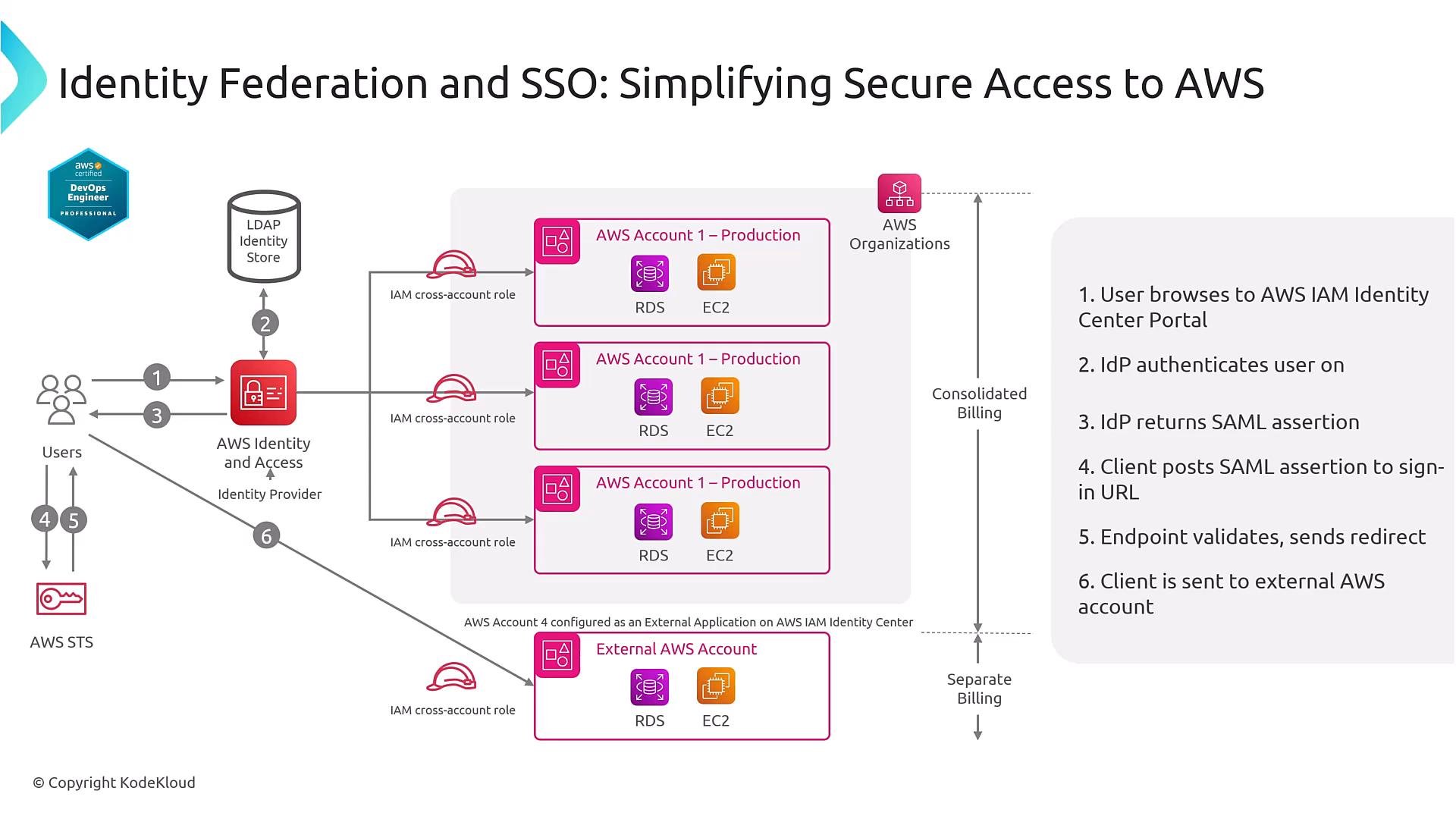
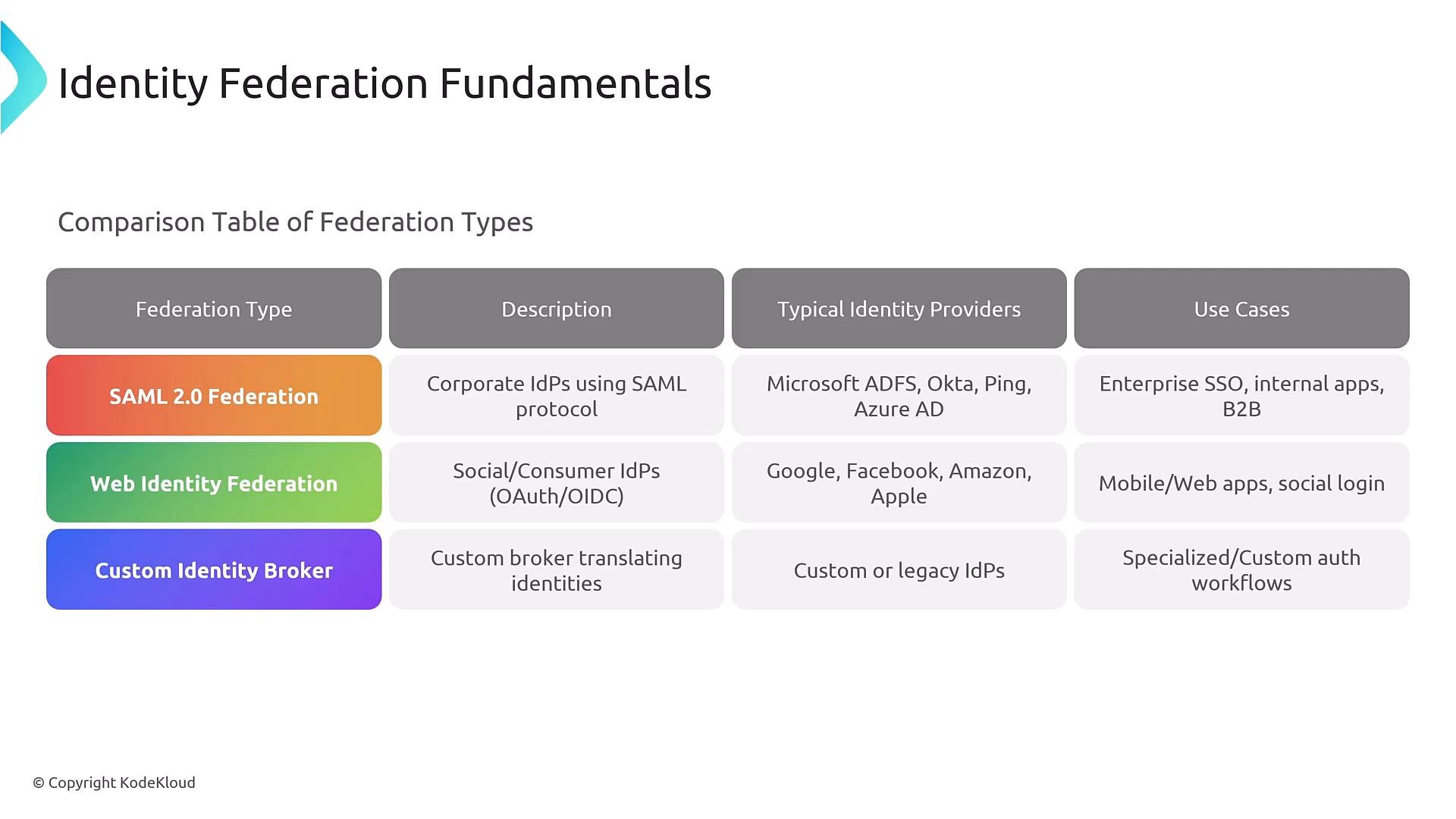
- The browser or client is redirected to the corporate IdP (examples: AD FS, Okta, PingFederate).
- The IdP returns a signed SAML assertion or web identity token (OIDC/OAuth).
- AWS validates the assertion and Security Token Service (STS) issues temporary credentials that allow the user to assume a role in one or more AWS accounts.
- STS is an API/service responsible for temporary credentials; it is central to federation even though it is not a UI management surface.
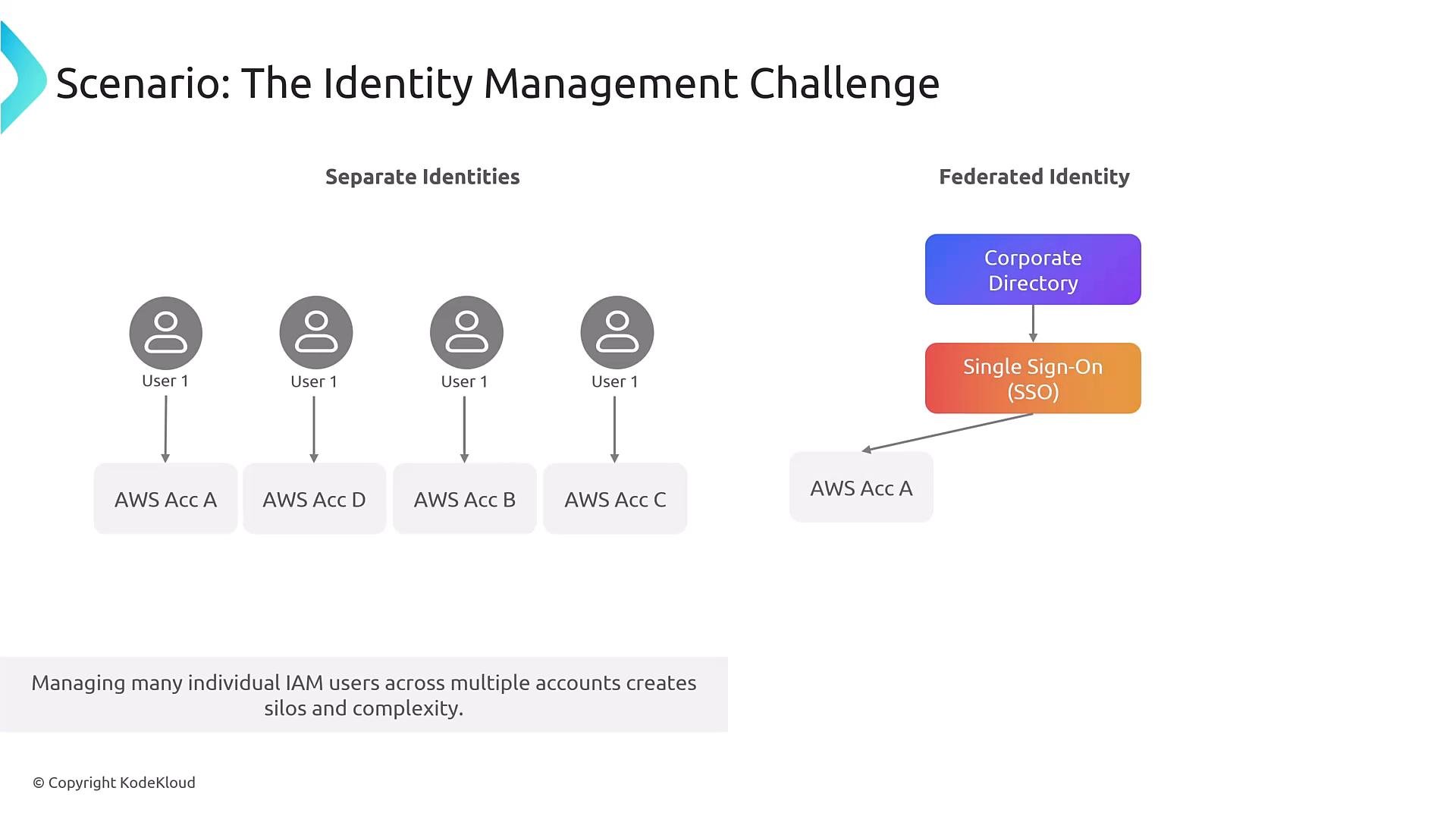
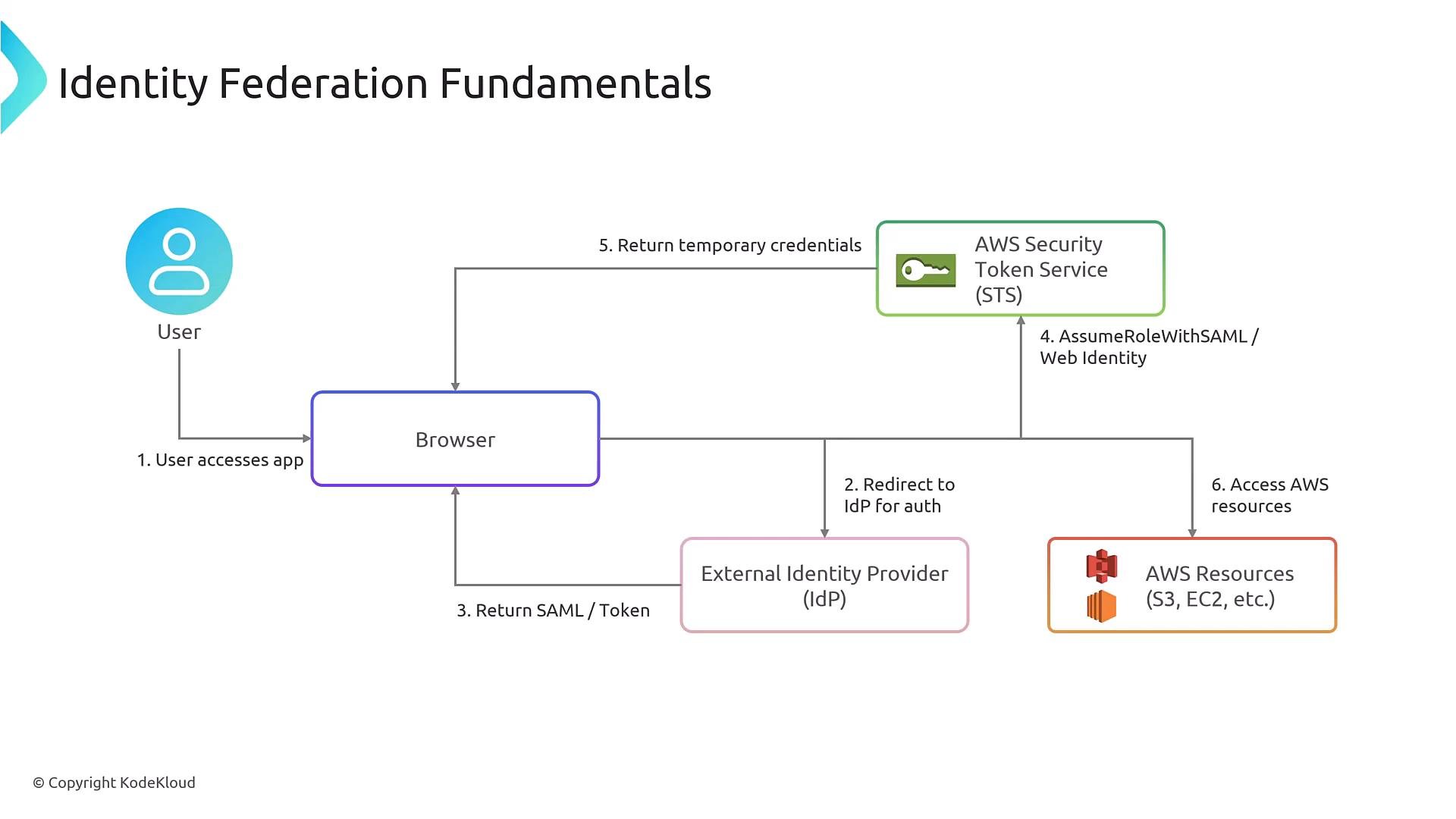
- An application or AWS console flow redirects the user to an IdP to obtain a SAML assertion or OIDC token.
- The assertion/token is exchanged with AWS STS for temporary AWS credentials.
- The browser or client uses these temporary credentials to call AWS APIs or access the console.
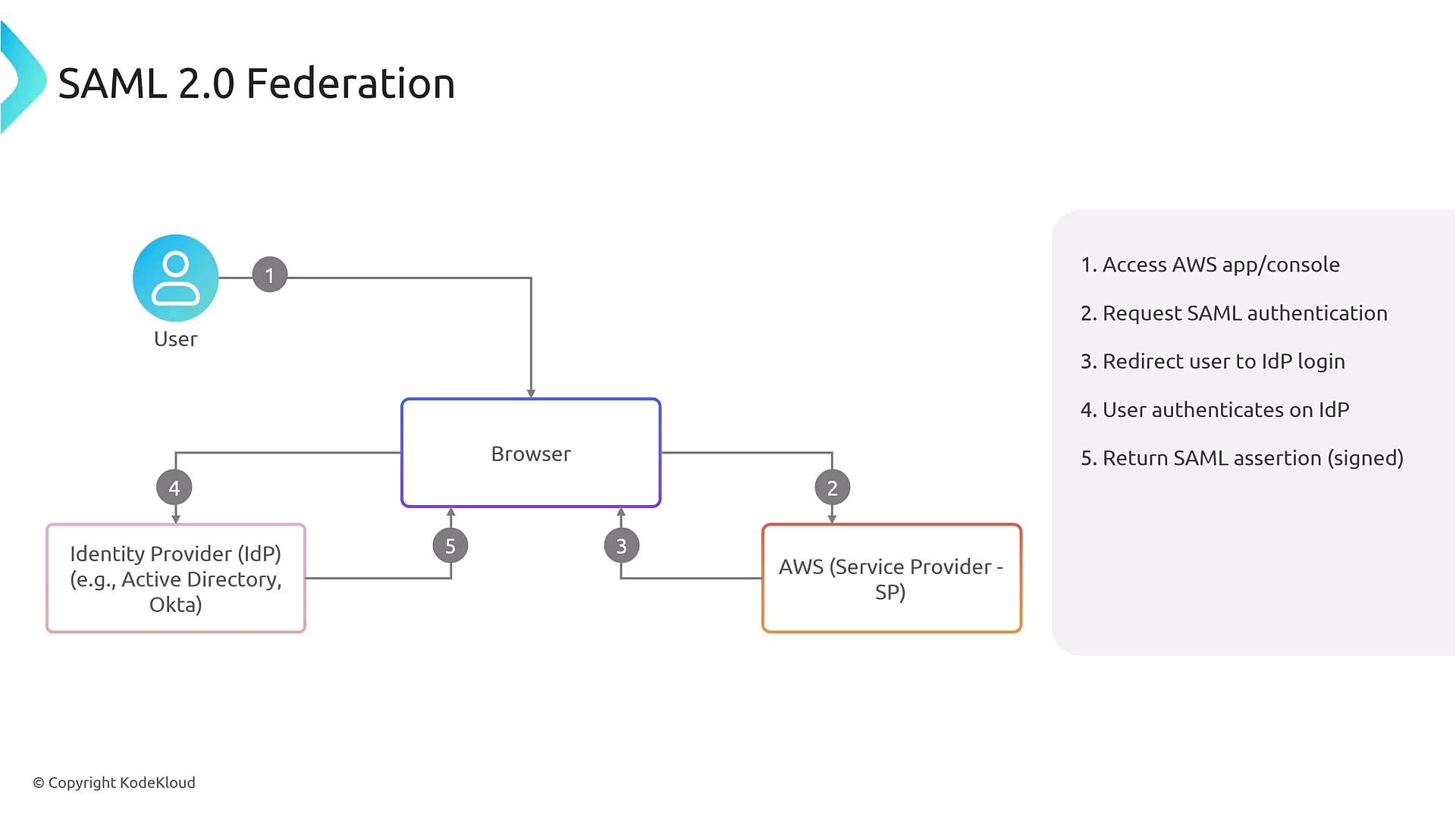
- SAML = Security Assertion Markup Language.
- It establishes trust between the service provider (SP — e.g., AWS) and the identity provider (IdP).
- Typical flow: user requests access → SP redirects to IdP → user authenticates → IdP returns a signed SAML assertion → SP validates assertion and issues temporary credentials.
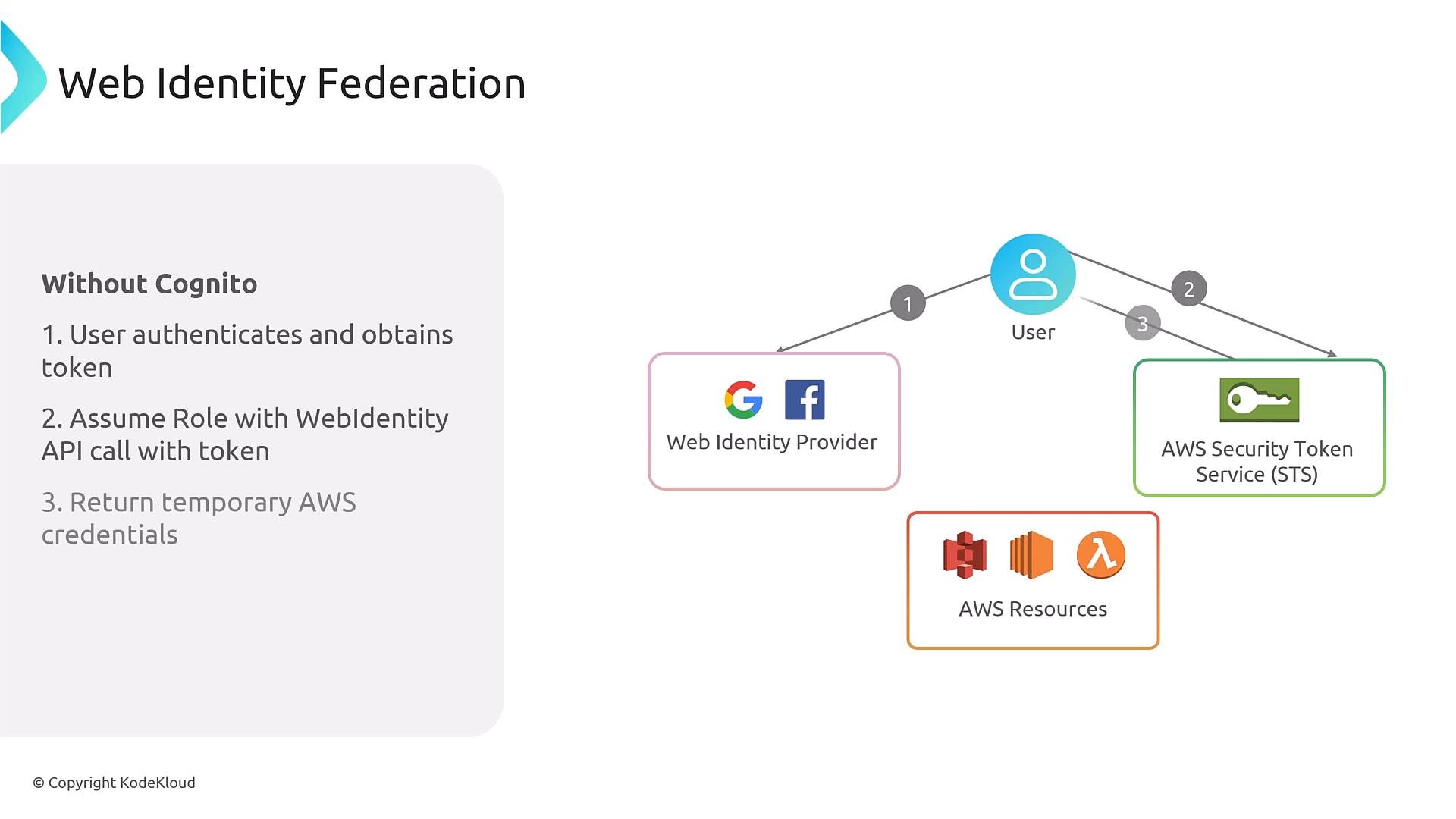
- The user authenticates with an external web identity provider (for example, Google).
- The provider returns an OIDC / OAuth token.
- The token is exchanged with AWS STS to obtain temporary AWS credentials used to assume a role.
- Amazon Cognito identity pools can simplify token exchange and identity mapping for mobile/web apps.
- IAM Identity Center is AWS’s managed SSO solution. It provides a user portal, centralized user/group provisioning, account assignments, and permission sets.
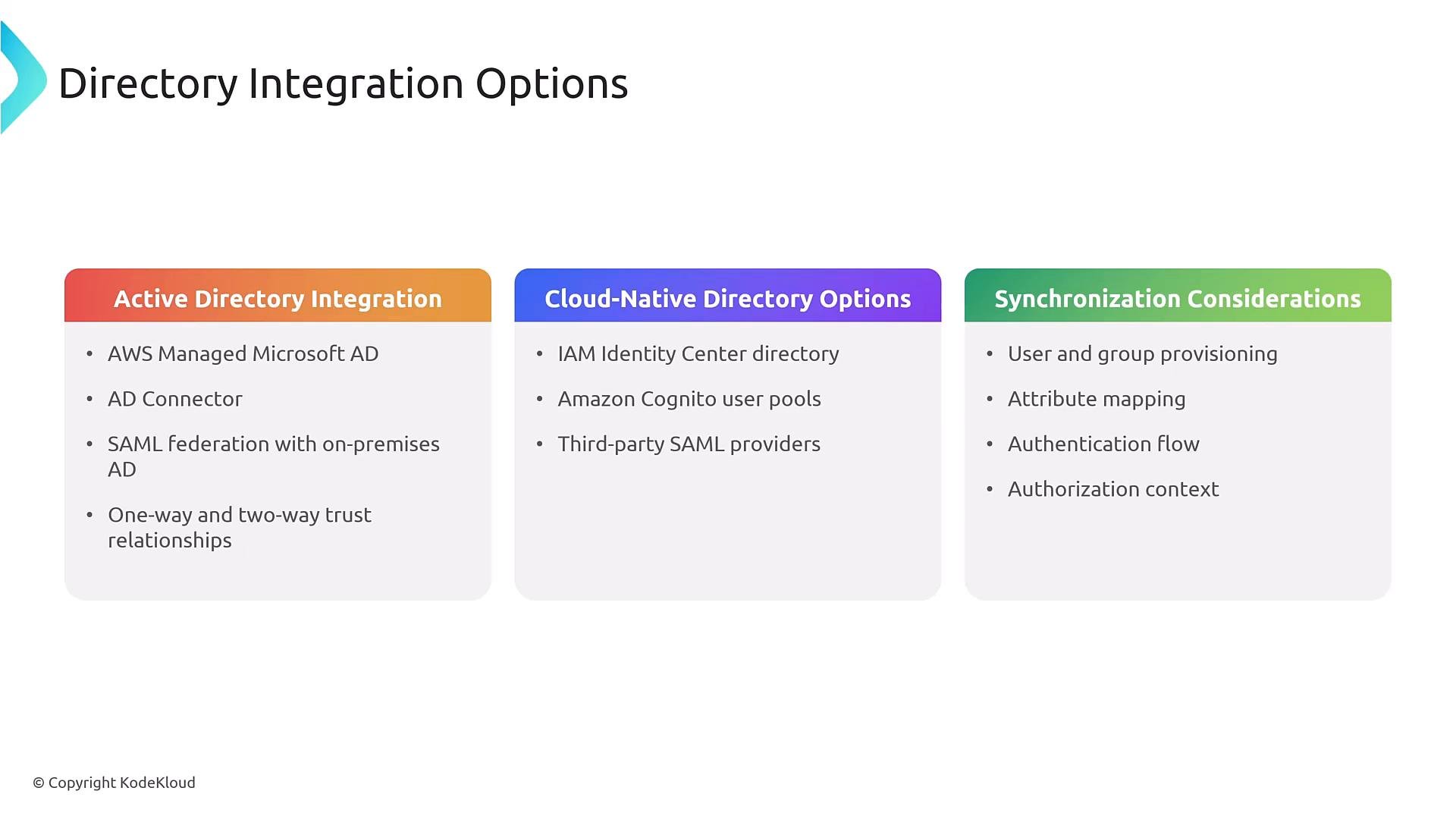
- It enables a single user directory (built-in Identity Center directory, AWS Managed Microsoft AD, or an external SAML IdP) to manage access across an AWS Organization.
- Use IAM Identity Center to centralize account access, standardize permission sets, and simplify the user experience across multiple AWS accounts.
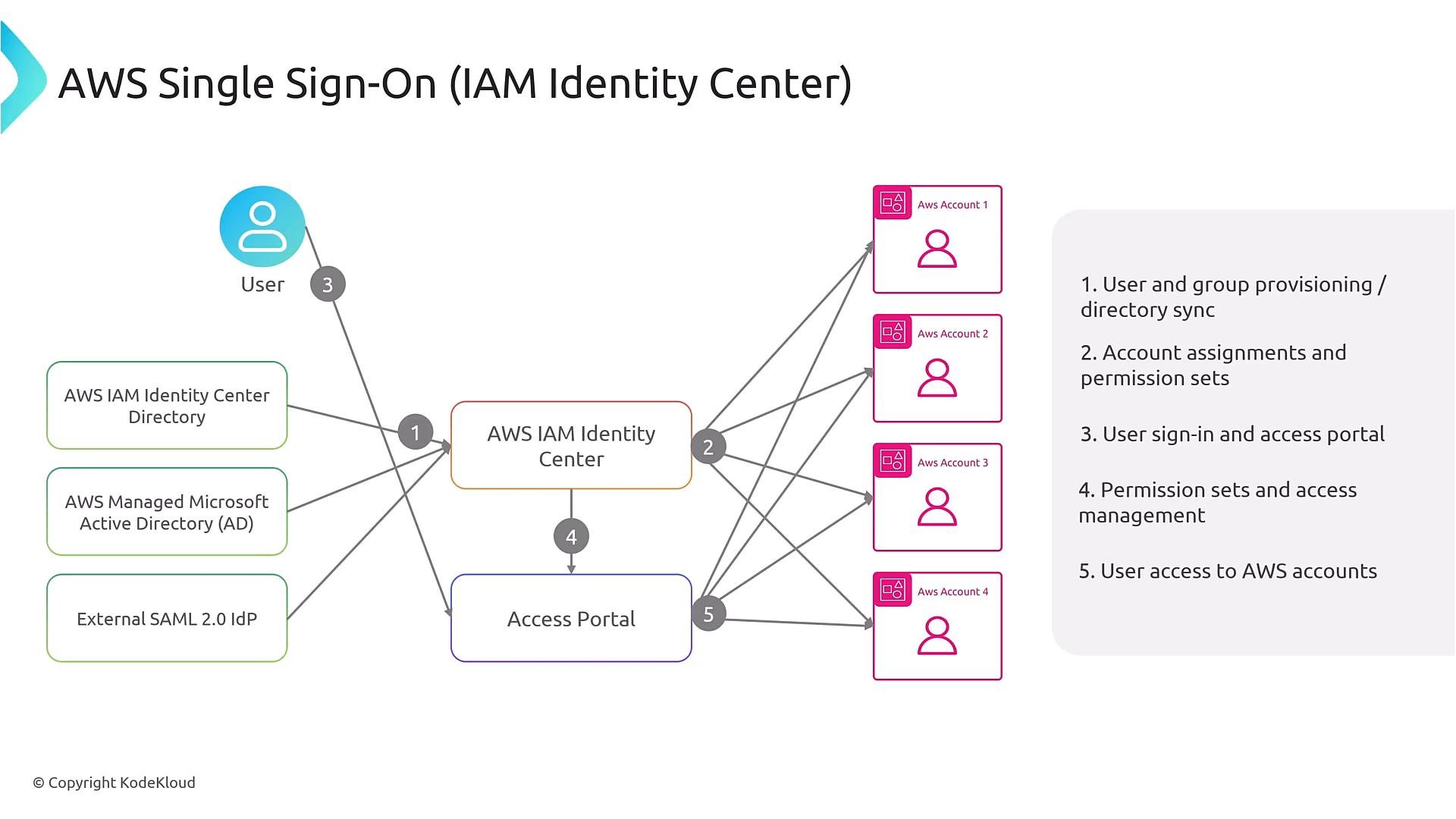
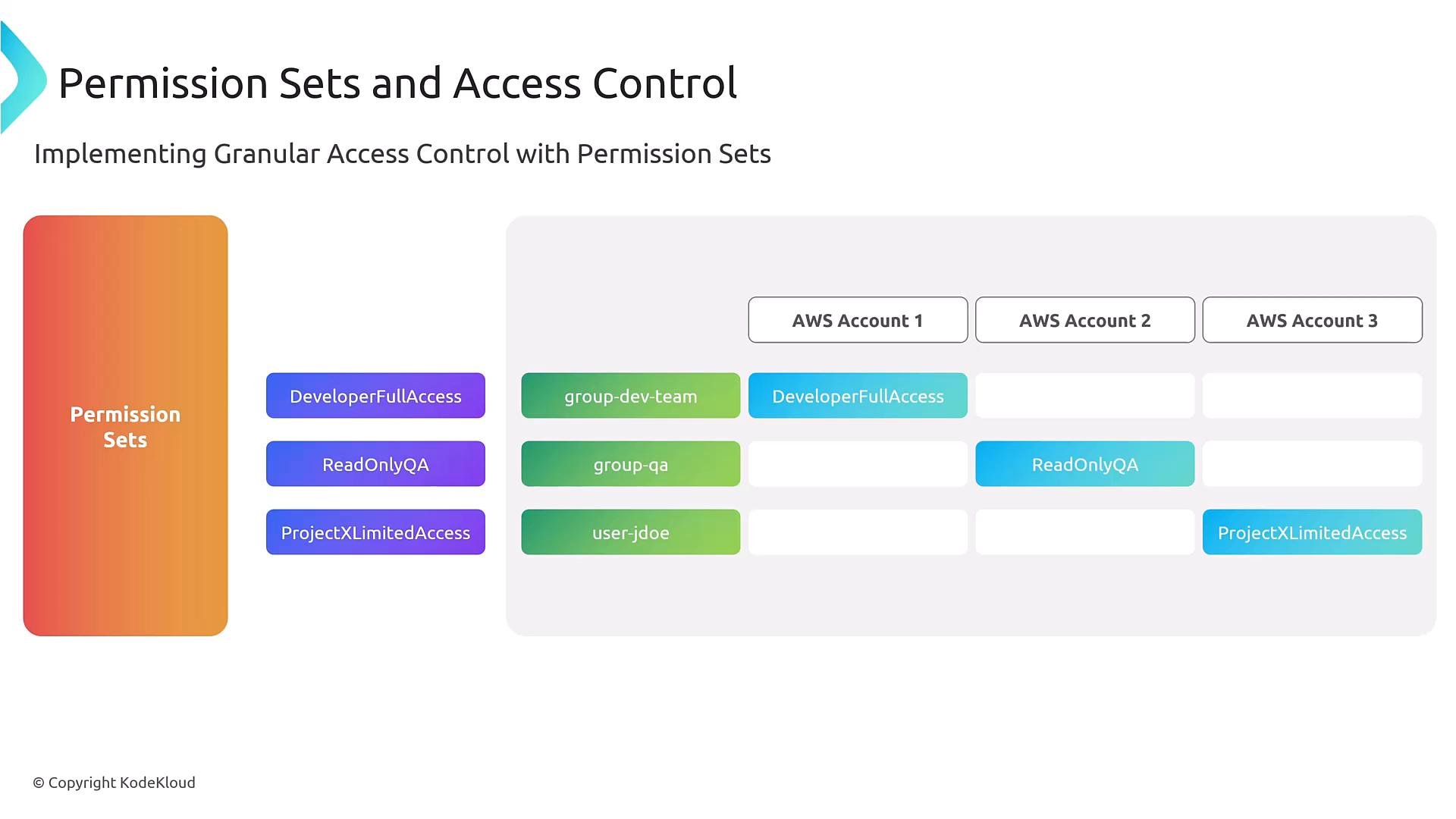
- A permission set is a collection of AWS managed policies, inline policies, and session settings (duration, relay state). You assign permission sets to users or groups via IAM Identity Center for specific AWS accounts.
- Permission sets are easier to manage than creating role/policy attachments per account.
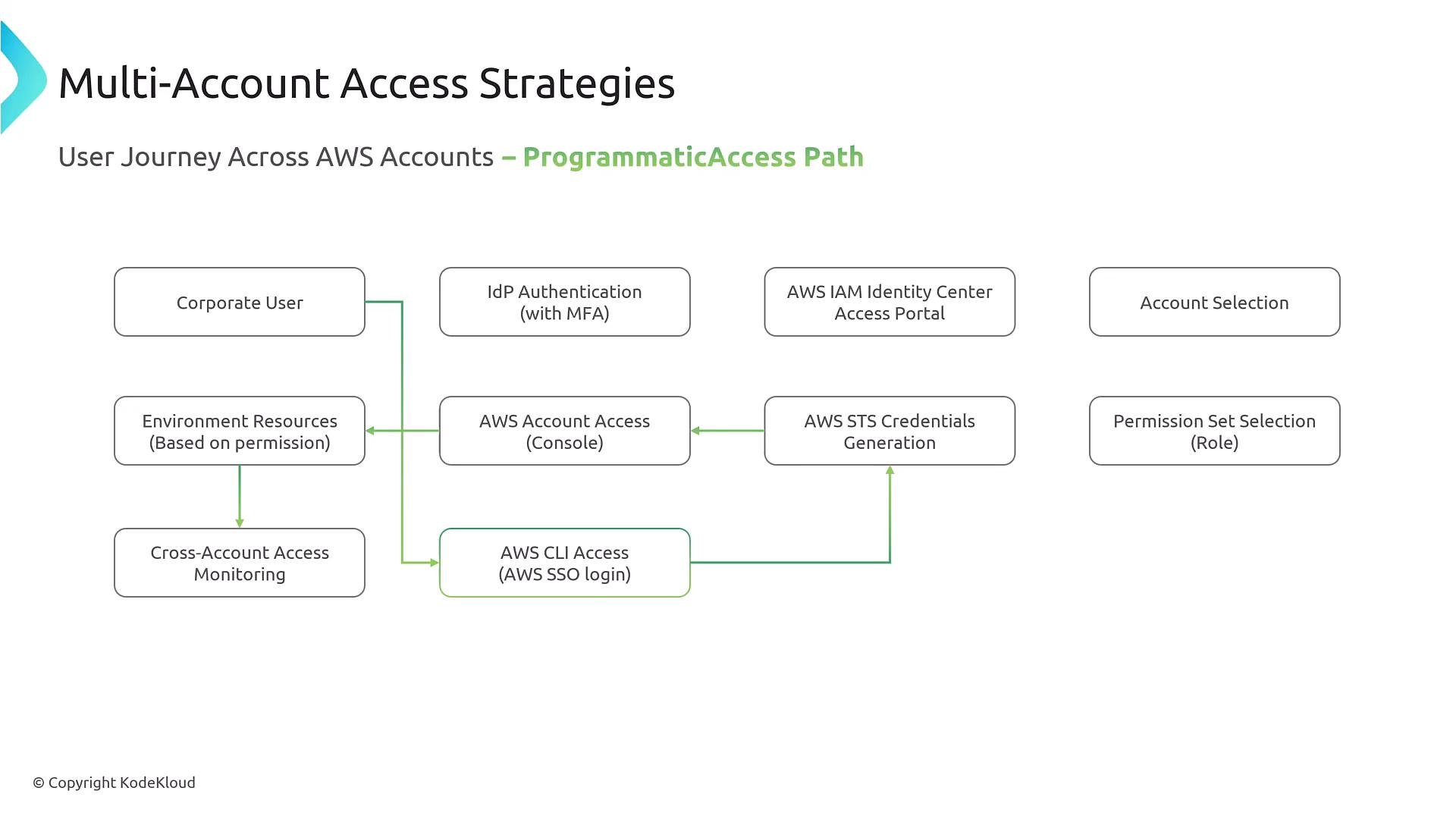
- The AWS CLI supports SSO login flows. Example commands:
aws configure ssoandaws sso login. The user authenticates via browser and the CLI stores short‑lived credentials for API calls. - Session durations, MFA enforcement, and permission boundaries apply to both console and programmatic sessions.
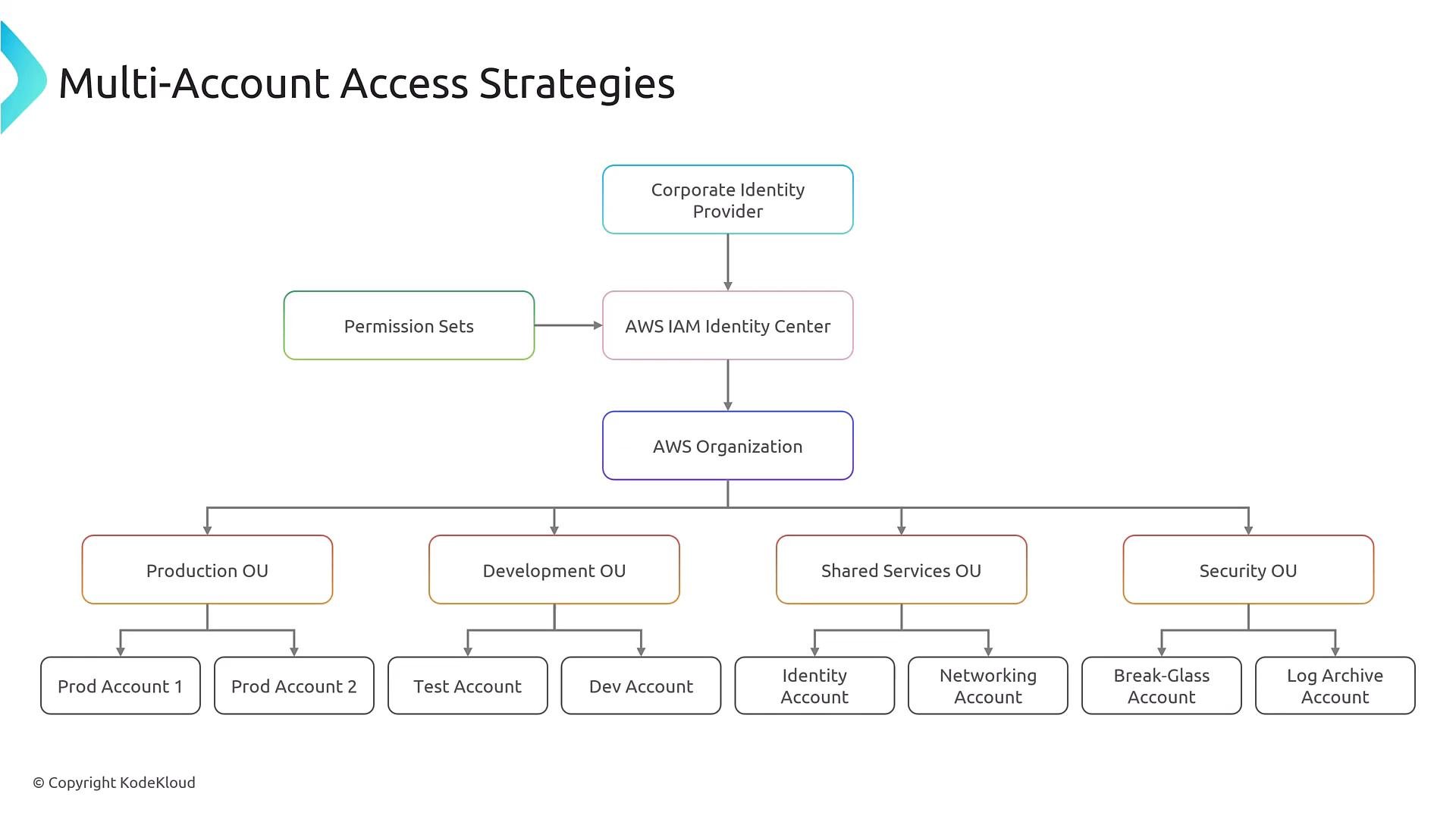
- IAM Identity Center is designed to work with AWS Organizations. Define permission sets centrally and assign them to accounts in the organization.
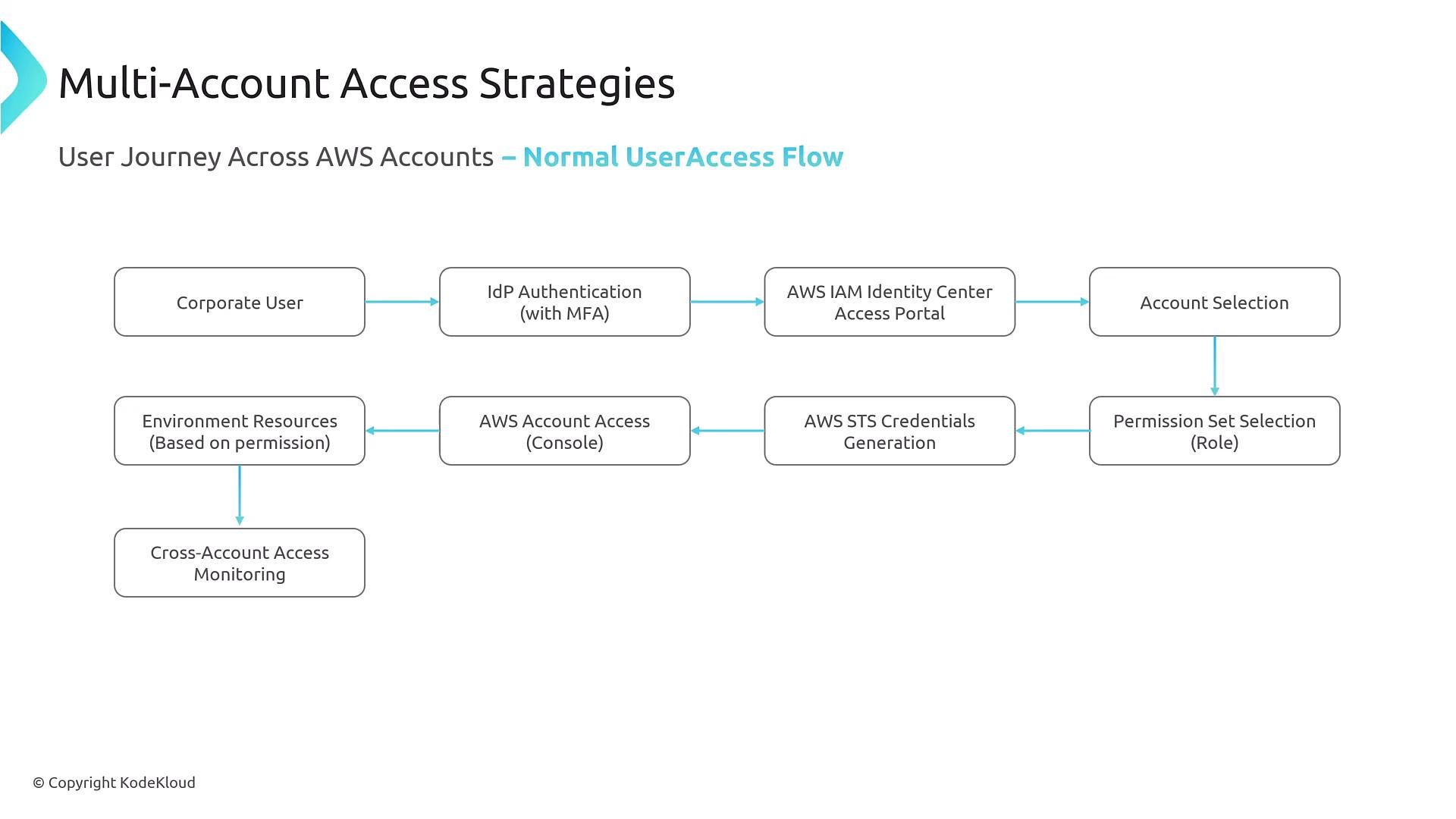
- Typical user flow:
- Authenticate with corporate IdP (MFA enforced as required).
- Access IAM Identity Center portal.
- Select target account and permission set.
- IAM Identity Center (via STS) issues temporary credentials.
- User accesses the selected account and resources.
- AWS CloudFormation supports
AWS::SSO::PermissionSetandAWS::SSO::Assignmentso you can automate permission set creation and account assignments. - You are not expected to memorize the full CloudFormation syntax for exams, but know that automation and infrastructure-as-code for permission sets and assignments is supported.
- CloudTrail should be enabled to capture API calls, including federation and SSO events.
- Collect Identity Center logs, IdP authentication logs, and CloudTrail into a centralized analytics platform or SIEM to detect anomalies (unusual geolocations, privilege escalation, or unexpected account activity).
- Retain logs according to compliance requirements and use automated alerting/analytics for privileged access reviews.
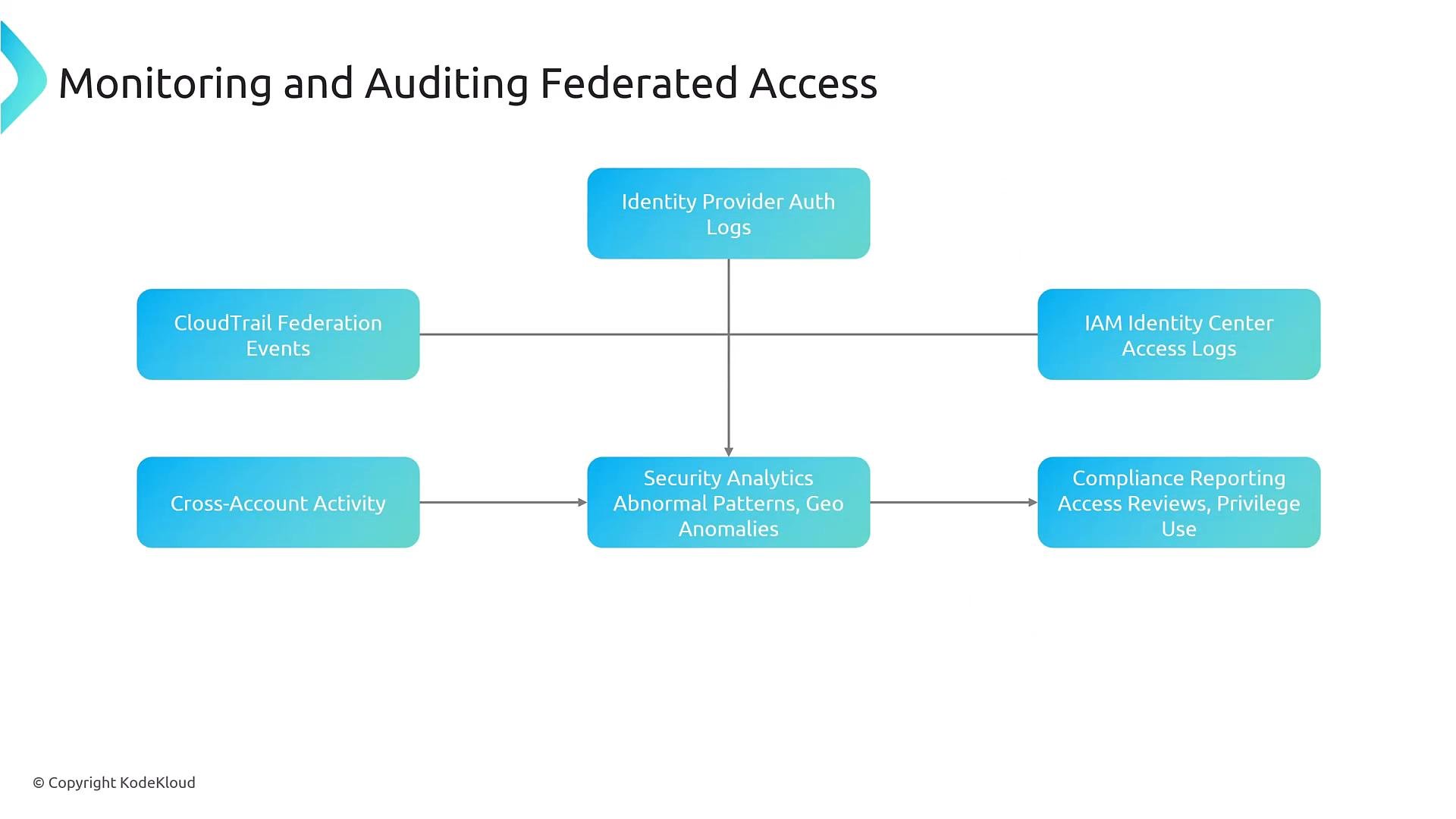
Protect the federation trust: ensure IdP metadata is validated, rotate signing keys, enforce MFA, and monitor token usage. A compromised IdP can lead to broad access across your AWS Organization.
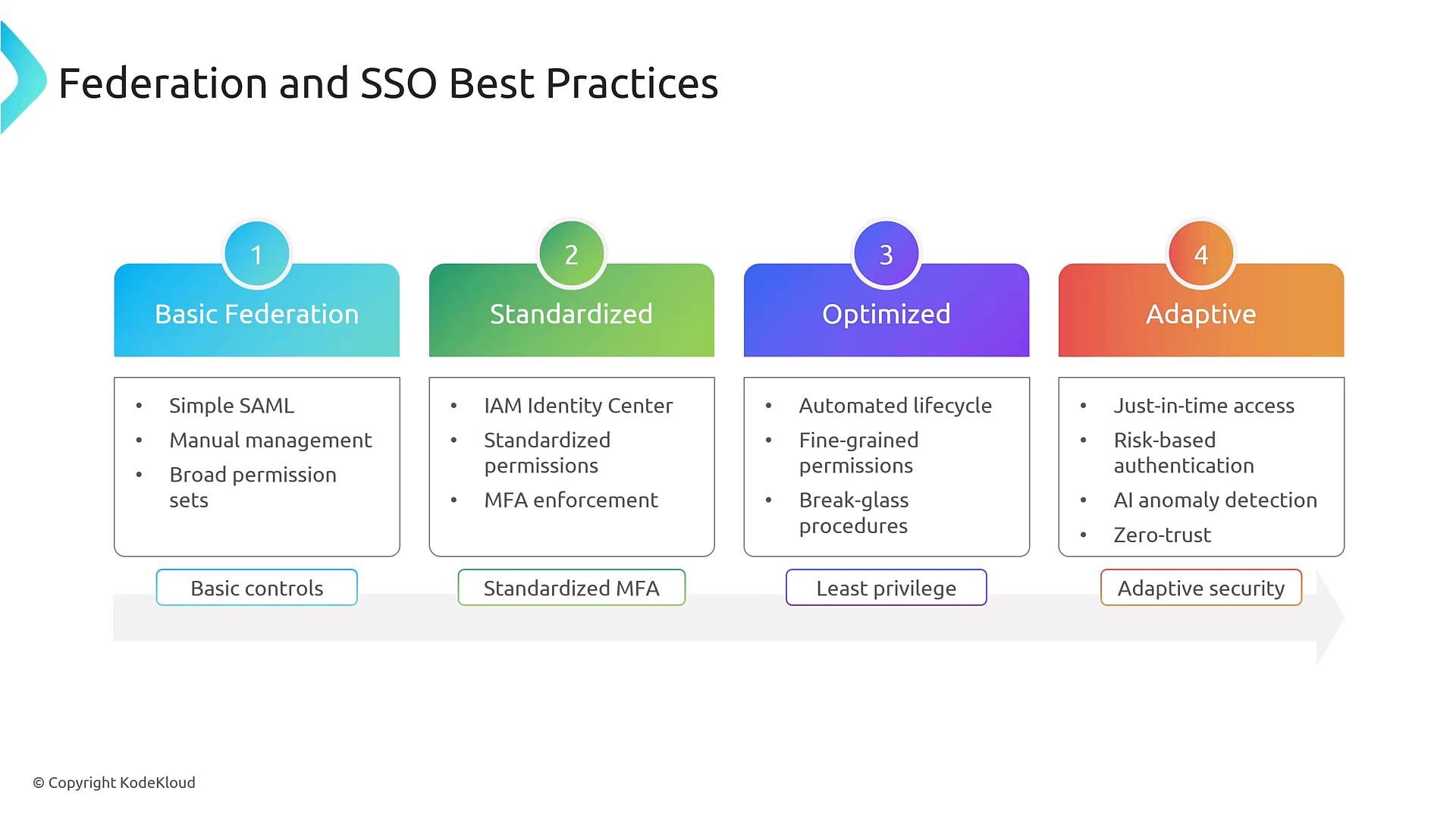
- Basic Federation: SAML-based SSO with manual provisioning.
- Standardized: Adopt IAM Identity Center, consistent permission sets, enforced MFA.
- Optimized: Automated lifecycle/provisioning, permission boundaries, centralized monitoring.
- Adaptive: Just-in-time access, risk-based adaptive controls, dynamic privilege elevation.
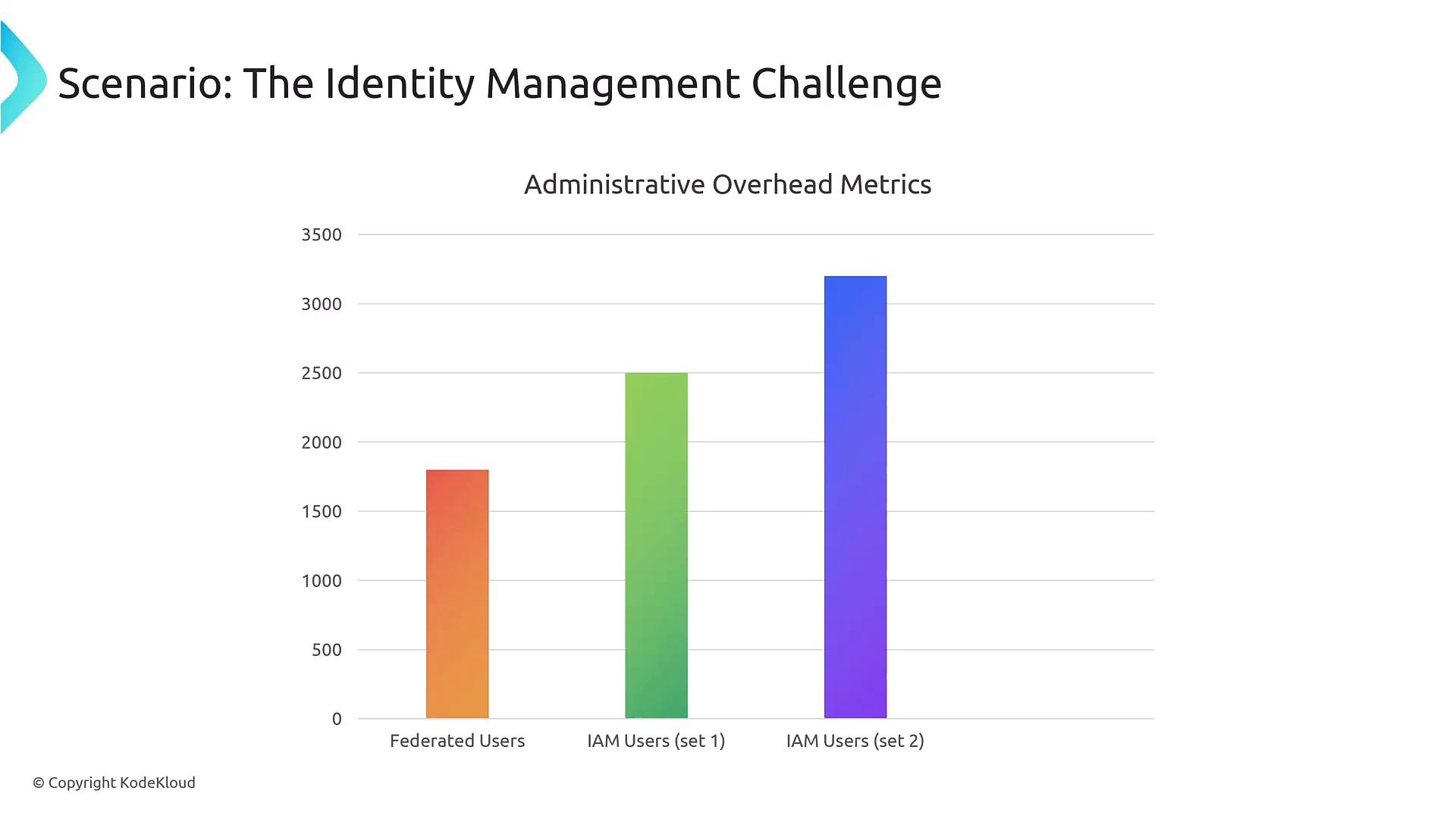
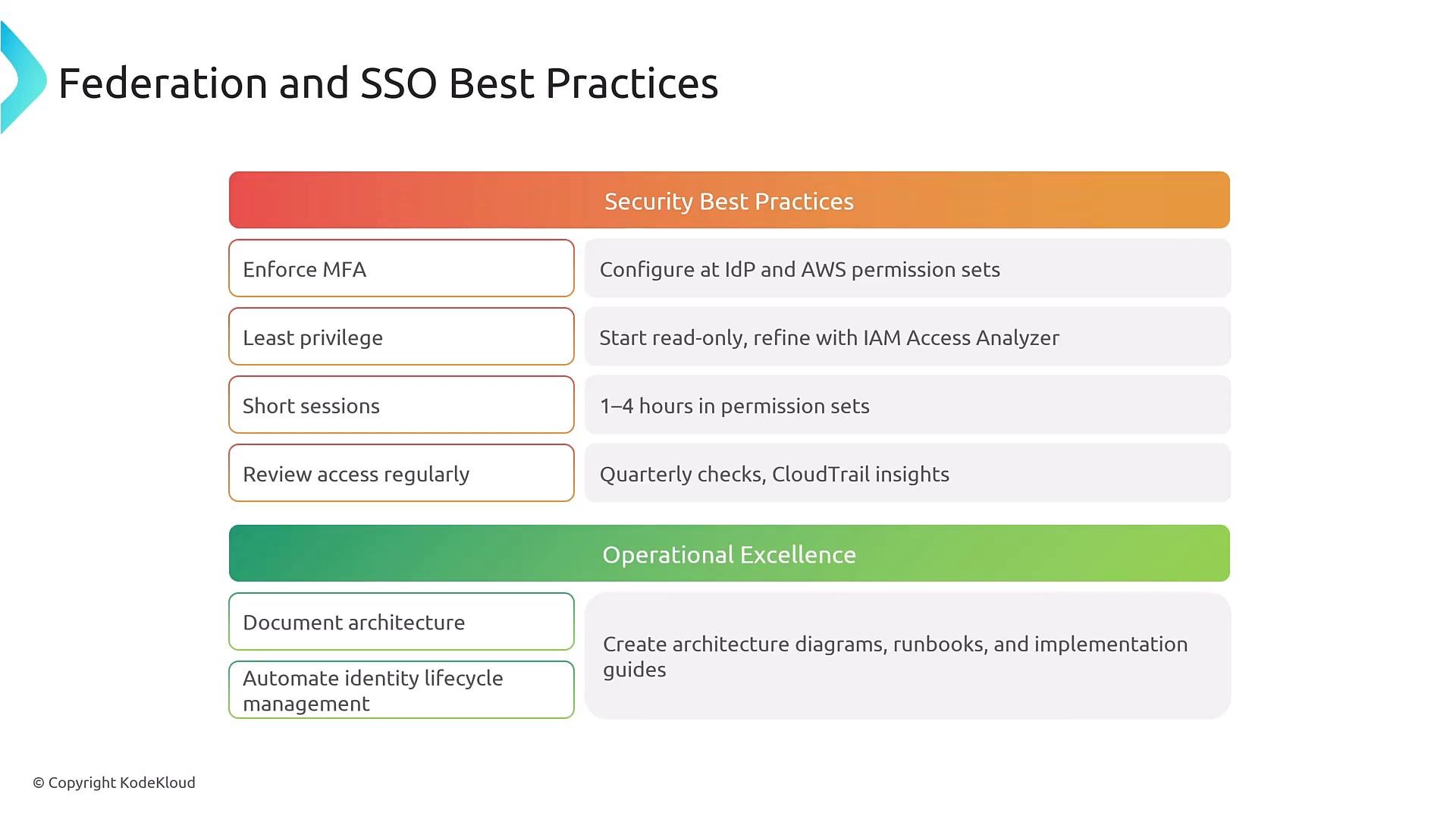
- Federation + SSO reduces administrative overhead, improves security posture, and simplifies compliance across multi‑account AWS environments.
- Understand SAML/OIDC/Web Identity flows and the role of STS in issuing temporary credentials.
- Use IAM Identity Center permission sets to centralize and standardize access across AWS Organizations.
- Automate provisioning where possible; enforce MFA, least privilege, and centralized logging; and continuously monitor for anomalous access.
- AWS IAM Identity Center (SSO) documentation
- AWS Security Token Service (STS)
- AWS Organizations
- SAML 2.0 Overview