

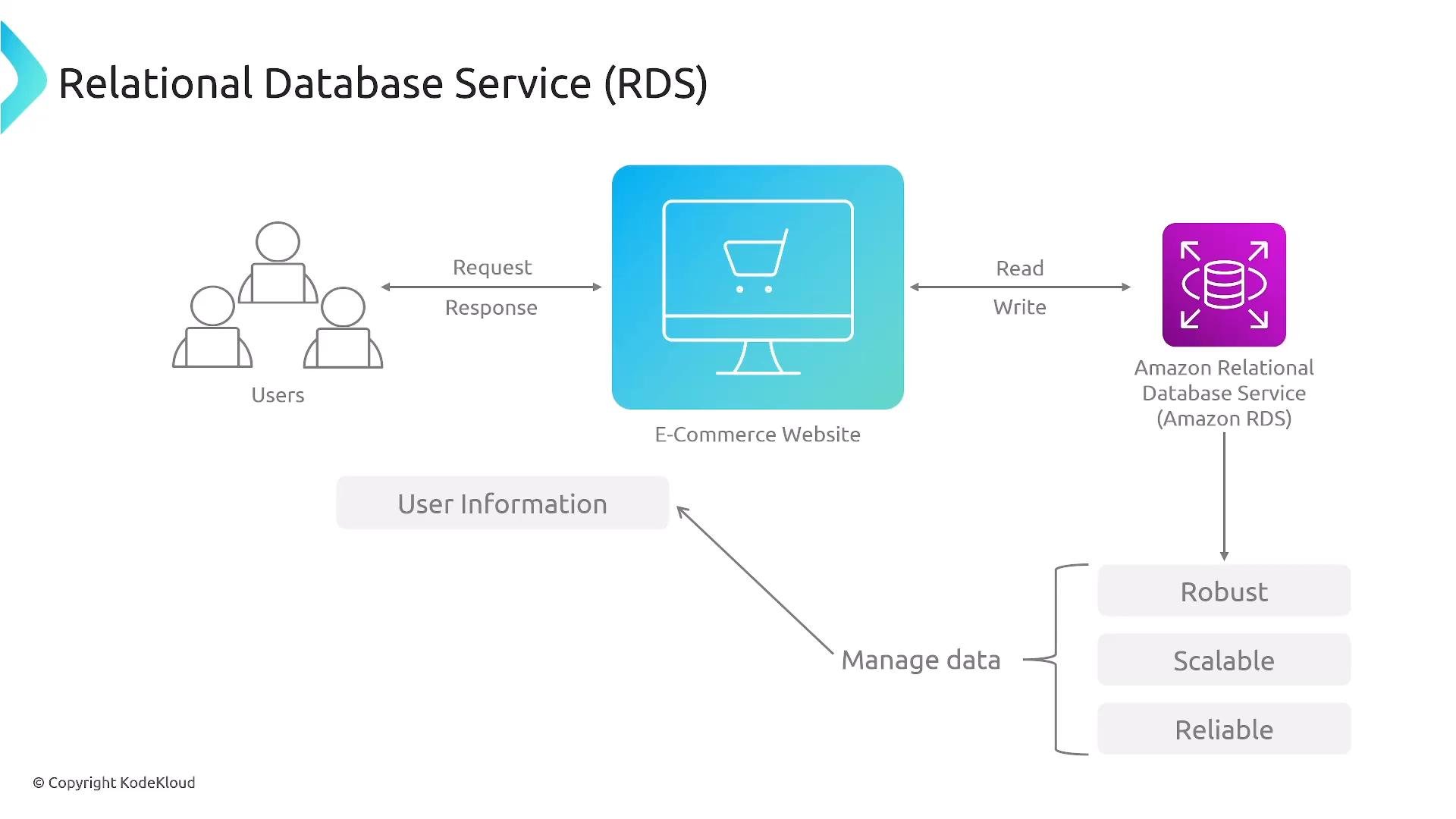
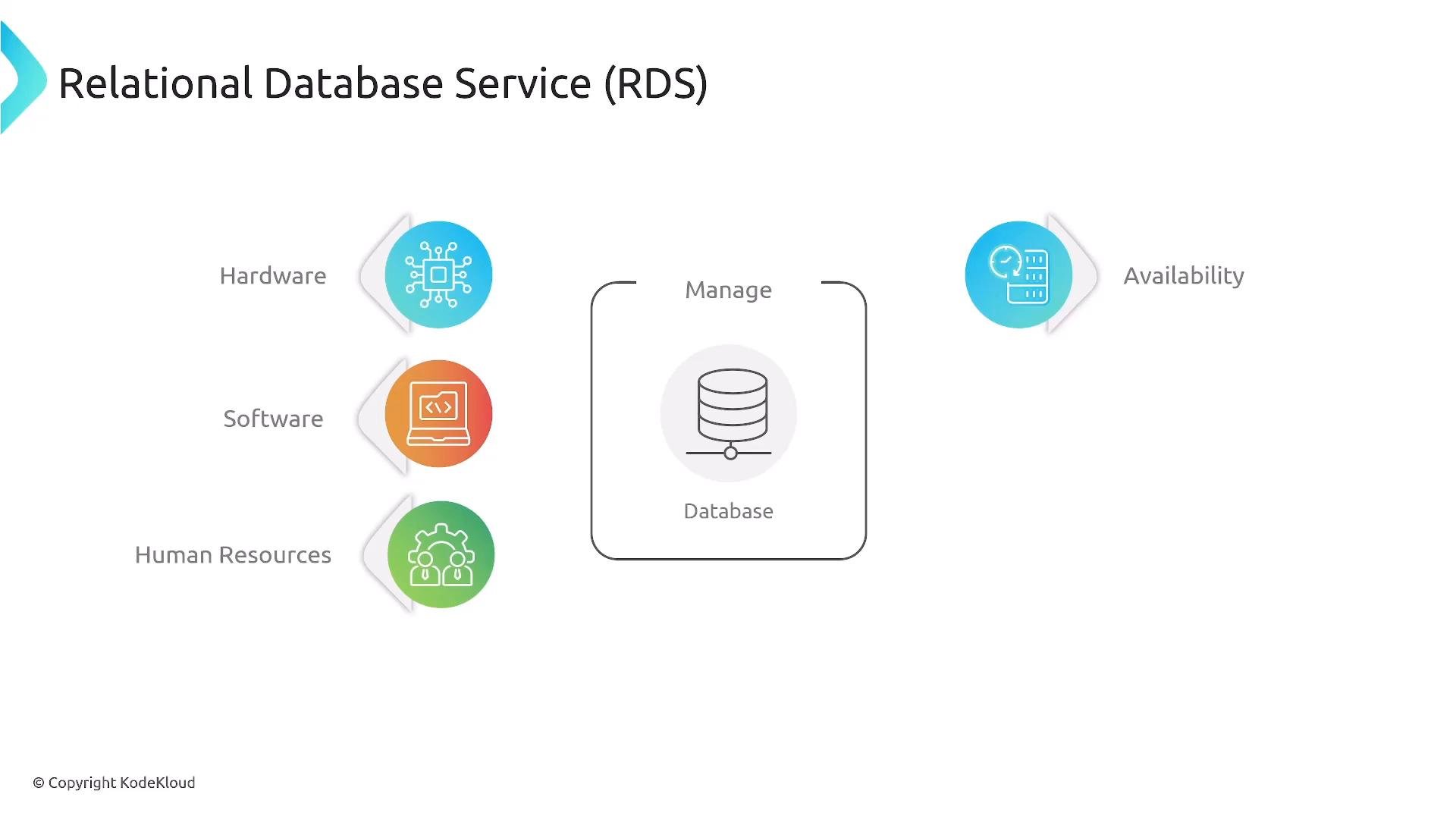
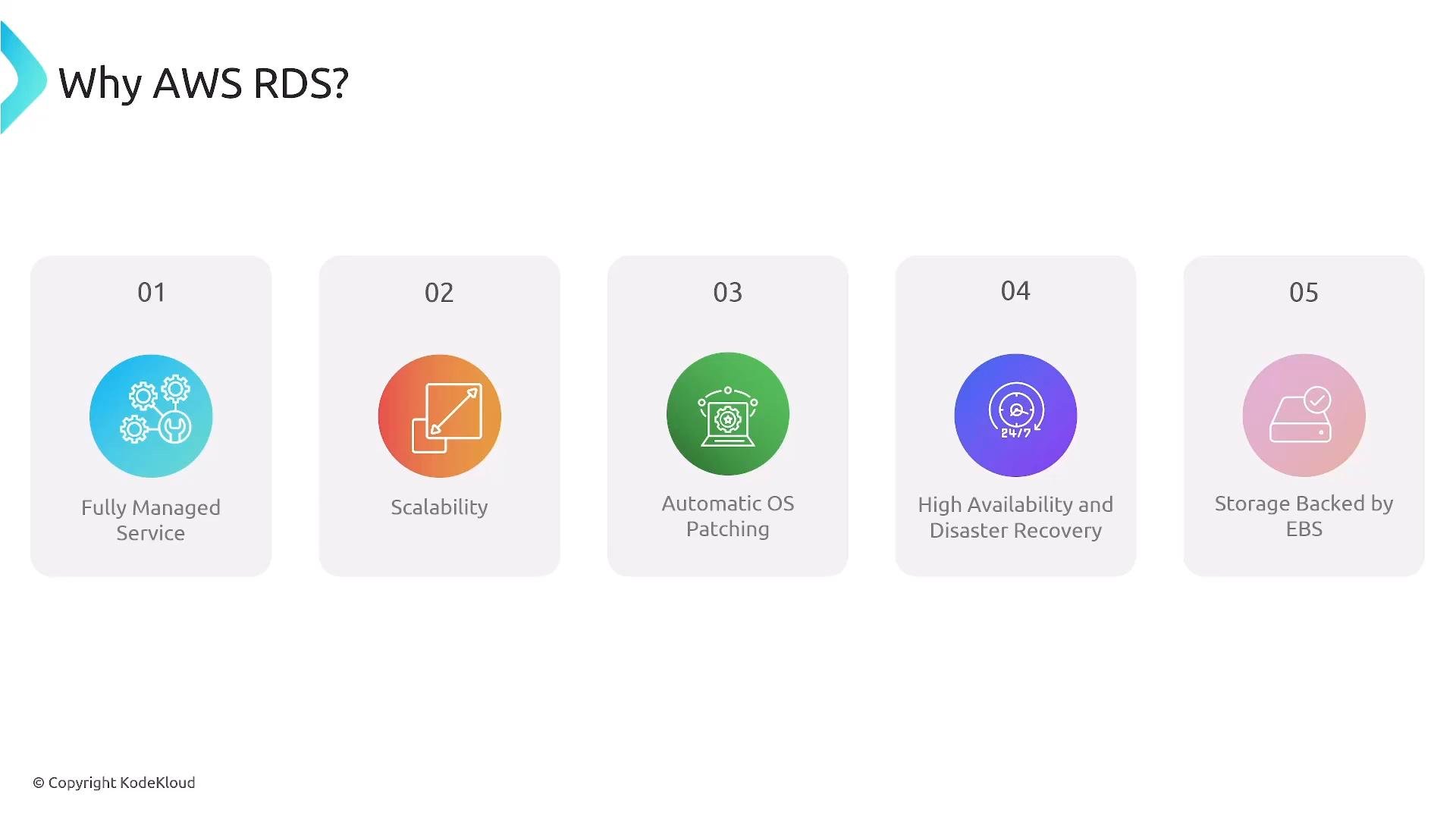
- Fully managed provisioning, automated patching, backups, and maintenance.
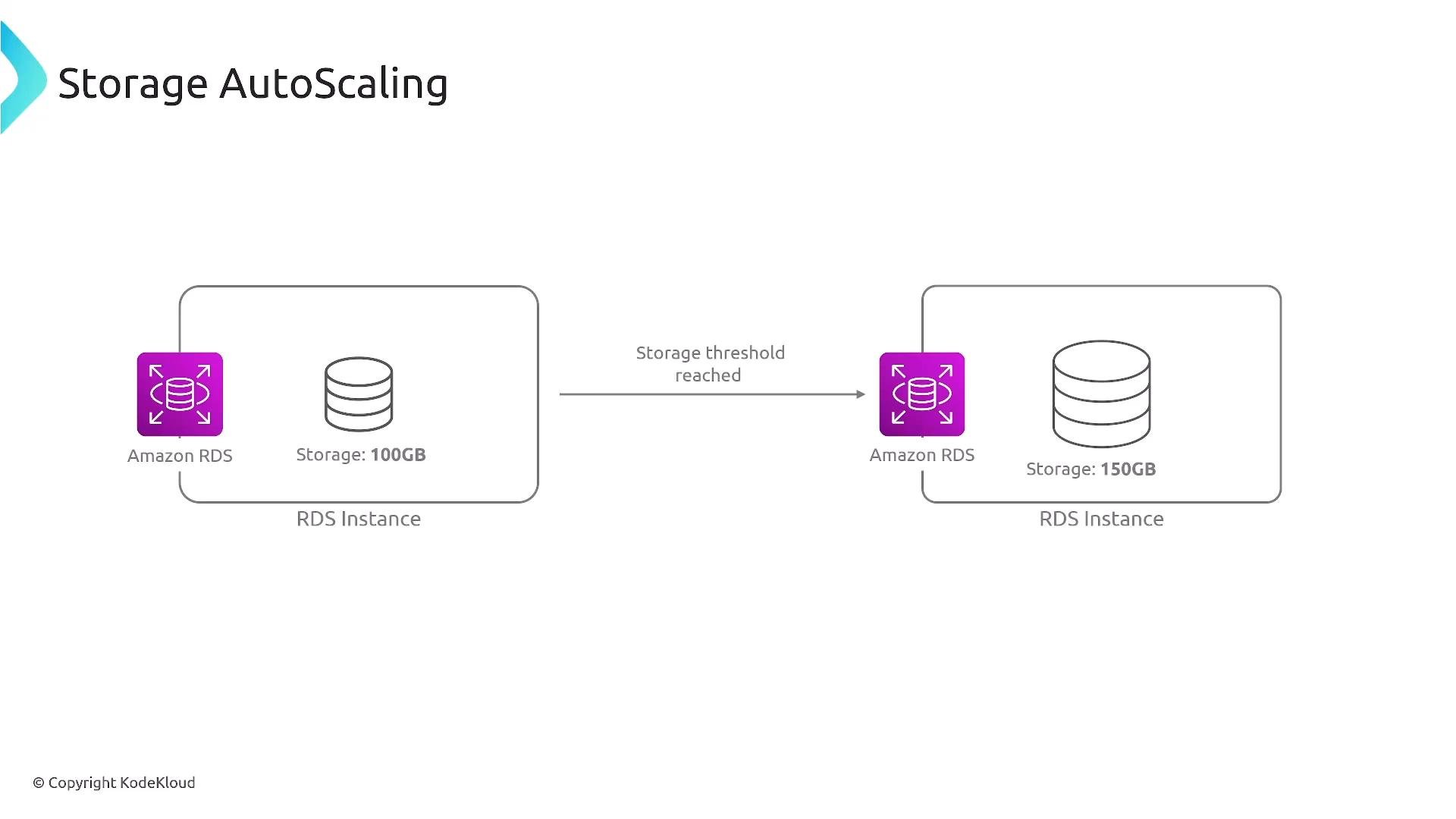
- Built-in scalability (compute and storage) and read-scaling via replicas.
- Automated OS and database engine patching.
- Multiple high-availability and disaster recovery strategies.
- Durable storage backed by Amazon EBS with snapshotting to S3.
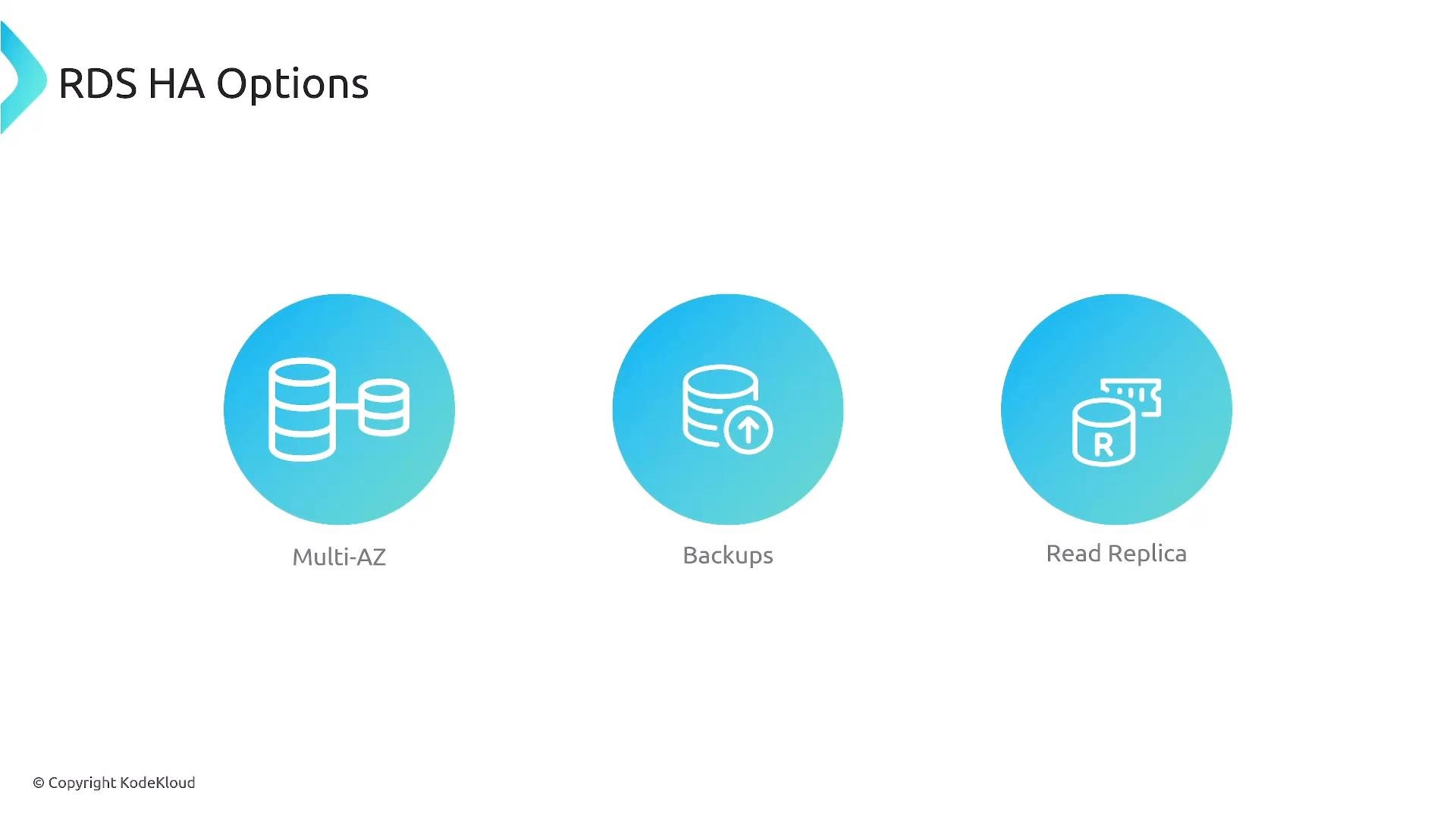
- Multi‑AZ (synchronous standby with automatic failover)
- Automated backups and snapshots (cold backups)
- Read replicas (asynchronous, for read scaling and DR)
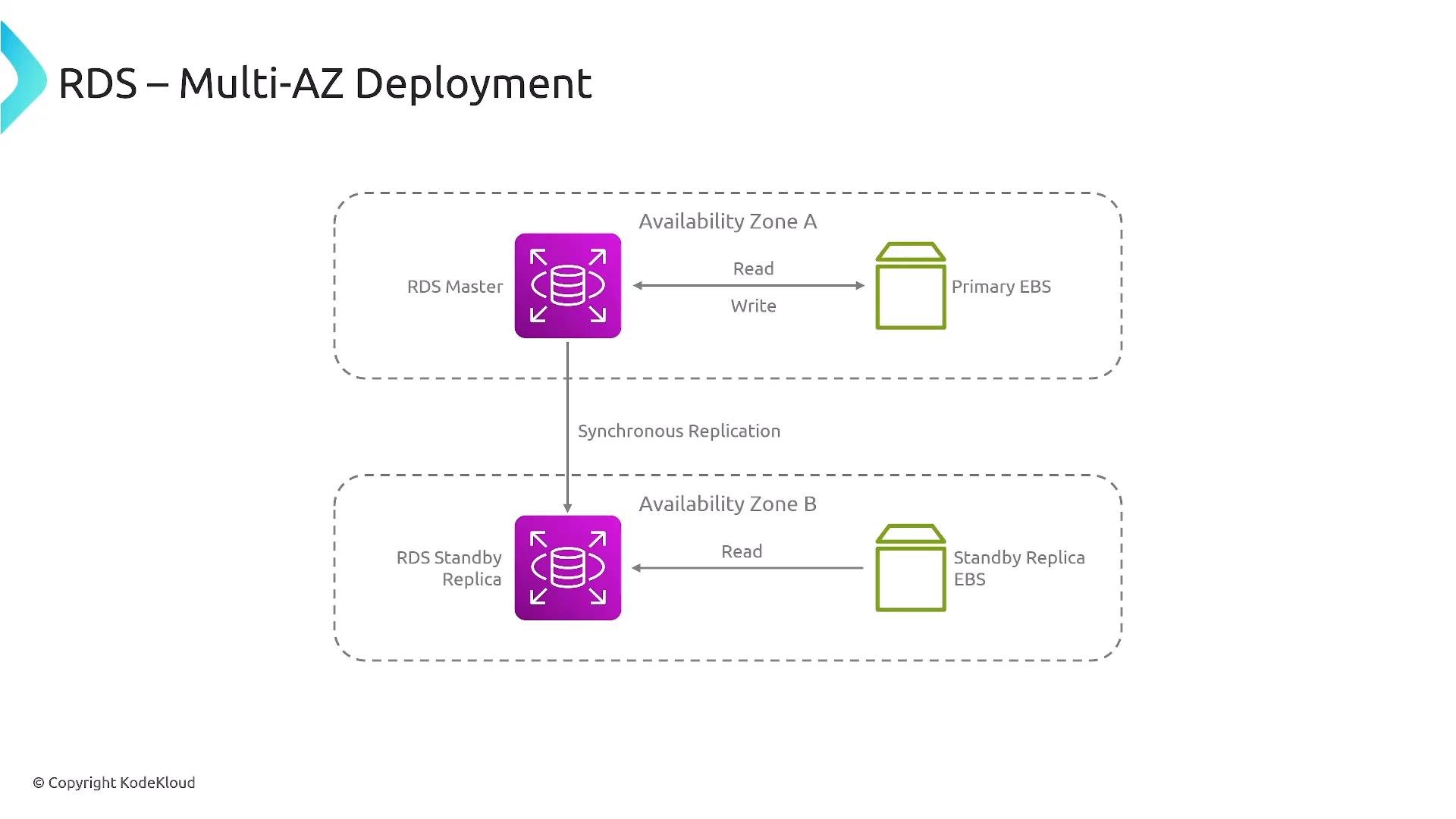
- Multi‑AZ provides synchronous replication between a primary instance and a standby instance in a different Availability Zone (AZ).
- Writes are acknowledged only after both primary and standby have the data, protecting against AZ failure and minimizing data loss.
- Failover to the standby is automatic; clients continue connecting to the same endpoint while RDS redirects traffic to the new primary.
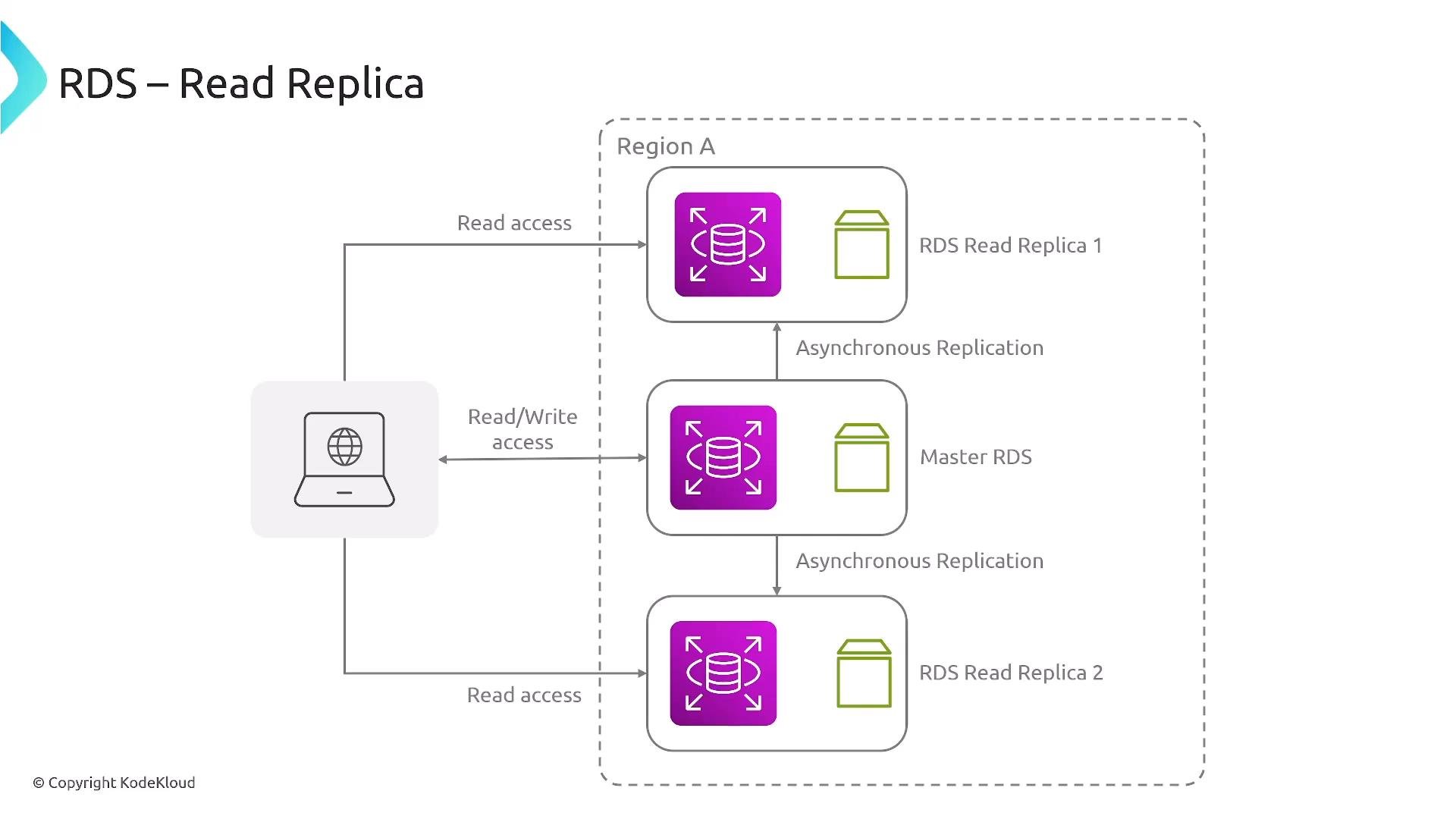
- Read replicas are asynchronous copies of the primary and are ideal for scaling read-heavy workloads (reporting, analytics, storefront reads).
- Replication can be within an AZ, across AZs, or cross-region. Because replication is asynchronous there can be replication lag — typically small but present.
- Read replicas can be promoted to become a primary, but promotion is a manual or orchestrated action and may lead to data loss for in-flight transactions that hadn’t replicated yet.
Synchronous replication (Multi‑AZ) maximizes durability and enables automatic failover. Asynchronous replicas prioritize read scalability and lower write latency but can exhibit replication lag and potential for lost in‑flight transactions if you promote a replica too soon.
- Instance (standard) Multi‑AZ: One primary and one synchronous standby in a separate AZ. The standby is not directly accessible for reads; clients connect to the primary endpoint only.
- Cluster Multi‑AZ (cluster deployments): Architectures with a writer endpoint and reader endpoints (common for Aurora and some cluster-based engines). These provide writer/read separation and can allow reader instances to serve traffic while still offering a resilient storage layer.
- Cross‑region read replicas are always asynchronous and are intended for geo‑distributed reads and disaster recovery (DR). Synchronous cross‑region replication would make writes prohibitively slow and is not offered.
- You can combine Multi‑AZ for local high availability with cross‑region replicas for DR and geo‑distribution.
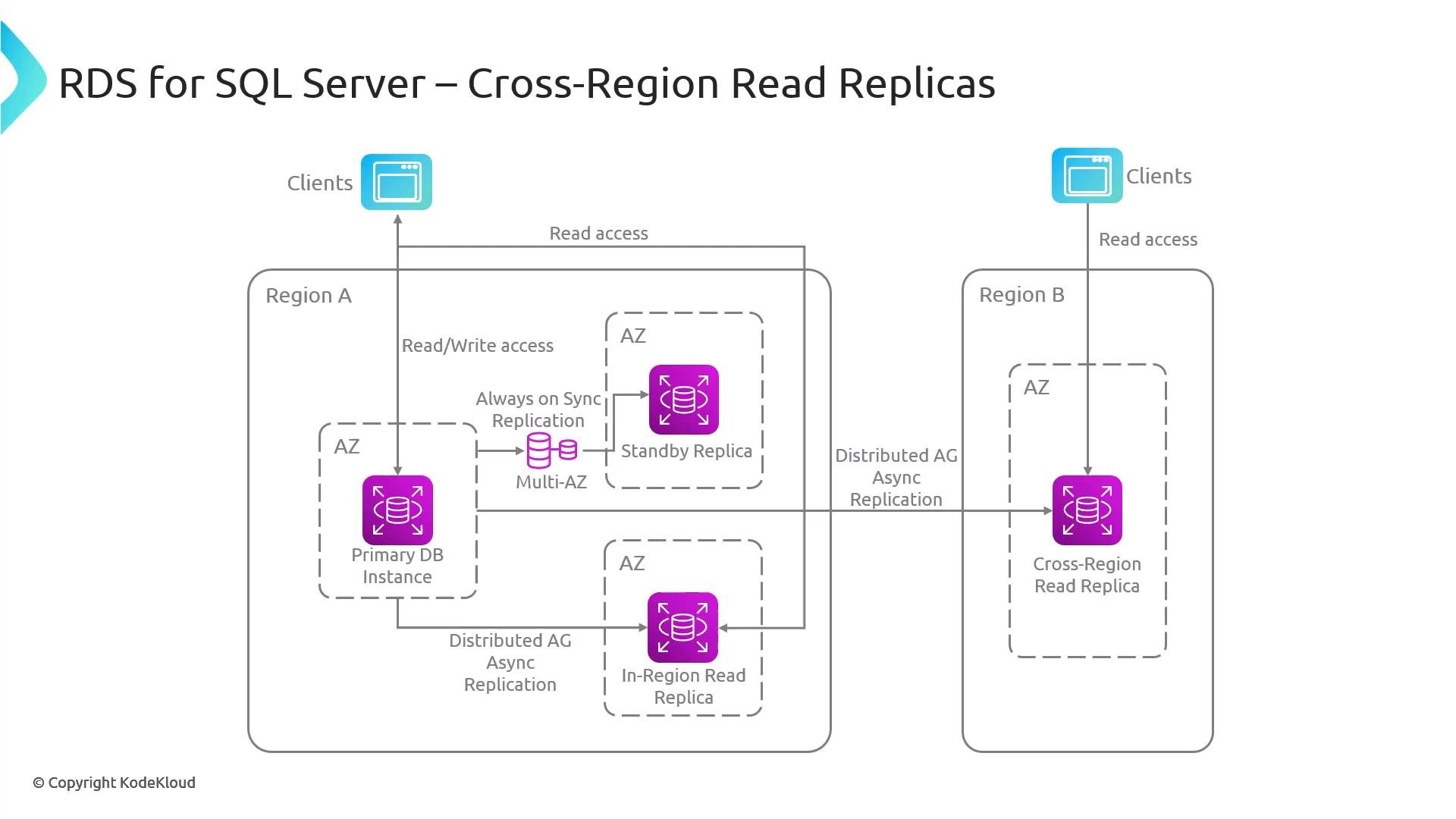
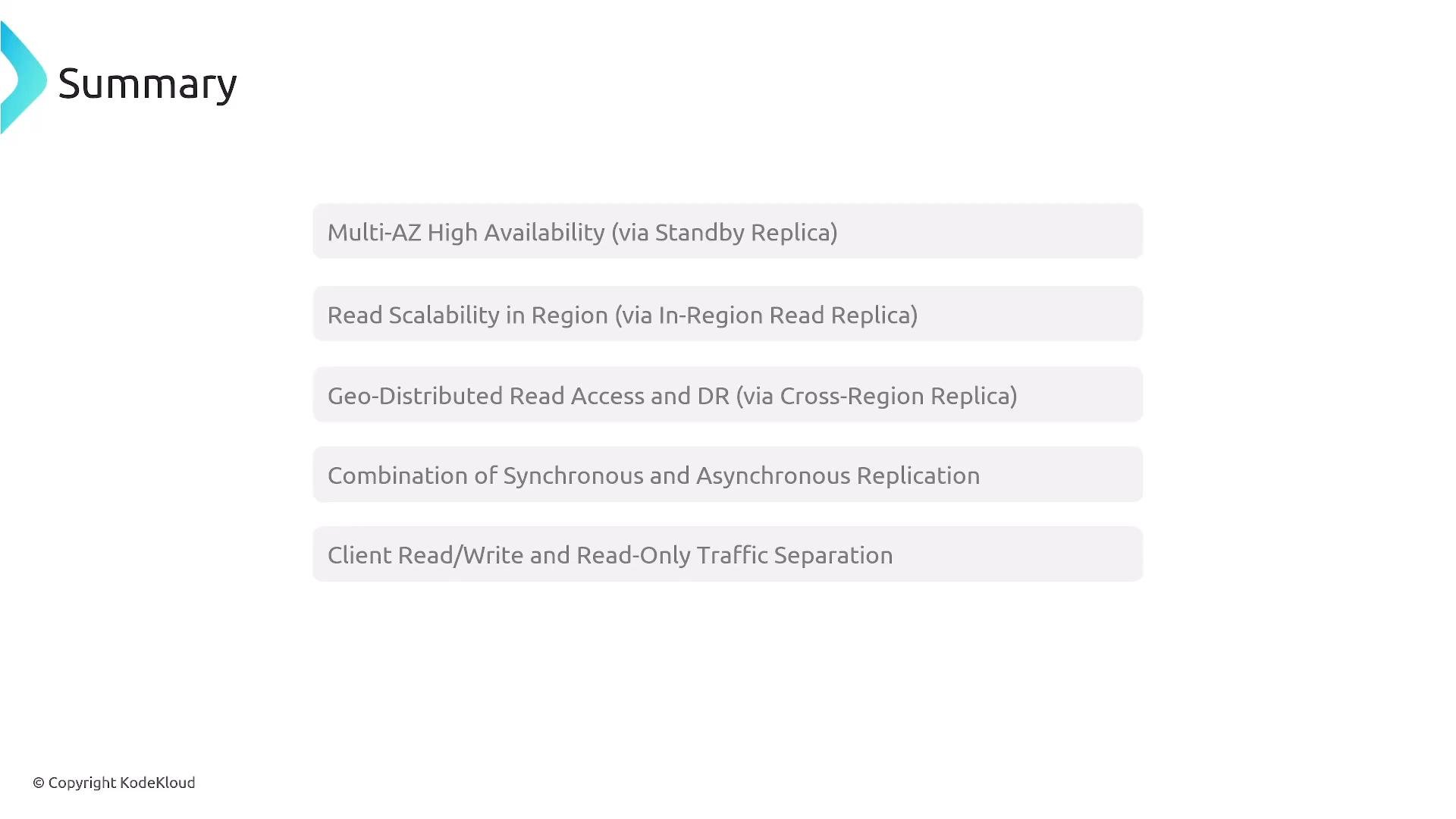
- Multi‑AZ standby replicas: synchronous replication for automatic failover and strong durability.
- In‑region read replicas: asynchronous, used to scale reads within a region.
- Cross‑region read replicas: asynchronous, used for geo‑distributed reads and disaster recovery.
- Cluster deployments: provide separate writer and reader endpoints for workload separation and can combine high availability with read scalability.
- Use automated backups, snapshots, and cross‑region replication strategies to build cold or warm backups and DR solutions.
Design considerations
- Use Multi‑AZ for production databases where automatic failover and data durability are required.
- Use read replicas to offload reads and to create reporting or analytics environments, keeping in mind asynchronous lag.
- Use cluster deployments when you need separate writer and reader endpoints and want high read scalability.
- Combine local synchronous Multi‑AZ and asynchronous cross‑region replicas for a layered DR strategy.
Avoid relying on asynchronous read replicas for workloads that require strict transactional consistency. If you need zero data loss, design with synchronous Multi‑AZ options and test failover behavior regularly.
- Amazon RDS documentation: https://docs.aws.amazon.com/rds/
- Amazon Aurora overview: https://docs.aws.amazon.com/aurora/
- Backups and snapshots for RDS: https://docs.aws.amazon.com/AmazonRDS/latest/UserGuide/CHAP_Backup.html