

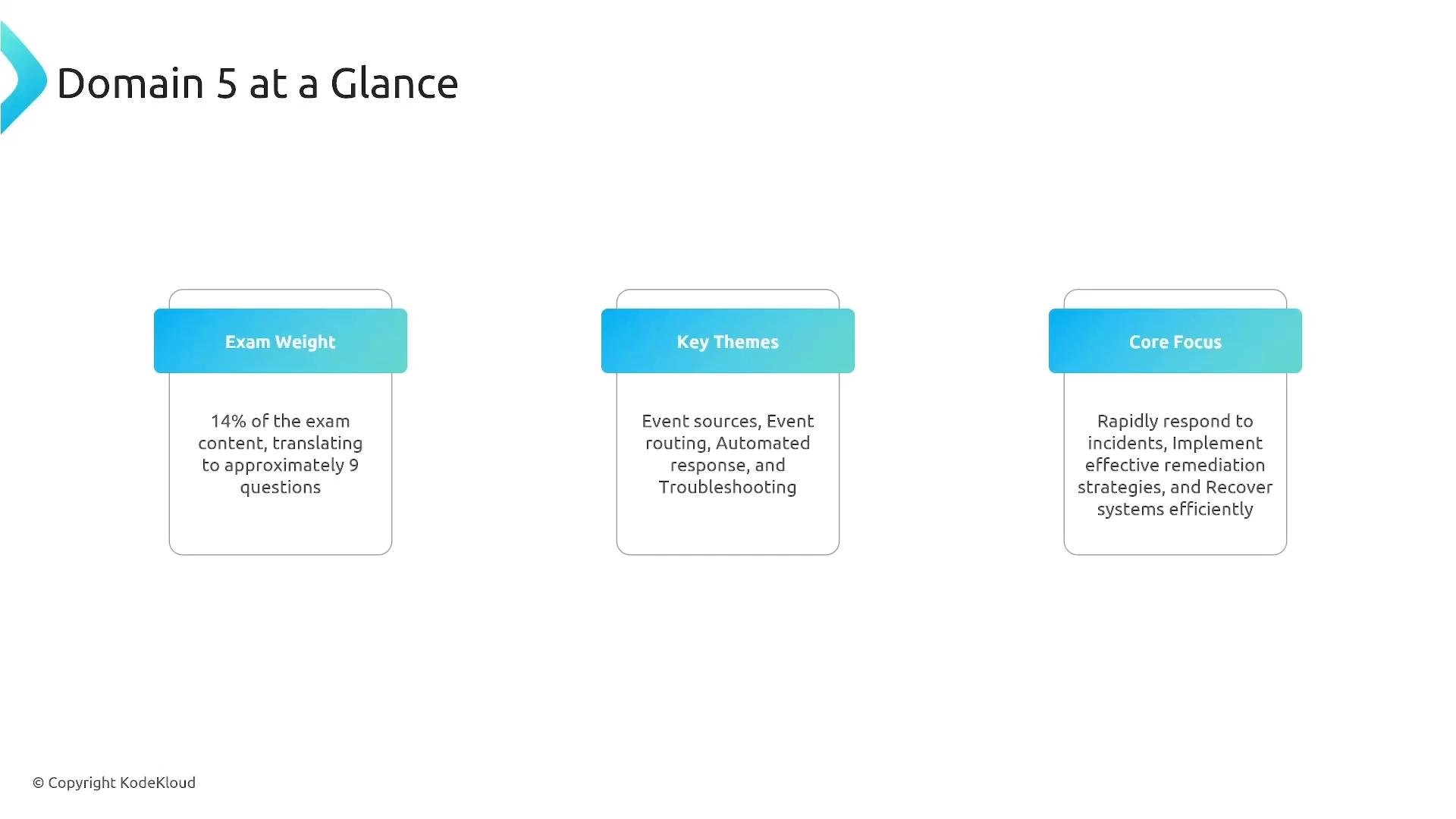
- Amazon EventBridge — centralized event router: event bus, pattern matching, routing, cross-account event flows.
- AWS Systems Manager (SSM) — execution and operational orchestration: Automation documents, Run Command, Session Manager, OpsCenter, Incident Manager.
- AWS Health — account-specific health events and public service status (Personal Health Dashboard, Service Health Dashboard, Health API).
- AWS Config — continuous configuration tracking, drift detection, managed/custom rules, conformance packs, and auto-remediation triggers.
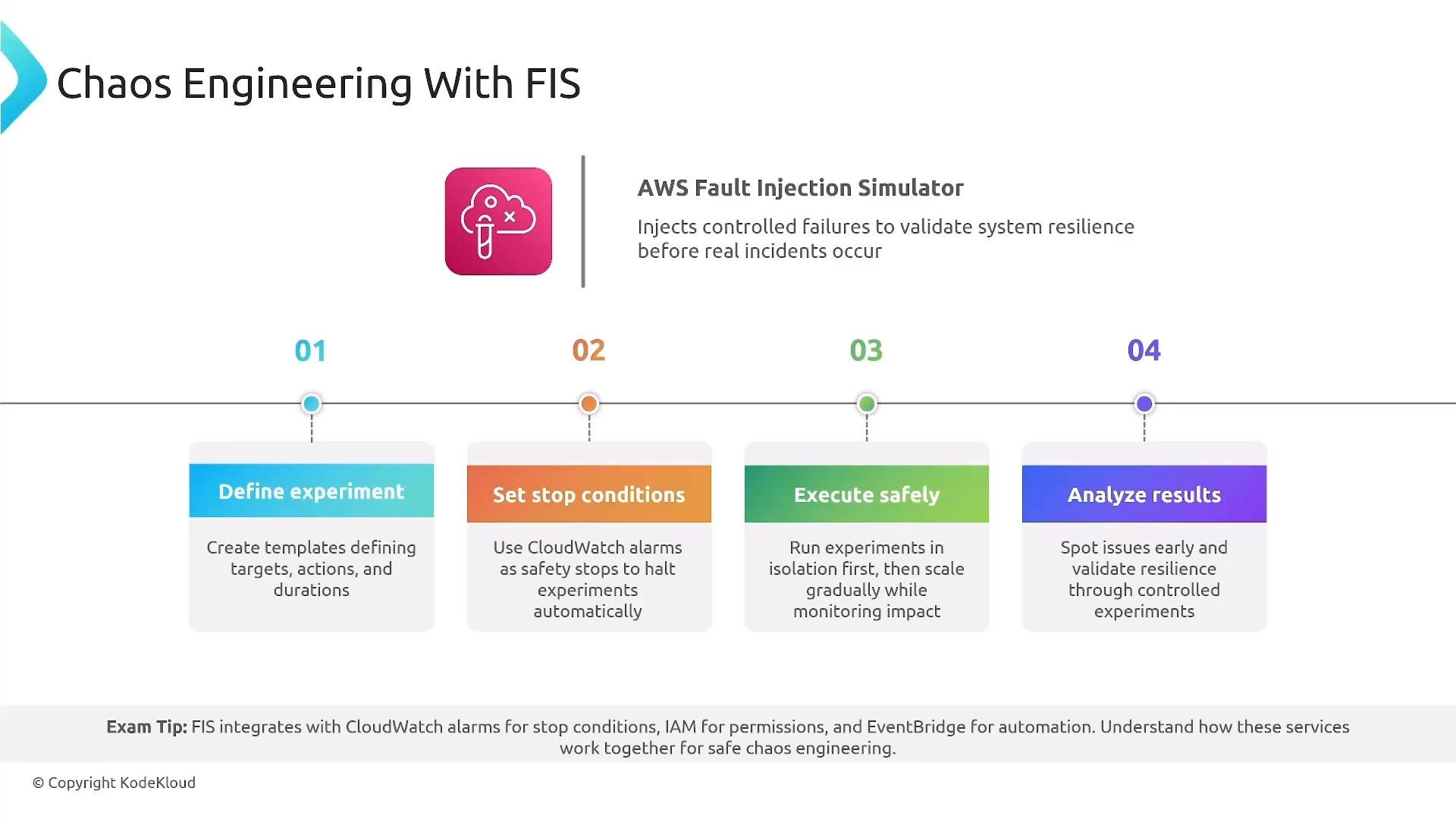
- AWS Fault Injection Simulator (FIS) — controlled chaos experiments for validating resilience.
Remember:
- Which service detects AWS infrastructure/service issues? AWS Health.
- Which service routes events and triggers responses? EventBridge.
- Which service tracks configuration and compliance? AWS Config.
- Which service performs controlled chaos testing? AWS Fault Injection Simulator.
- CloudTrail — management plane API calls (who did what, when).
- AWS Config — configuration change notifications and rule evaluations.
- AWS Health — service or account-impacting events.
- CloudWatch Alarms & Logs — metric alarms and log-based events.
- GuardDuty — security findings.
- Custom applications via PutEvents or API Destinations.
- Lambda — lightweight remediation or enrichment.
- Step Functions — orchestrated, multi-step workflows with approval gates.
- Systems Manager (SSM) Automation or Run Command — execute remediation across instances.
- SNS/SQS — fan-out or durable queuing for teams and systems.
- Cross-account event buses — centralized or multi-account pipelines.
- Automation — reusable, versioned runbooks (Automation documents) for remediation and standard work.
- Run Command — execute commands across EC2 and on-prem instances securely and at scale.
- Session Manager — interactive, auditable shell access without opening inbound ports.
- OpsCenter — aggregate and track operational items (OpsItems) for investigation.
- Incident Manager — create response plans, contact schedules, and escalation workflows.
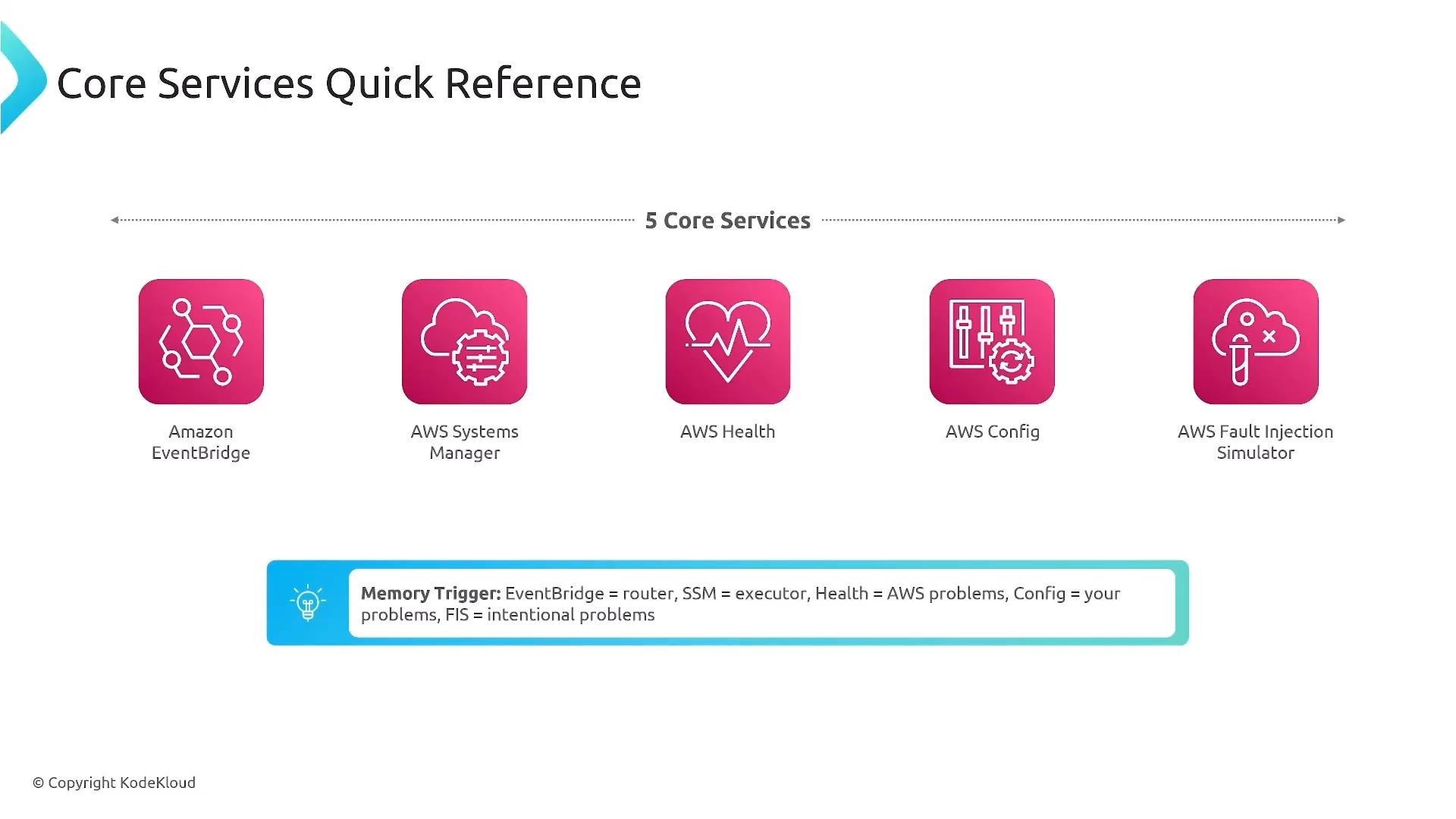
- 300+ managed rules available from AWS and additional custom rules you can author.
- Broad resource coverage (100% where supported).
- Conformance packs: bundled rules and remediation for compliance standards (CIS, PCI-DSS, HIPAA).
- Auto-remediation: Config can trigger remediation actions that invoke SSM Automation documents.
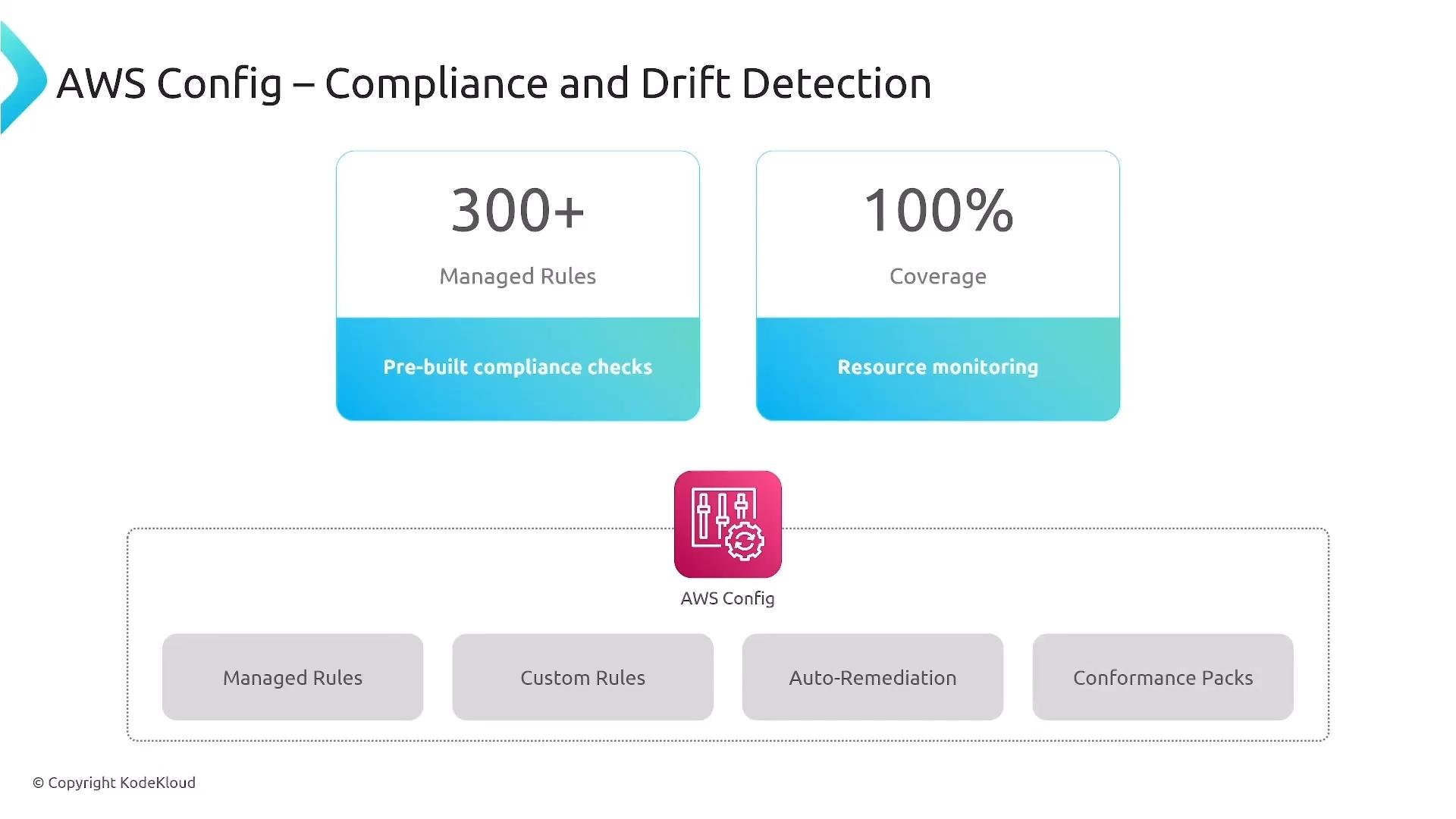
- Personal Health Dashboard — account-specific events and remediation guidance.
- Service Health Dashboard — general public status of AWS services. AWS Health also provides an API and can publish events to EventBridge, enabling automated escalation or notifications when AWS reports service disruptions affecting your account.
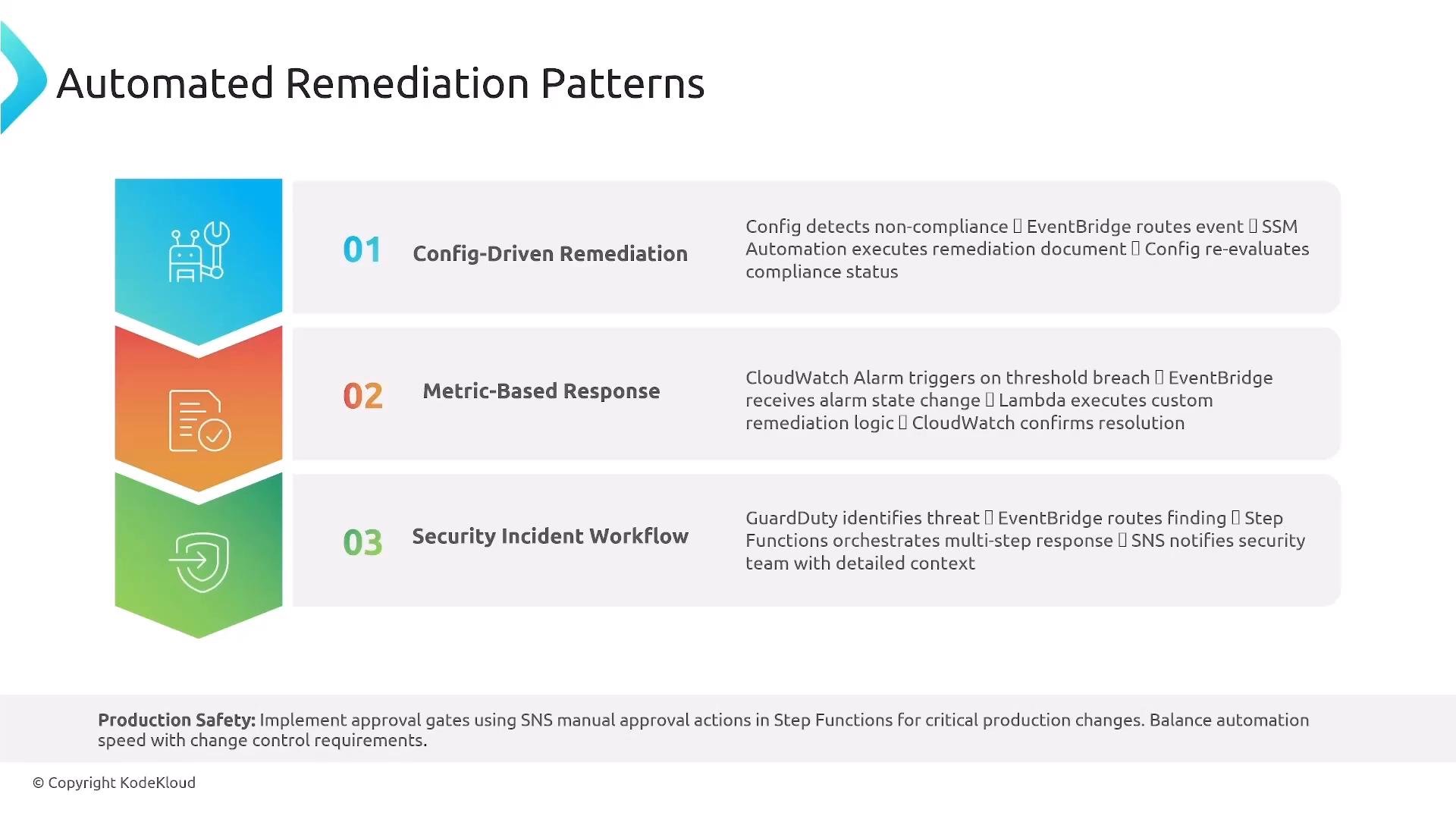
- Config-driven remediation
- AWS Config detects a non-compliant resource.
- Config emits an event to EventBridge.
- EventBridge routes the event to SSM Automation to remediate.
- AWS Config re-evaluates the resource and updates compliance status.
- Metric-based response (operational scaling or recovery)
- CloudWatch alarm triggers when a metric breaches its threshold.
- EventBridge receives the alarm event and invokes Lambda, SSM, or Step Functions for remediation or autoscaling.
- CloudWatch tracks outcome; alarms clear when metrics return to normal.
- Security incident workflow
- GuardDuty emits a finding.
- EventBridge routes the finding to Step Functions to orchestrate detection-enrichment-remediation steps.
- Use SNS to notify security teams; automated quarantine or credential revocation can run with manual approval gates.
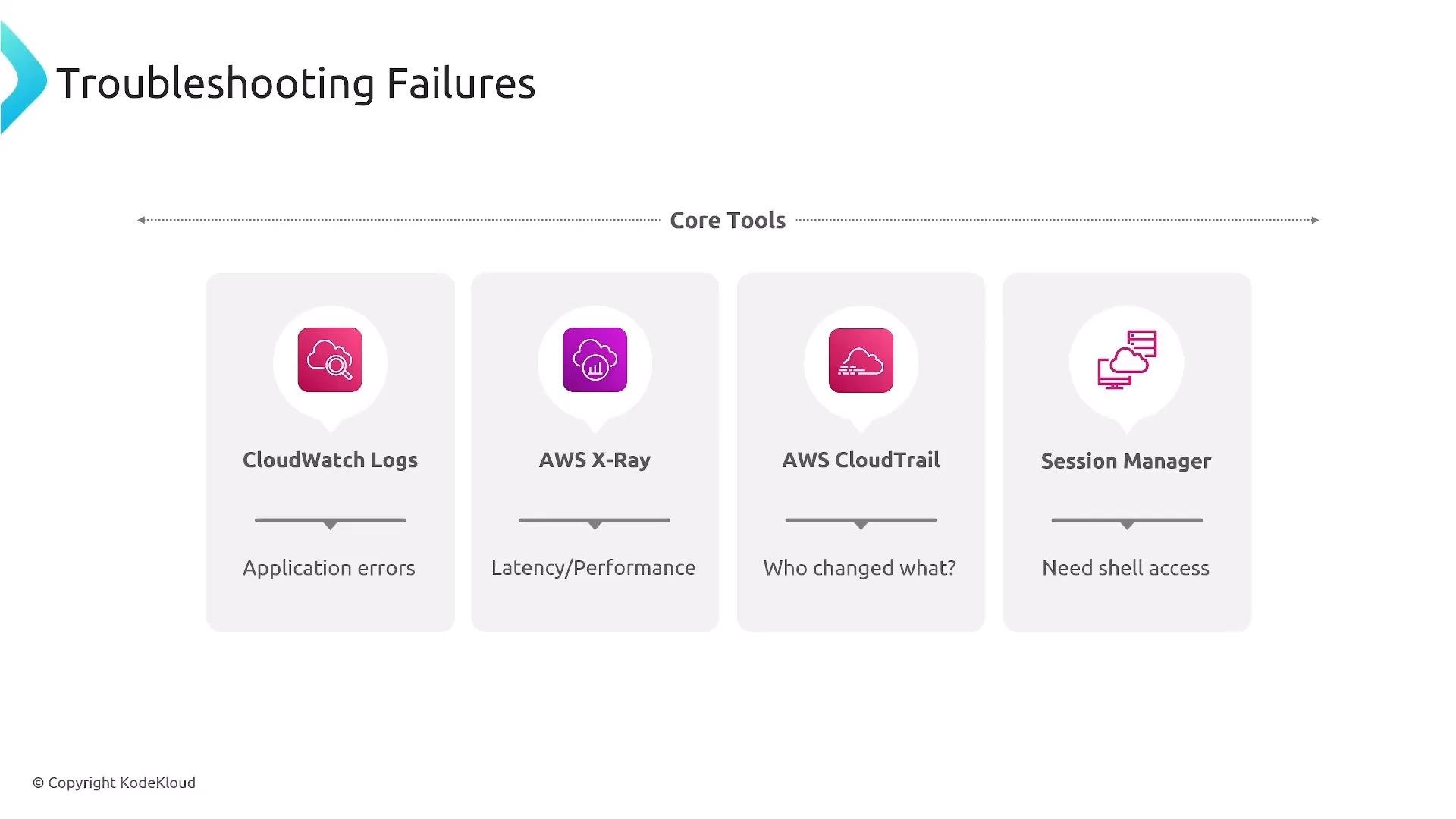
Workflow example: CloudWatch metrics/alarms detect an anomaly → CloudWatch Logs/X-Ray are used to diagnose → CloudTrail provides audit context → Session Manager or SSM Run Command executes fixes.
- Define experiments that target resources, instances, or API behavior.
- Set stop conditions using CloudWatch alarms for safety.
- Execute experiments under IAM policies and safeguard constraints.
- Analyze results and iterate improvements.
- OpsCenter (Systems Manager) — aggregate OpsItems across accounts into centralized work items for triage and assignment.
- Incident Manager — define response plans, contact and escalation schedules, runbooks, and on-call rotations. Both integrate with EventBridge and Systems Manager to automate incident lifecycle, notification, and remediation while maintaining auditability.
- EventBridge is the central event router: pattern-based matching, routing to multiple targets, and cross-account routing.
- Systems Manager (Automation, Run Command, Session Manager, OpsCenter, Incident Manager) is the main execution and operational toolset for remediation and incident coordination.
- AWS Config provides continuous configuration tracking, drift detection, rules, conformance packs, and SSM-based auto-remediation.
- AWS Fault Injection Simulator validates resilience through controlled experiments and integrates with CloudWatch/EventBridge to ensure safety.
- OpsCenter and Incident Manager enable incident aggregation and coordinated responses at scale.
- Observability stack (CloudWatch metrics/logs/alarms, X-Ray) and CloudTrail are essential for detection, diagnosis, and forensics.
This summary is concise and assumes familiarity with each service. If you need deeper examples or step-by-step runbook templates, consult the official AWS documentation or your study notes at notes.kodekloud.com.