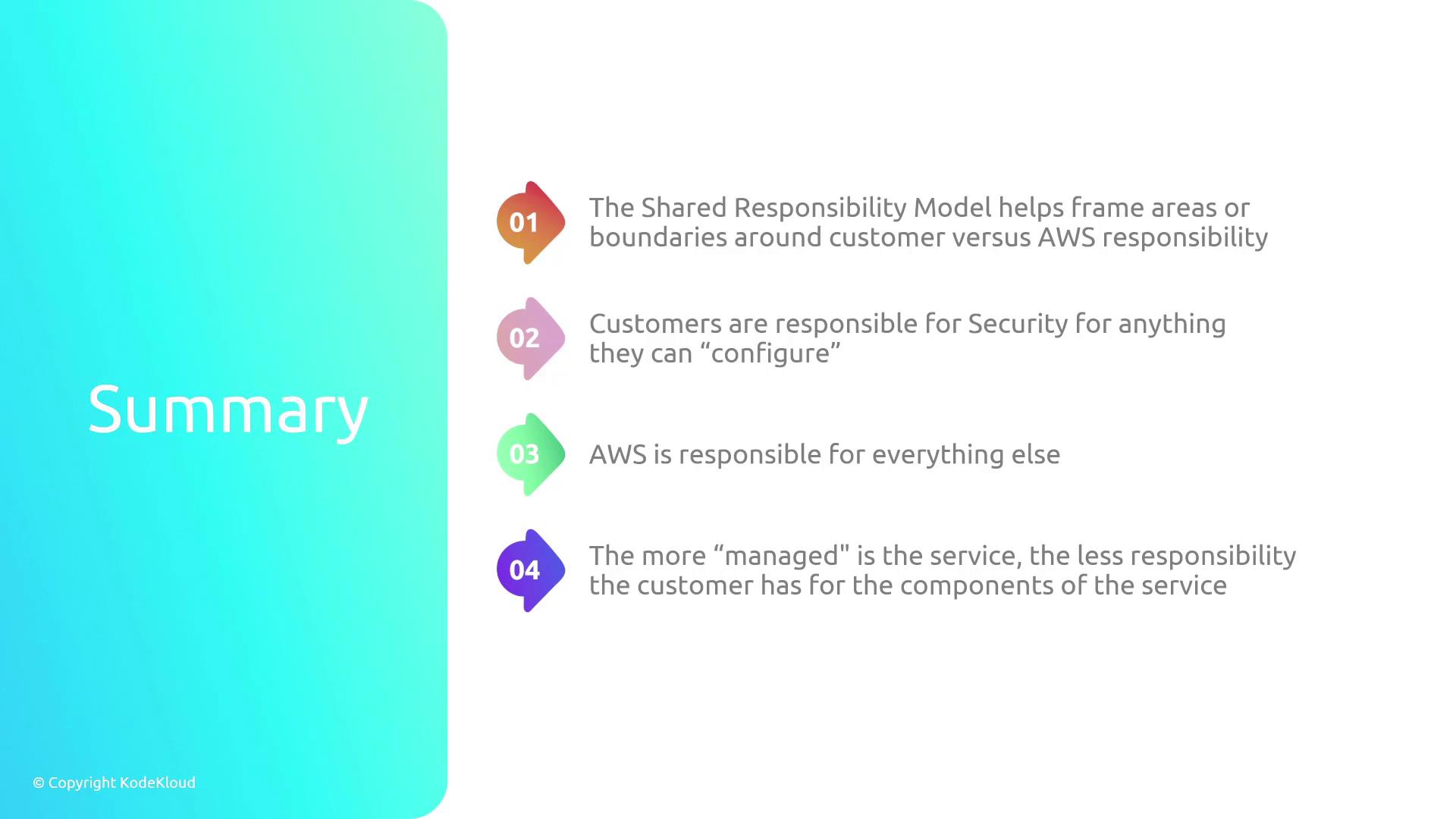
Welcome back, future AWS architects. In this article, we revisit the AWS Shared Responsibility Model—a critical framework that outlines the security responsibilities shared between AWS and its customers. Understanding this model is essential as it forms the foundation of security, resiliency, and compliance best practices in the cloud. The model clearly delineates roles. Responsibilities below the “hardware line” (e.g., compute, storage, databases, and networking components housed in AWS data centers) are managed entirely by AWS. In other words, if a component is part of the underlying infrastructure that you cannot access or configure, AWS is responsible for securing it. On the other hand, anything above that line falls under customer control. For instance, if you have the ability to log into and configure a compute instance or storage service, you are accountable for patching, managing, and securing these elements. This division of responsibilities evolves depending on the type of service:Documentation Index
Fetch the complete documentation index at: https://notes.kodekloud.com/llms.txt
Use this file to discover all available pages before exploring further.
- Infrastructure as a Service (IaaS): Customers maintain significant control and responsibility.
- Platform as a Service (PaaS): AWS manages a larger portion of the security, reducing customer responsibility.
- Software as a Service (SaaS): AWS handles almost everything, leaving customers with minimal security responsibilities.
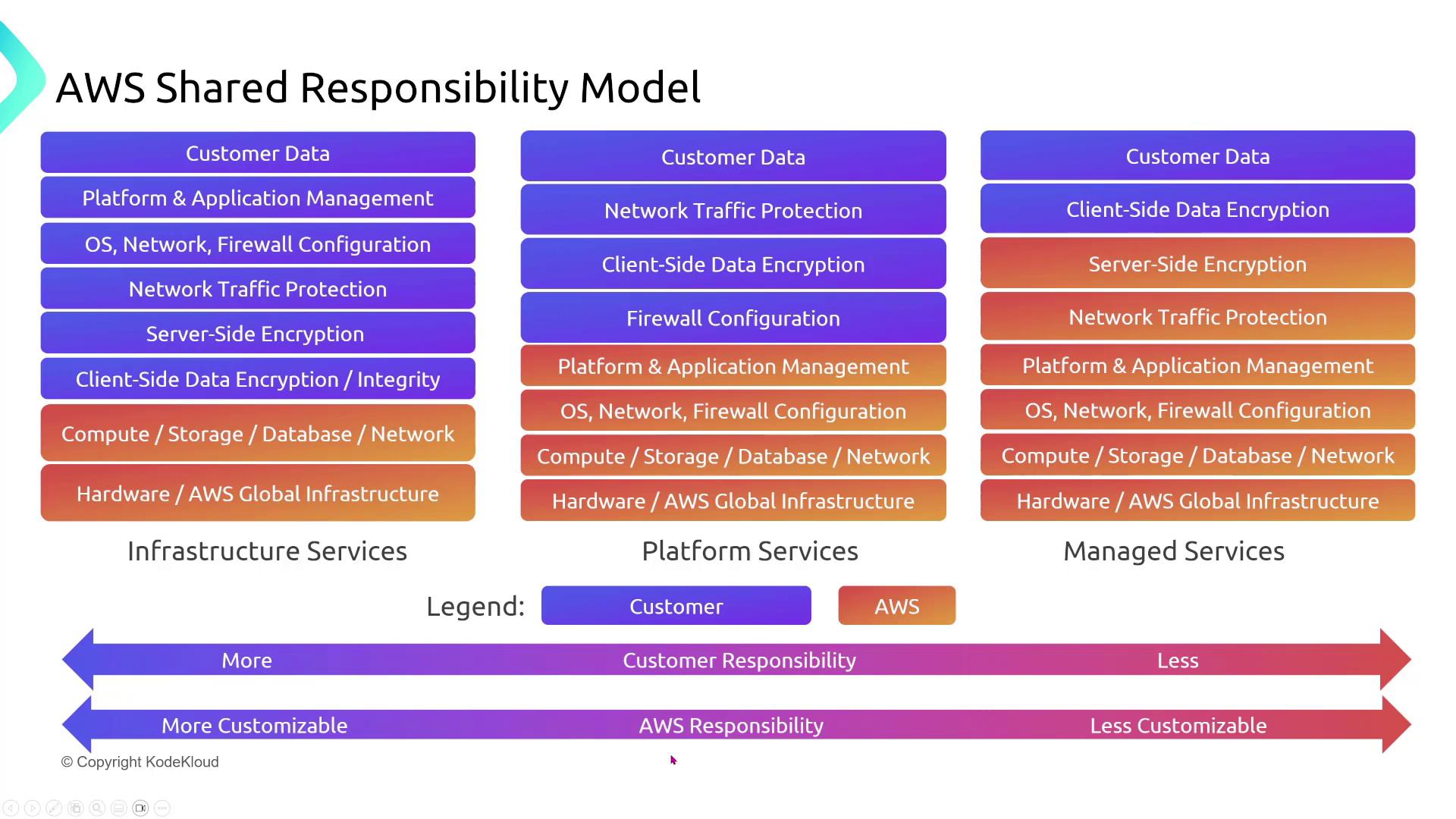
- With AWS RDS (a PaaS offering), AWS handles most of the underlying management.
- With SaaS offerings like Amazon Simple Storage Service (Amazon S3), DynamoDB, SNS, and SQS, your interaction is largely limited to an API, and you have virtually no insight into the servers or infrastructure details.
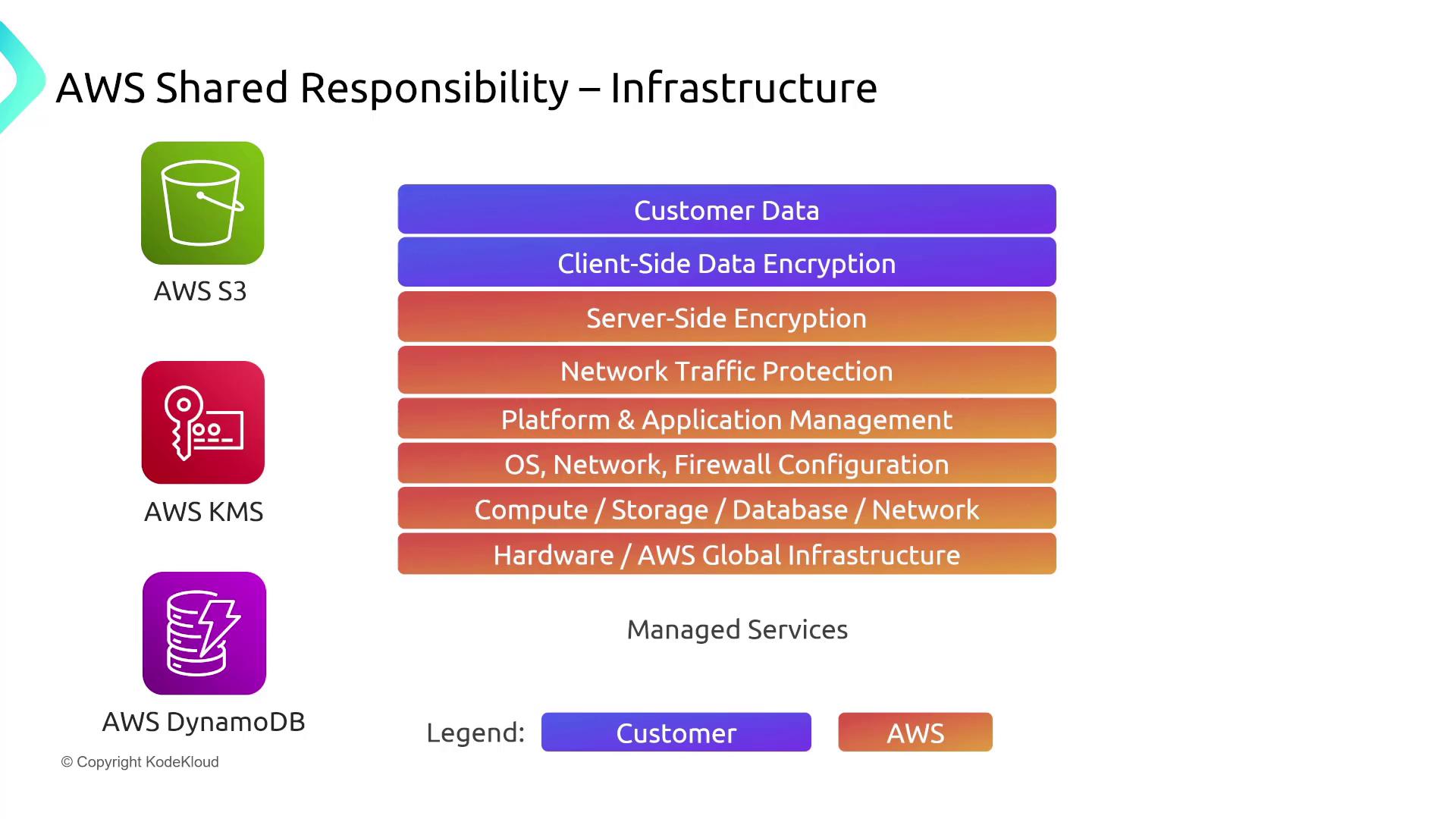
- If you can access, configure, or manage a component, you are responsible for its security.
- If you cannot access or configure a component, AWS assumes responsibility for its security.
- IaaS places the most responsibility on the customer, while PaaS and SaaS shift more responsibility to AWS.