

Key Benefits of Amazon MQ
Amazon MQ facilitates message queuing to promote a decoupled architecture, meaning that message producers and consumers operate independently without needing direct knowledge of each other. This decoupling enhances system scalability and flexibility. The service guarantees reliable message delivery by persisting messages to disk, ensuring that critical data is not lost even if consumers are temporarily unavailable or in the event of broker failures. Key features include:- Decoupled architecture for improved scalability
- Reliable message delivery with disk persistence
- Support for multiple messaging protocols, including MQTT, STOMP, AMQP, and OpenWire
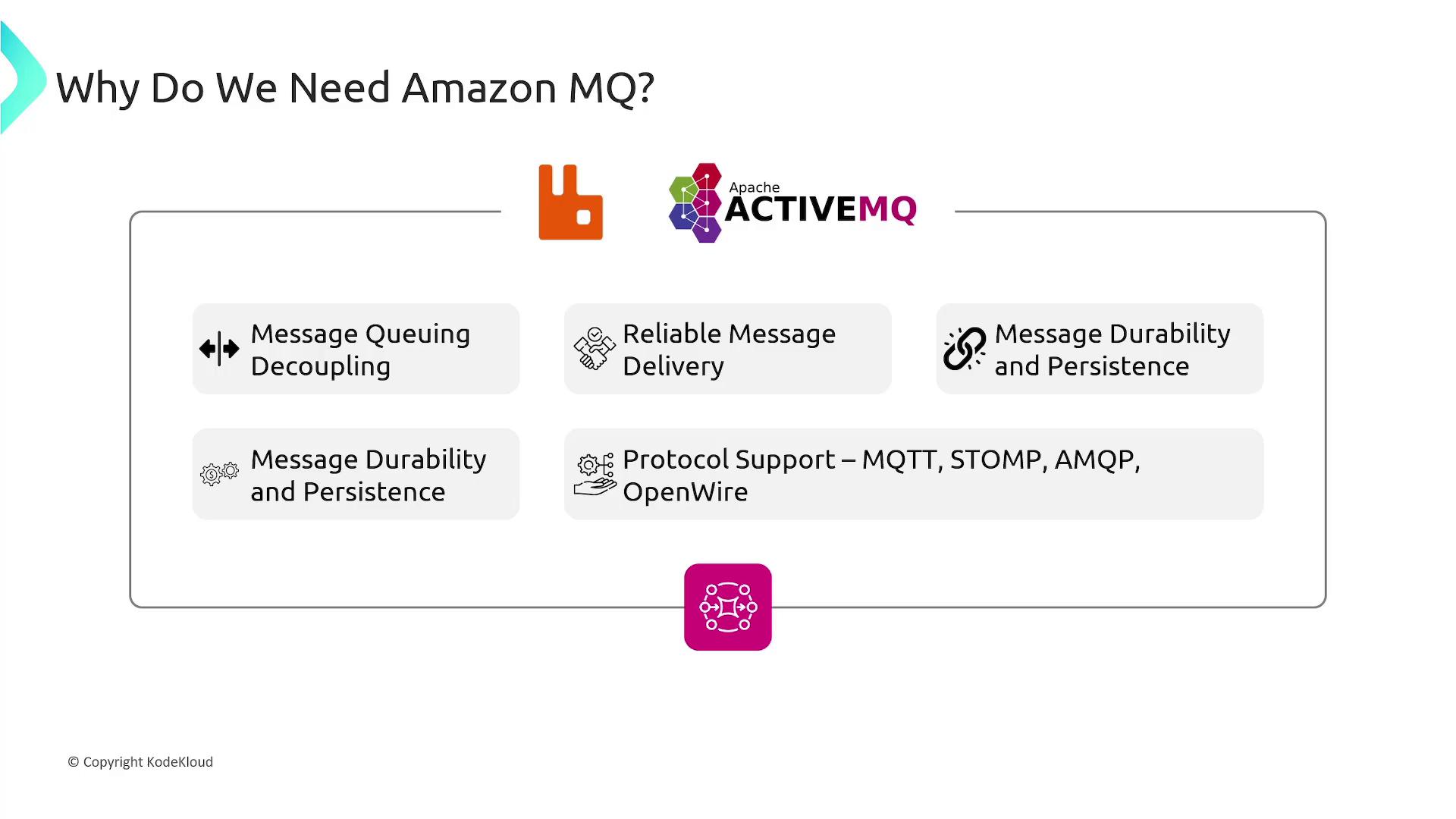
When deciding between Amazon MQ and AWS Simple Queue Service (SQS), consider your application’s requirements. SQS is ideal for new applications due to its simplicity, while Amazon MQ serves as a drop-in replacement for existing applications that already use RabbitMQ or ActiveMQ—eliminating the need for code changes.
Administrative and Security Features
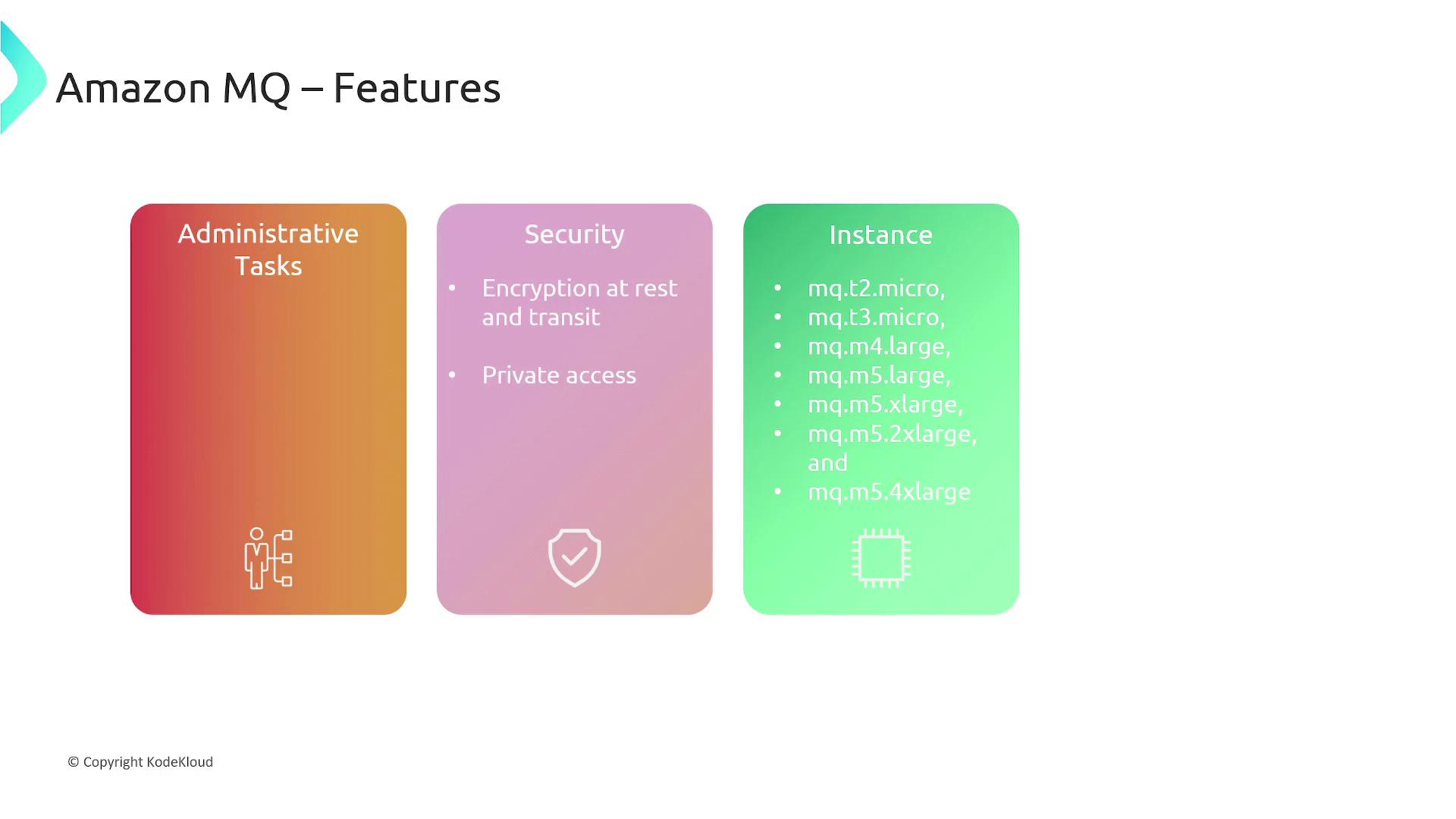
Amazon MQ alleviates the burden of many administrative tasks such as hardware provisioning, broker setup, software upgrades, and failure detection and recovery. The service also incorporates robust security features:- Encryption of messages at rest and in transit
- Secure connections established via SSL
- Option to restrict broker access to private endpoints within an Amazon VPC
Use Cases and Integration
Amazon MQ is designed as a drop-in replacement for RabbitMQ or ActiveMQ and supports applications that require low latency for processing thousands of events. It is an excellent choice for both migrating applications to the cloud and integrating with a wide range of AWS services. Its robust configuration options make it adaptable to varied messaging needs. Another powerful integration is with AWS Lambda. By triggering Lambda functions based on queue messages, you can build serverless, event-driven architectures that respond instantly to new events.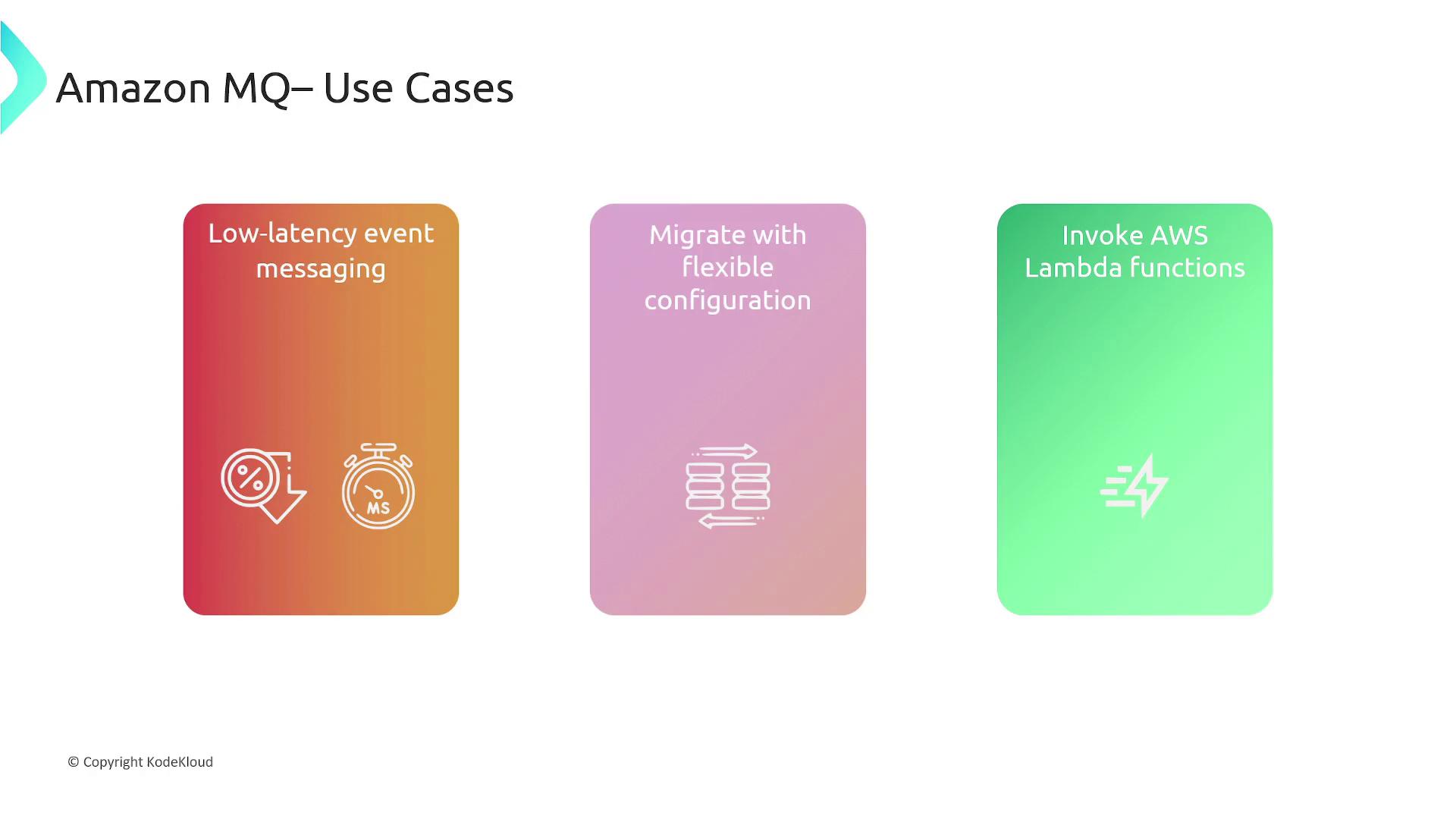
Leveraging Amazon MQ can streamline your messaging architecture, especially when transitioning from on-premises solutions or when your application demands high throughput and reliable message delivery.