

What is a cache and where does it sit?
A typical application architecture includes a client, an application server (business logic), and a database for persistent data (accounts, carts, inventory). Each request that needs persistent data can cause a round trip to the database. Databases are often the scaling bottleneck because they are harder to scale horizontally than stateless application servers. A cache layer sits between your application servers and the database to:- Reduce read latency by keeping frequently accessed data in memory.
- Reduce load on the primary database by serving repeated requests from the cache.
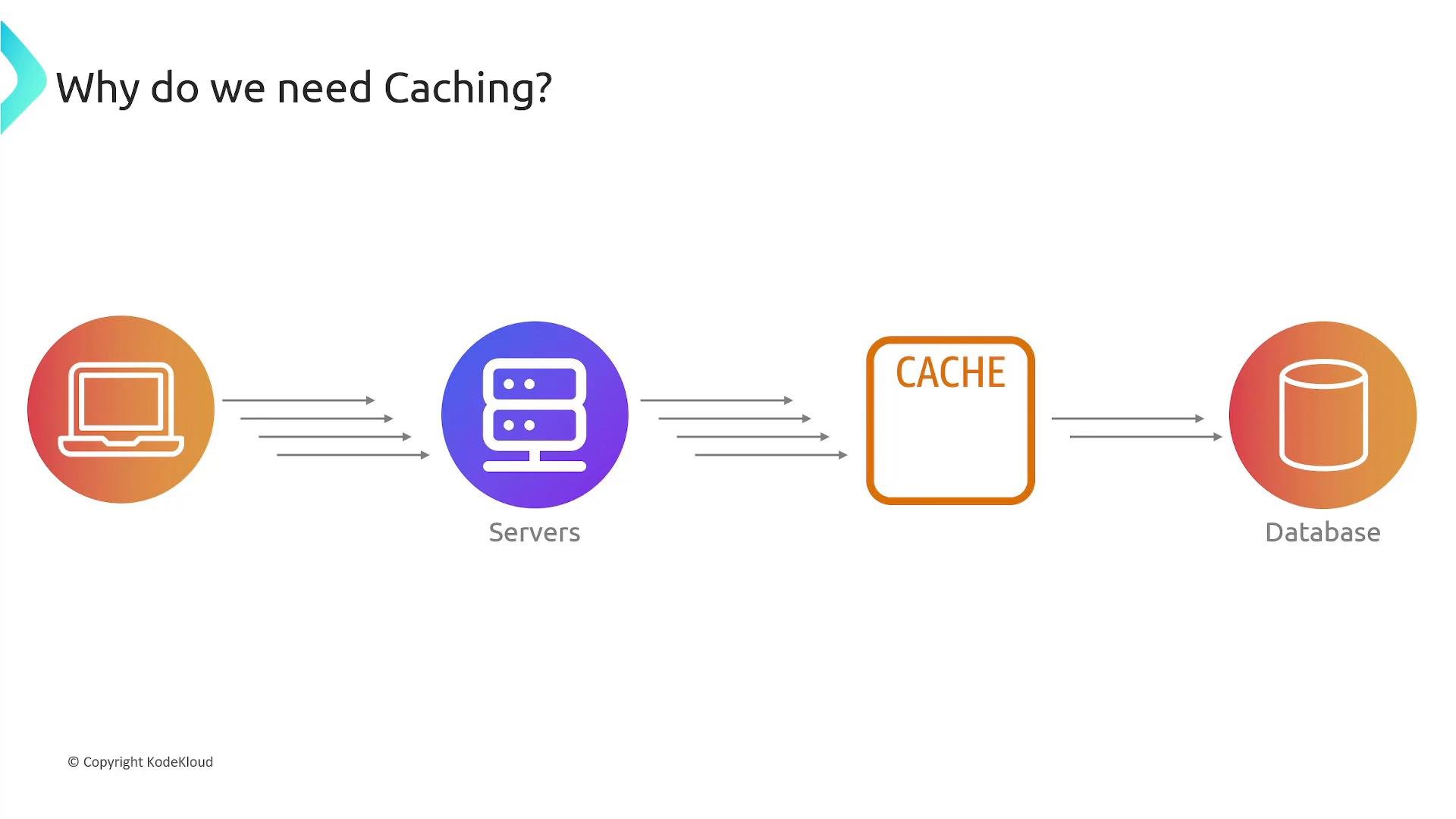
A common and recommended pattern is cache-aside (lazy loading): the application checks the cache first; on a miss it queries the database, returns the result, and populates the cache. Plan for TTLs, invalidation patterns, and eviction behavior to avoid serving stale data.
What is AWS ElastiCache?
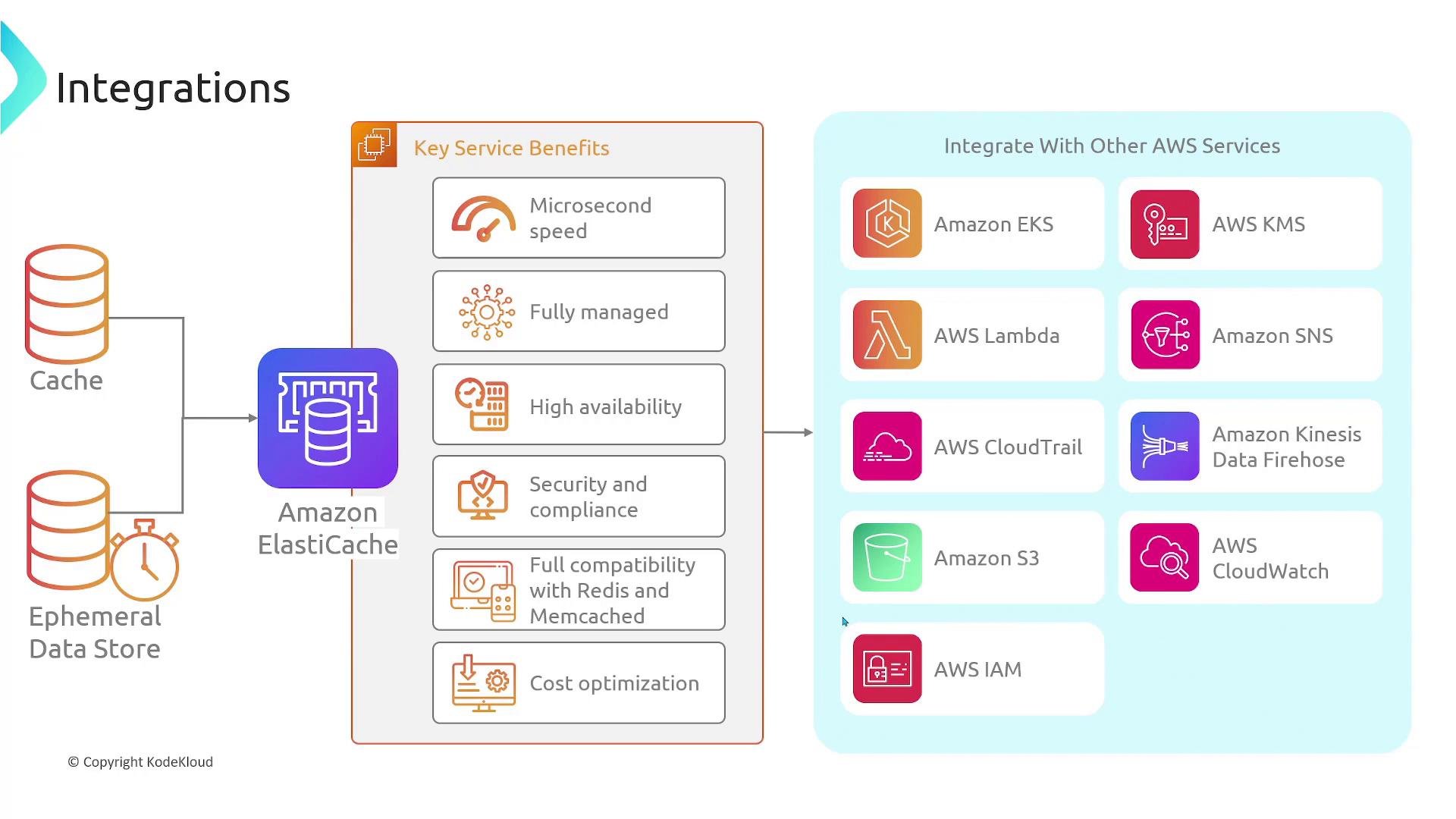
ElastiCache is a fully managed in-memory caching service on AWS that reduces operational overhead (provisioning, patching, scaling) and integrates with AWS monitoring and security services. It delivers microsecond-to-millisecond response times and can handle millions of operations per second for read-heavy workloads. ElastiCache supports two engines:- Redis — feature-rich, supports persistence, replication, advanced data structures, and pub/sub messaging.
- Memcached — simple, high-performance, multi-threaded key-value store for ephemeral caching.
Core ElastiCache components
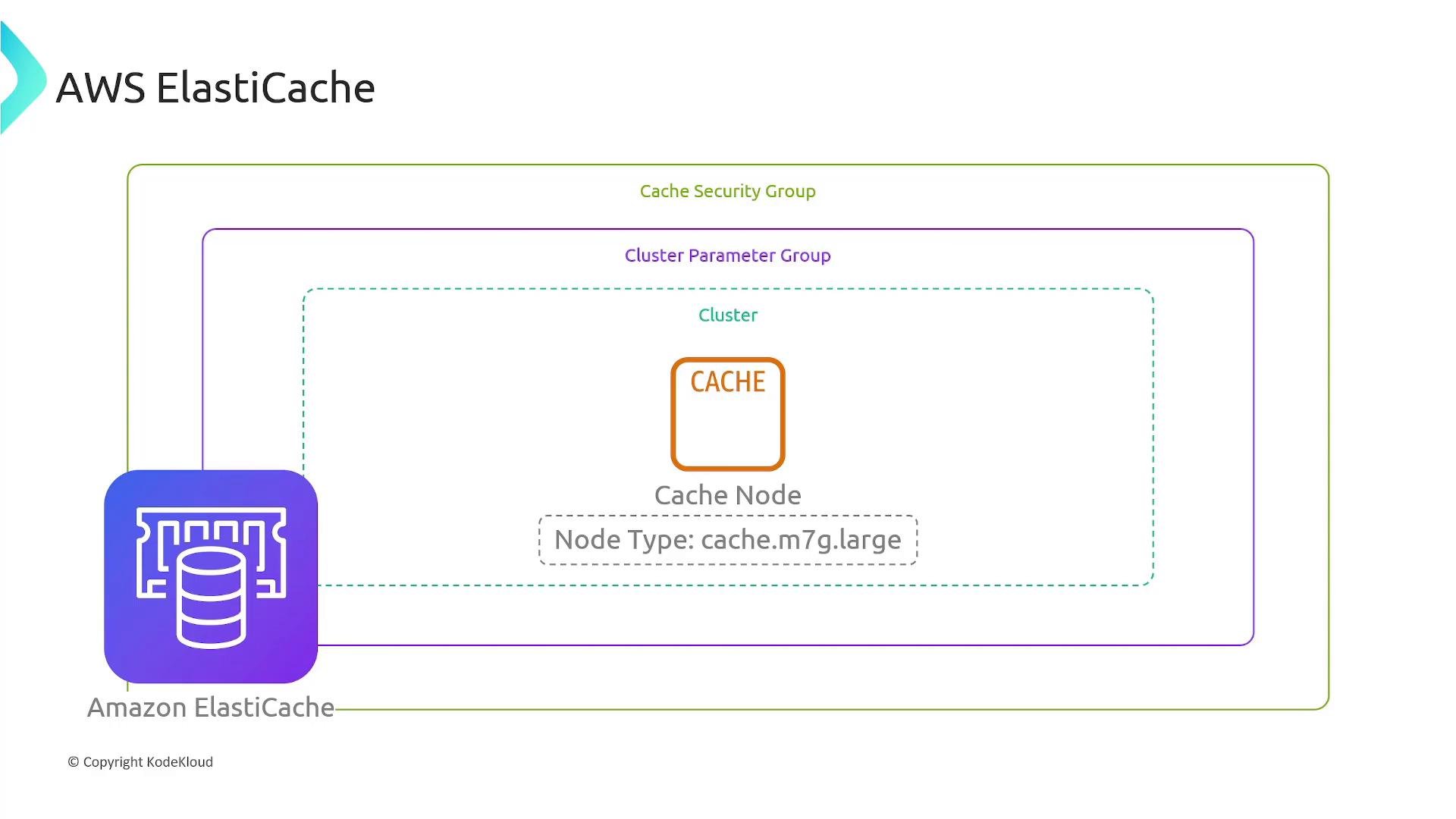
- Cache cluster / replication group: logical grouping of one or more cache nodes. Memcached uses clusters; Redis commonly uses replication groups and (if enabled) Redis Cluster shards for horizontal scaling.
- Node types: determine CPU and memory capacity for cache nodes. Select node types based on memory footprint and ops throughput.
- Cache parameter group: engine-level configuration settings (Redis or Memcached).
- Cache security group / VPC security groups: control network access. For VPC-based deployments, use VPC security groups.
- Subnet group: collection of subnets (AZs) where cache clusters are placed.
Engine-specific features
Redis and Memcached provide different capabilities. Choose based on your requirements for durability, data structures, and scalability.Redis (ElastiCache for Redis)
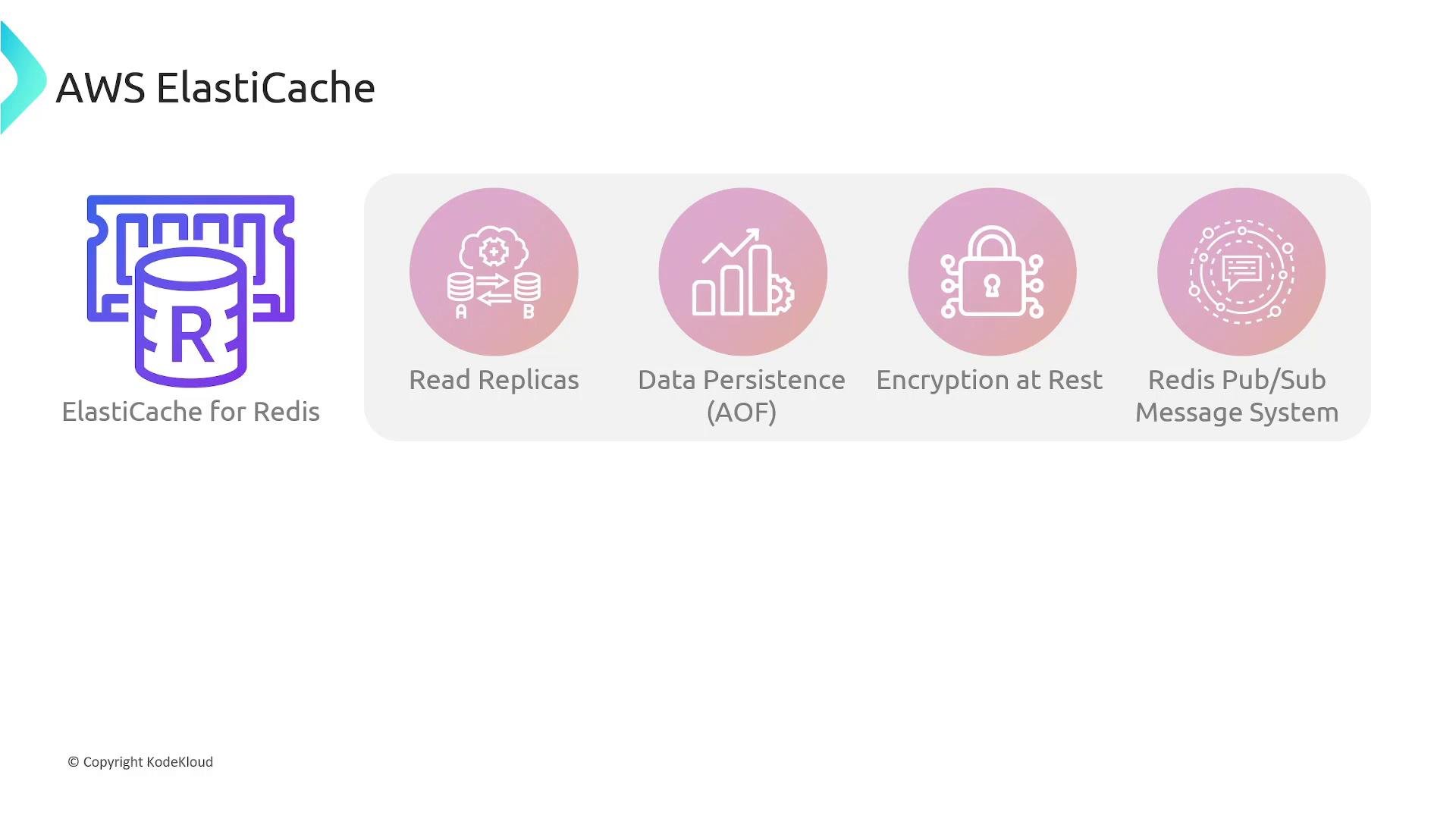
- Read replicas: use primary/replica replication to offload reads and increase availability.
- Persistence: snapshot (RDB) support for backups; AOF availability depends on engine/version and configuration — check engine-specific docs.
- Encryption and authentication: supports in-transit and at-rest encryption and AWS authentication mechanisms.
- Pub/Sub: built-in publish/subscribe for real-time messaging.
- Clustering and sharding: Redis Cluster mode shards data across multiple nodes for horizontal scalability.
Memcached (ElastiCache for Memcached)
- Multi-AZ deployments: place nodes across Availability Zones to improve availability.
- Auto-discovery: clients can discover and connect to cluster nodes (ElastiCache provides discovery endpoints).
- Partitioning / sharding: Memcached partitions keys across nodes (client-side sharding).
- Simpler feature set: optimized for ephemeral, high-throughput key-value caching (no built-in persistence).
Quick comparison: Redis vs Memcached
ElastiCache overall features and advantages
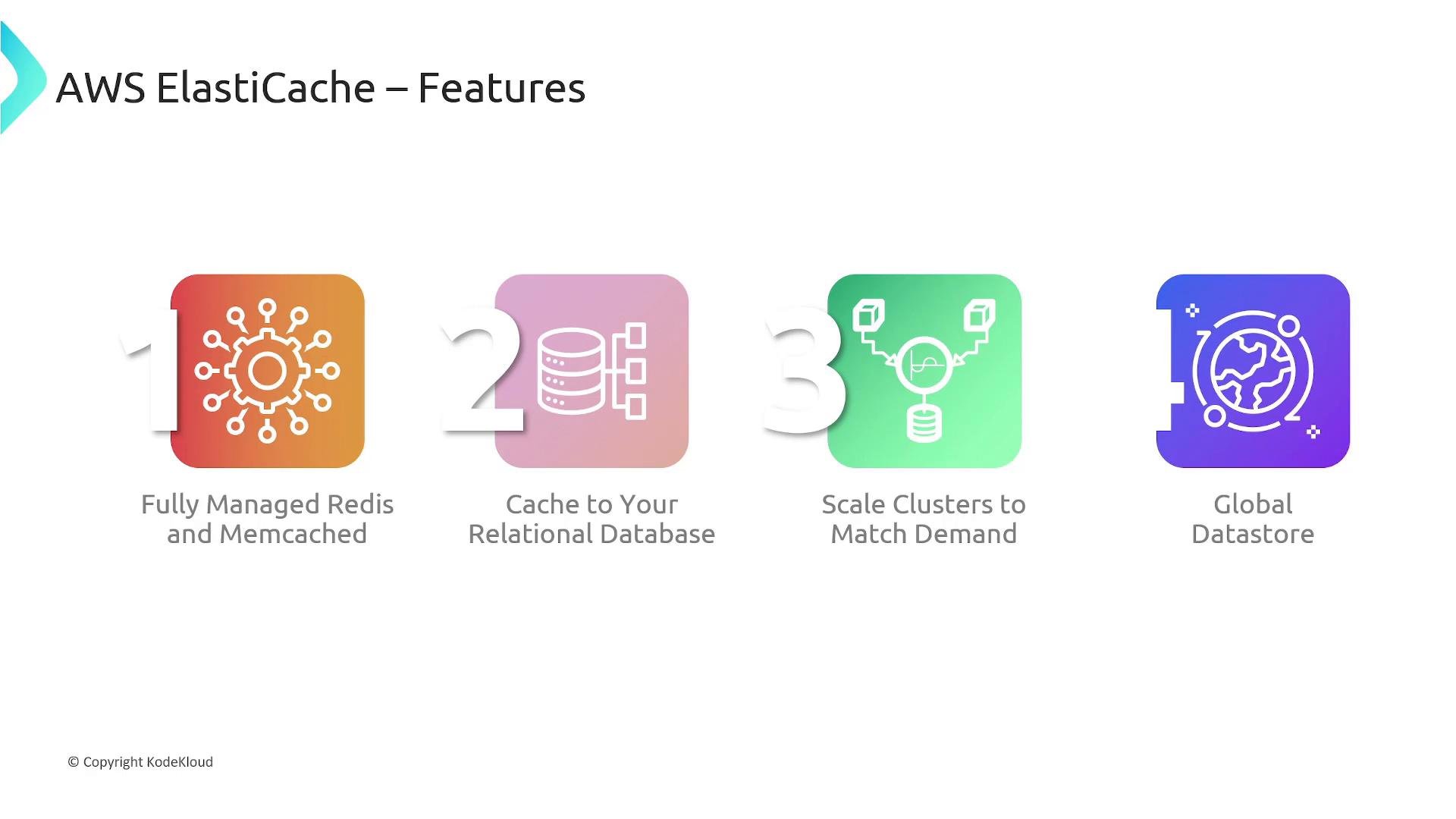
- Fully managed: AWS handles provisioning, patching, and many scaling tasks.
- Integrates with relational databases (e.g., RDS) as a read cache to reduce DB I/O.
- Scale up/out: add nodes or shards as demand increases.
- Redis Global Datastore: cross-region replication for low-latency reads and DR (Redis-specific).
- Integrations:
- Monitoring and auditing: CloudWatch, CloudTrail.
- Backups: Redis snapshots can be stored in Amazon S3.
- Security: manage access with IAM, encrypt data using AWS KMS keys where supported.
Common use cases
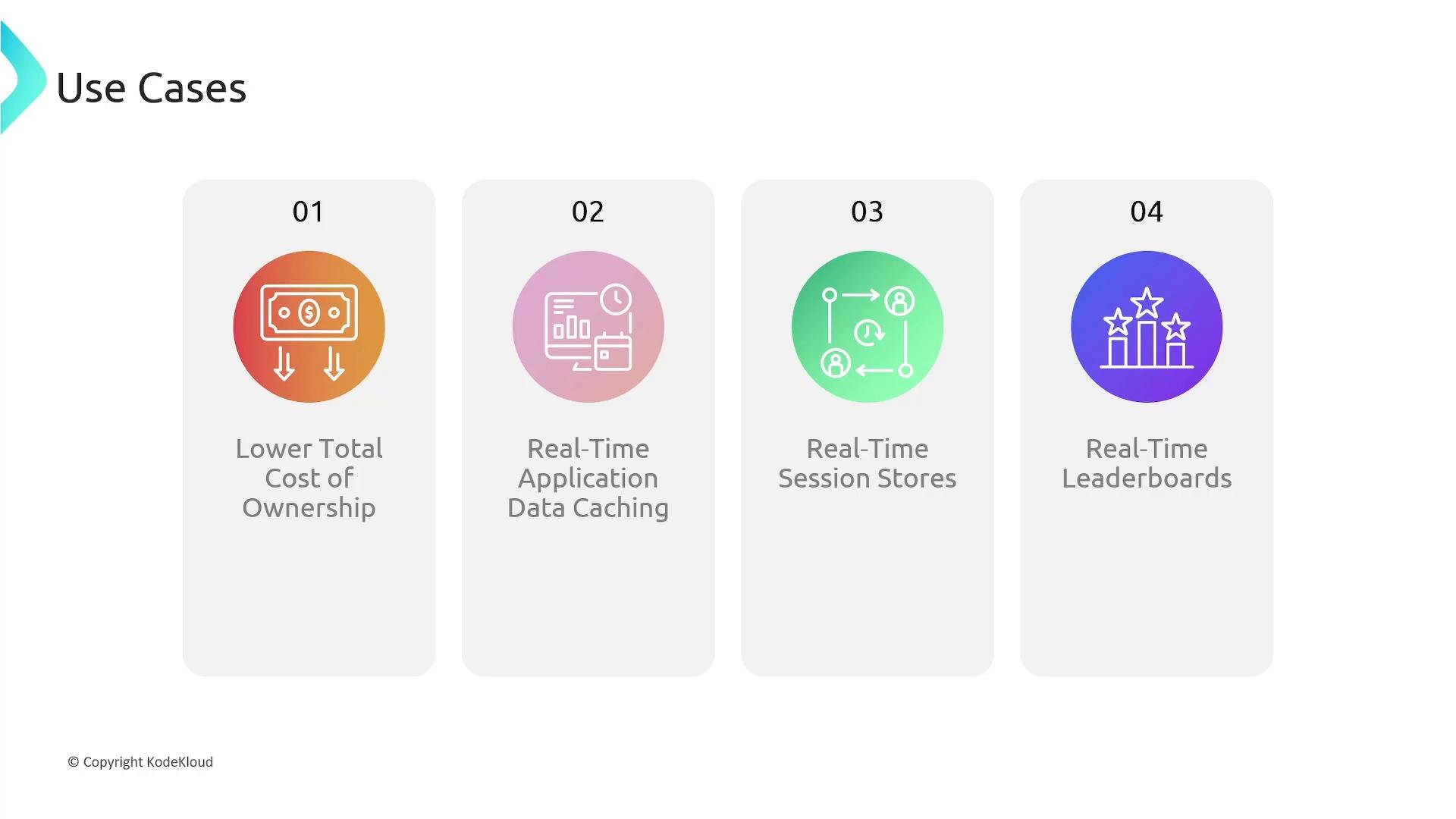
- Offloading read traffic from databases to lower latency and cost.
- Storing frequently accessed data for microsecond response times.
- Session stores for web and gaming applications.
- Real-time leaderboards, counters, and analytics.
- Caching expensive computed or aggregated results to avoid repeated DB computation.
Important operational considerations
- Cache invalidation & consistency: caches may serve stale data. Design TTLs, invalidation strategies, and choose patterns appropriate for your consistency requirements (e.g., cache-aside, write-through, write-back).
- Eviction policies: memory is limited. Know eviction policies (LRU, volatile-ttl, etc.) and size your nodes appropriately.
- Cost vs durability: Redis persistence increases durability but affects performance and cost. Memcached is typically ephemeral and cheaper for pure caching.
- Security: restrict network access using VPC and security groups, enable encryption in transit and at rest where supported, and audit using CloudTrail.
Cache design mistakes commonly cause outages or stale data: always plan for invalidation, eviction, and failover scenarios. Test cache failures and failover paths in staging before production roll-out.
Best practices (summary)
- Use cache-aside for many read-heavy patterns; ensure your application updates or invalidates the cache on writes.
- Set sensible TTLs to balance freshness and cache hit ratio.
- Monitor CacheMetrics (hit rate, evictions, CPU, memory) in CloudWatch and set alerts.
- Right-size node types for memory footprint and network throughput; scale horizontally for large datasets.
- Use Redis Cluster or sharding for large keyspaces and high throughput.
- Secure your cluster: VPC, security groups, encryption, and IAM for management operations.
Summary
AWS ElastiCache is a fully managed, in-memory caching platform supporting Redis and Memcached. It helps reduce latency and offload databases by caching frequently accessed data. Choose Redis for persistence, advanced data types, replication, or pub/sub; choose Memcached for a simple, high-performance, ephemeral cache. ElastiCache integrates with AWS monitoring, security, and compute services and can scale to meet application demand.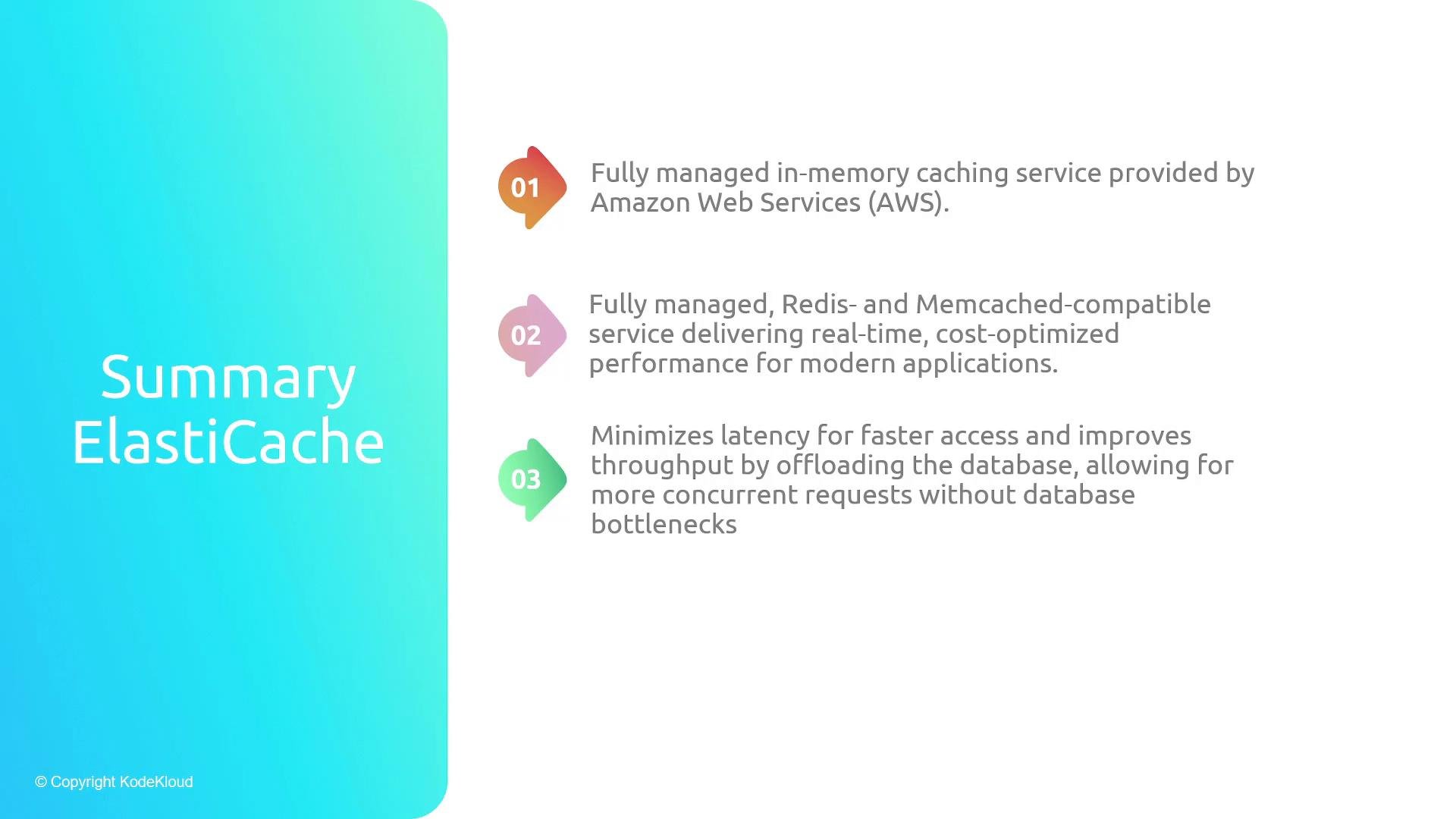
Links and references
- ElastiCache documentation: https://docs.aws.amazon.com/elasticache/
- Redis documentation: https://redis.io/documentation
- Memcached documentation: https://memcached.org/
- AWS CloudWatch: https://learn.kodekloud.com/user/courses/aws-cloudwatch
- AWS RDS: https://learn.kodekloud.com/user/courses/aws-rds
- AWS Lambda: https://learn.kodekloud.com/user/courses/aws-lambda
- Amazon EKS: https://learn.kodekloud.com/user/courses/aws-eks
- AWS IAM: https://learn.kodekloud.com/user/courses/aws-iam
- AWS KMS: https://aws.amazon.com/kms/