

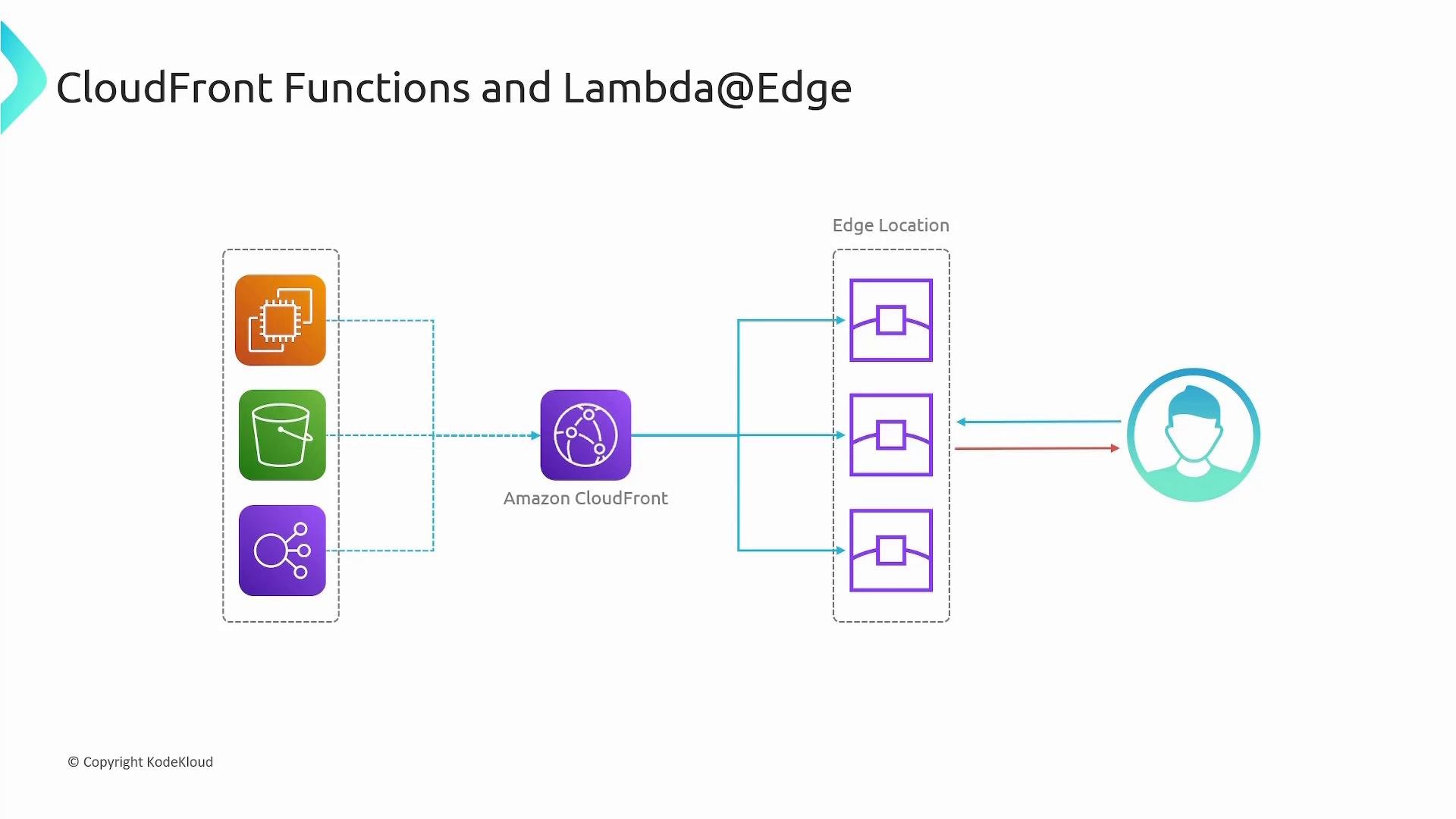
- Reduce origin load by handling simple responses, redirects, or authentication at edge locations.
- Lower latency by executing logic in the same region/network as end users.
- Modify requests and responses (headers, URLs, cache keys) before they reach your origin or before they return to clients.
-
CloudFront Functions run at viewer-facing events:
- viewer-request — when CloudFront receives a request from a viewer
- viewer-response — when CloudFront prepares to return a response to the viewer
They are built for extremely short, stateless operations with minimal cold start time.
-
Lambda@Edge supports additional CloudFront event hooks:
- viewer-request
- origin-request — before forwarding to the origin
- origin-response — after receiving the origin response
- viewer-response
Lambda@Edge enables more complex processing both before and after origin communication, including use of libraries and network access.
CloudFront Functions are optimized for
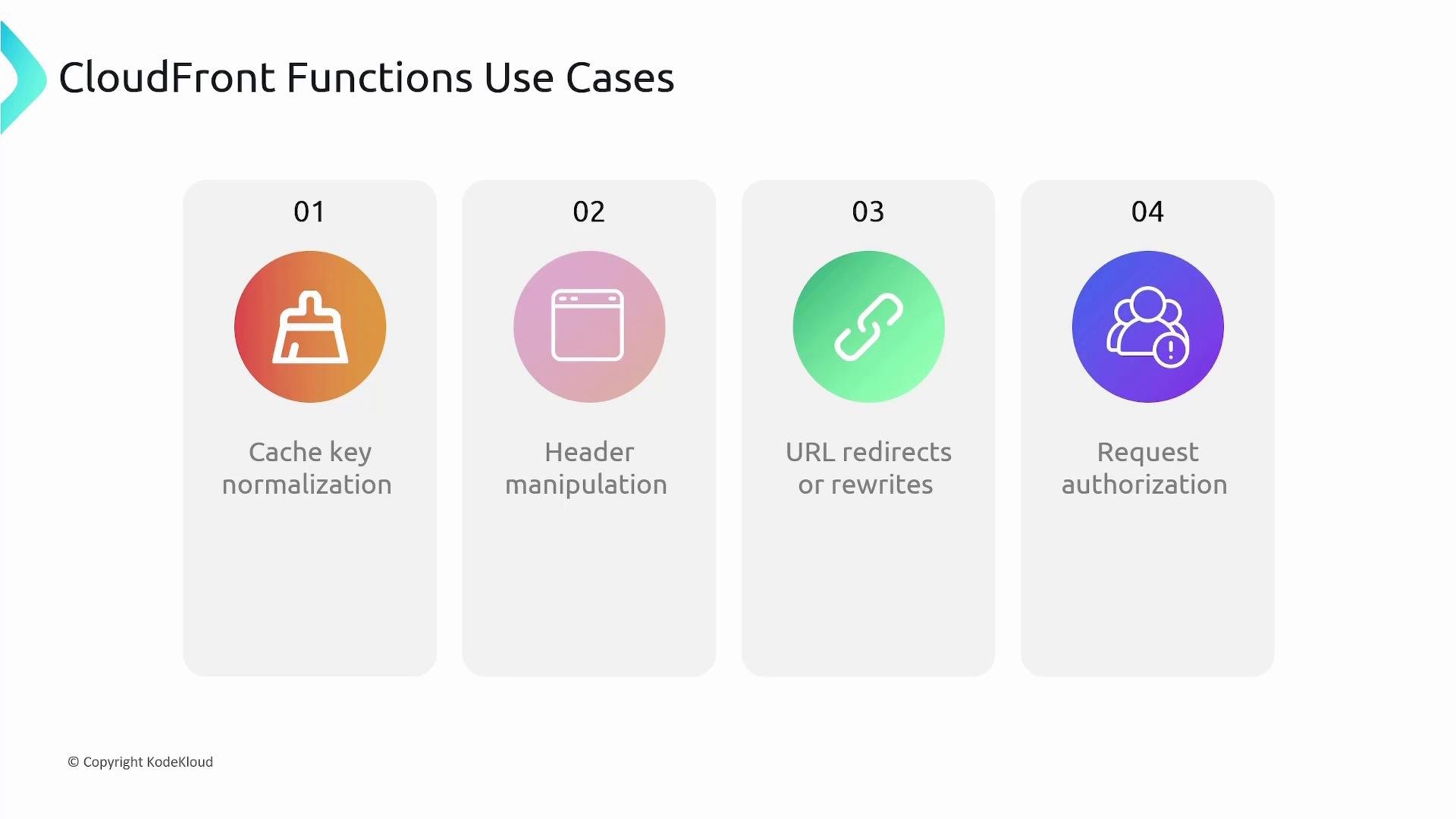
viewer-request and viewer-response events and are ideal for very short, latency-sensitive tasks. Lambda@Edge can run at viewer-* and origin-* events, enabling more complex workflows that require additional compute, libraries, or external calls.- Cache key normalization — rewrite or normalize request attributes to improve cache hit rates.
- Header manipulation — insert, modify, or delete HTTP headers (for example, add
true-client-ip). - URL redirects and rewrites — implement redirects or rewrite URIs at the edge.
- Simple request validation or authorization — basic token/header checks that do not require network access.
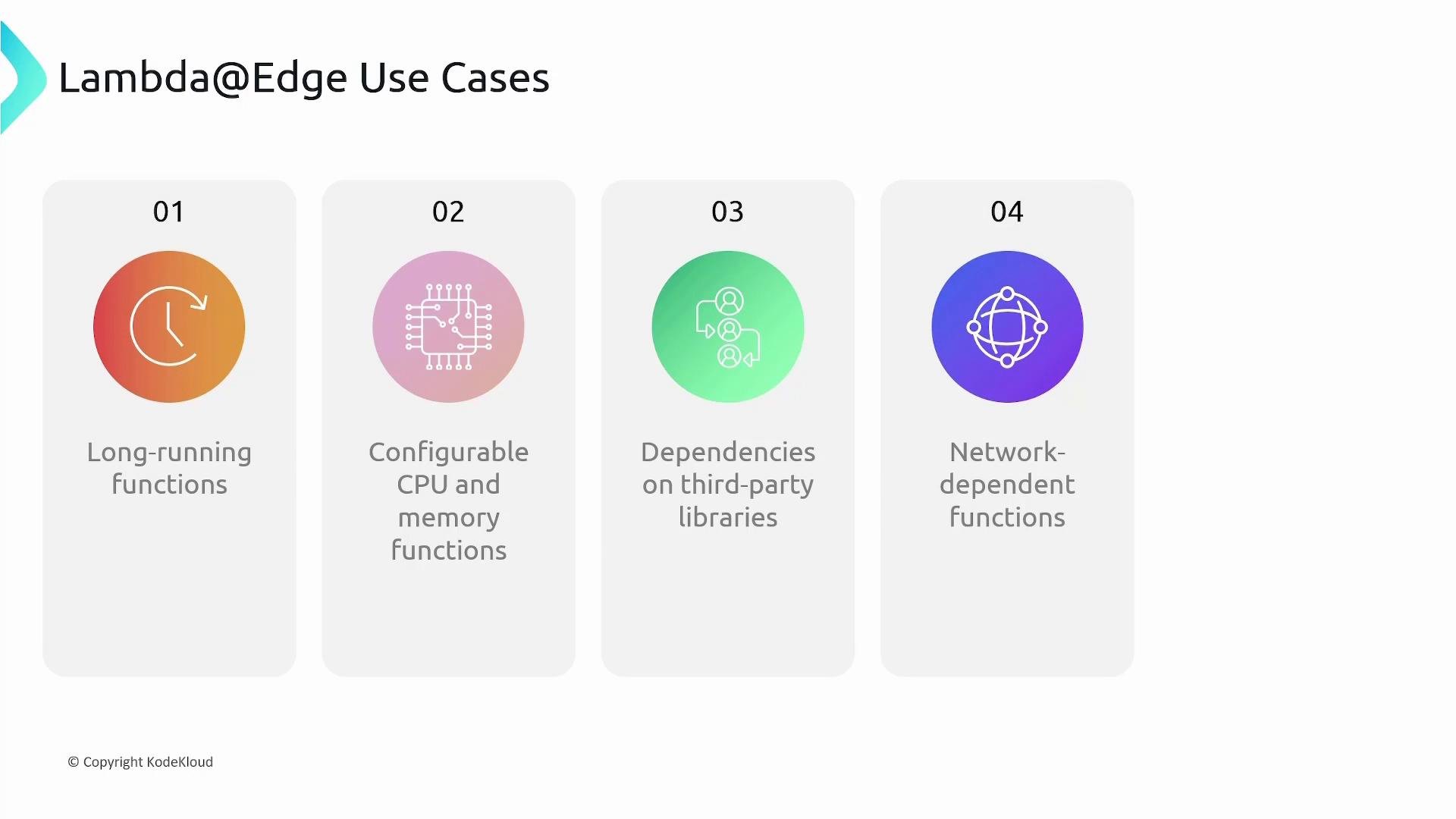
- Longer-running operations (tens to hundreds of milliseconds or more).
- Custom CPU/memory requirements or other Lambda configuration options.
- Use of third-party libraries or the AWS SDK to call other AWS services.
- Network access to external systems or downstream services.
- File system access (for example, limited
/tmpusage) or handling of request bodies for supported events.
Best practices and considerations
- Prefer CloudFront Functions for tiny, stateless tasks executed at viewer events to minimize cost and latency.
- Use Lambda@Edge when you need runtime flexibility, libraries, or origin-side processing (origin-request/origin-response).
- Carefully consider cold-start and concurrency characteristics for Lambda@Edge functions — test under realistic traffic patterns.
- Keep edge logic minimal and maintainable to avoid complexity spread across many edge functions.
Remember: CloudFront Functions cannot make outbound network calls and have a restricted, small runtime environment. If your logic requires external API calls or third-party libraries, use Lambda@Edge.
- Both CloudFront Functions and Lambda@Edge let you execute code at CloudFront edge locations to manipulate requests/responses and reduce origin traffic.
- Use CloudFront Functions for ultra-low-latency, short-lived tasks (header manipulation, cache-key normalization, redirects, simple validation).
- Use Lambda@Edge for longer-running, dependency-rich, or networked tasks and when you need processing at origin request/response events.