

- Amazon Augmented AI (A2I) is an AWS service that inserts human review into ML inference pipelines. It makes it easy to route low-confidence predictions to people for verification or correction before the result is acted on or stored.
- Use A2I when your model’s automated output falls below a confidence threshold and you require human validation to ensure correctness, compliance, or safety.
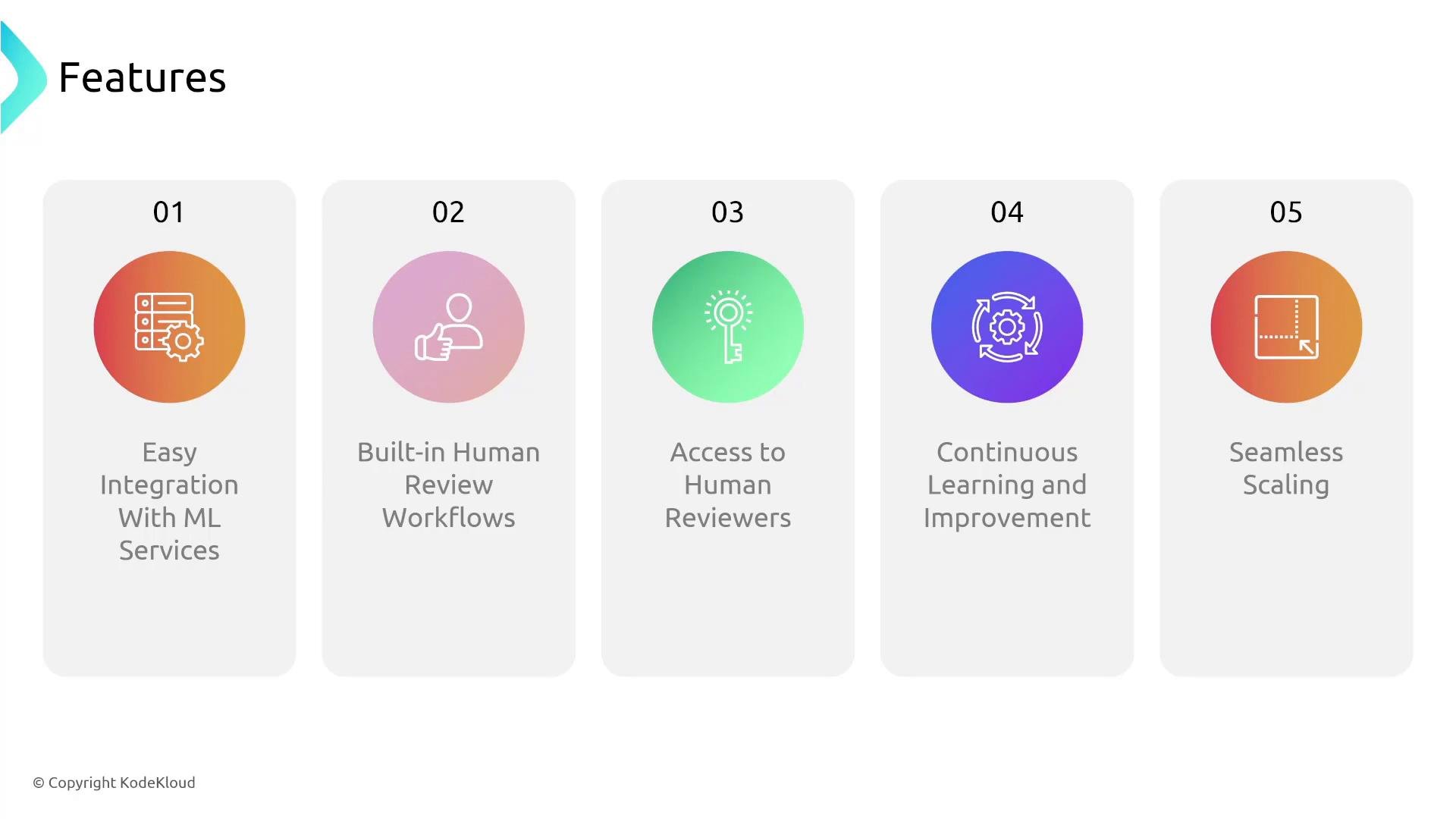
- Automatically route low-confidence predictions to human reviewers to improve the accuracy and reliability of decisions.
- Feed human corrections back into training data to reduce future errors and improve model performance.
- Use built-in review templates (for content moderation, text extraction, classification, etc.) or create custom workflows without managing large amounts of infrastructure.
- Choose reviewer pools that fit your needs: your internal workforce, third-party vendors, or Amazon Mechanical Turk for scalable crowd-sourcing.
- Capacity planning: if you use internal reviewers, estimate headcount, shifts, and SLAs to meet latency and throughput targets.
- Scalability: using Mechanical Turk or vetted third-party vendors can scale quickly; A2I handles task distribution.
- Data handling: store human-reviewed and high-confidence automated outputs in Amazon S3 for downstream processing, auditing, or model retraining.
Design your end-to-end flow so that reviewed results include metadata (reviewer ID, timestamp, confidence scores, and version of the model) to support auditing and continuous improvement.
When reviewers process sensitive or personally identifiable information (PII), enforce least-privilege access, enable encryption, use VPC endpoints where possible, and implement strict S3 lifecycle/retention rules. Audit logs and IAM policies are critical to reduce exposure and meet compliance requirements.
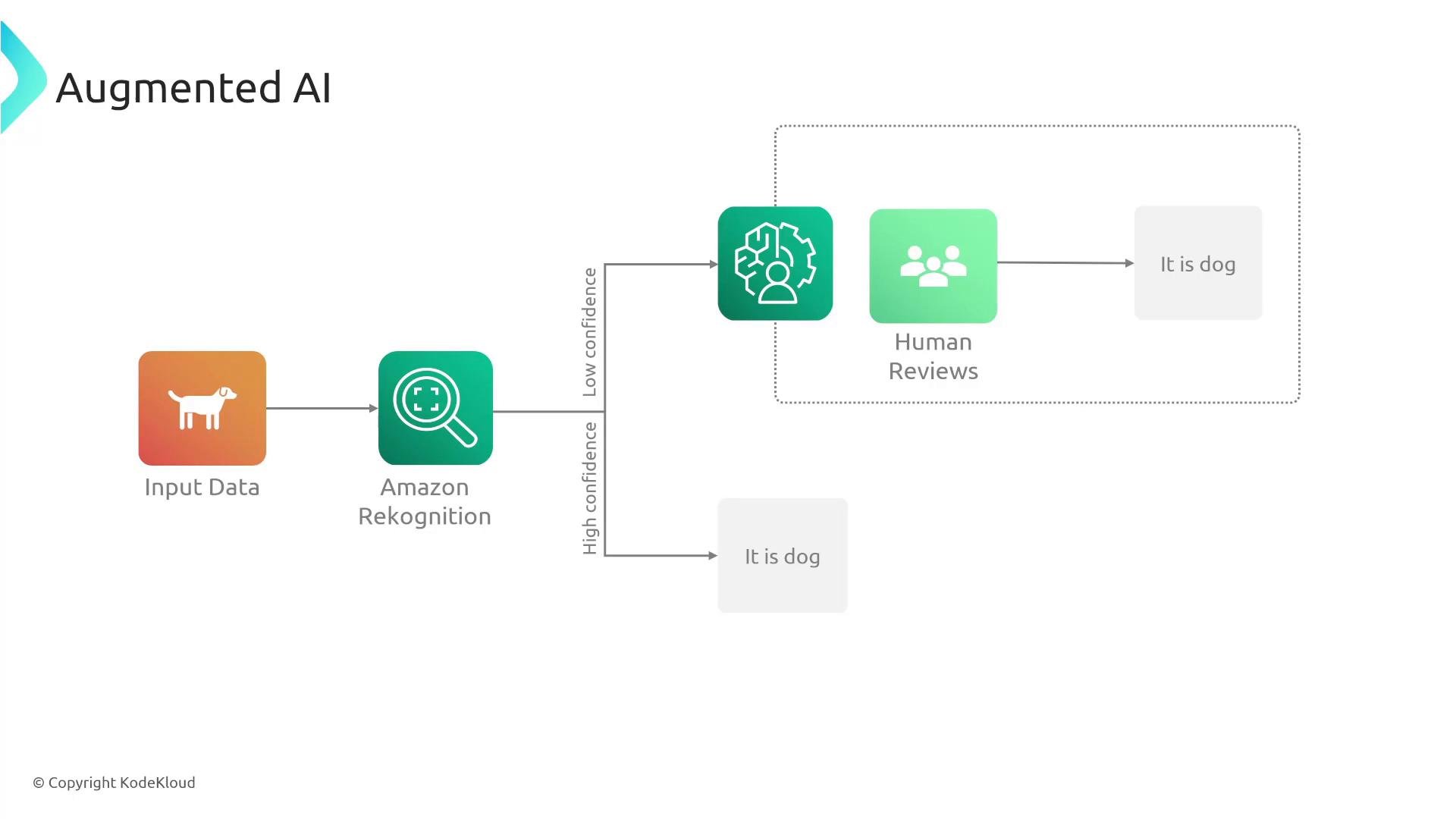
- Image recognition (Amazon Rekognition) example
- A vision model analyzes an input image and returns a predicted label with a confidence score.
- If the score is above the configured threshold, the system accepts the prediction automatically.
- If the score falls below the threshold, A2I routes the item to human reviewers who confirm or correct the label; the final label is returned to the pipeline and can be persisted for retraining.
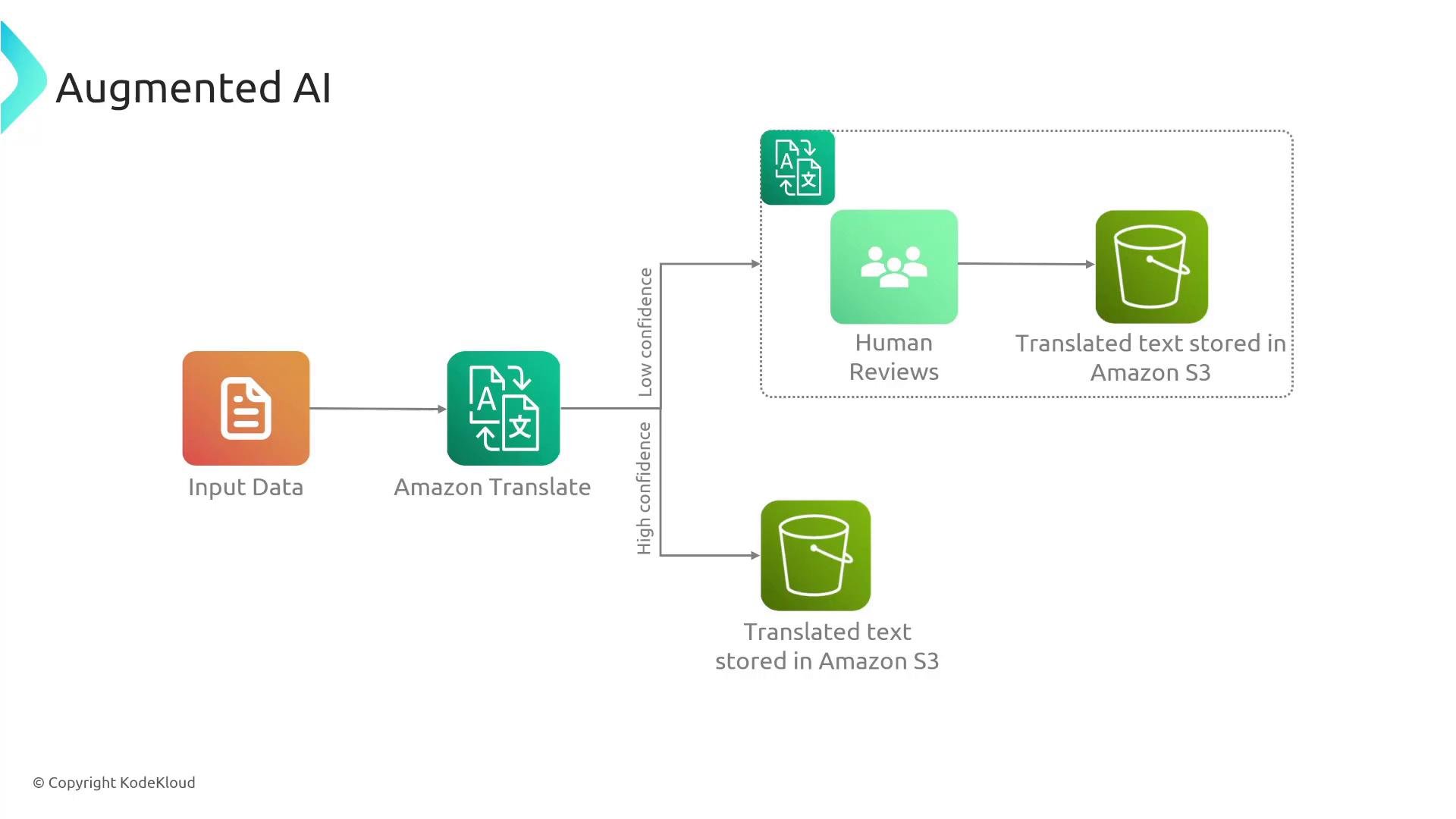
- Translation (Amazon Translate) example
- Machine translation performs an initial pass and assigns confidence or quality scores.
- A2I routes ambiguous or low-confidence translations to human linguists for a nuanced or domain-specific translation.
- Both human-reviewed and high-confidence automated translations are stored (for example in S3) for downstream use or evaluation.
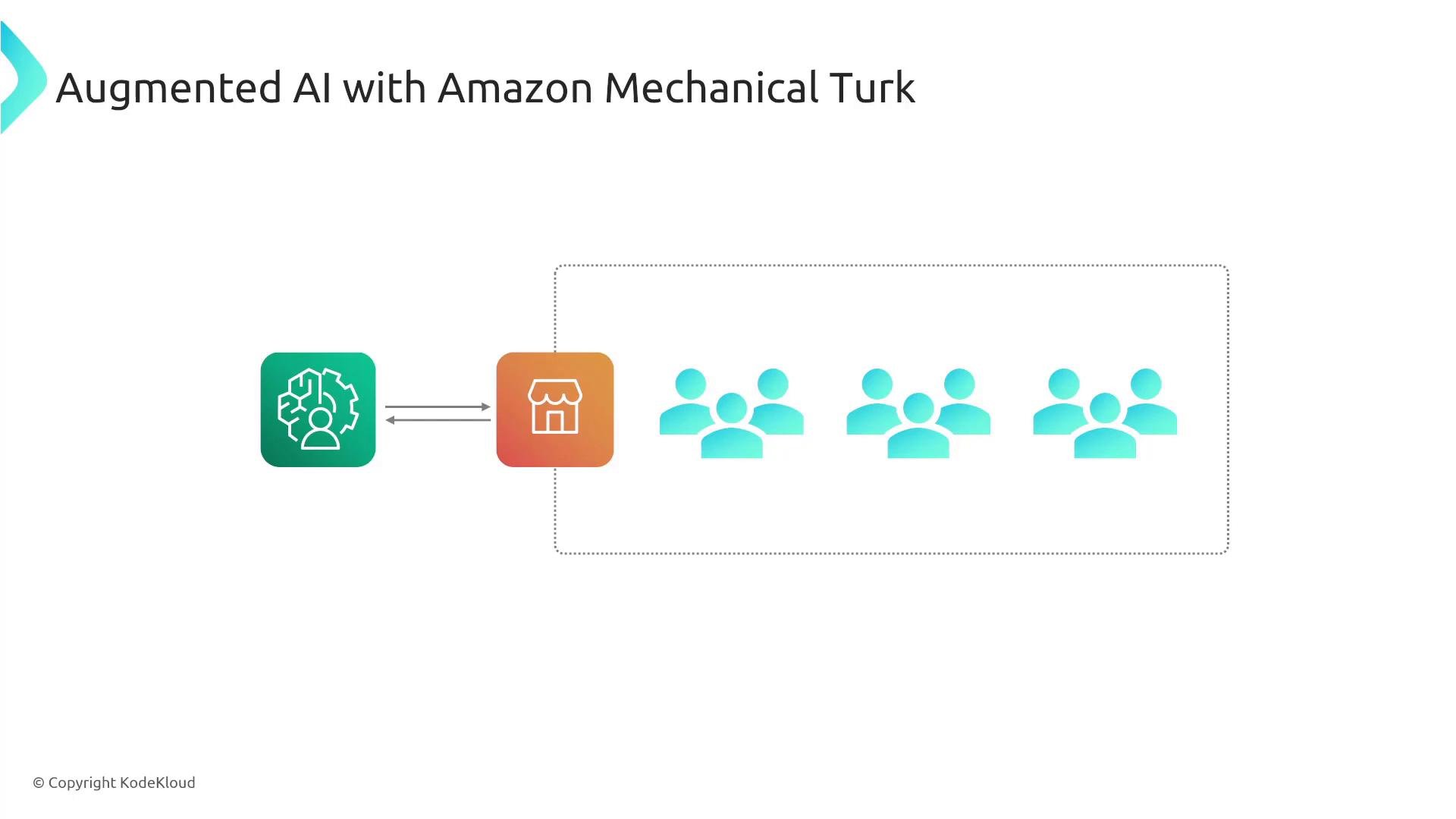
- Using Amazon Mechanical Turk for scaling human reviews
- When you need crowd-sourced reviewers, A2I can create HITs (Human Intelligence Tasks) on Amazon Mechanical Turk.
- Results from Mechanical Turk are returned to A2I, which validates and forwards them into your application pipeline or storage layer.
- Define a human review workflow in A2I: create UI templates, question types, and expected responses.
- Set the confidence threshold that triggers routing to human review (for example,
0.7for labels). - Select worker type: internal workforce, vetted third-party vendor, or Mechanical Turk for scale.
- Persist results and metadata to S3 and/or a database; use reviewed examples to retrain or fine-tune models.
Best practices
- Log reviewer decisions, timestamps, and reviewer IDs to support audits and traceability.
- Keep model versioning metadata with each prediction so you can track performance improvements after retraining.
- Aggregate human corrections into a labeled dataset for periodic re-training or active learning cycles.
- Use A2I when human-in-the-loop validation is required to increase trust, correctness, or compliance for model outputs.
- A2I integrates with common AWS ML services, supports configurable review workflows, allows flexible reviewer pools, and scales to match task volume.
- Persist reviewed outputs and metadata so you can measure impact and improve models over time.
- Amazon Augmented AI documentation
- Amazon Rekognition
- Amazon Textract
- Amazon Translate
- Amazon Mechanical Turk
- Amazon S3