

Why Step Functions?
Consider a typical e-commerce order flow — from order placement to fulfillment and delivery. A simplified workflow includes:- Order placement (trigger)
- Payment processing
- Inventory check
- Shipping label generation
- Customer notification (email/SMS)
- Shipping initiation (dispatch)
- Marking the order as completed
- Long-running processes — Lambda has a 15-minute runtime limit.
- Passing distributed state and JSON payloads between services.
- Implementing consistent retry/backoff/error-handling across tasks.
- Visualizing and maintaining complex flows as the application evolves.
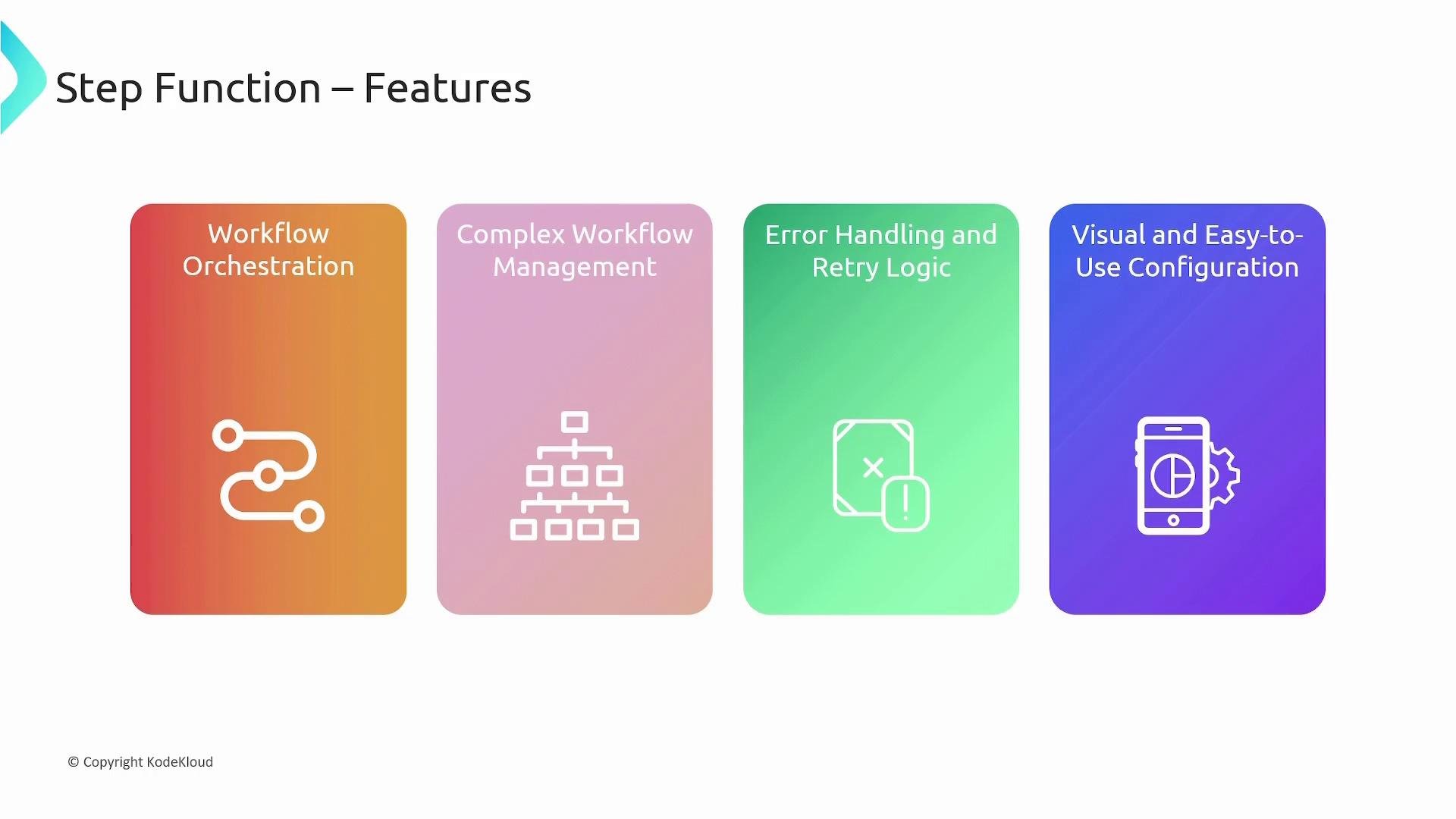
How Step Functions help
- Workflow orchestration: Define ordered steps and JSON data flow between them. Steps (Task states) can invoke Lambda, ECS/EKS/Fargate tasks, API Gateway, DynamoDB, SNS/SQS, Batch, SageMaker, and more.
- Managed state: Step Functions persist execution state and pass JSON between states so orchestration logic stays out of application code.
- Visual editor: Use the console’s visual editor to design and inspect state machines, making workflows easier to reason about.
- Error handling & retries: Configure per-state retry/catch semantics, backoff strategies, and error pattern matching.
- Parallelization: Use Parallel to run branches concurrently; Map to iterate over collections.
- Monitoring: Execution history, CloudWatch logs/metrics, and step-level output let you debug and track workflows.
Step Functions come in two main flavors: Standard Workflows — durable, long-running executions (up to one year) — and Express Workflows — low-cost, high-throughput, short-lived executions. Choose based on execution duration, throughput, latency, and cost.
Example: e-commerce order processing implemented with Step Functions
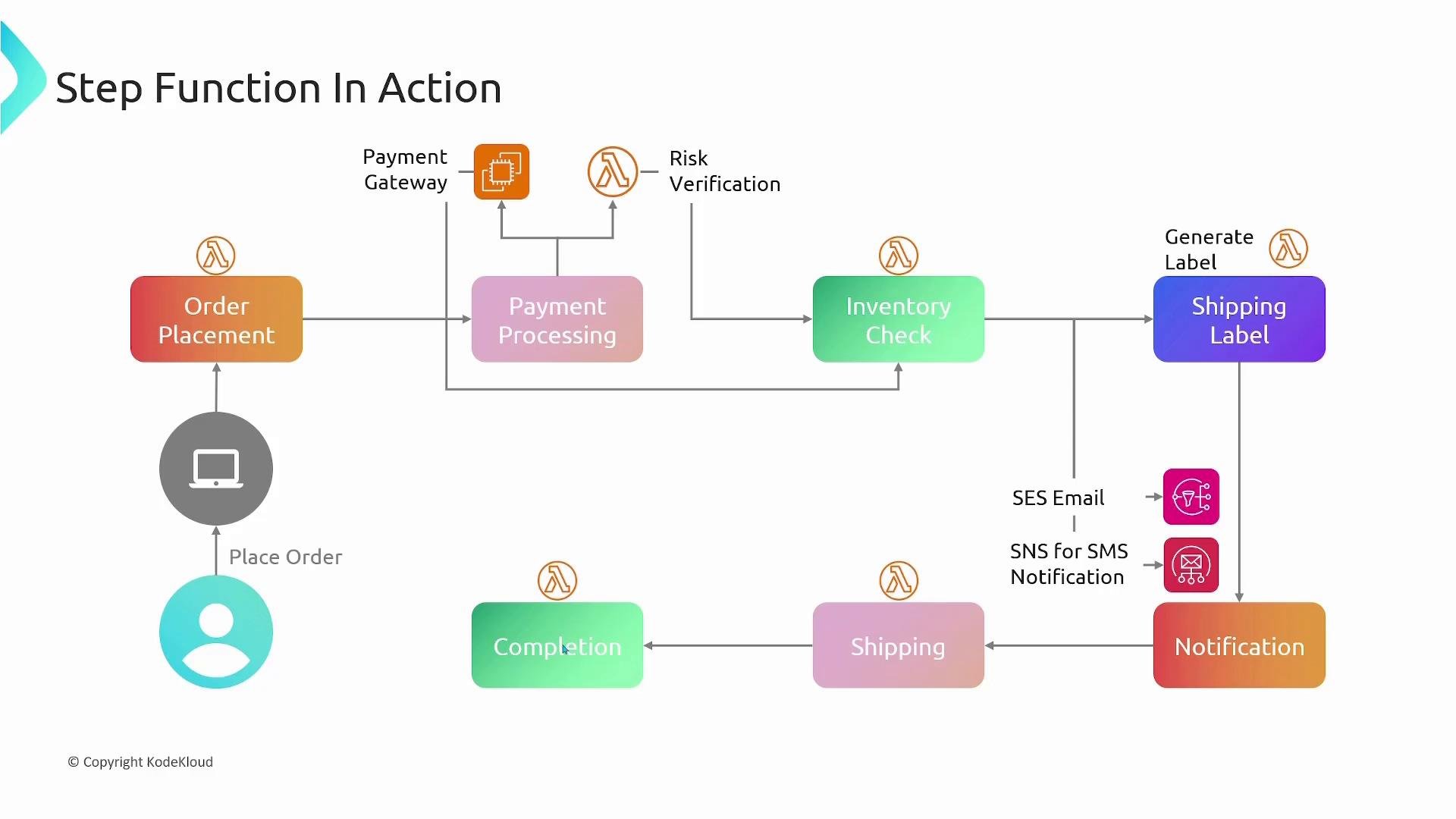
Below is a typical state-machine orchestration for order processing. The sequence follows the original business flow while showing where Parallel and Task states are useful.- Order placement triggers the state machine (via API Gateway, EventBridge, SQS, or Lambda).
- Start a Payment Processing step (Task). This may call an EC2-hosted gateway, a payment API via API Gateway, or a Lambda.
- Payment and fraud detection are independent: run them concurrently with a Parallel state:
- Branch A: Payment processing task
- Branch B: Fraud/risk detection (Lambda)
- After both branches succeed, proceed to Inventory Check (Task). If inventory is available:
- Generate shipping label (Task).
- Notify the customer via SES (email) and SNS (SMS) — these can run in parallel.
- Initiate the shipping process (Task or external API call).
- When shipping is initiated and tracking info exists, mark the order completed (Succeed/Task state).
Minimal ASL example (Parallel + Task flow)
The following ASL snippet demonstrates a Parallel state that runs Payment and Fraud checks concurrently, then continues to an Inventory Check and a final Success state.Step Function states and common patterns
Use these patterns to design robust, understandable state machines.
Practical benefits and integrations
- Simplified application code: Each component focuses on its own job; the state machine coordinates sequencing and data flow.
- Resilience: Configure retries, backoff, and catches so transient failures are handled automatically.
- Parallelism and scaling: Parallel and Map states let you scale work concurrently and process large collections.
- Wide integrations: Step Functions integrate natively with many AWS services (compute, databases, messaging, ML), and can call external APIs via API Gateway or service integrations.
- Observability: Console execution history, CloudWatch Logs and Metrics, and step-level outputs make it straightforward to debug and monitor workflows.
Quick tips
- Keep tasks single-purpose — smaller tasks are easier to test, reuse, and retry.
- Use Choice states to keep flows clear; avoid embedding complex branching into Task code.
- Choose Standard vs Express based on duration, expected throughput, and cost.
- Add CloudWatch Logs and X-Ray for deeper observability into complex workflows.
Summary
AWS Step Functions provide a managed, visual, and code-driven way to coordinate distributed components into durable workflows. By moving orchestration into a state machine, you get:- Clearer architecture and separation of concerns
- Built-in error handling and retries
- Easy parallelism and collection processing
- Better observability and maintainability
Links and references
- Amazon States Language (ASL) — https://docs.aws.amazon.com/step-functions/latest/dg/concepts-amazon-states-language.html
- AWS Step Functions documentation — https://docs.aws.amazon.com/step-functions/
- AWS Lambda — https://learn.kodekloud.com/user/courses/aws-lambda
- Amazon ECS — https://learn.kodekloud.com/user/courses/amazon-elastic-container-service-aws-ecs
- Amazon EC2 — https://learn.kodekloud.com/user/courses/amazon-elastic-compute-cloud-ec2
- Amazon SageMaker — https://learn.kodekloud.com/user/courses/aws-sagemaker
- Amazon CloudWatch — https://learn.kodekloud.com/user/courses/aws-cloudwatch