

Why use a graph database?
Graph databases model relationships as first-class citizens. They shine when your data is highly connected and you need to traverse or analyze relationships quickly. Think of an investigation board where photos, documents, and people are connected with lines — those lines (relationships) are as important as the items themselves. Graph databases let you represent and query those links directly and efficiently, avoiding complex JOINs or multiple lookups common in relational models. Keywords: graph database, connected data, relationship traversal, graph queriesWhat is Amazon Neptune?
Amazon Neptune is a fully managed graph database service on AWS designed for storing and querying highly connected datasets with low-latency, high-throughput graph queries. Neptune provides:- Managed operations: automatic backups, patching, and maintenance.
- Security: VPC, IAM integration, encryption at rest and in transit.
- Scalability: independent storage scaling and options for read replicas or serverless compute.
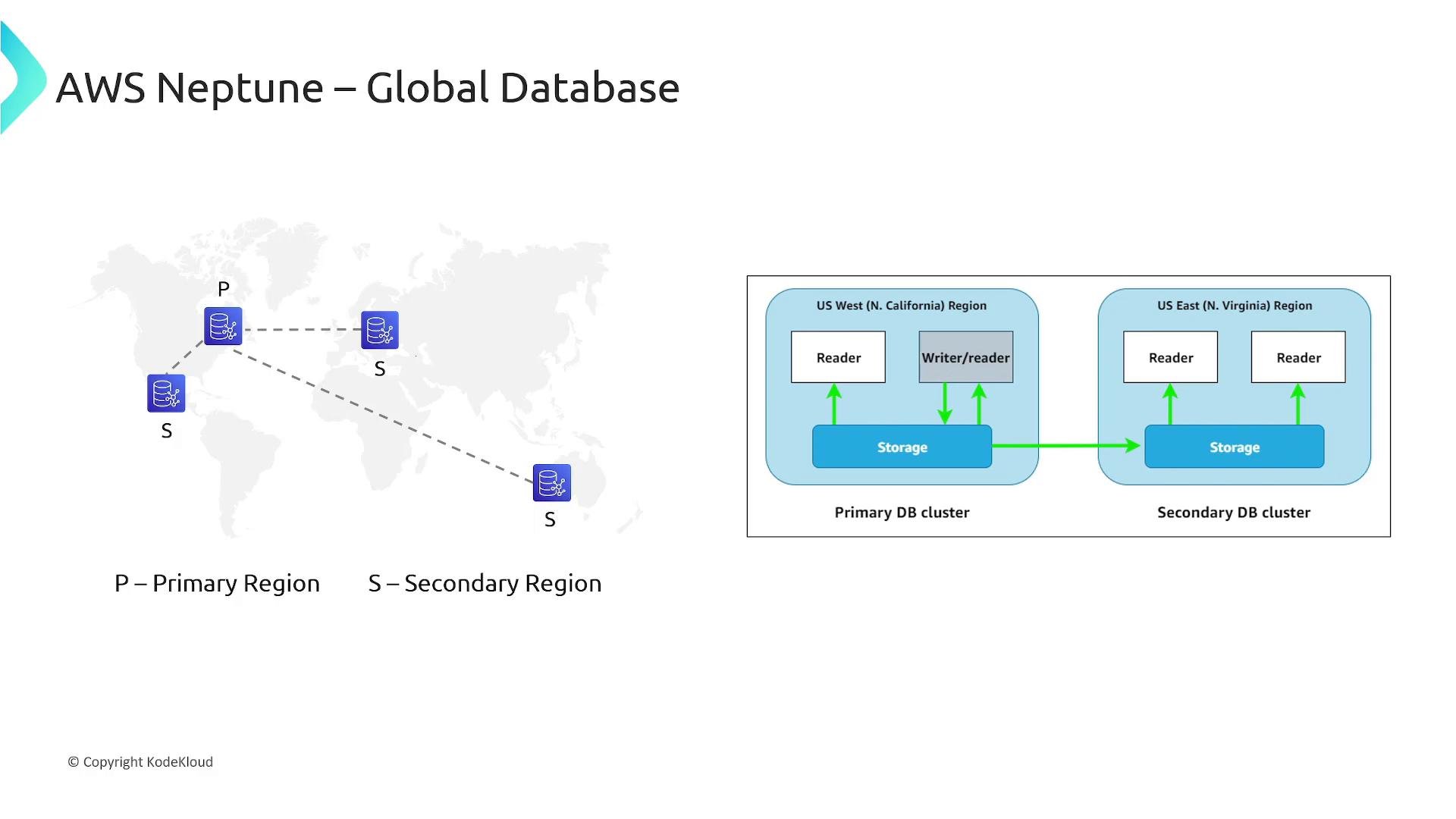
- Global resilience: Neptune Global Database for cross-Region read replicas and fast, regional reads.
Neptune Serverless
Neptune Serverless automatically scales compute capacity to match your workload and bills you for resources used, making it ideal for variable or unpredictable graph workloads. Storage scales independently, and you don’t need to manage instance sizes or read replica provisioning. For consistent, high-throughput workloads, provisioned Neptune clusters with read replicas provide predictable performance and low-latency reads. Keywords: serverless database, auto-scaling, pay-per-useNeptune ML (Graph ML with GNNs)
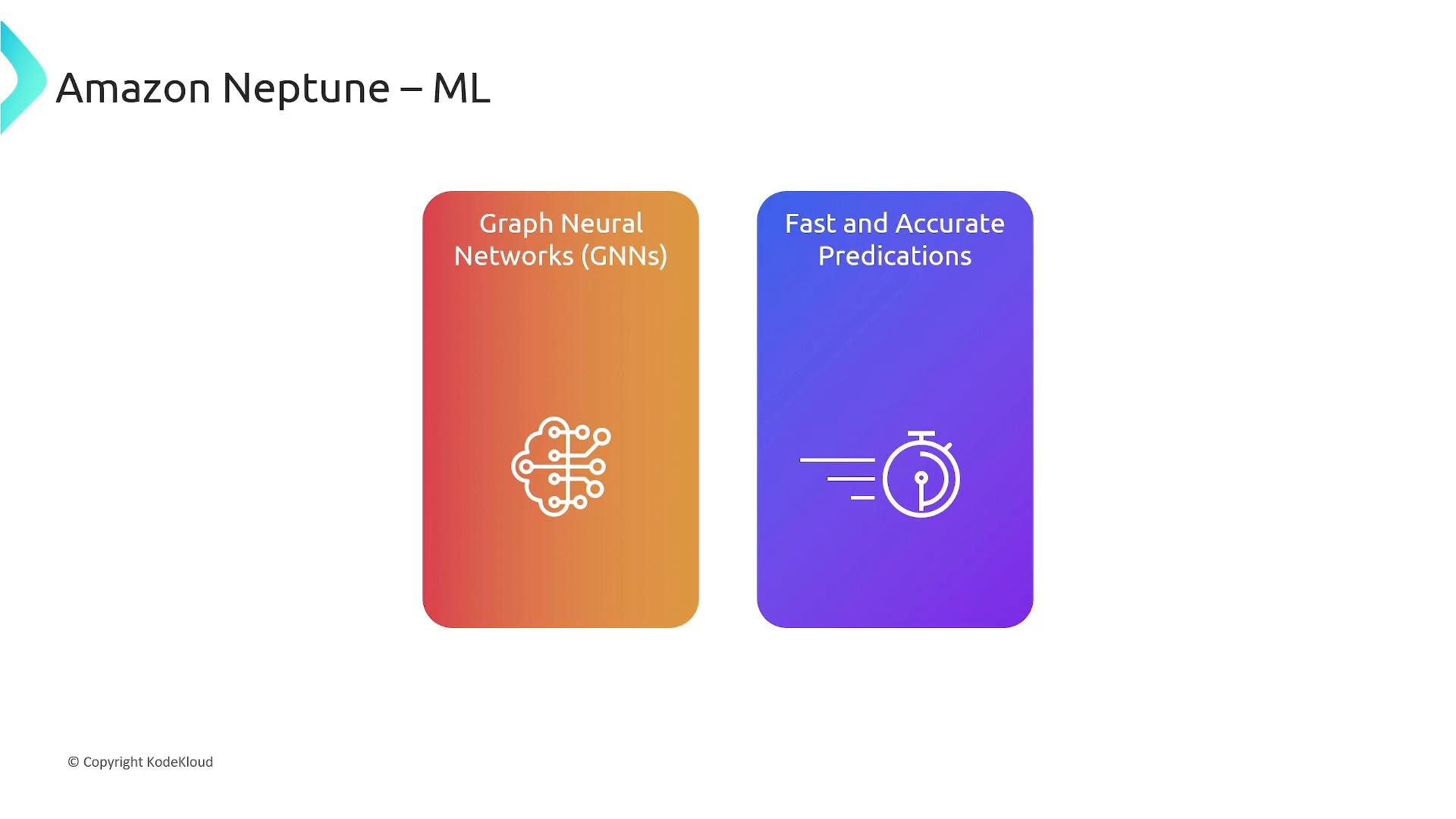
Neptune ML integrates graph machine learning into the Neptune stack by leveraging Graph Neural Networks (GNNs). It simplifies building, training, and deploying models for graph-specific tasks such as:- Node classification (e.g., user segmentation)
- Link prediction (e.g., recommendation or relationship prediction)
- Entity resolution (e.g., deduplicating records)
Key features and capabilities
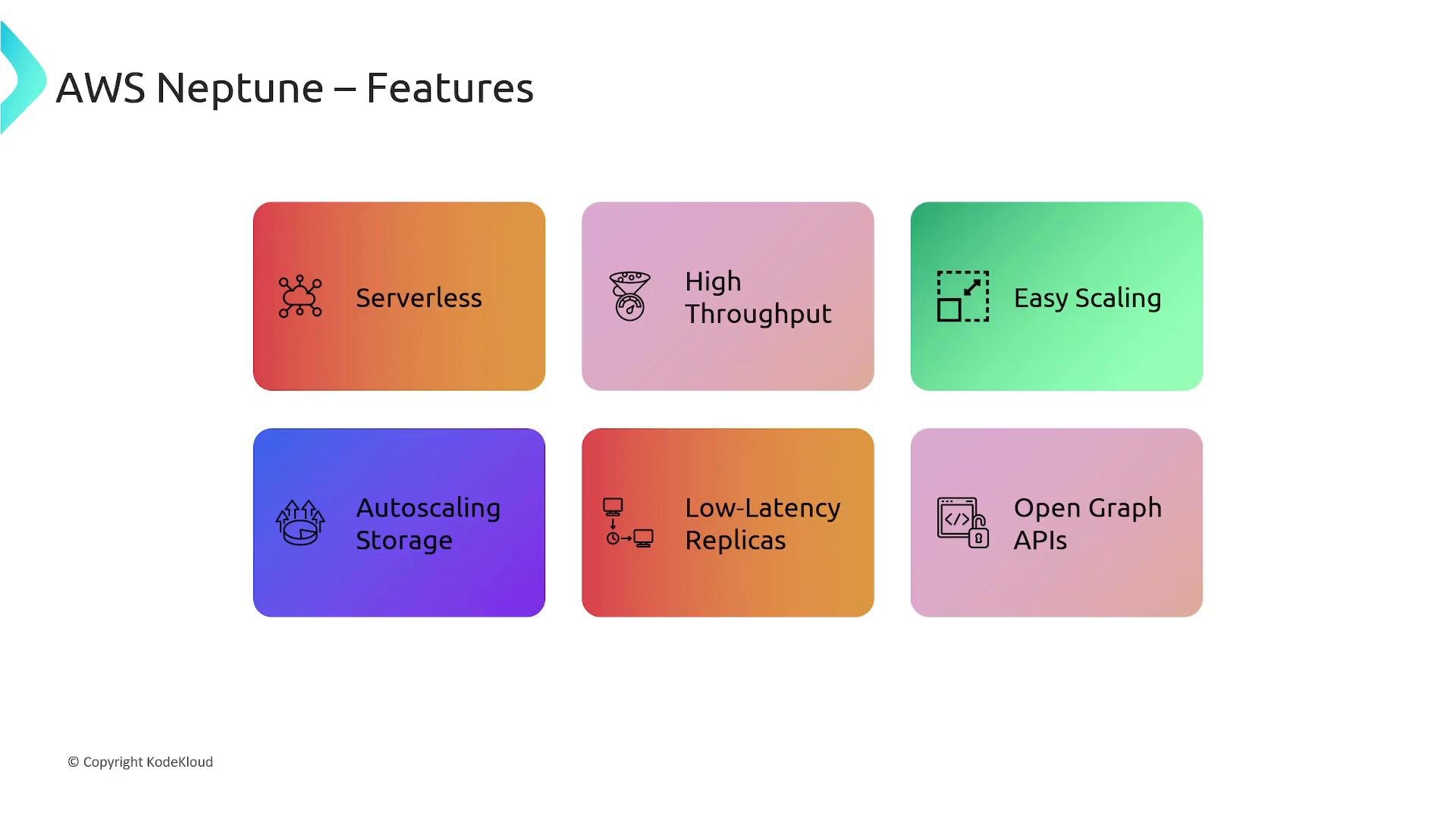
- Serverless option for on-demand compute scaling and pay-for-use billing.
- High throughput, low-latency graph queries with support for read replicas.
- Independent compute and storage scaling.
- Support for open graph APIs and standards.
- Integration with AWS services: AWS Glue, SageMaker, Lambda, Amazon Athena, Database Migration Service (DMS), and AWS Backup.
- Managed security, monitoring, and automated backups.
Neptune supports both major graph models: the Property Graph (queried via Apache TinkerPop/Gremlin) and W3C RDF (queried via SPARQL). Choose the model and query language that best fits your application’s data model and ecosystem.
Choose your graph model early. Migrating between Property Graph and RDF can be complex and time-consuming. Match your query patterns and tooling needs (Gremlin vs SPARQL) before committing to a production design.
Common use cases
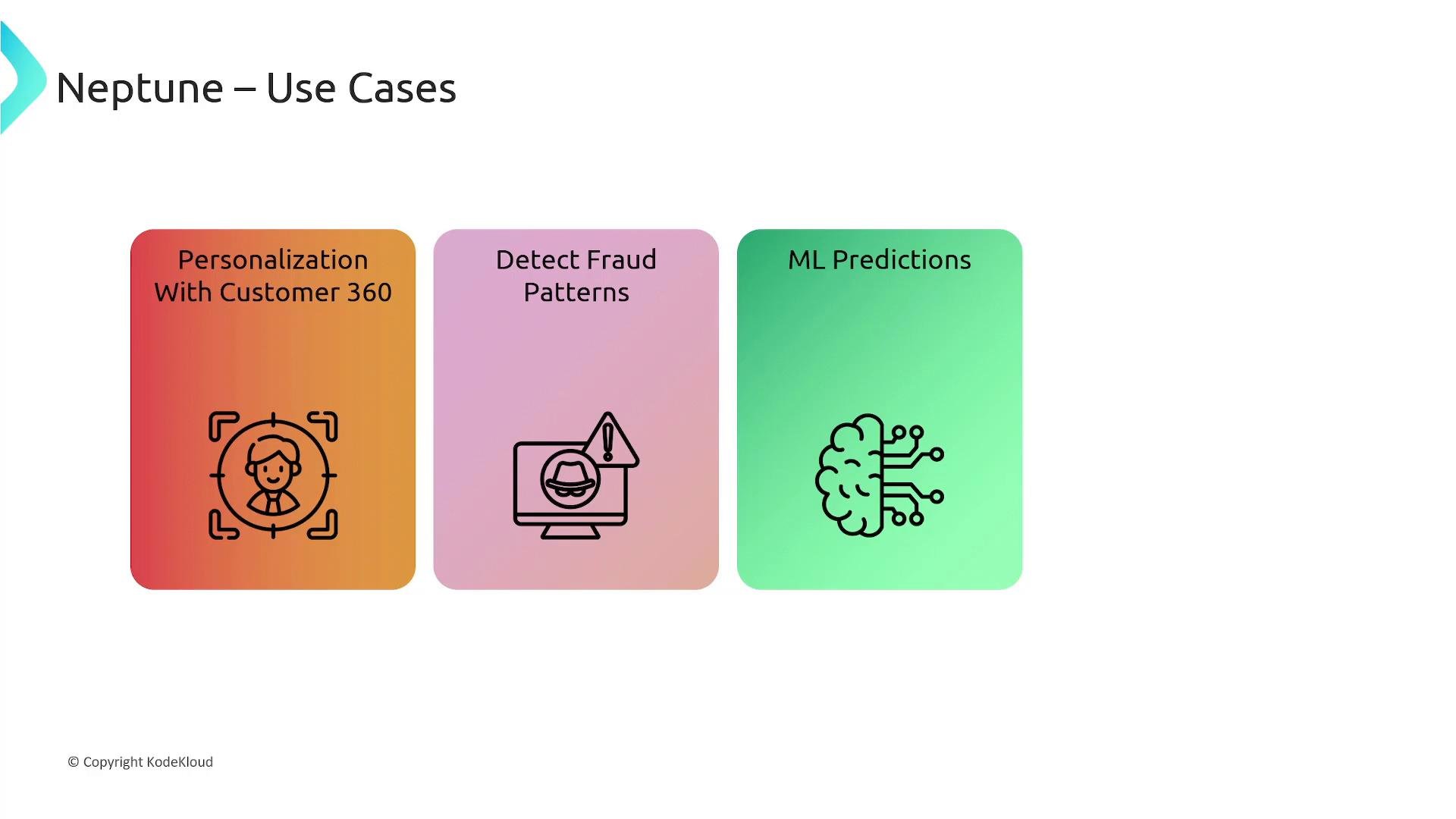
- Customer 360 and identity graphs for unified views, personalization, and targeted campaigns.
- Fraud detection by modeling and querying complex transactional and relationship patterns.
- Graph-based machine learning (Neptune ML) for improved predictive accuracy on graph-structured data.
- Investigations and knowledge graphs where relationship exploration and semantic queries drive value.
When to choose Neptune
Consider Neptune when relationships are central to your queries and analysis — for example, when you need graph traversal, pattern detection, or graph-aware ML at scale. Neptune is especially compelling when you need a managed service that integrates with the AWS ecosystem and offers production-ready features like Global Database replication and Neptune ML.Summary
Amazon Neptune is a fast, reliable, fully managed graph database service optimized for storing and querying highly connected data with millisecond latency. It supports both Property Graph and RDF models, provides serverless and provisioned deployment options, and includes Neptune ML for graph-native machine learning. Neptune is a strong choice for applications that rely on relationship traversal, pattern detection, and scalable graph-based ML.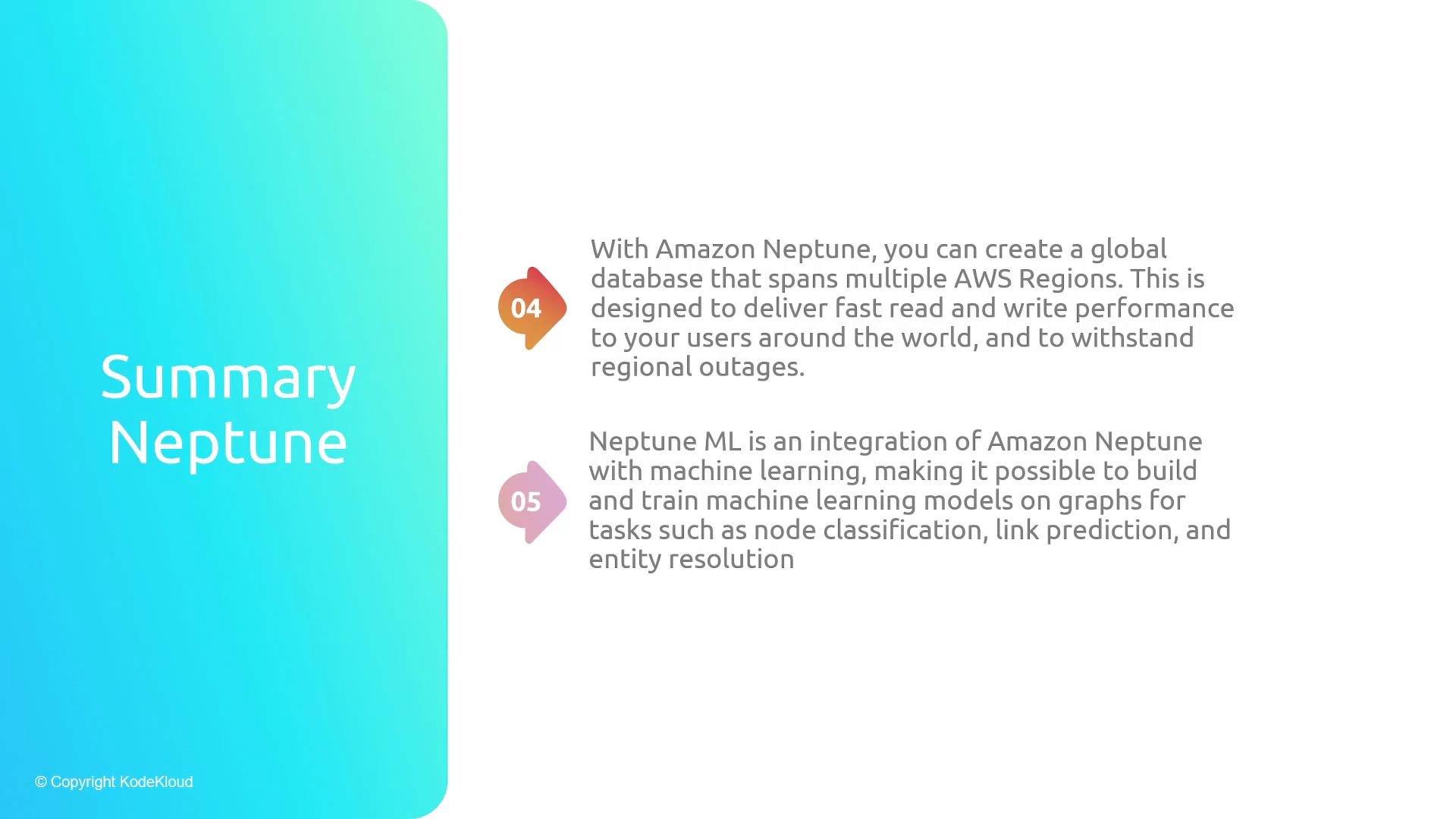
Links and references
- Amazon Neptune documentation: https://docs.aws.amazon.com/neptune/
- Neptune ML: https://docs.aws.amazon.com/neptune/latest/userguide/neptune-ml.html
- Graph Neural Networks overview: https://en.wikipedia.org/wiki/Graph_neural_network
- Apache TinkerPop (Gremlin): https://tinkerpop.apache.org/
- SPARQL (W3C RDF query language): https://www.w3.org/TR/rdf-sparql-query/