

- Assessing existing mainframe applications and dependencies.
- Updating or developing code in legacy languages such as COBOL or PL/I.
- Implementing automated CI/CD pipelines and managed runtime environments.
- Choosing a migration strategy—automated refactoring or replatforming—based on business and technical goals.
Refactoring
Refactoring transforms legacy mainframe artifacts so they run in modern cloud-native environments. This typically involves code and data conversion and often requires rewriting or adapting portions of the application so it integrates with modern platforms, frameworks, and toolchains. Highlights:- Automated transformation of business logic, data access, and interfaces into components suitable for modern runtimes.
- Opportunity to enable service-oriented or microservice-based architectures and modern developer workflows.
- Better long-term maintainability and ability to leverage modern CI/CD, containerization, and observability tools.
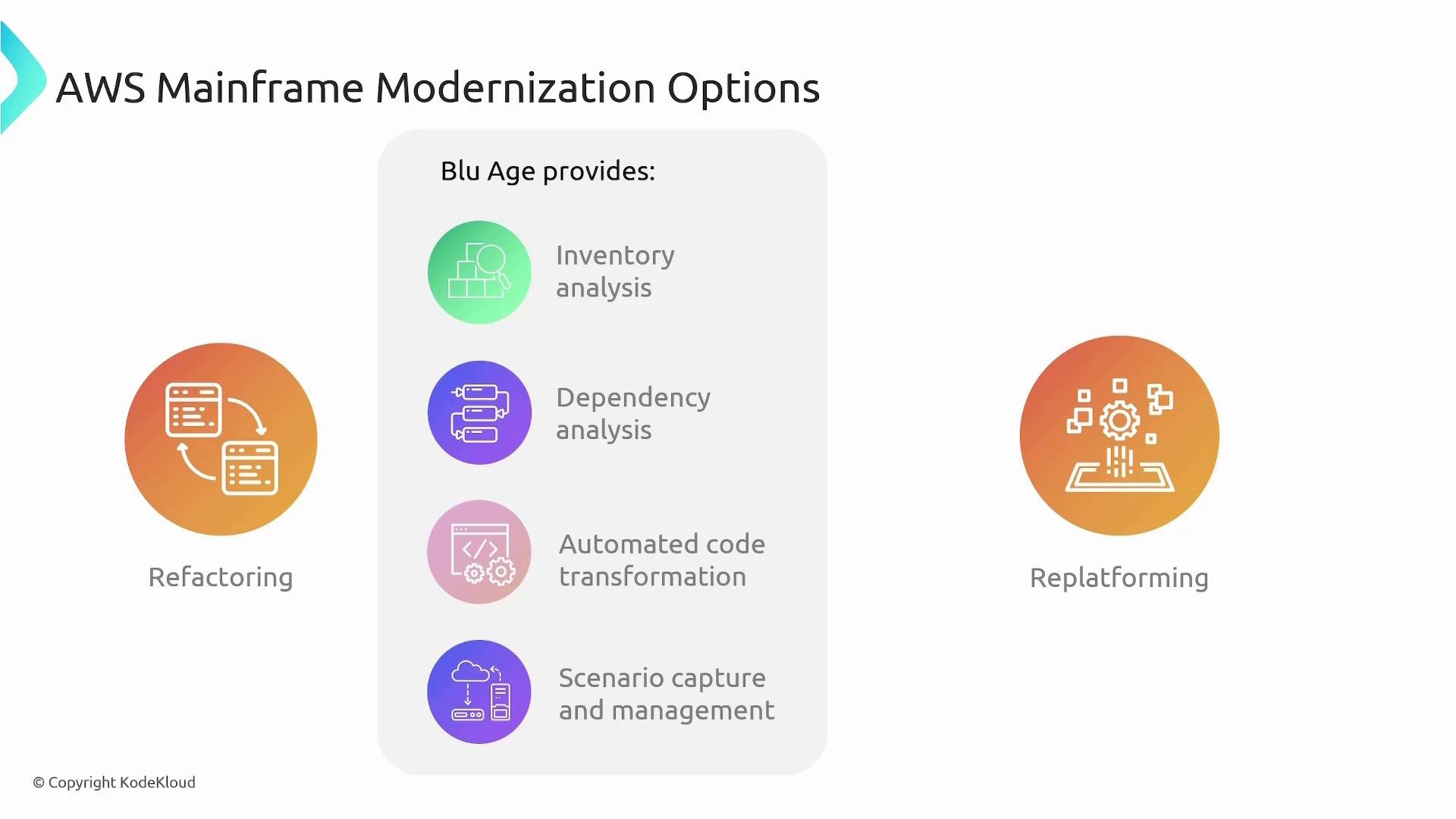
- Blu Age offers an end-to-end transformation workflow that helps convert COBOL/PL/I applications into modern application components.
-
Typical automated refactoring steps:
- Inventory analysis to discover application components and assets.
- Dependency analysis to map external and internal interactions.
- Automated transformation of source code and artifacts into target runtimes.
- Scenario capture and automated validation to ensure behavior matches expectations after transformation.
- External partner: Blu Age
Replatforming
Replatforming moves your mainframe application to a different host or runtime without changing the source code or business logic. It is essentially a lift-and-shift approach that gets workloads into the cloud quickly and with minimal code changes. When to choose replatforming:- Primary goal is fast migration with minimal code modification.
- Short-term cost and time constraints outweigh the need for architectural modernization.
- You plan to modernize incrementally after migrating to the cloud.
- Choose replatforming for quick migrations with minimal source-code changes.
- Choose refactoring to modernize the application stack, enable microservices or macroservices, and adopt modern developer tooling and deployment models.
Other features of AWS Mainframe Modernization
- Assess: The assessment capability discovers applications, maps dependencies, and estimates the scope and effort required for migration and modernization.
- Refactor (Blu Age): Automate conversion of legacy languages and architectures into modern components and access Blu Age insights directly from the AWS console.
- Replatform: Move applications to AWS without changing source code or recompiling when appropriate.
- Integrated development environment (IDE): On-demand IDEs allow developers to write, edit, debug, compile, and unit test code with smart editing and instant feedback.
- Managed runtime environment: AWS provides managed runtime clusters that monitor workloads with self-healing compute and automated scaling to keep enterprise workloads running.
- Built-in CI/CD: Integrated CI/CD capabilities enable more frequent and reliable code delivery, accelerating migration, increasing quality, and reducing operational risk.
Decision checklist
- Run an assessment first to discover code, data, and dependencies.
- Align migration strategy with your business timeline and modernization goals.
- Use replatforming if you need speed and minimal disruption.
- Use refactoring if you want long-term modernization, microservices adoption, and improved developer experience.
When planning a migration, run an assessment first to understand the effort, dependencies, and risks. Use replatforming for quick migrations and refactoring when you need long-term modernization and improved developer productivity.
Links and references
- AWS Mainframe Modernization: https://aws.amazon.com/migration/mainframe-modernization/
- Blu Age: https://www.blu-age.com/