

- Billing is separated per account, complicating cost visibility and payments.
- Administrative overhead rises: separate sign-ins, user management, and account setup.
- Security configuration must be applied per account, increasing the risk of inconsistent posture.
- Resource sharing is limited across accounts, which can cause duplication and higher costs.
Service Control Policies (SCPs)
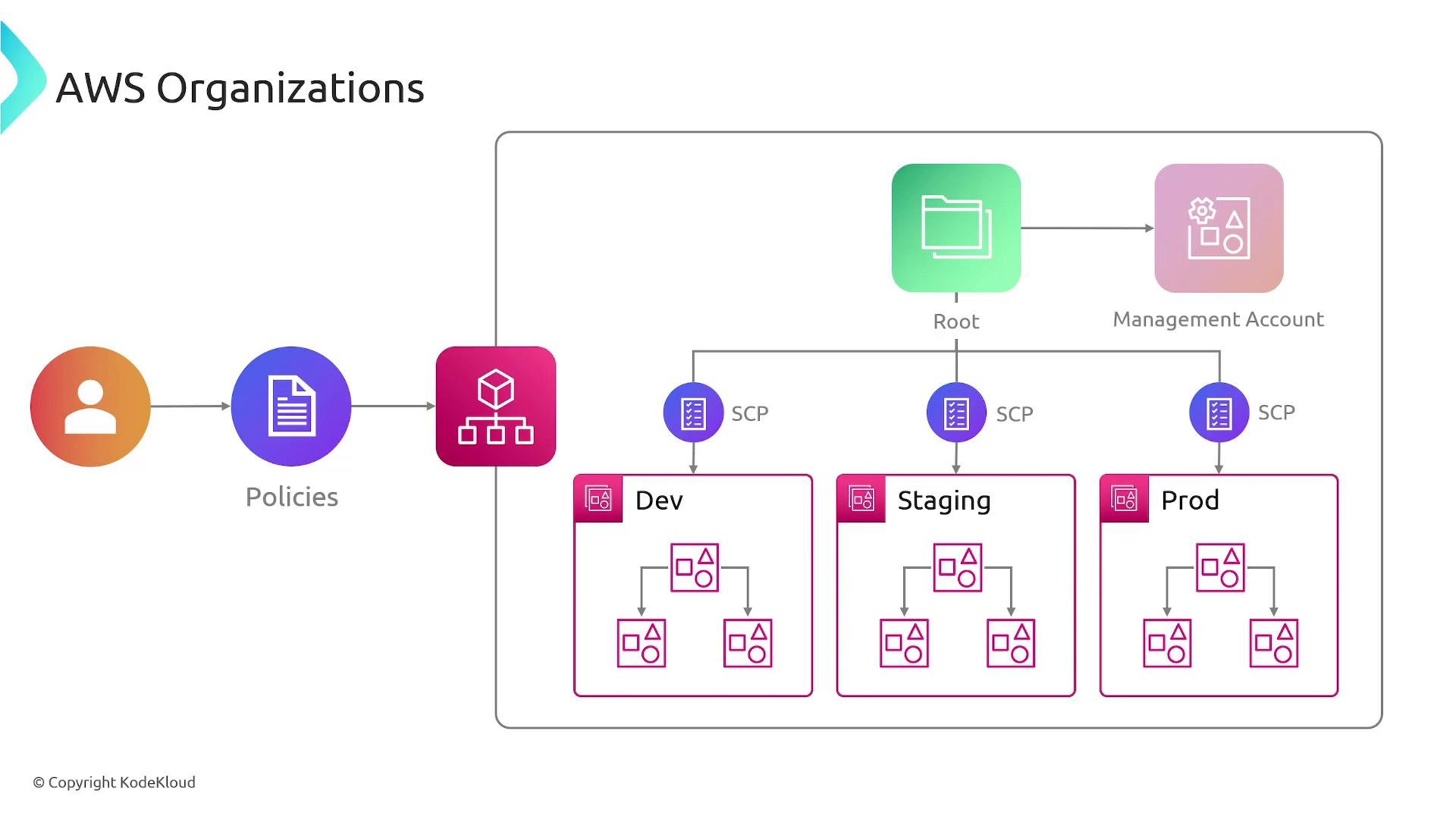
Service Control Policies are the primary mechanism for defining organization-level guardrails. SCPs define the maximum set of actions that accounts (and the principals inside them) are allowed to perform.
How SCPs work:
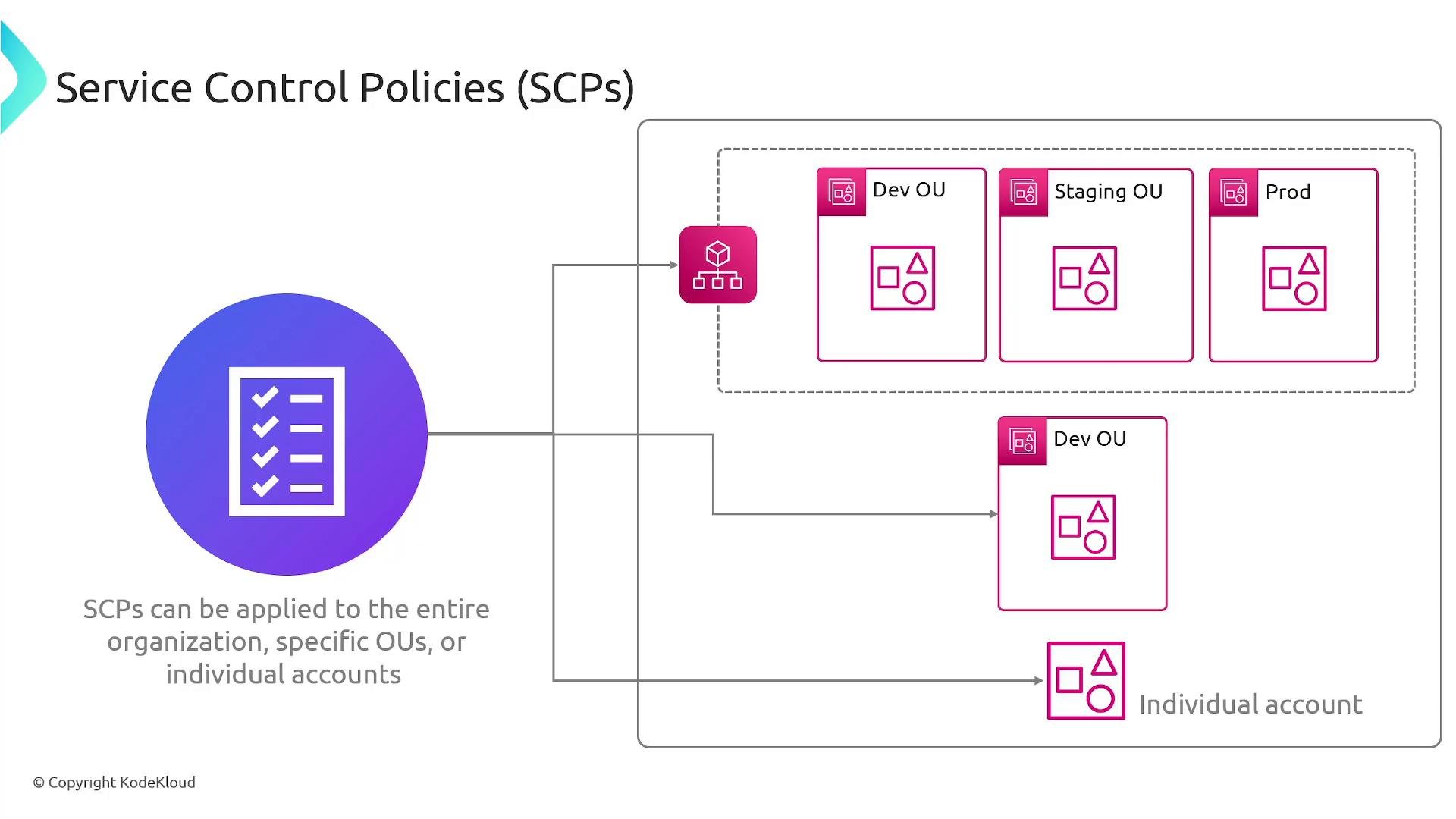
- SCPs are attached to the organization root, an OU, or an individual account.
- Policies applied at a higher level are inherited by child OUs and member accounts.
- SCPs set a permissions boundary: even if an IAM policy in an account permits an action, an SCP can block it. SCPs cannot grant permissions that IAM policies do not also grant.
- Prohibit high-cost services in non-production OUs.
- Restrict use of specific services in particular environments.
- Enforce cross-account security constraints consistently.
- Centralized account management: administer multiple accounts from one place rather than logging into each individually.
- Consolidated billing: aggregate usage across member accounts for a single payment point.
- Strong governance: apply SCPs at the root, OU, or account level to enforce organization-wide guardrails.
- Service integrations: AWS Organizations integrates with other AWS services to enable unified access, auditing, and cost control.
- IAM Identity Center (AWS Single Sign-On) for centralized user access and SSO: https://docs.aws.amazon.com/singlesignon/latest/userguide/what-is.html
- AWS CloudTrail for centralized auditing: https://docs.aws.amazon.com/awscloudtrail/latest/userguide/
- AWS Config for centralized configuration tracking: https://docs.aws.amazon.com/config/latest/developerguide/
- AWS Budgets and Cost Management for centralized cost control: https://docs.aws.amazon.com/cost-management/latest/userguide/budgets-managing-costs.html
SCP vs IAM: SCPs define the maximum allowed actions at the account level (a permissions boundary). IAM policies inside an account can further restrict what a principal may do, but IAM cannot override an SCP to grant additional permissions.
- AWS Organizations — Overview: https://docs.aws.amazon.com/organizations/latest/userguide/orgs_introduction.html
- Service Control Policies (SCPs): https://docs.aws.amazon.com/organizations/latest/userguide/orgs_manage_policies_scp.html
- IAM — Amazon Web Services Identity and Access Management: https://docs.aws.amazon.com/IAM/latest/UserGuide/introduction.html
- AWS CloudTrail: https://docs.aws.amazon.com/awscloudtrail/latest/userguide/
- AWS Config: https://docs.aws.amazon.com/config/latest/developerguide/
- IAM Identity Center (SSO): https://docs.aws.amazon.com/singlesignon/latest/userguide/what-is.html