

- General design principles for security
- The seven foundations of Security (aligned to the Well-Architected Framework)
- The shared responsibility model (what AWS manages vs. what you manage)
- Design patterns that increase security across nine major service areas
- A final Design for Security Design Challenge (applied exercise near the end)
A quick tip: take notes as you go — sketches and even messy notes help retention. Treat this as active learning: draw diagrams, label services, and write why each choice improves security.
Design principles and the seven foundations
Key design principles we’ll apply throughout this section:- Maintain traceability: document decisions, assumptions, and trade-offs so designs are auditable.
- Defense-in-depth: apply layered controls at network, host, application, and data layers.
- Automate security: use Infrastructure as Code, CI/CD gates, and continuous scanning to enforce standards.
- Least privilege: grant the minimum rights required and audit those privileges regularly.
- Observability and response: design for detection, alerts, and rapid automated or manual response.
Categories for security actions
We group security controls into four fundamental categories. Every control typically maps to one or more of these areas:
Use this table as a quick lookup when deciding where a control fits in a design or exam scenario.
Shared responsibility model
Understanding the shared responsibility model is critical: AWS manages the security of the cloud (hardware, global network, hypervisor, managed service infrastructure) while you manage security in the cloud (customer data, application configuration, identity, OS/network configuration, encryption). The boundary can shift depending on the service model (IaaS vs. managed services vs. SaaS).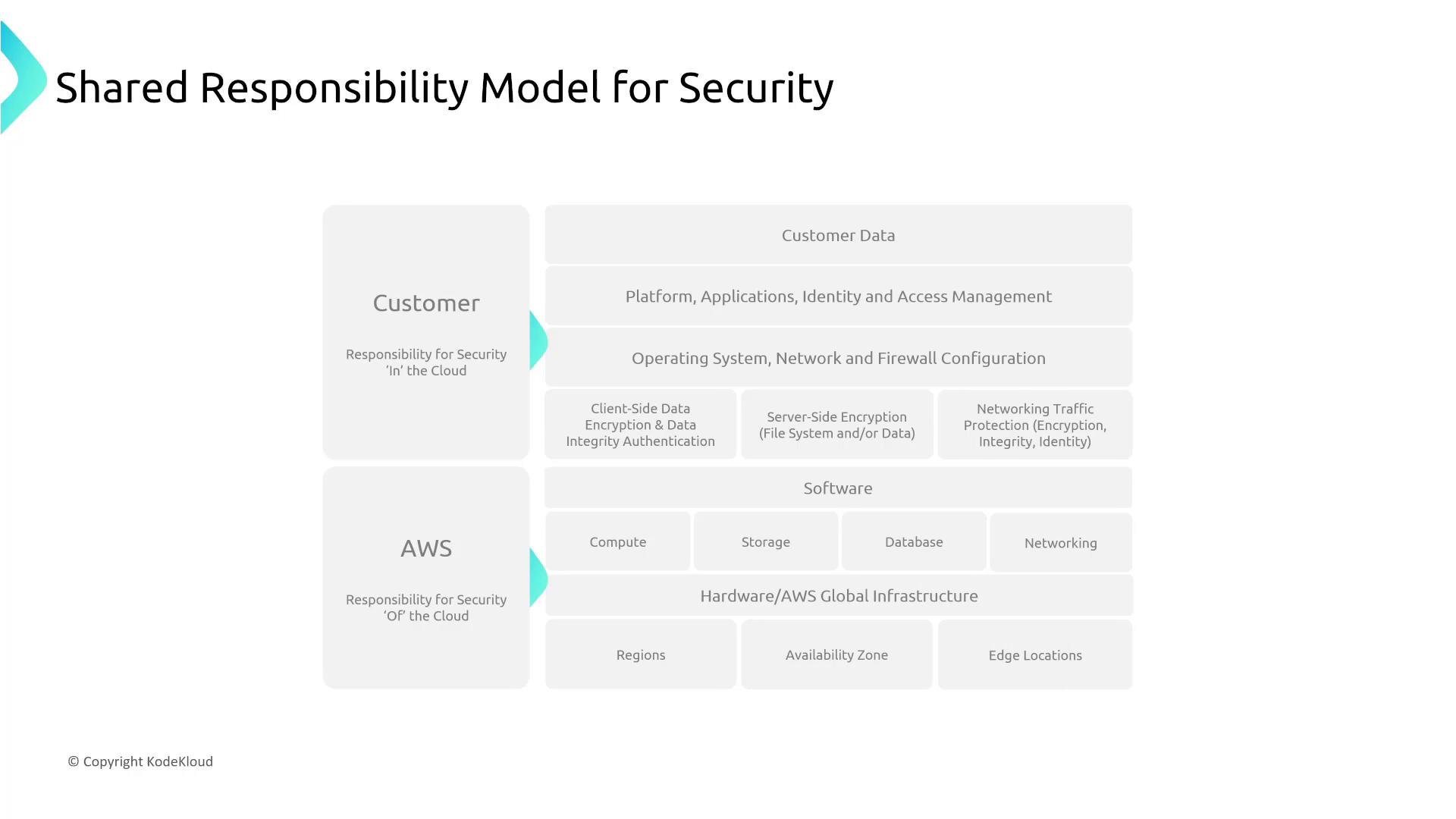
Turning up security on services
Sections 4 through 11 review exam-style security questions and show how to “turn up” security across major service categories: network, compute, storage, databases, application integration, management, and data/machine learning. For many fully managed services, AWS handles lower-level security controls, but you must still configure service-specific settings (encryption, access policies, VPC integration). For compute and network (for example, EC2 or VPC), explicit configuration is often required.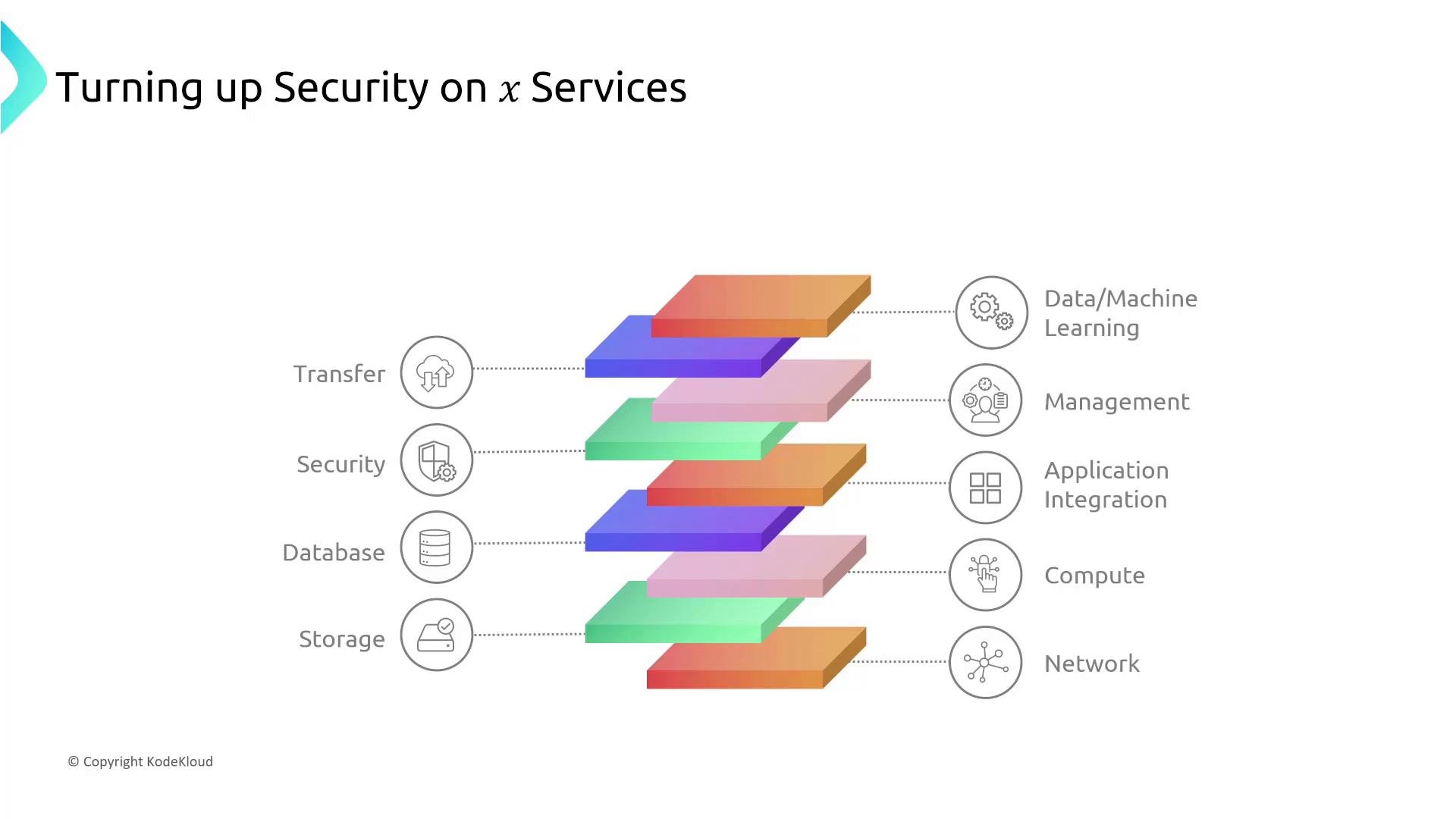
Design for Security Design Challenge
After the “Design for X” sections, you’ll encounter a Design for Security Design Challenge. The challenge presents an architecture diagram with missing components. Your task is to choose services or features that satisfy functional and security requirements and place them correctly in the diagram. Interaction tips:- Read the requirement carefully and map it to one of the four security categories (IAM, Detect, Protect, Respond).
- Narrow choices by service capabilities (for example, does the option provide DDoS protection or web filtering?).
- Consider the shared responsibility boundary for each service before assuming a control is handled by AWS.
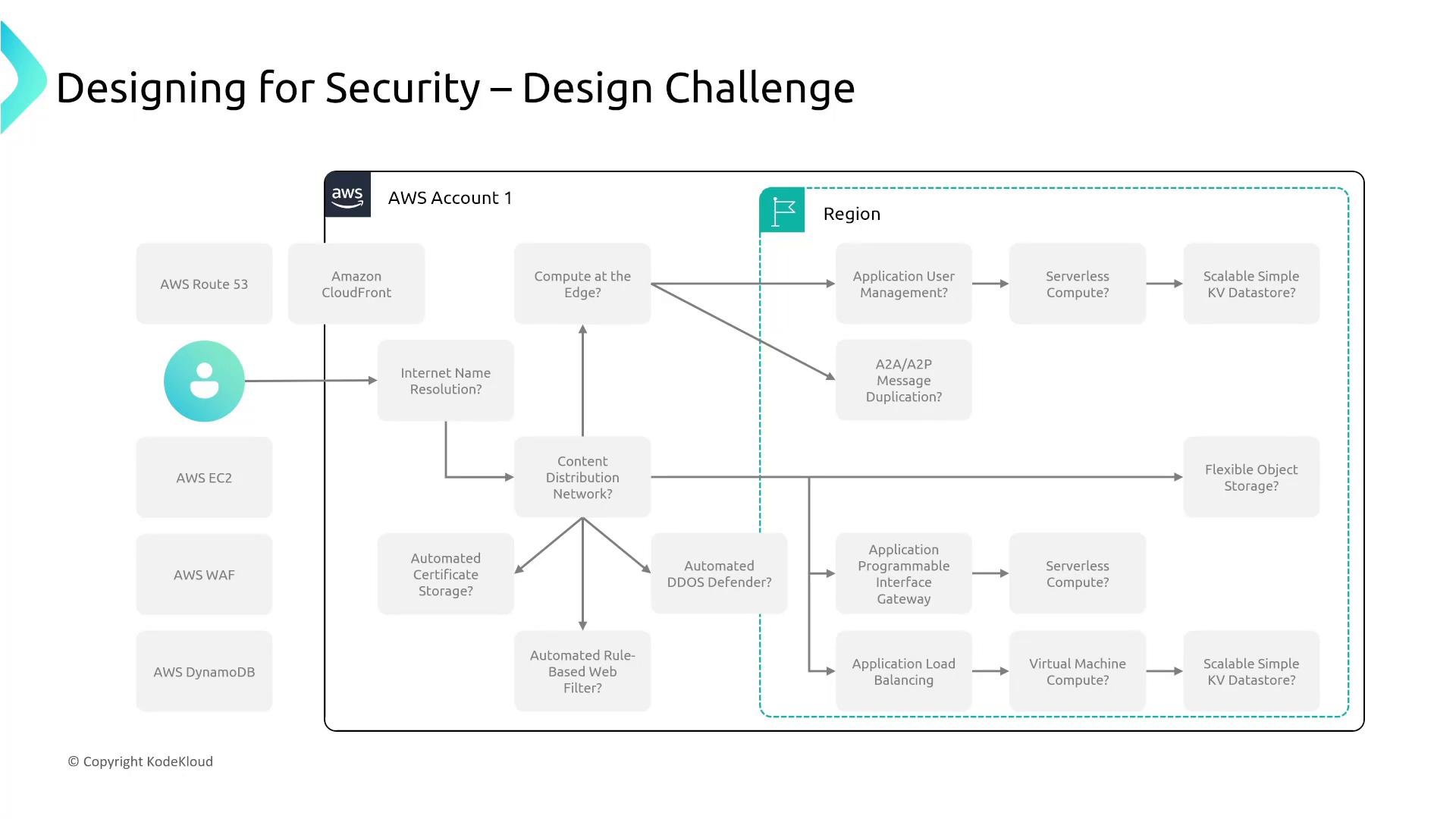
Example picks you might make while solving a challenge
- Internet name resolution: place Route 53.
- Rule-based web application filtering: place AWS WAF.
- Serverless, high-scale key-value store: place Amazon DynamoDB.
- Virtual machine requirement: place EC2.
- Serverless compute for event-driven tasks: place AWS Lambda.
Summary
- This security section is the first of four “Design for X” modules. We begin with AWS security fundamentals tied to the Well-Architected Framework, then apply security principles and reference architectures you’ll encounter on the exam.
- You will practice exam-style questions to sharpen architectural reasoning and exam technique.
- The Design for Security Design Challenge reinforces learning through a practical, applied exercise.