

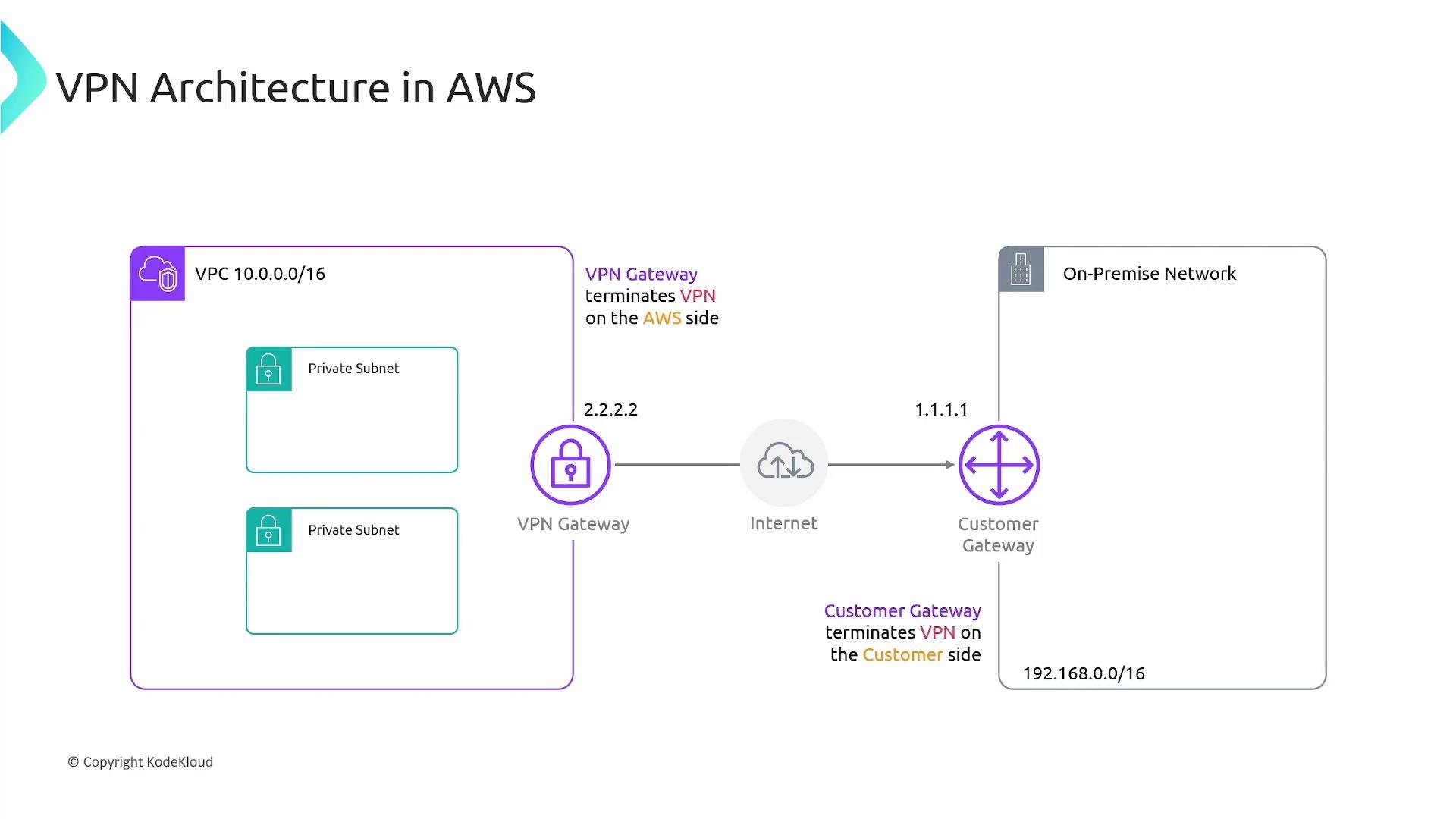
10.0.0.0/16 and one or more private subnets containing instances without public IP addresses. If your on-premises datacenter uses 192.168.0.0/16 and needs access to those private resources, you need a secure, routable connection between the two networks. A site-to-site VPN uses IPsec to encrypt traffic between the on-premises Customer Gateway (CGW) and the AWS-side Virtual Private Gateway (VGW).
On AWS you attach a VGW to your VPC to terminate the VPN. On-premises you deploy a CGW that terminates the other end of the IPsec tunnel; the CGW uses a public IP (for example 1.1.1.1), and AWS assigns a public IP to the VGW (for example 2.2.2.2). Once the tunnel is established, all traffic routed into the tunnel is encrypted across the Internet.
Key components
- Virtual Private Gateway (VGW): the AWS-side VPN endpoint attached to your VPC.
- Customer Gateway (CGW): your on-premises VPN endpoint with a public IP.
- IPsec Tunnel: encrypts traffic between the CGW and VGW.
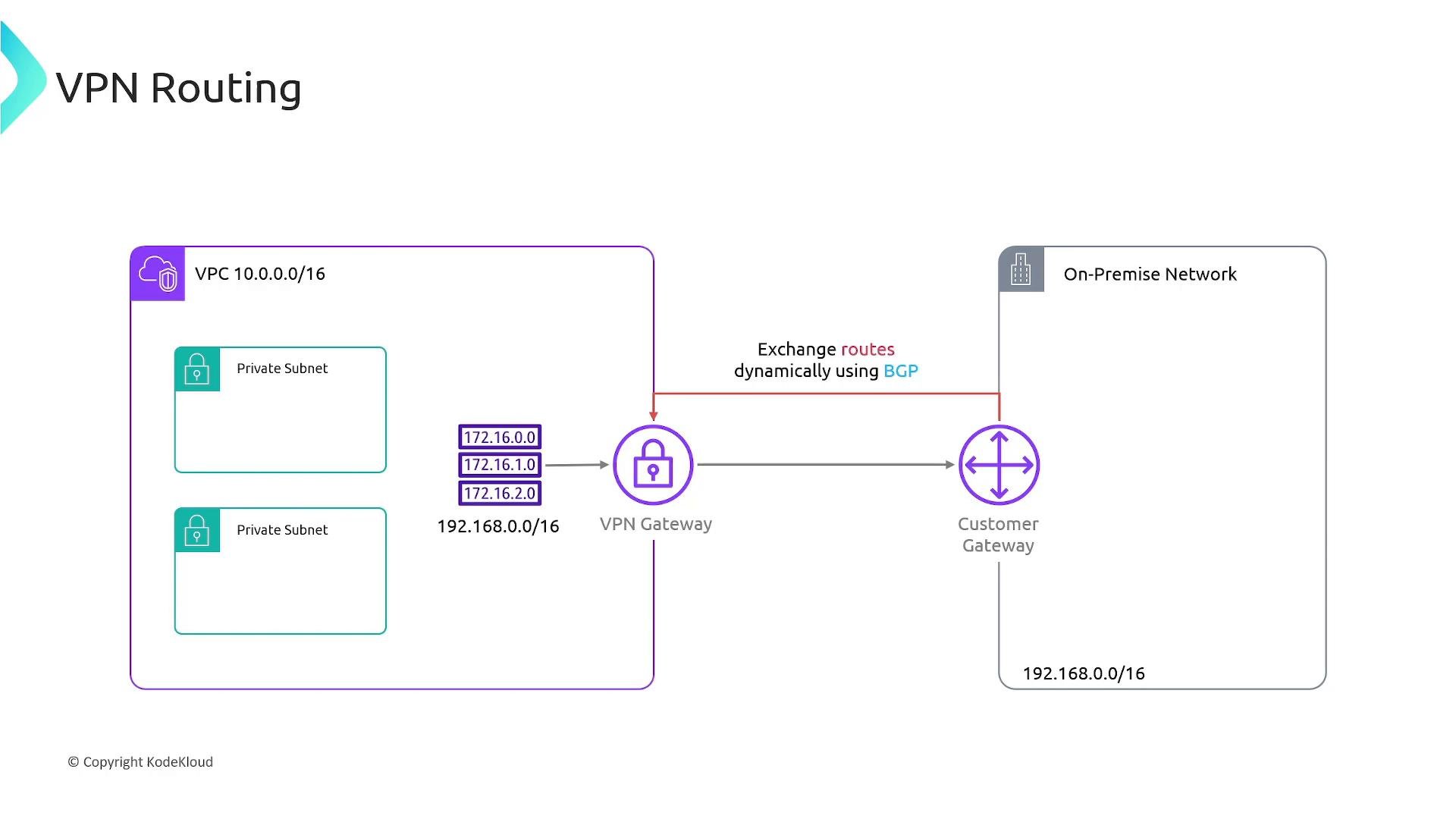
- Routes: ensure traffic for the remote network is forwarded into the tunnel.
Routing options
Routing controls which traffic is sent over the VPN tunnel. AWS supports two primary approaches:
Both approaches work. Use dynamic routing (BGP) when you want automatic prefix updates and easier scaling; use static routes for simple, predictable networks.
Pricing overview
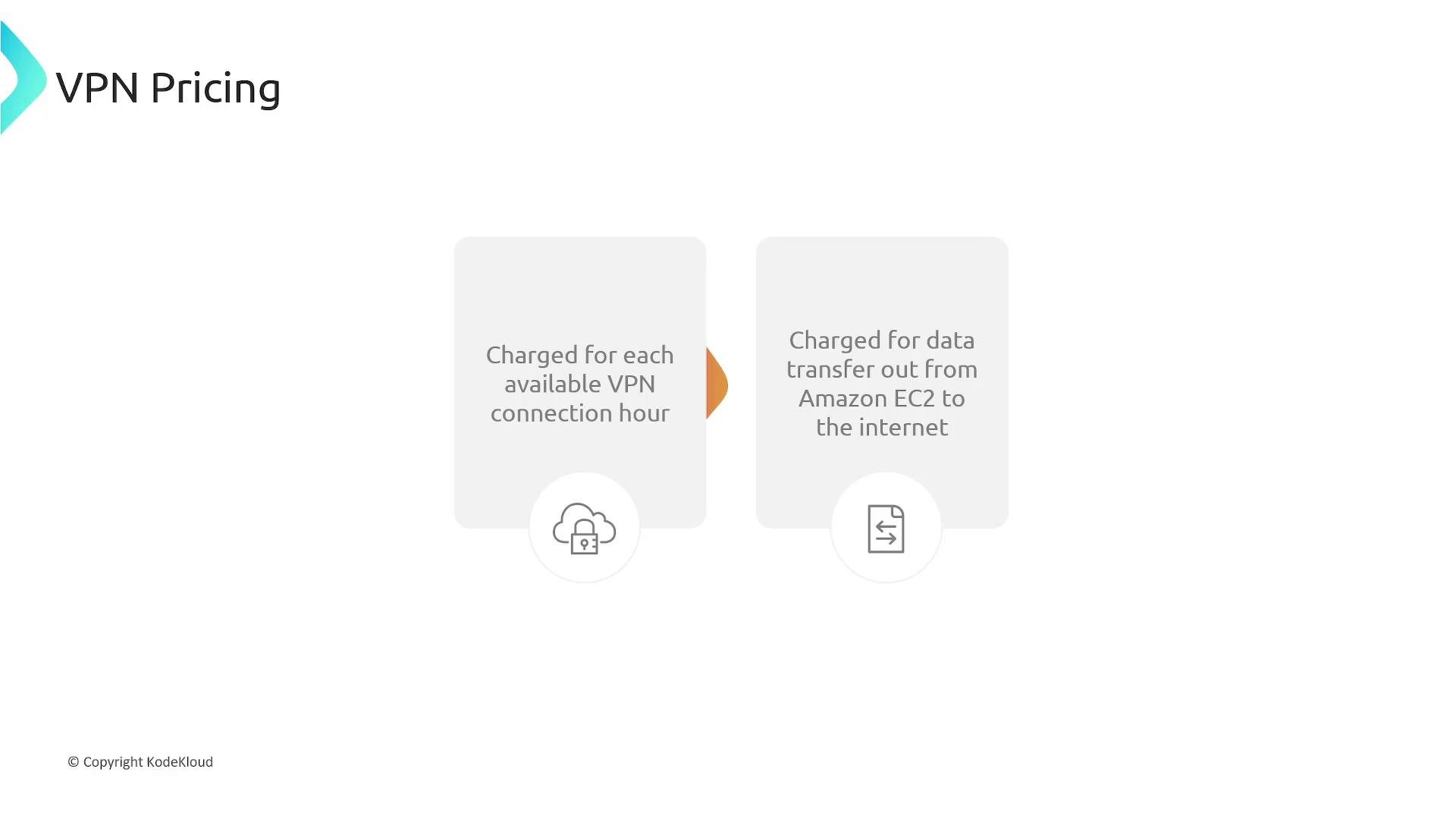
AWS bills site-to-site VPNs in two main ways:
Always estimate traffic egress and number of concurrent VPN connections when budgeting, since data transfer costs can be significant for heavy workloads.
VPN gateway limits and characteristics
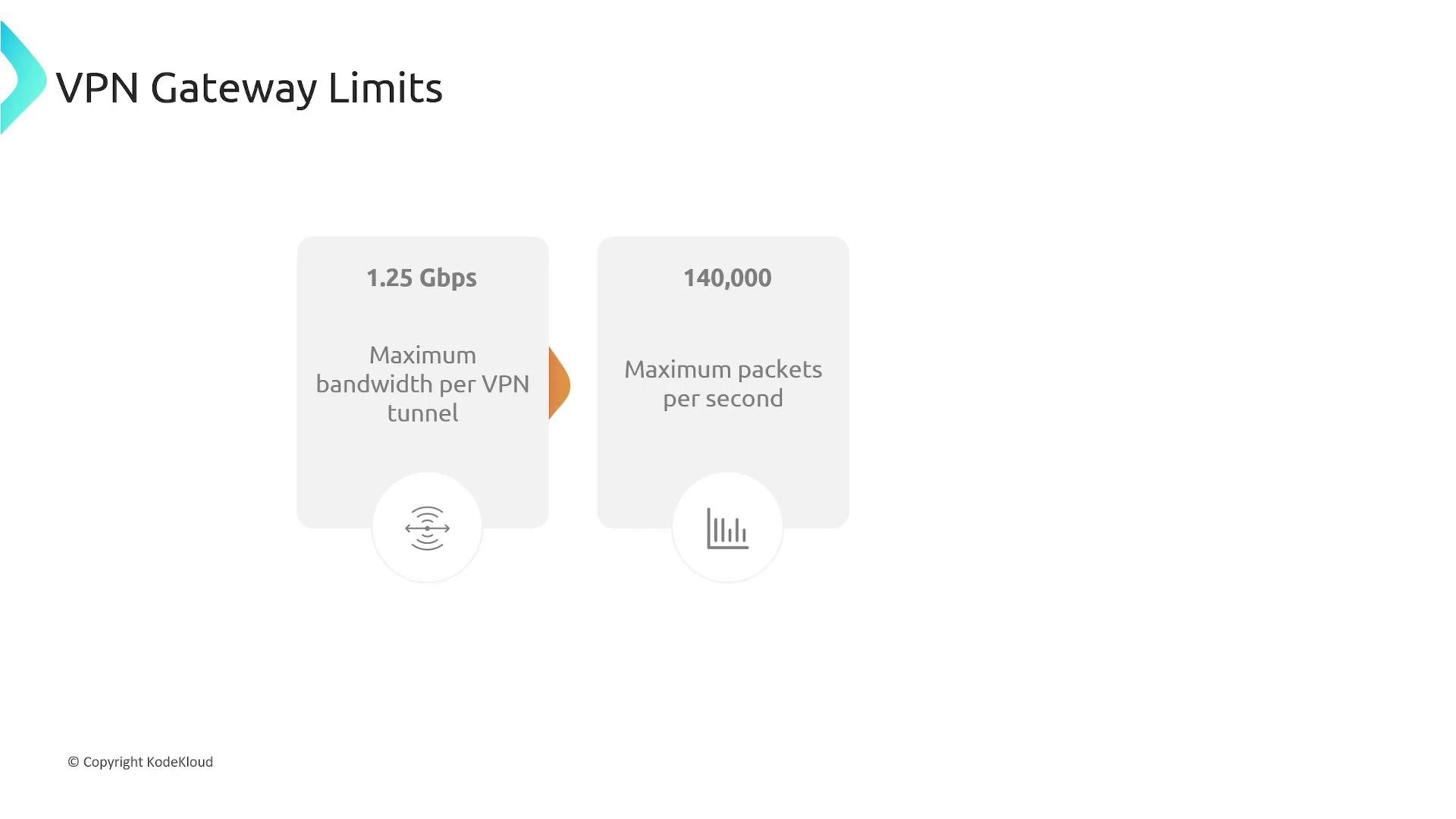
Important performance and configuration characteristics to plan for:- Maximum bandwidth per VPN tunnel: 1.25 Gbps.
- Maximum packets per second: 140,000 pps.
- MTU: 1466 bytes.
- Multi-tunnel HA: AWS typically provisions two tunnels per connection (different AWS-side endpoints) for high availability.
- ECMP: You can use Equal-Cost Multi-Path (ECMP) across multiple tunnels to increase aggregate throughput and resiliency.
AWS site-to-site VPN connections are commonly provisioned with two tunnels (each terminating at a different AWS-side endpoint) for high availability. Each tunnel has its own public IP and IKE/IPsec configuration; when using BGP, you can let the tunnels exchange routes and fail over automatically.
Remember: VPN traffic traverses the public Internet. Although the tunnel encrypts the traffic, you will still incur data egress charges for traffic leaving AWS.
Best practices
- Use BGP route exchange when you have multiple prefixes or expect frequent topology changes.
- Deploy the two-tunnel HA configuration AWS provides and enable ECMP where appropriate.
- Monitor throughput and packet rates; consider AWS Direct Connect if you need predictable, high-bandwidth, and lower-latency connectivity.
- Account for MTU (1466 bytes) when troubleshooting fragmentation or application issues across the tunnel.
Summary
- A Virtual Private Gateway (VGW) is the AWS-side VPN endpoint you attach to a VPC to terminate a site-to-site VPN.
- A Customer Gateway (CGW) is the on-premises endpoint (with a public IP) that terminates the other side of the VPN.
- The IPsec tunnel encrypts traffic across the Internet; choose static routes or BGP for routing.
- AWS charges an hourly fee per VPN connection plus data transfer out; VPN tunnels are limited to about 1.25 Gbps each and support ECMP for aggregation.
Links and references
- AWS: What is VPN?
- Amazon VPC documentation
- VPC VPN documentation (VGW & CGW)
- IPsec (Wikipedia)
- BGP (Wikipedia)
- ECMP (Wikipedia)
- Amazon EC2 Pricing & Data Transfer