

Why use OpenSearch instead of a relational database?
Modern applications generate diverse data types — free-form text, logs and events, geospatial data, time-series metrics, and JSON or semi-structured documents. Relational databases excel at structured, schema-driven data but can struggle with:- fast full-text search,
- flexible indexing of semi-structured documents,
- high-throughput analytics across large text corpora,
- and the operational patterns needed for observability and real-time search.
When to choose OpenSearch vs a relational database
What is OpenSearch?
OpenSearch is a search and analytics engine originally forked from the last Apache License 2.0–compatible Elasticsearch and Kibana releases. It provides distributed indexing, searching, and analytics with a strong focus on observability, logging, and search experiences.Elasticsearch vs OpenSearch (short comparison)
OpenSearch is a community-maintained fork of Elasticsearch/Kibana that preserves an open-source path for search and analytics use cases.
Core components and deployment options on AWS
On AWS you can deploy OpenSearch in two primary ways:- Amazon OpenSearch Service — managed OpenSearch clusters with options for instance types, storage, security, backups, and fine-grained access control.
- OpenSearch Serverless — an on-demand, auto-scaling serverless option that removes much of the operational burden of provisioning and tuning clusters. AWS manages capacity and scaling.
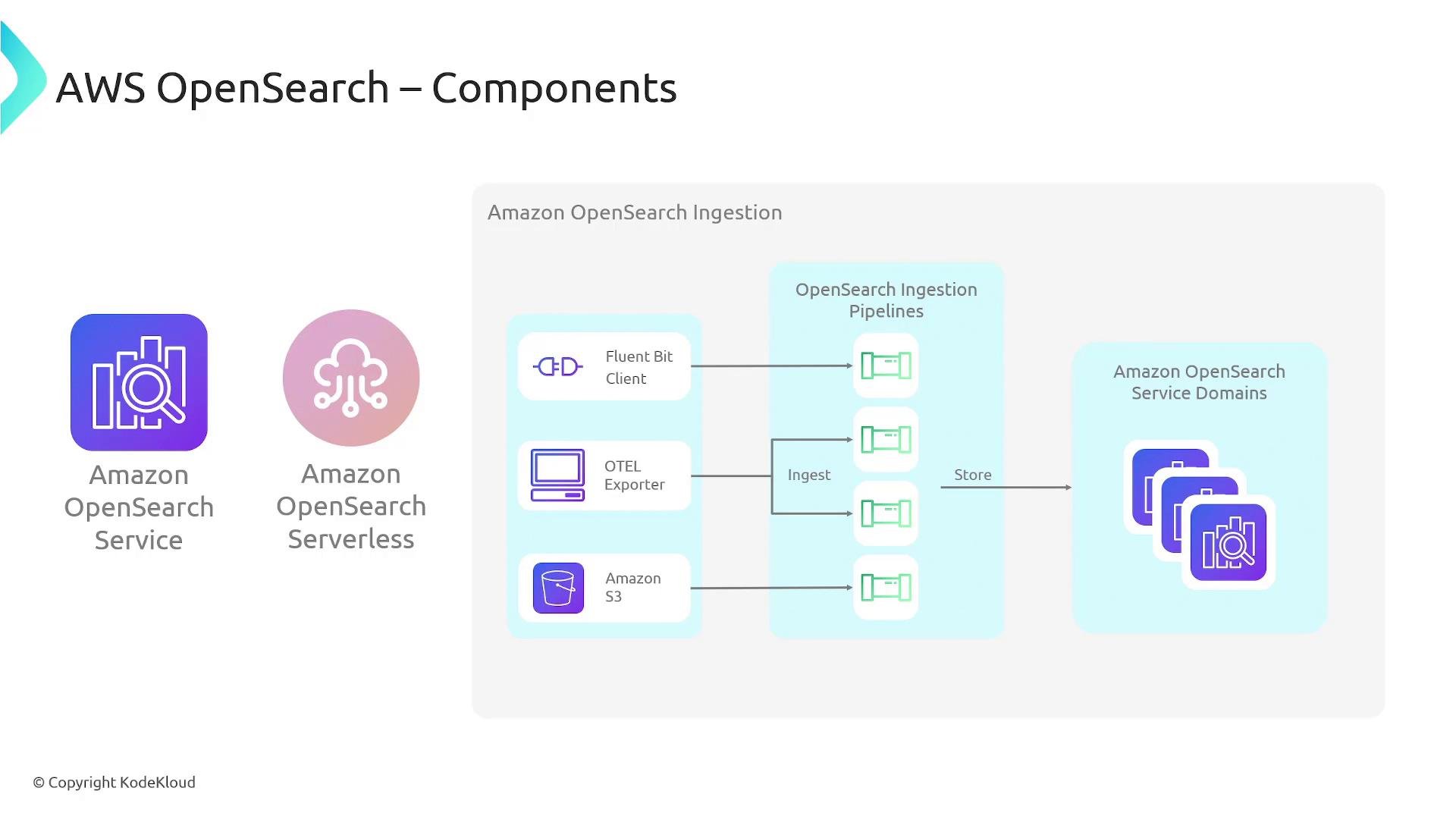
OpenSearch Ingestion simplifies getting data from producers into OpenSearch: apply transformations, filter noise, and route events without managing collector infrastructure.
Key features
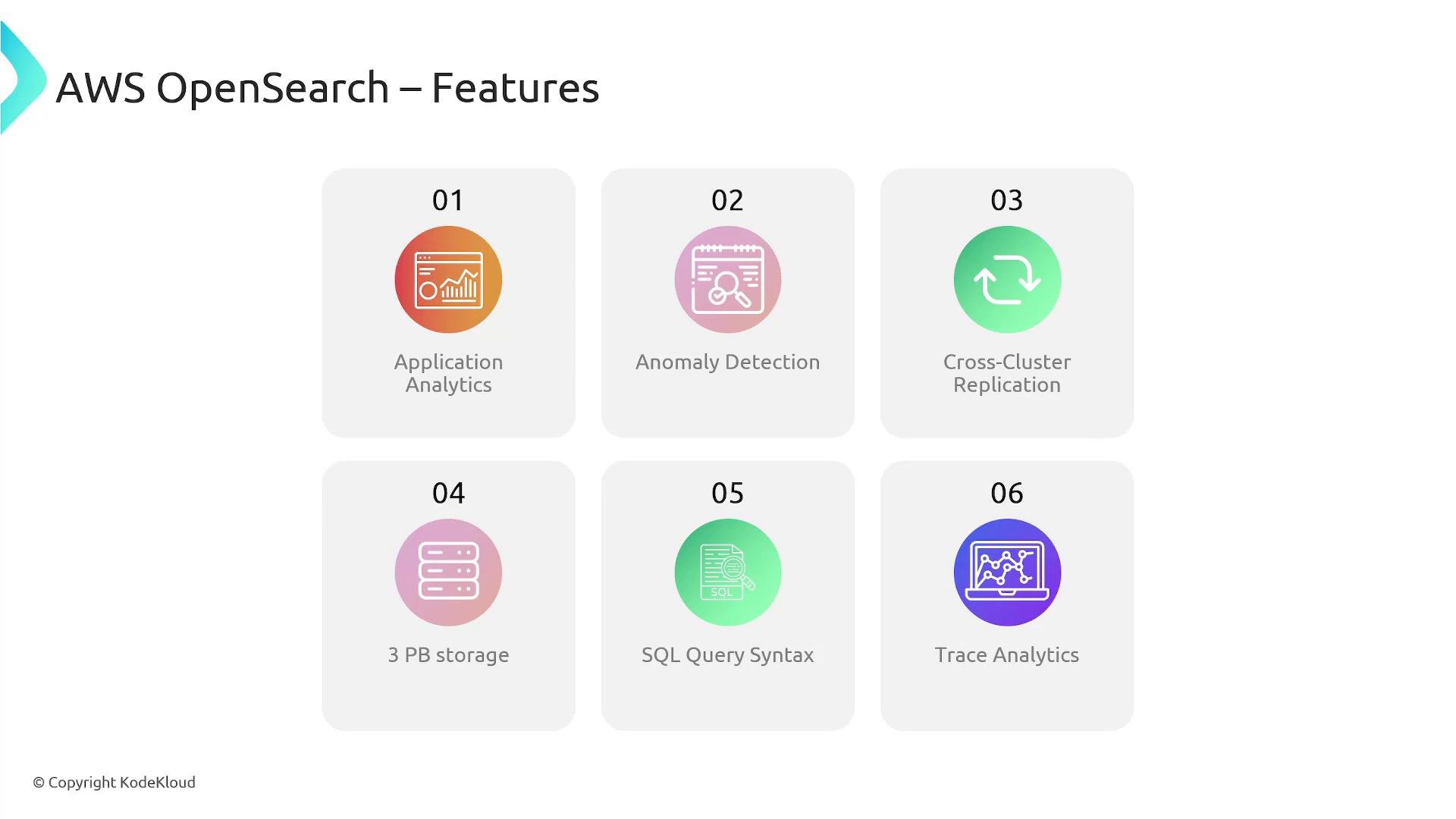
- Unified observability: Correlate logs, traces, and metrics to analyze service health and performance in context.
- Full-text search and relevance: Powerful inverted-index search for low-latency query responses.
- Aggregations and analytics: Grouping, histogramming, and statistical aggregations suited to operational analytics and dashboards.
- Anomaly detection: Built-in ML-powered features to flag unusual patterns in metrics or logs.
- Cross-cluster replication: Replicate indices and metadata between clusters for failover, geo-redundancy, or reporting offload.
- Scale and capacity: Supports a wide range of instance types and architectures; can scale to petabyte-class storage with proper configuration.
- SQL-style query support: Familiar SQL-like query syntax for users comfortable with relational queries; export results as JSON or CSV.
- Trace analytics: Ingest and visualize OpenTelemetry data for distributed tracing and performance diagnosis.
Integrations with AWS services
OpenSearch integrates across the AWS ecosystem to simplify ingestion, security, monitoring, and visualization. Below is a concise mapping of common integrations and uses.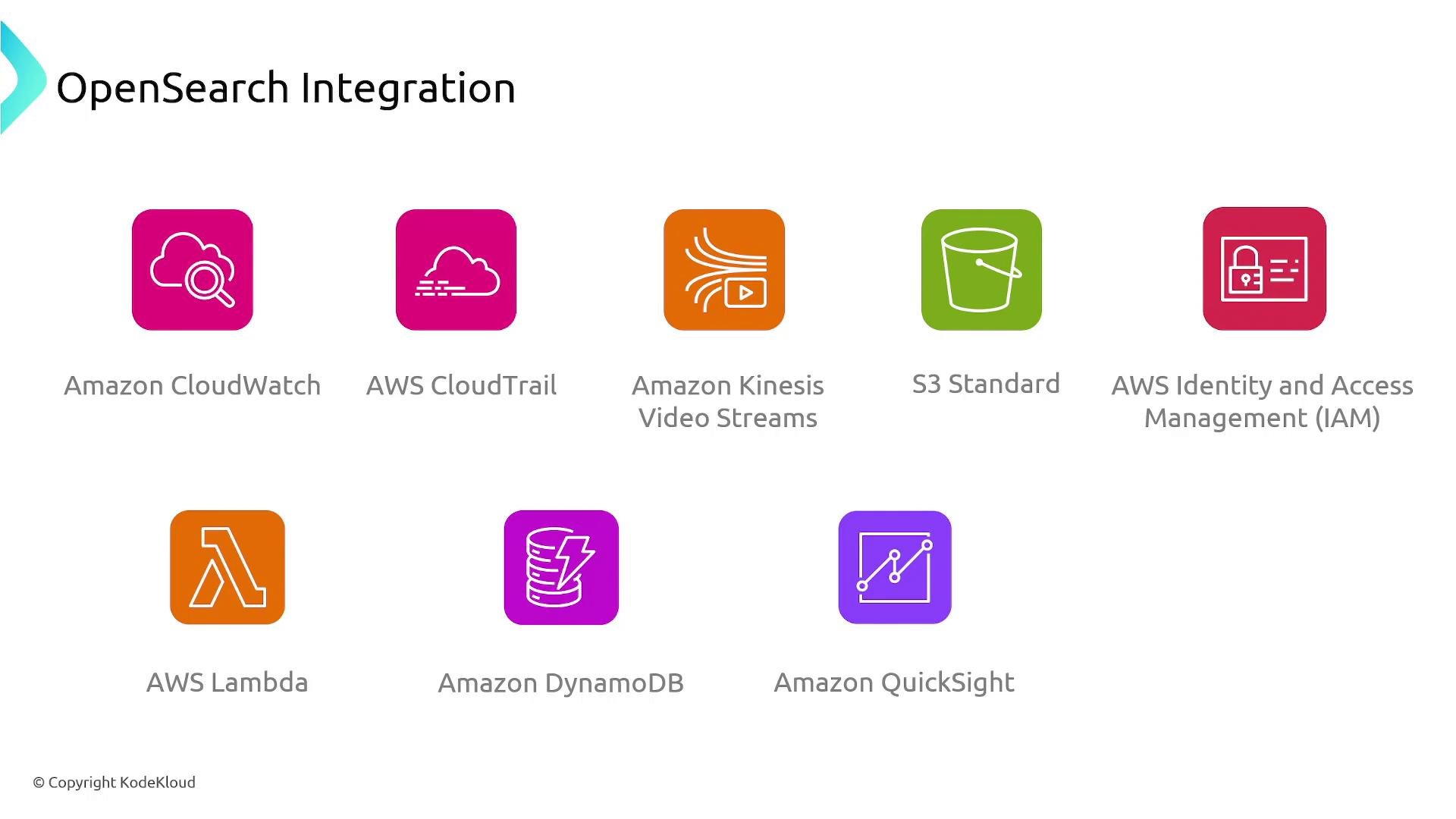
Common use cases
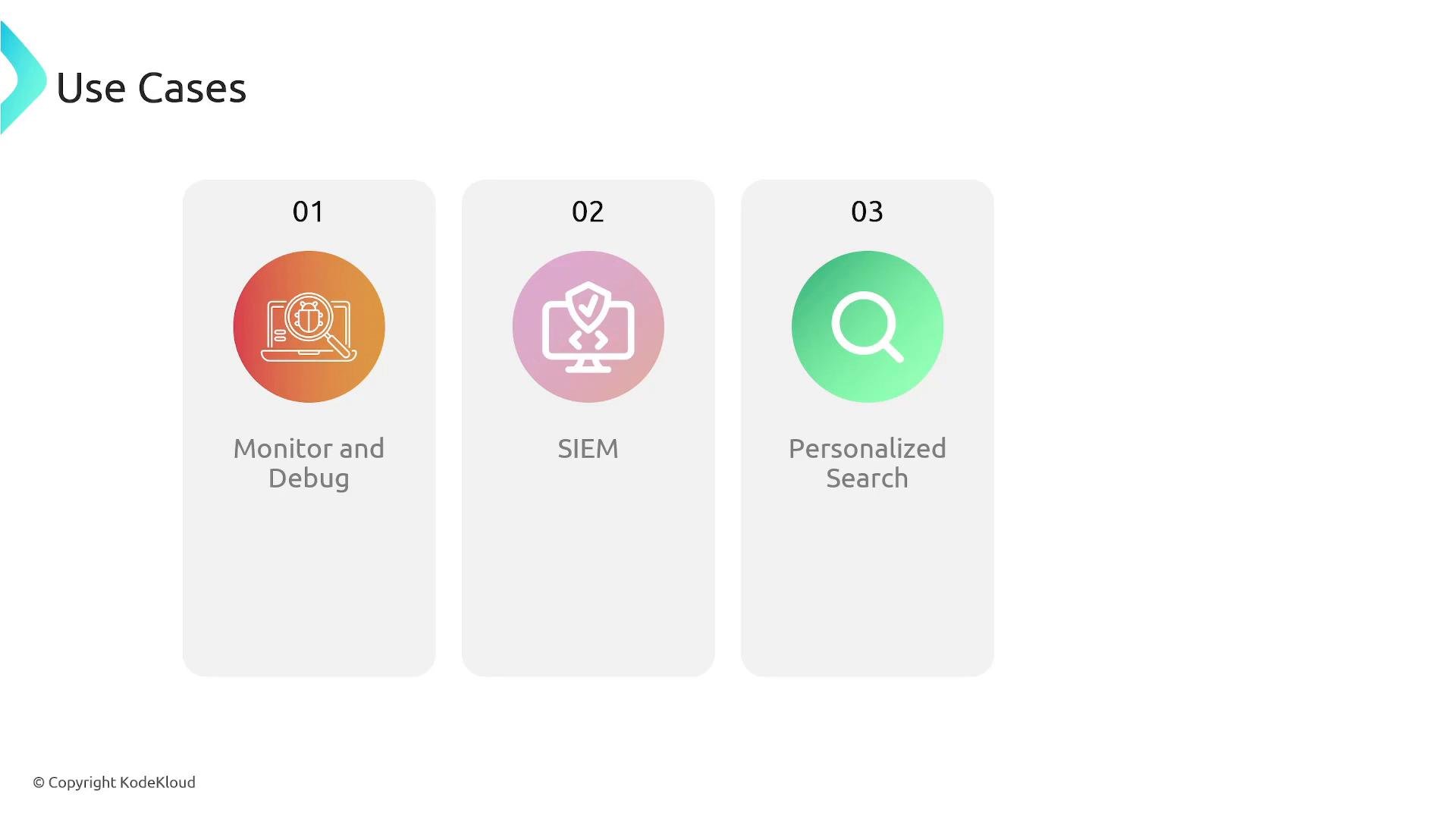
OpenSearch is widely adopted for:- Observability — Centralize logs, metrics, and traces to monitor, alert, and debug distributed applications.
- Security information and event management (SIEM) — Real-time threat detection, searching, and incident response workflows.
- Search — Fast, relevant, and personalized search experiences for applications and websites.
Deployment guidance and best practices (brief)
- For predictable workloads and full control over configuration, choose Amazon OpenSearch Service with dedicated instances and EBS or instance storage.
- For variable or bursty workloads and lower operational overhead, OpenSearch Serverless can automatically scale and reduce management.
- Use OpenSearch Ingestion or streaming services (Kinesis, Lambda) to centralize and transform telemetry before indexing.
- Set up CloudWatch alarms on OpenSearch metrics (CPU, JVM memory pressure, disk utilization) and enable automated snapshots to S3.
- Use IAM policies and fine-grained access control to restrict data access; enable TLS for encryption in transit.
Summary
OpenSearch is an open-source, community-driven search and analytics suite forked from Elasticsearch/Kibana. It supports high-performance full-text search, aggregations, trace analytics, and observability at scale. On AWS you can run OpenSearch as managed clusters (Amazon OpenSearch Service) or serverless collections (OpenSearch Serverless) and simplify ingestion with OpenSearch Ingestion. These options reduce operational complexity while enabling powerful search, monitoring, and analytics use cases.Links and references
- OpenSearch project: https://opensearch.org/
- Elasticsearch: https://www.elastic.co/elasticsearch/
- OpenSearch Ingestion documentation: https://docs.aws.amazon.com/opensearch-service/latest/developerguide/what-is-opensearch-ingestion.html
- AWS OpenSearch Service: https://aws.amazon.com/opensearch-service/
- OpenTelemetry: https://opentelemetry.io/