

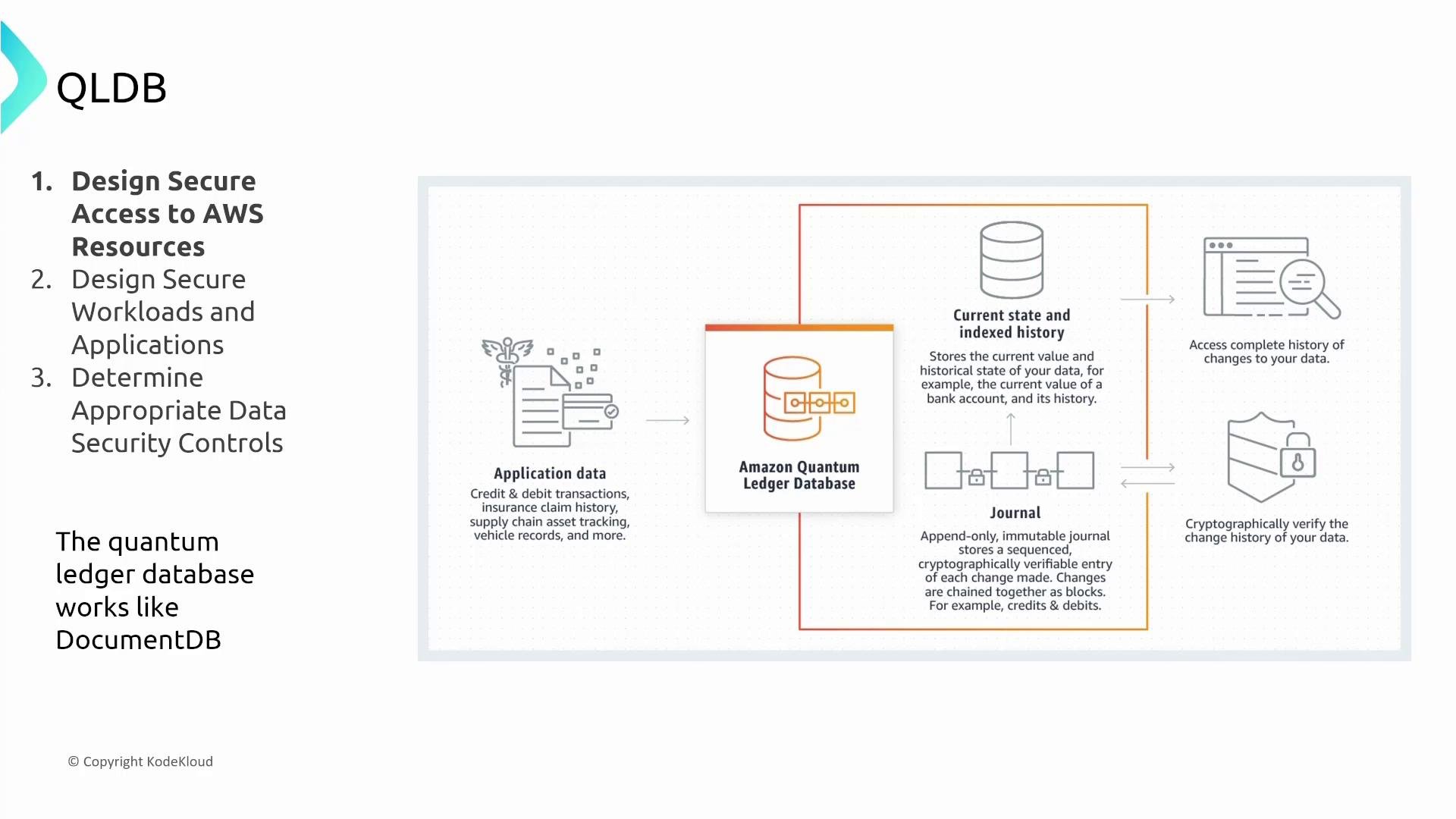
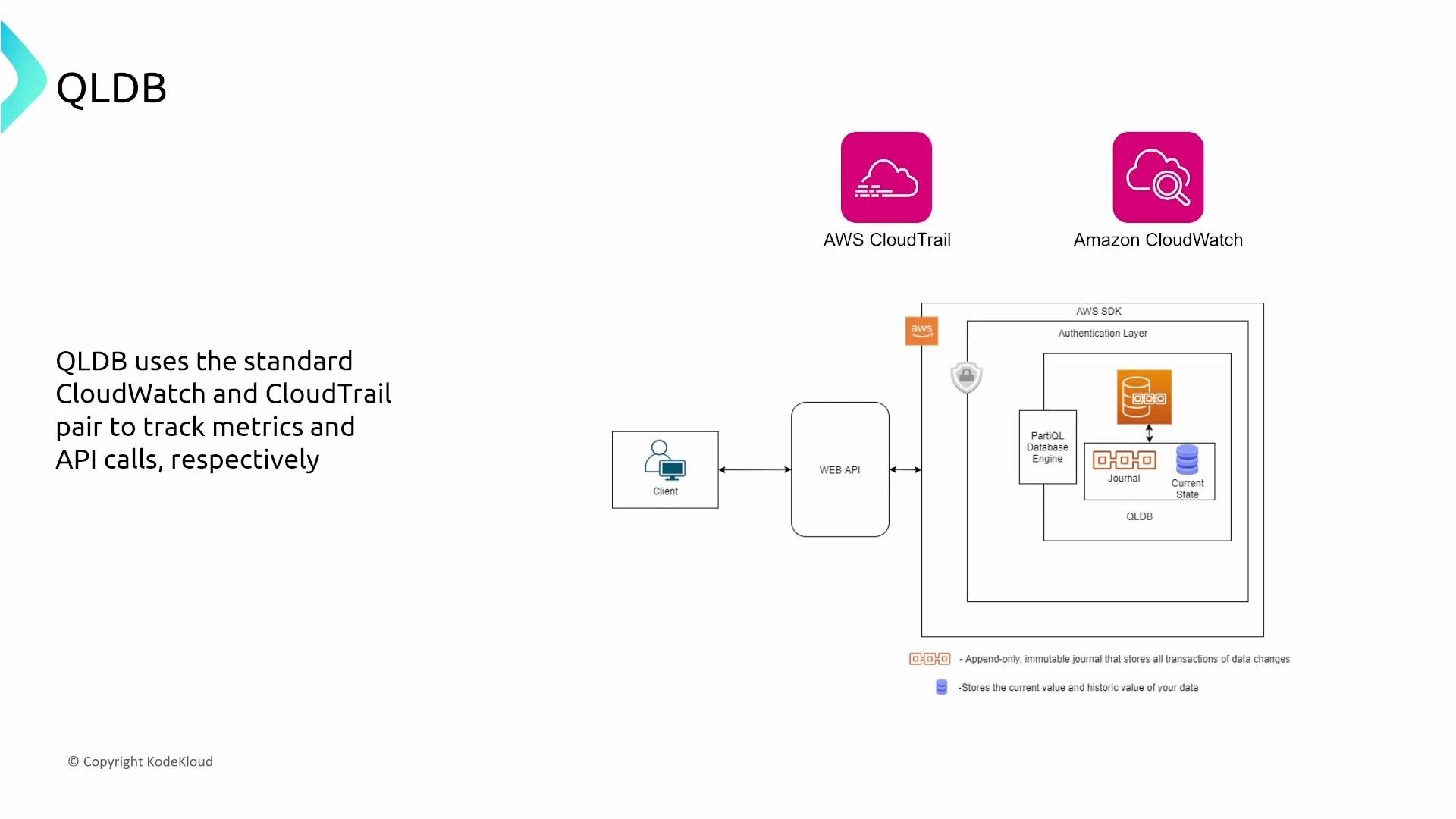
- QLDB is a centralized ledger service managed by AWS that provides an append-only journal and cryptographic verification primitives.
- QLDB is not a decentralized blockchain with multiple independent validators. If you require a decentralized network, evaluate Amazon Managed Blockchain.
- The journal preserves the full history of changes (who, when, what) while allowing updates to the current state; cryptographic digests enable integrity verification of the journal.
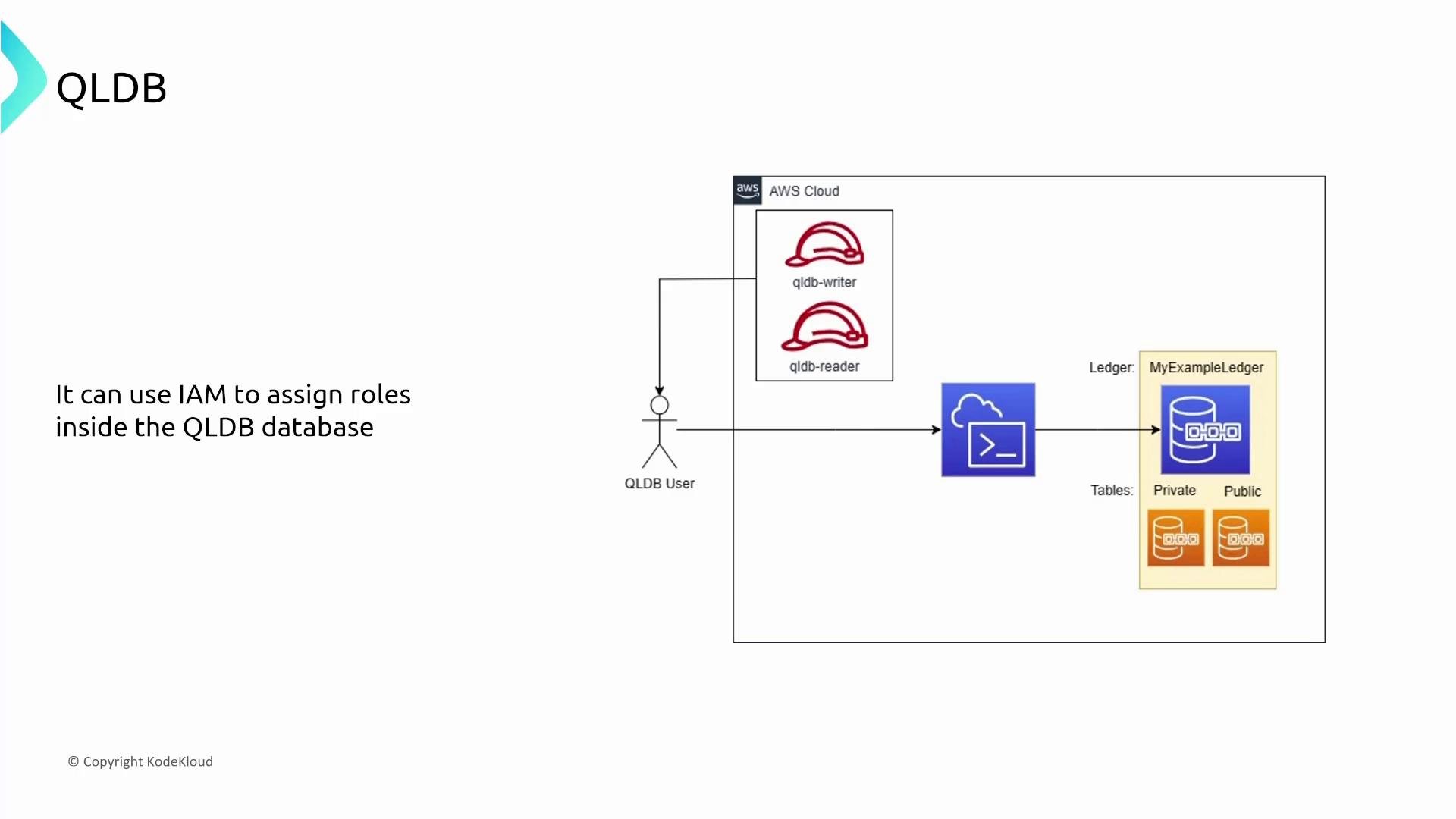
qldb-writer— permissions to insert and modify ledger table rows and perform write operations.qldb-reader— permissions to run PartiQL queries and read current-state or historical data.
- Use least privilege IAM policies scoped to specific ledgers and actions.
- Prefer IAM roles for EC2, Lambda, or containers rather than long-lived credentials.
- Audit access with CloudTrail and alert on unusual API activity.
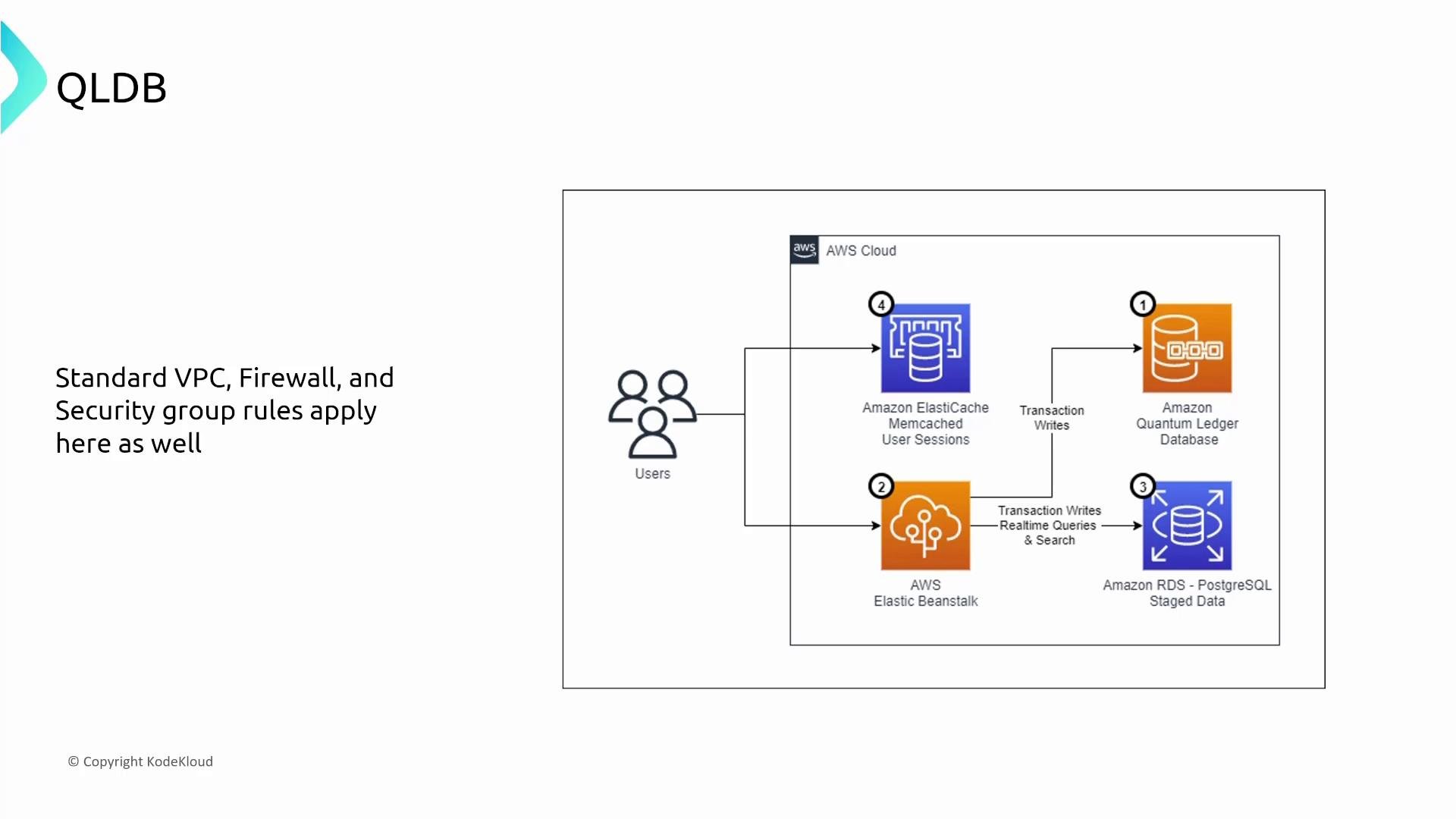
- Use PrivateLink interface VPC endpoints so traffic between your VPC and QLDB remains off the public internet.
- Apply security groups to the VPC endpoint (not directly to QLDB); these control network-level access (ingress/egress rules) for clients in your VPC.
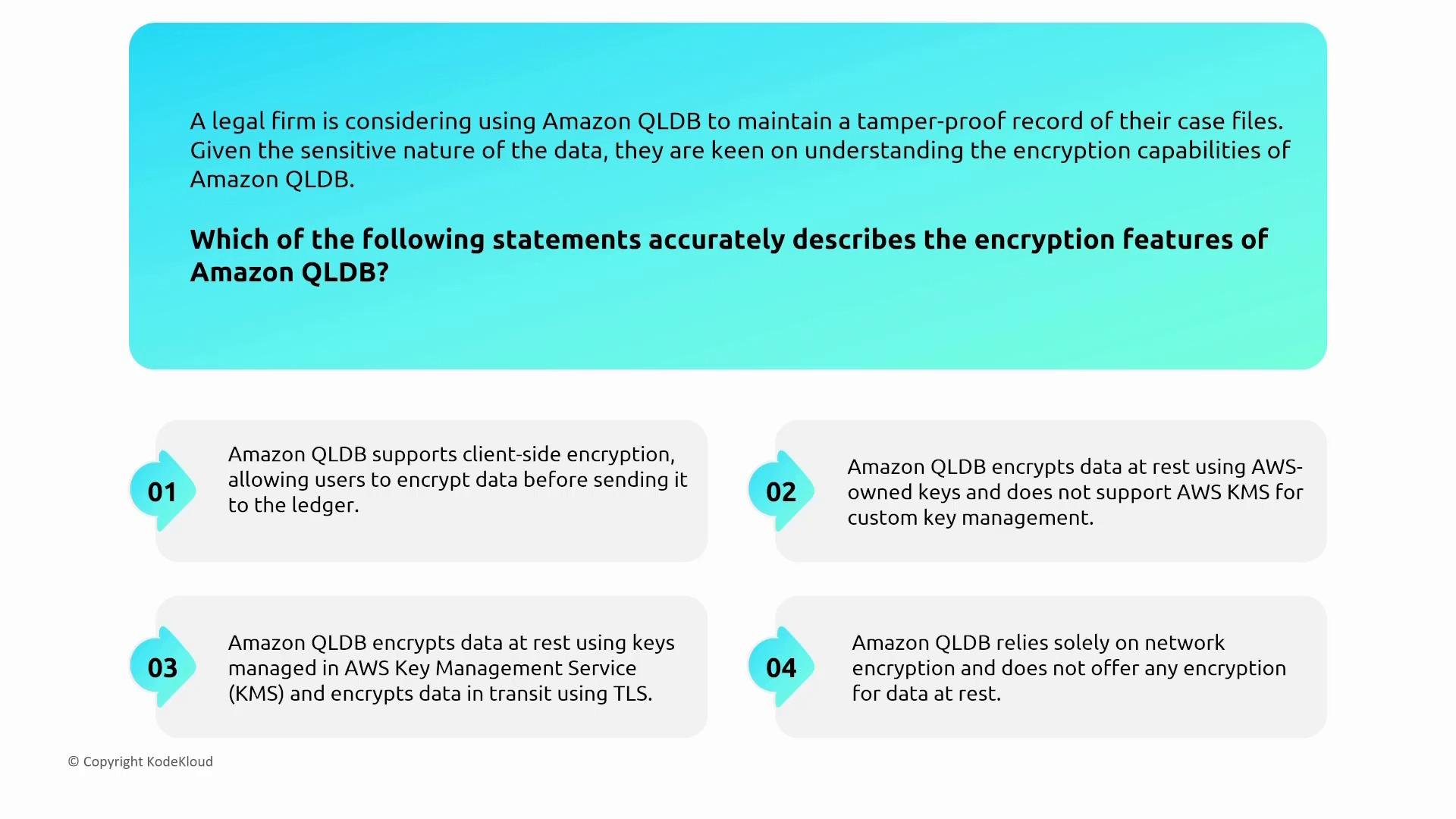
- At-rest: QLDB uses AWS KMS for encryption at rest by default. You can provide a custom KMS key to control key rotation and access.
- In-transit: TLS protects data transferred between clients and QLDB endpoints.
- Integrity: QLDB exposes digest and verification APIs that let you cryptographically verify the journal’s integrity.
- CloudWatch for metrics and alarms (throughput, latency, errors).
- CloudTrail for API logging and auditing.
ACID clarification: ACID stands for Atomicity, Consistency, Isolation, and Durability. QLDB provides ACID guarantees for transactions within a ledger, but it is not a direct replacement for a full-featured multi-model RDBMS in every transactional use case.
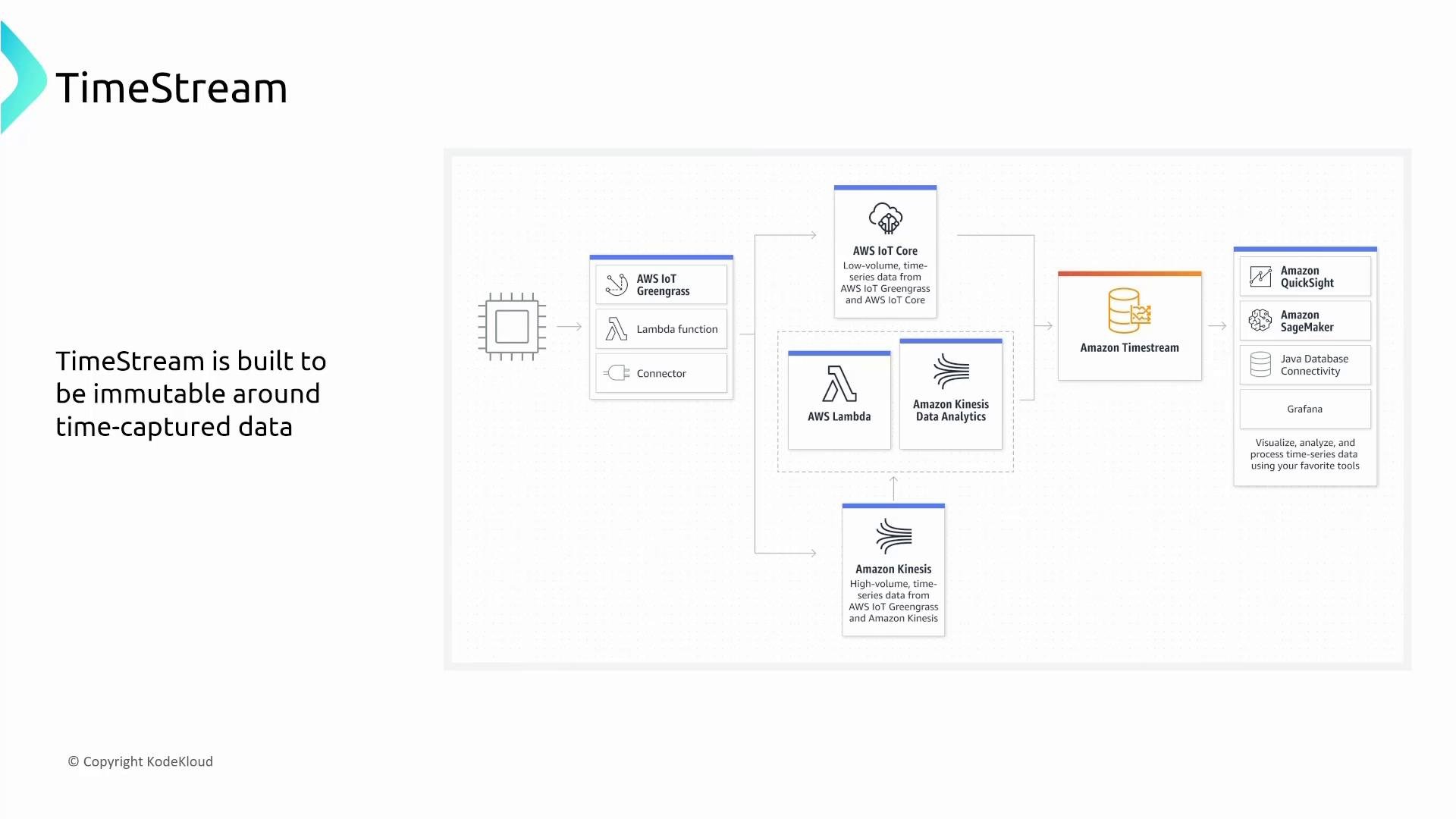
- Timestream optimizes for time-ordered data and enforces retention and tiering policies, but it is not an immutable, append-only ledger like QLDB. Data can be expired or moved between
memoryandmagnetictiers based on retention rules; it does not provide cryptographic append-only guarantees.
- Use cases: high-volume telemetry, real-time metrics, observability pipelines, and lightweight analytics.
- IAM: Supports fine-grained identity and access control for roles assigned to EC2, Lambda, IoT devices, or other AWS services.
- Networking: Supports interface VPC endpoints (PrivateLink) so you can keep service traffic private and apply security groups at the endpoint level.
- Retention & tiering: Configure retention policies and data tiering to balance cost and performance.
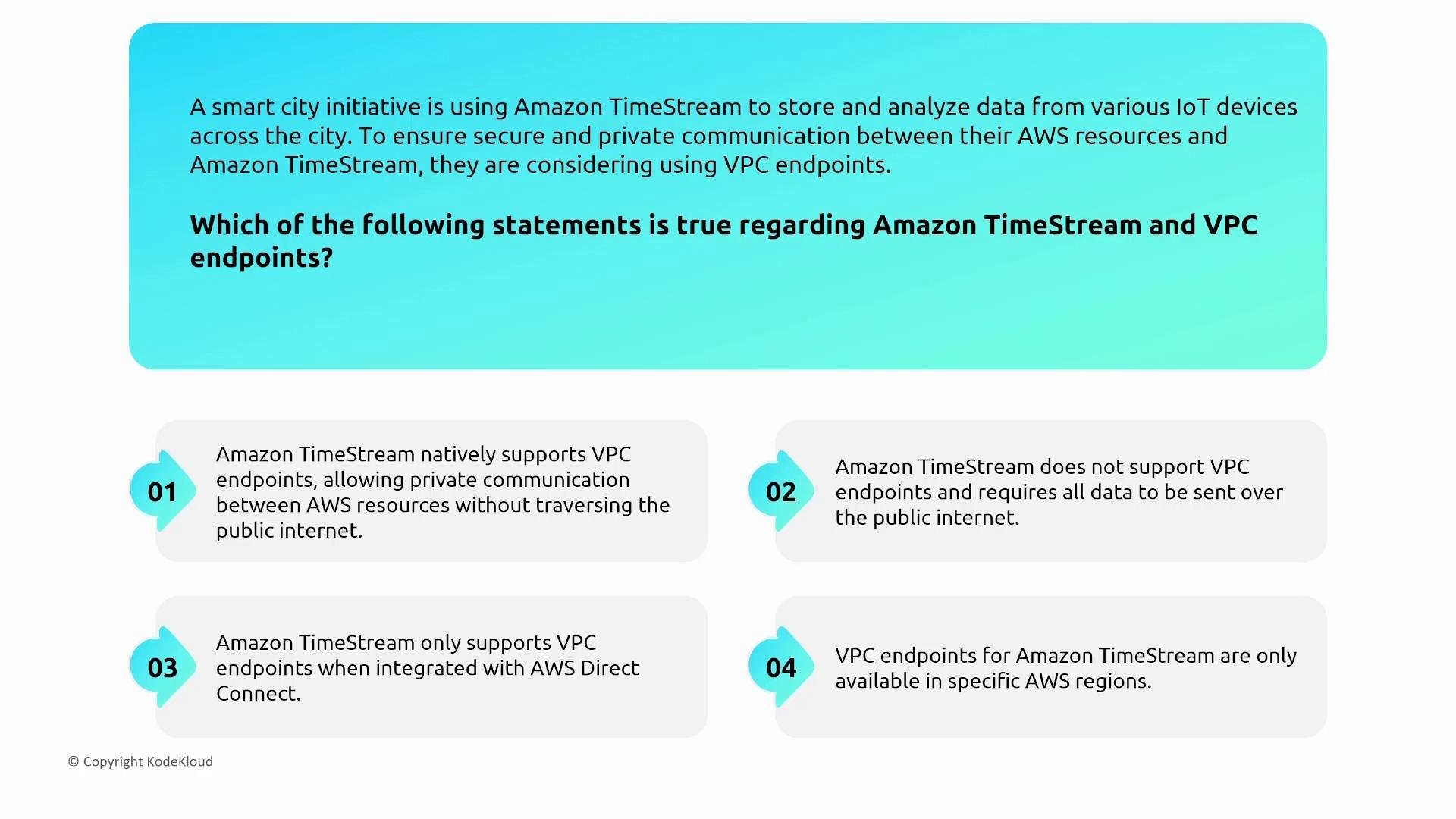
- At-rest encryption: Uses AWS KMS-managed keys by default; you may specify a customer-managed KMS key to control access and rotation.
- In-transit encryption: TLS is used to protect data in transit.
- Observability: Emits metrics to Amazon CloudWatch and records API calls in AWS CloudTrail for auditing and anomaly detection.
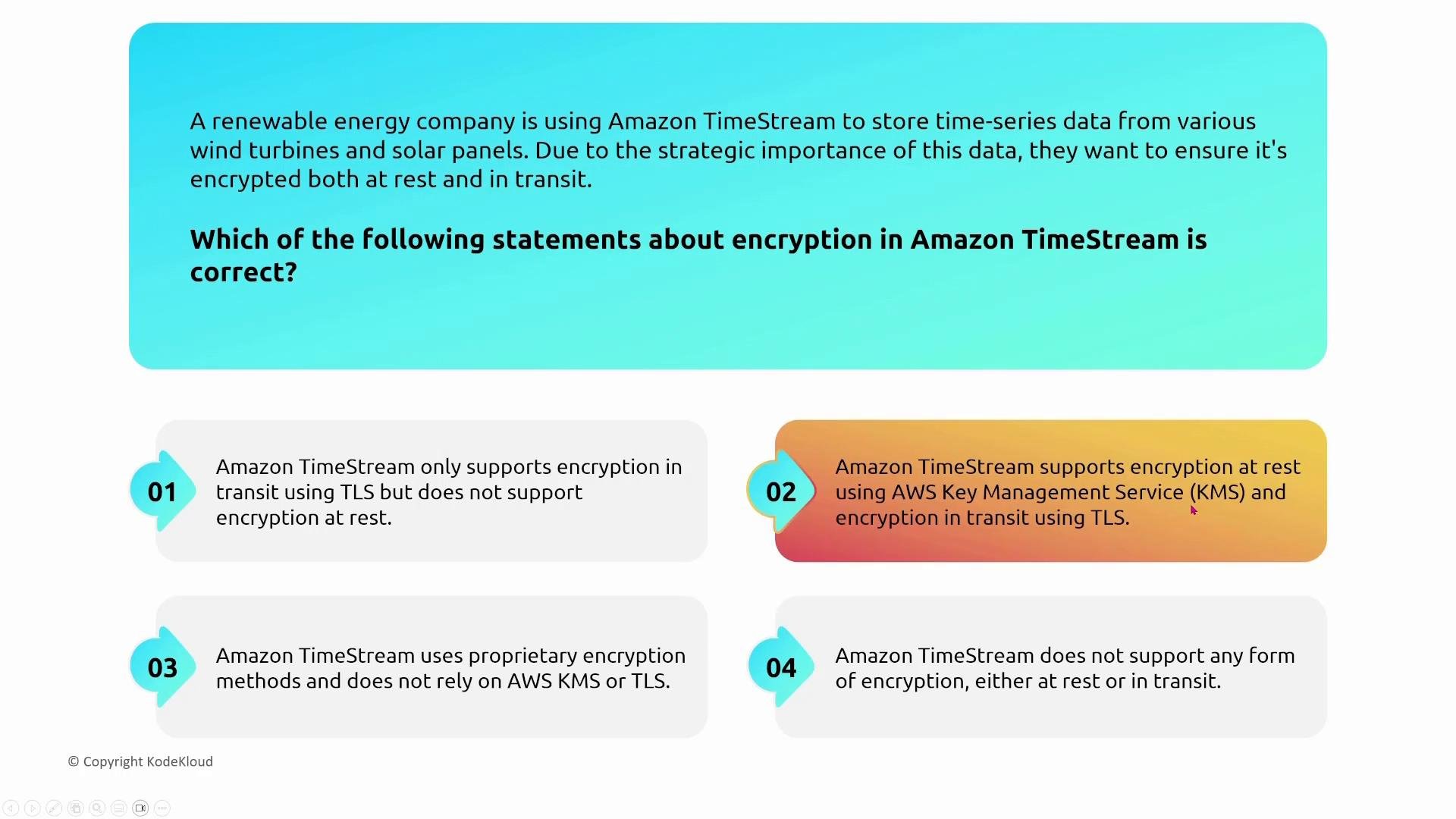
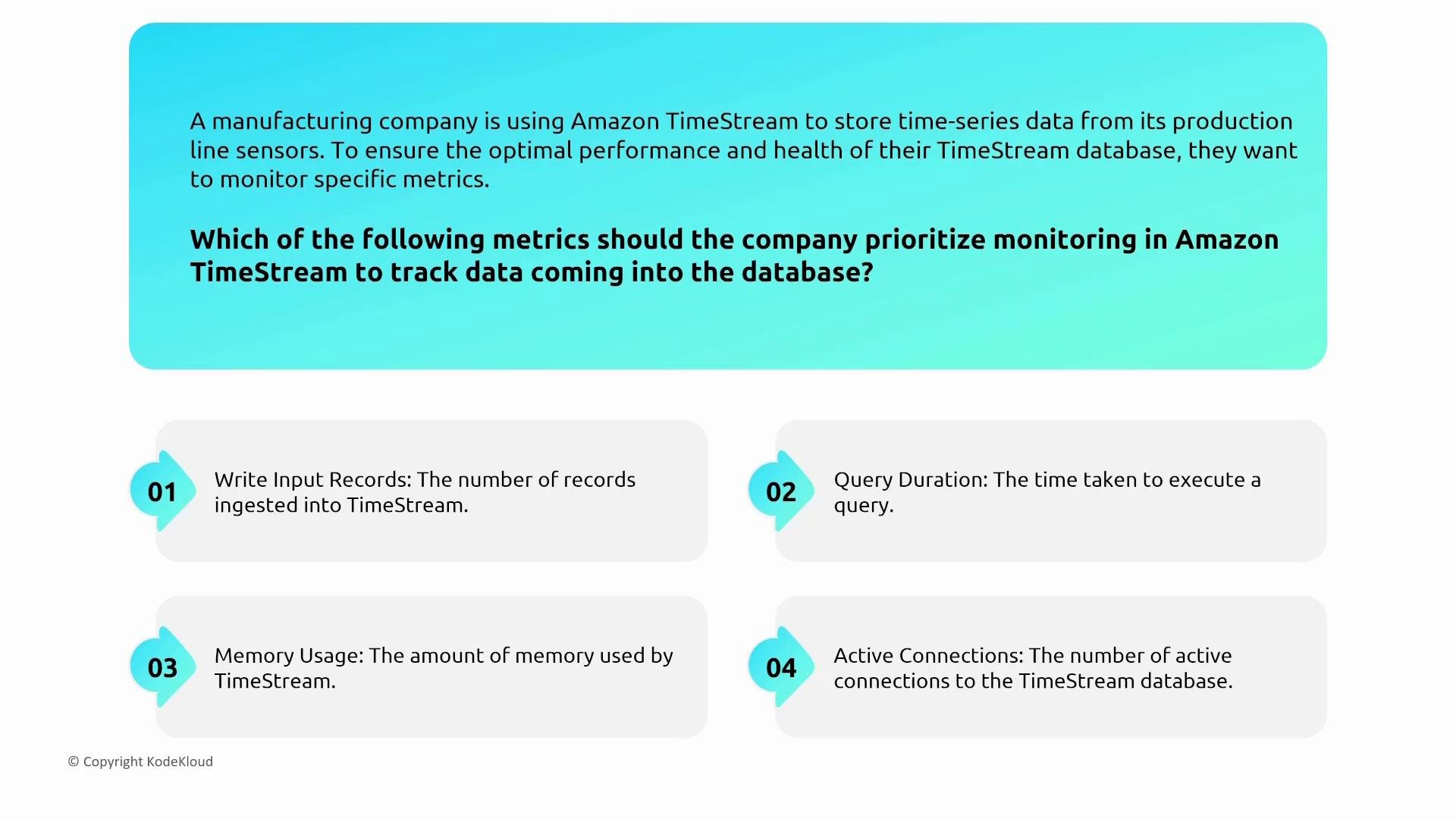
- Prioritize monitoring of write input records / write requests — these indicate ingestion load and help size and tune producers.
- Use query duration and memory usage for troubleshooting query performance and resource constraints.
- Active connections is a weaker signal for write volume because persistent connections do not necessarily mean high ingestion throughput.
Summary and recommended controls
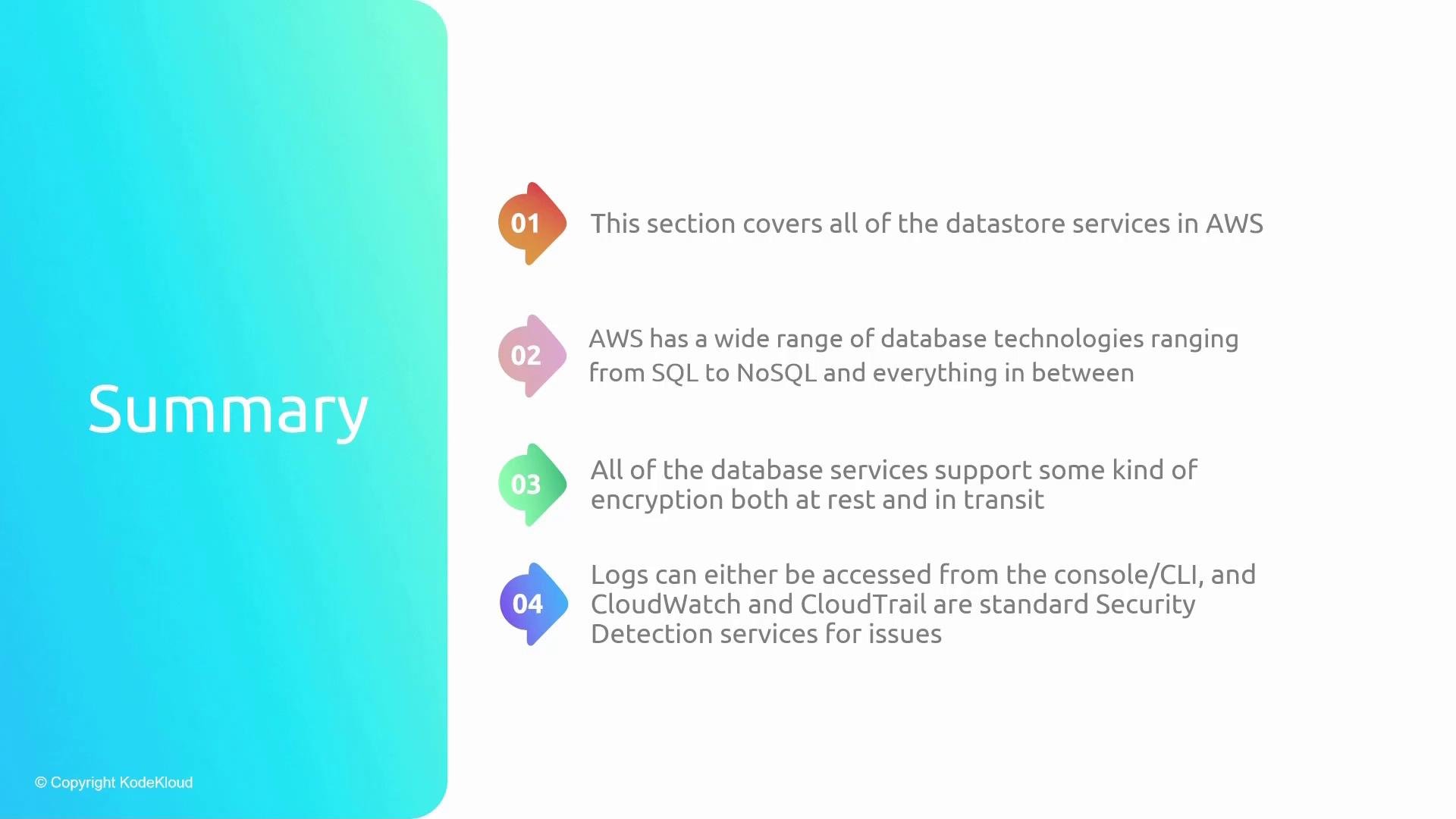
- Choose the right specialized datastore: QLDB for tamper-evident ledgers and full history, Timestream for cost-effective, high-throughput time-series workloads.
- Enforce least-privilege IAM roles and policies, and prefer short-lived credentials or IAM roles for compute resources.
- Keep traffic private by using interface VPC endpoints (PrivateLink) and apply security groups to endpoints.
- Use AWS KMS for key management; consider customer-managed keys when you need strict key control and auditability.
- Monitor both services with CloudWatch metrics and CloudTrail logs; tune alerts for ingestion rates (Timestream) and API/audit anomalies (QLDB).
- Amazon QLDB Documentation: https://docs.aws.amazon.com/qldb/latest/developerguide/what-is.html
- Amazon Timestream Documentation: https://docs.aws.amazon.com/timestream/latest/developerguide/what-is-timestream.html
- AWS PrivateLink (Interface VPC endpoints): https://docs.aws.amazon.com/vpc/latest/privatelink/what-is-privatelink.html
- AWS Key Management Service (KMS): https://docs.aws.amazon.com/kms/latest/developerguide/overview.html
- Amazon CloudWatch: https://docs.aws.amazon.com/cloudwatch/index.html
- AWS CloudTrail: https://docs.aws.amazon.com/cloudtrail/index.html