

- High volume and velocity: Devices and monitoring pipelines can emit millions to trillions of events per day. General-purpose relational databases may struggle to ingest and query this throughput efficiently.
- Evolving or variable schema: New metrics and attributes can appear over time. Fixed-schema databases require migrations to accommodate schema changes.
- Data lifecycle and cost: Older time-series data often has lower value but still must be retained for compliance or analysis. Efficient tiering and automated retention reduce cost while keeping recent data fast to access.
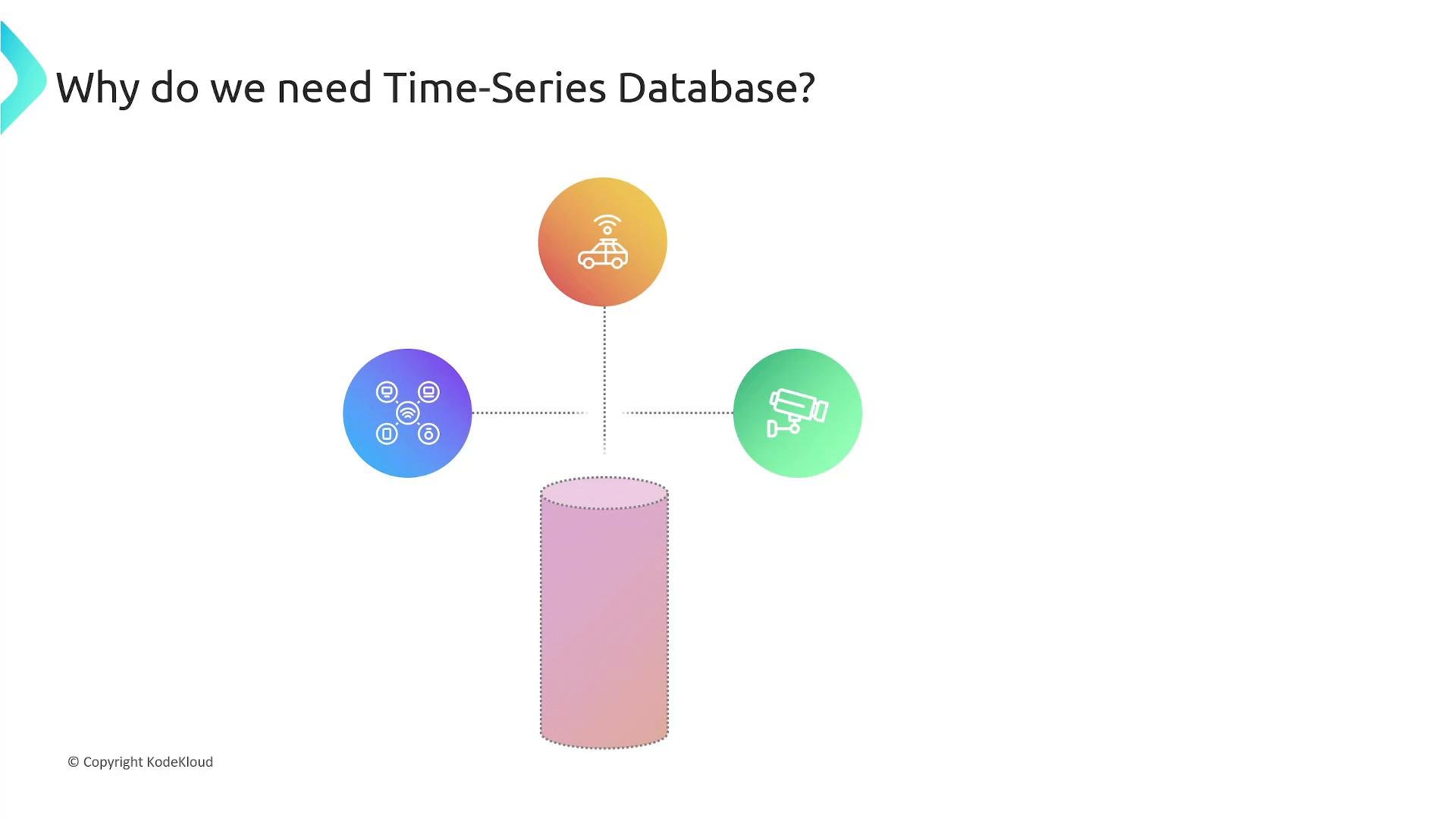
What Amazon Timestream provides
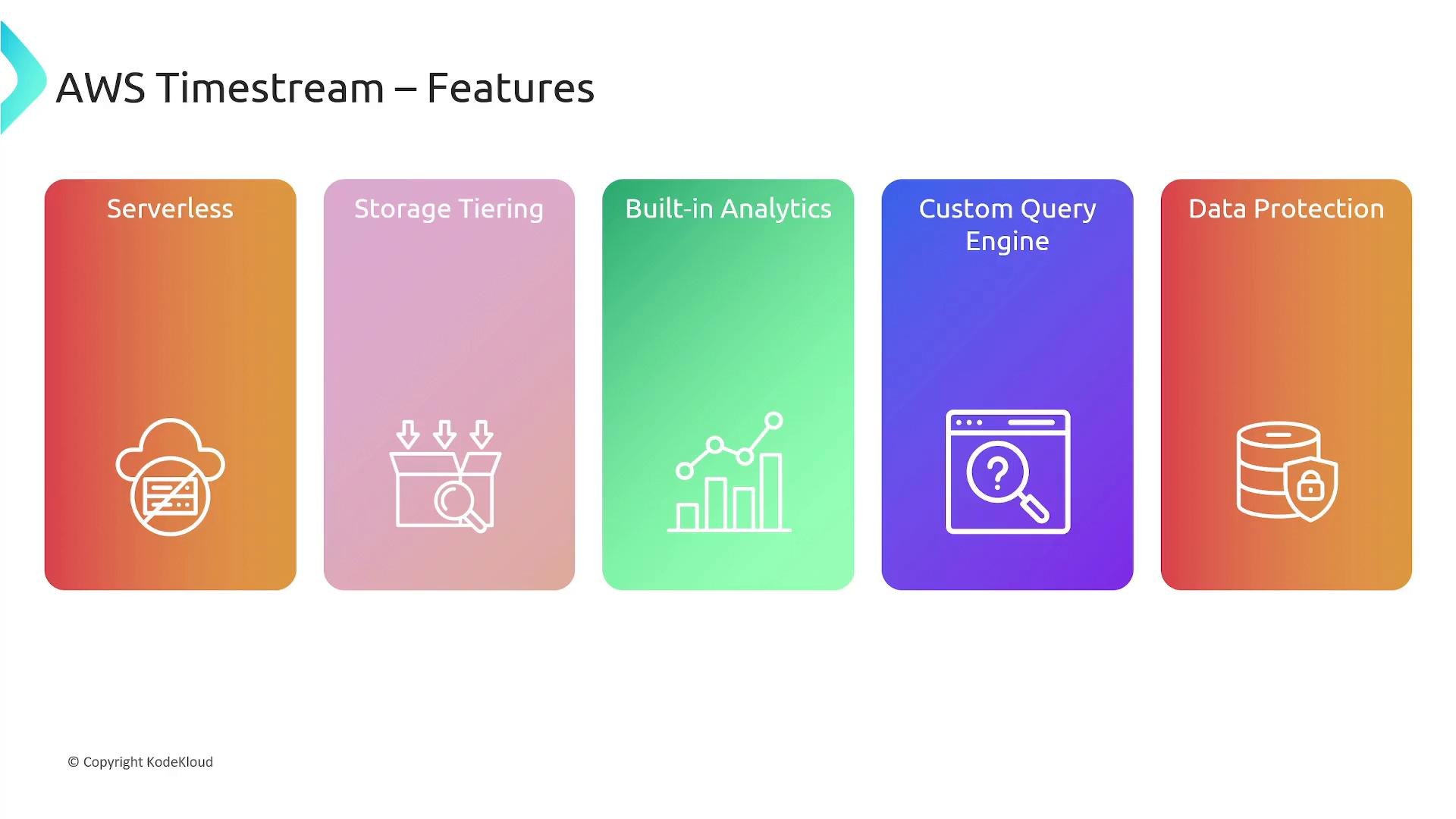
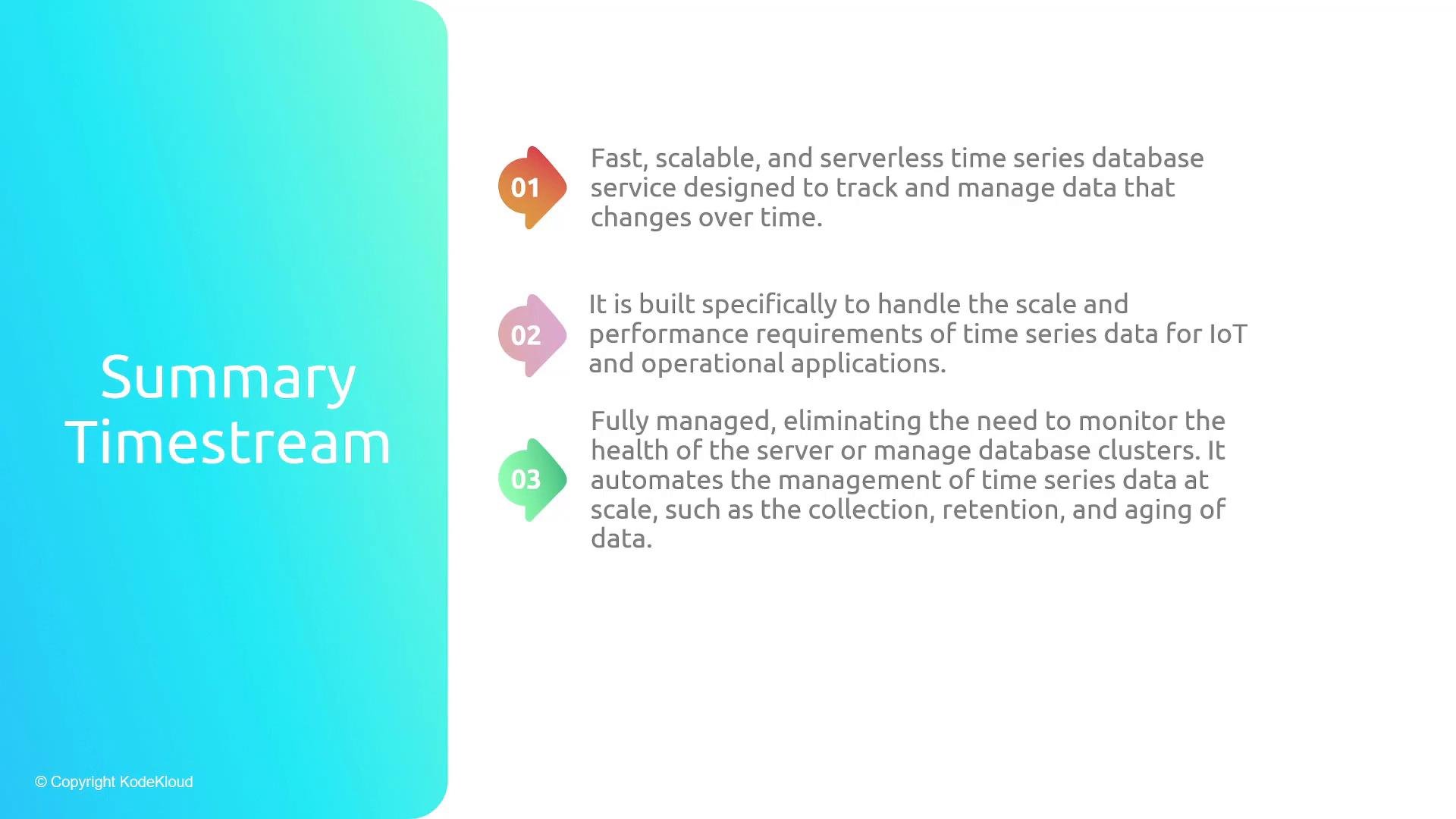
Timestream is built specifically for time-series data and addresses the challenges above with these key design points:- Serverless scaling: No capacity planning or infrastructure management—Timestream automatically scales to handle ingestion and query load.
- Flexible schema: Schemas are inferred from incoming records, allowing metrics and attributes to evolve without disruptive migrations.
- Storage tiering and lifecycle policies: Recent data is maintained in a memory store for fast access; older data is moved automatically to a magnetic store based on configurable retention rules to control cost.
- Time-aware indexing & partitioning: Data is partitioned by time and by attributes to accelerate time-series aggregations and windowed queries.
- Purpose-built query engine: A SQL-like query language supports time-series functions, windowing, interpolation, and aggregation across storage tiers in a single statement.
Quick example: Timestream SQL
Here is a simple query to retrieve CPU utilization metrics for the last hour and aggregate by minute:Integrations and ecosystem
Timestream integrates with AWS ingestion and analytics services as well as third-party visualization tools:- Ingestion: AWS IoT Core, Amazon Kinesis Data Streams, Kinesis Data Firehose, Amazon MSK (Kafka), and AWS Lambda are common ingestion paths.
- Analytics & ML: Use Amazon SageMaker and analytics frameworks to train models or analyze trends by querying Timestream or exporting data.
- Visualization: Amazon QuickSight, Grafana, and other BI/visualization tools can connect to Timestream to build dashboards and alerts.
- Backup & protection: Timestream supports backups and can be managed via AWS Backup for recovery and compliance.
- AWS IoT Core
- Amazon Kinesis Data Streams
- Kinesis Data Firehose
- Amazon MSK (Kafka)
- Amazon SageMaker
- Amazon QuickSight
Key features at a glance
Amazon Timestream is a strong choice when you need a managed, scalable datastore for timestamped data with built-in time-series operations and lifecycle controls. Consider it when ingesting telemetry, operational metrics, or industrial sensor data at high volume.
Common use cases
- IoT telemetry and sensor data collection — high-cardinality, time-stamped device measurements.
- DevOps, observability, and monitoring — system metrics, KPIs, and operational trends over time.
- Industrial telemetry and predictive maintenance — analyze long-running patterns to anticipate failures.
Operational model and cost considerations
Timestream is fully managed—AWS handles patching, availability, scaling, and replication. Still, consider the following when designing your solution:- Retention policies: Configure retention periods carefully to balance query performance and long-term storage cost.
- Ingestion patterns: Batch vs. streaming ingestion affects cost and latency.
- Query efficiency: Use appropriate binning, filtering, and aggregation to minimize scanned data and reduce query costs.
Monitor your ingestion and retention settings. High-cardinality dimensions, long retention periods, or inefficient queries can increase costs. Plan schema and retention policies to align with analytics needs and budget.
Schema evolution and flexible data model
Timestream adapts as new fields are added to incoming records. This schema-on-write flexibility means you do not need to predefine every metric or attribute before ingestion—Timestream infers types and stores measures and dimensions in a way that supports evolving telemetry data. Combined with automatic tiering and lifecycle management, this helps control storage cost while keeping recent data fast to query.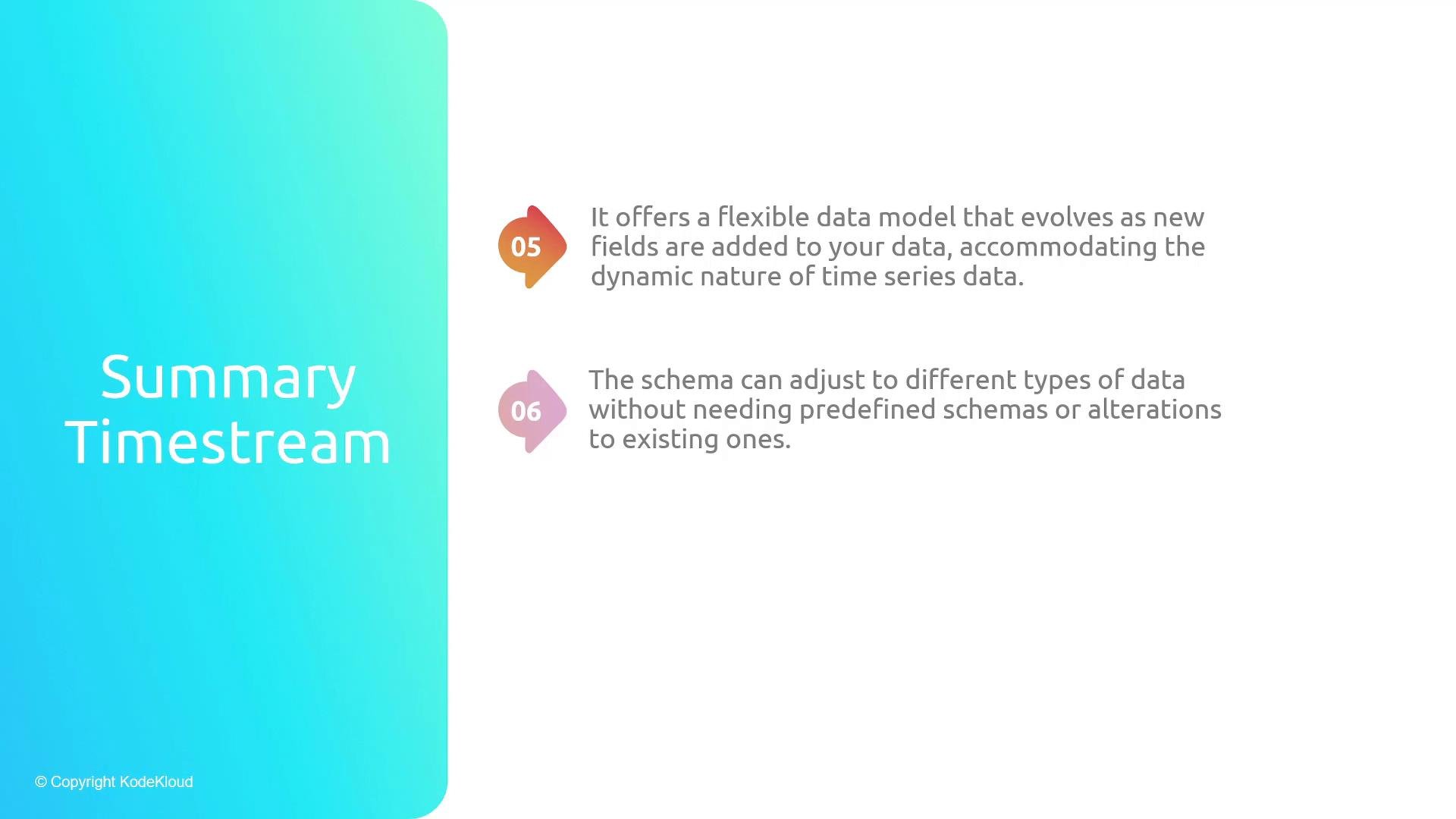
Further reading and references
- Amazon Timestream documentation: https://docs.aws.amazon.com/timestream
- AWS time-series best practices and architecture guides
- Tutorials for connecting Timestream to Grafana and QuickSight