

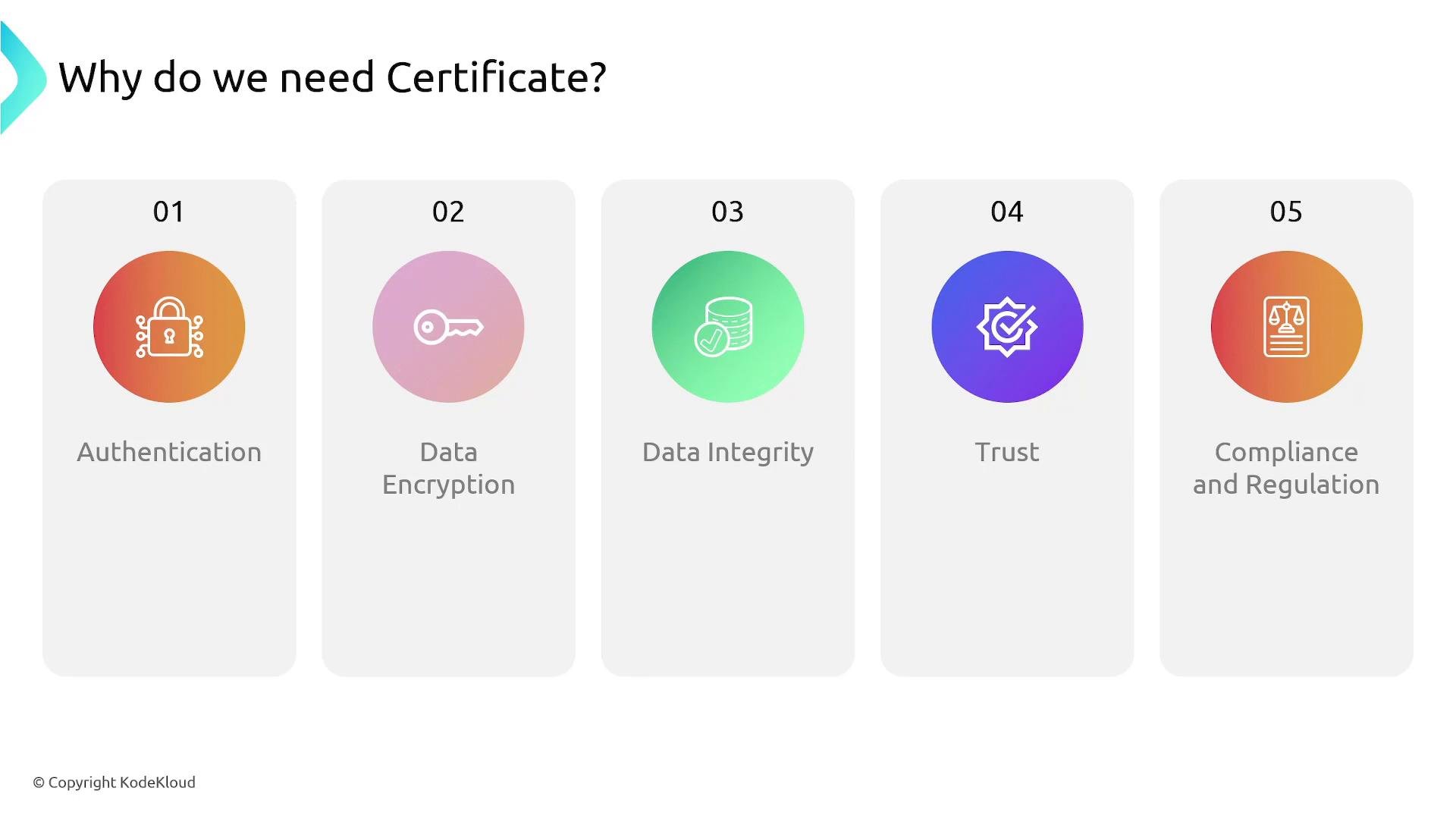
- Authentication — verify the identity of the server or service so clients know they are talking to the intended party.
- Encryption — enable TLS/SSL to encrypt data in transit between client and server.
- Integrity — ensure the data has not been tampered with in transit.
- Trust — certificates are issued by trusted certificate authorities after verification.
- Compliance — many regulatory standards require SSL/TLS protection for sensitive data.
- AWS Certificate Manager (ACM): requests, validates, issues, and manages certificates for supported AWS services.
- AWS Private Certificate Authority (PCA): a managed private CA for internal/private certificates (PCA is a paid feature).
- Elastic Load Balancing (ALB/NLB)
- Amazon CloudFront
- Amazon API Gateway
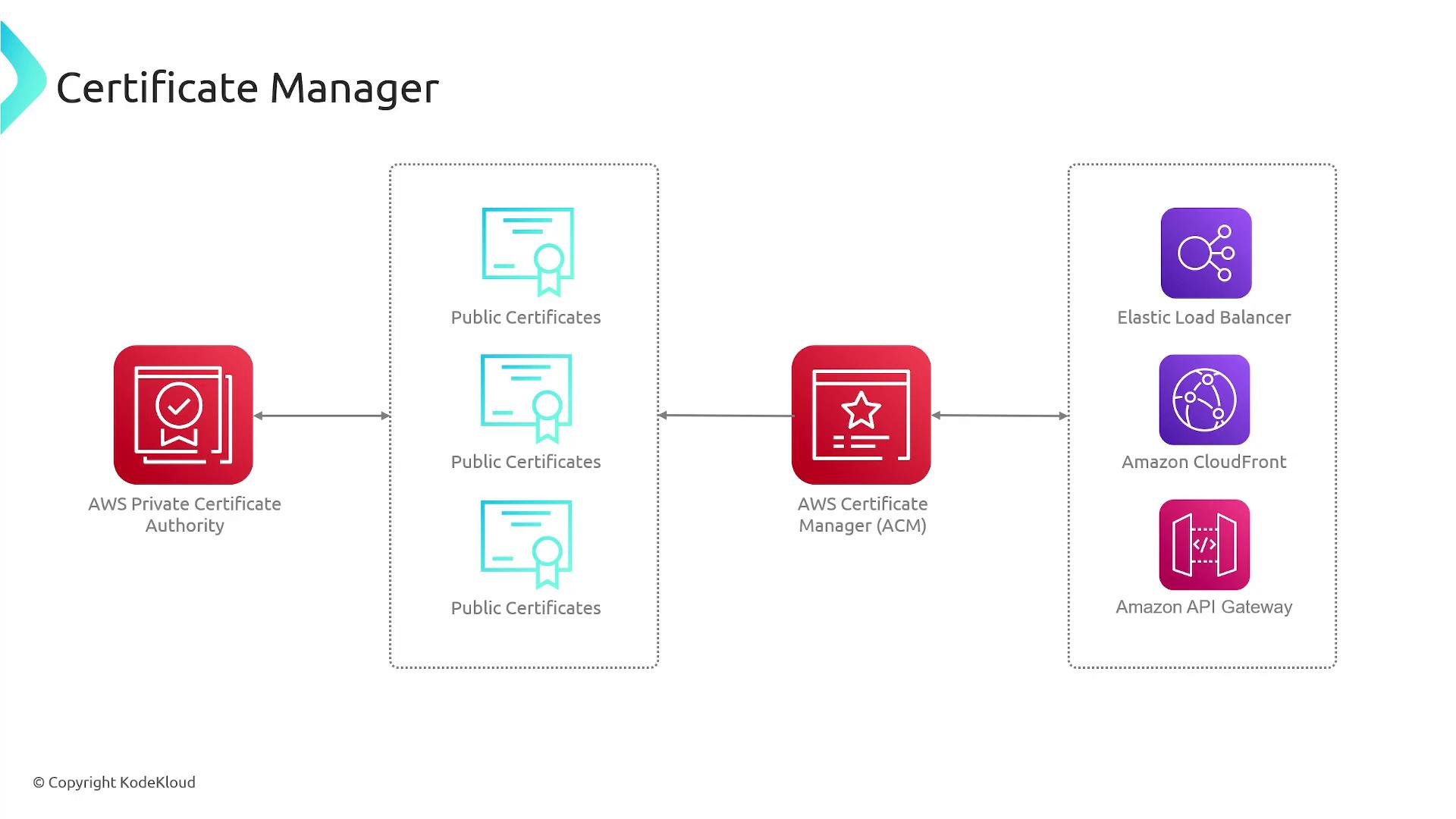
ACM-issued public certificates are provided at no additional cost. The private key for certificates issued by ACM is managed by AWS and is not exportable. If you need an exportable certificate (for example, to install directly on an on-prem server), you must import your own certificate with its private key into ACM.
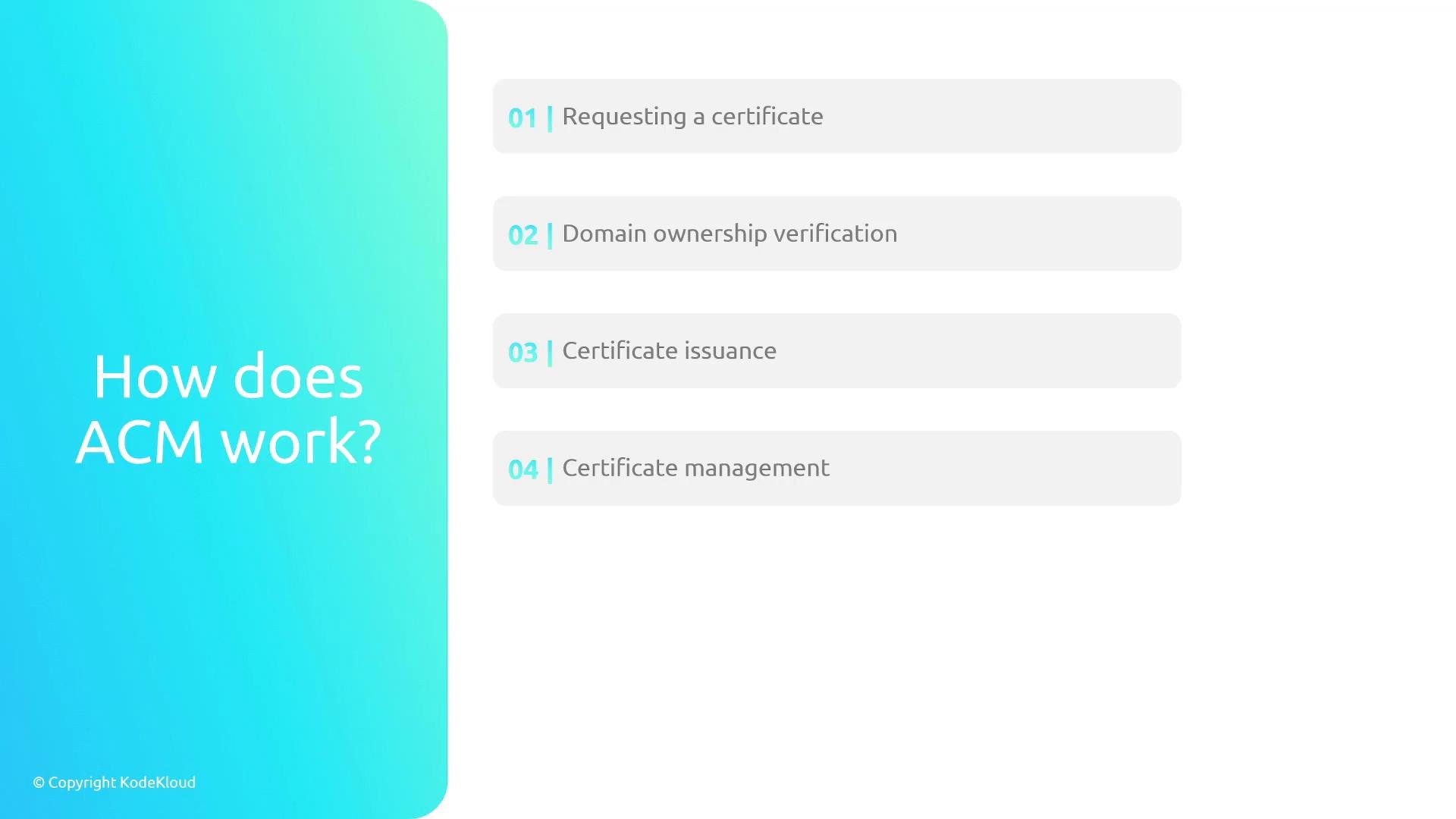
- Request or import a certificate — specify the domain names the certificate must cover, e.g.,
example.comandwww.example.com. - Domain ownership validation — validate domain control with DNS validation (recommended and automatable using Amazon Route 53) or email validation.
- Certificate issuance — ACM issues the certificate after successful validation.
- Certificate management — ACM auto-renews issued certificates; retain validation records (DNS) to allow automatic renewal.
-
Attach certificates to HTTPS/TLS listeners on fronting services:
- Application Load Balancer (ALB) — use for HTTP(S) and path-based routing.
- Network Load Balancer (NLB) — use TLS listeners for high-performance, low-latency TCP-based TLS termination.
- CloudFront — use for global CDN-distributed HTTPS termination (public certificates for CloudFront must be in
us-east-1). - API Gateway — use for TLS termination on APIs.
- Backend communication: between the load balancer and backend instances you can choose HTTP or HTTPS. Use end-to-end encryption (HTTPS) for stronger security and compliance.
-
Regional scope: ACM is regional. Certificates are created in a specific AWS Region and cannot be used across Regions. Exception: public ACM certificates for CloudFront must be created in
us-east-1(N. Virginia).
Because ACM is regional, request certificates in the region where the fronting service resides. For CloudFront distributions, request the certificate in
us-east-1. Also, automatic renewal requires the DNS validation records to remain present (if using DNS validation).
Features and benefits
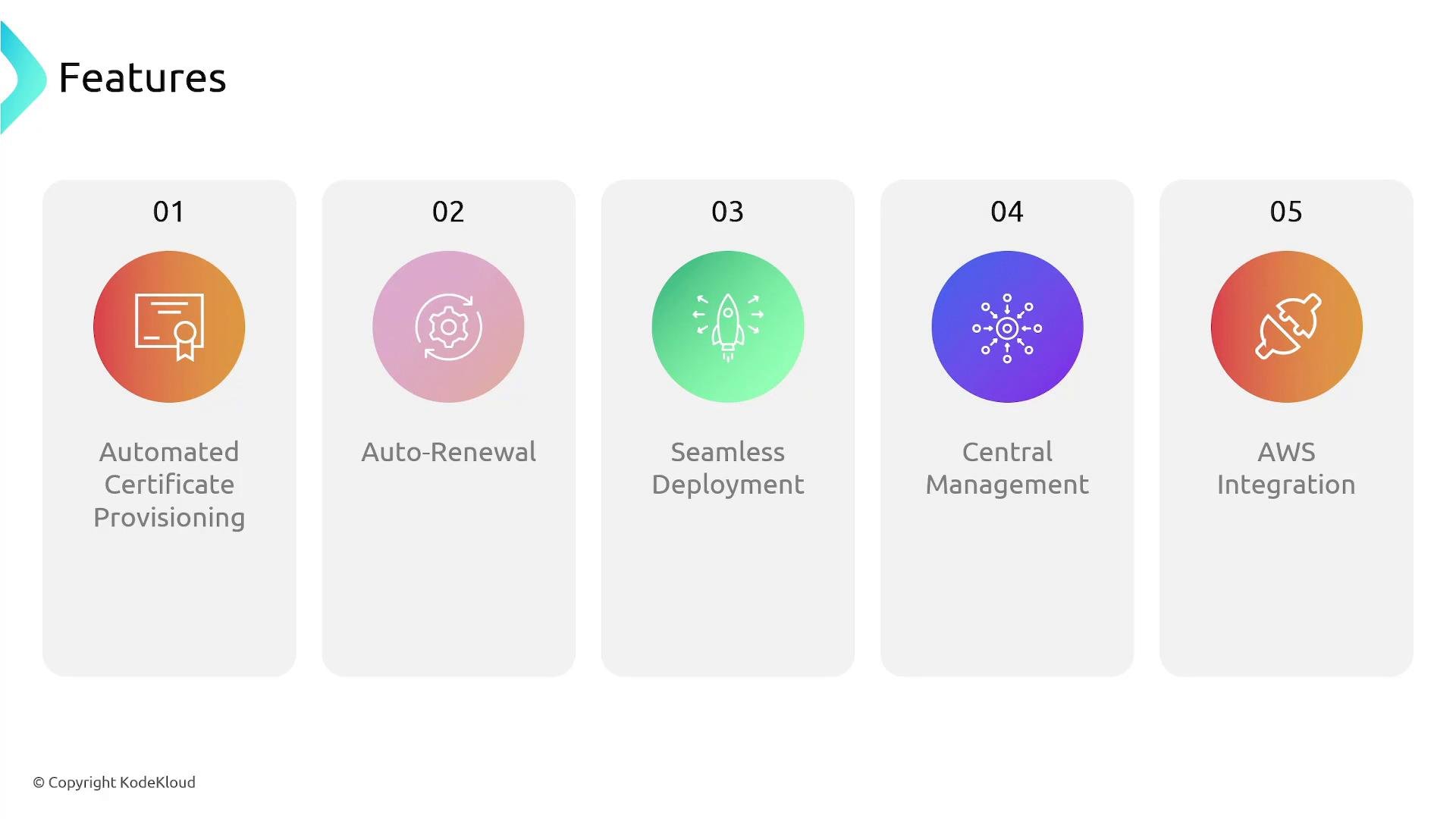
- Automated provisioning for public certificates and private certificates (with PCA).
- Auto-renewal for ACM-managed certificates (provided validation remains in place).
- Seamless deployment to supported AWS services, reducing manual configuration errors.
- Centralized certificate management across IAM and AWS-integrated services.
- Tight AWS integration: ELB, CloudFront, API Gateway, and more.
- Request a certificate (or import an existing one).
- Validate domain ownership (DNS or email).
- ACM issues the certificate.
- Attach the certificate to a supported service (ALB, NLB, CloudFront, API Gateway).
- ACM auto-renews certificates it manages (ensure validation records remain valid to enable automatic renewal).
- AWS Certificate Manager (ACM)
- AWS Private Certificate Authority (PCA)
- Elastic Load Balancing (ALB/NLB)
- Amazon CloudFront
- Amazon API Gateway
- Amazon Route 53