

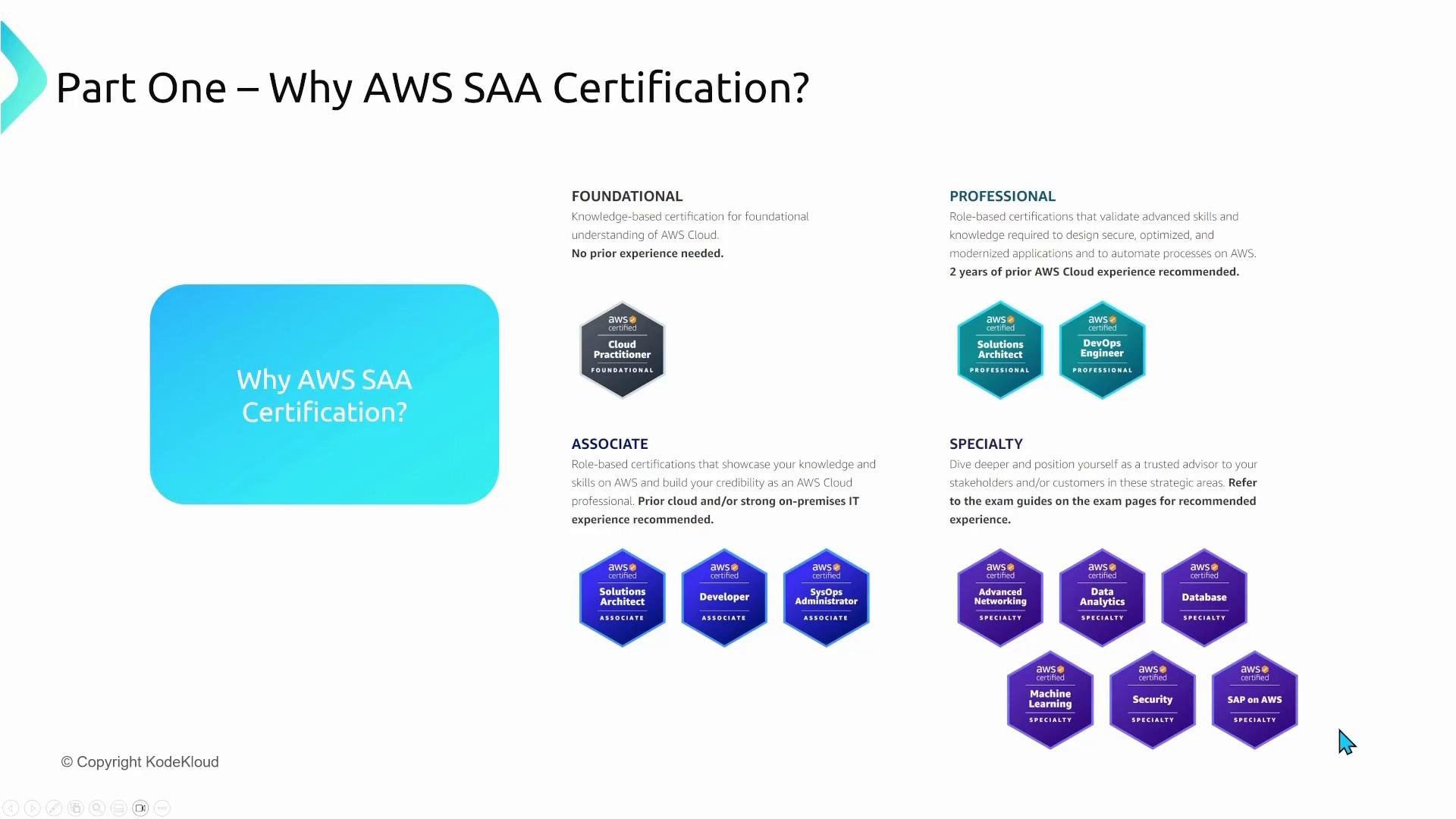
AWS periodically updates exam offerings. For example, the AWS Data Analytics (Associate) exam has been retired and AWS plans to offer a Data Engineering (Associate) exam as a replacement. Always verify current exam names, availability, and retirement notices on the official AWS Certification site before planning your study path.
Where the SAA fits in the AWS certification map
The hexagon/color metaphor on the slide simply maps exam levels visually: Foundational, Associate, Professional, and Specialty—indicating increasing depth and specialization.
Recommended hands-on experience
Why choose the Solutions Architect — Associate (SAA)?
- High industry value: commonly taken after the Cloud Practitioner and broadly recognized by employers.
- Broad applicability: covers core AWS services, architectural best practices, security fundamentals, cost optimization, and operational considerations that apply across many cloud roles.
- Career flexibility: prepares you for roles in cloud architecture, DevOps, platform engineering, and technical leadership.
What to expect on the SAA exam
The SAA focuses on practical design and architectural decisions rather than deep service internals. Core domains you’ll encounter include:- Designing resilient architectures (high availability and fault tolerance)
- Designing high-performing and scalable architectures
- Designing secure applications and architectures
- Designing cost-optimized architectures
- Defining operationally excellent architectures and runbook considerations
Study tips:
- Focus on core services (EC2, S3, RDS, VPC, IAM, Lambda, EBS, ELB, Auto Scaling) and how they combine to meet non-functional requirements (security, availability, cost).
- Practice with hands-on labs and real AWS accounts to reinforce design patterns.
- Use official exam guides and practice exams to get familiar with question style and time management.
Quick study roadmap
- Review core AWS services and their primary use cases.
- Learn architectural patterns for fault tolerance, scaling, and cost optimization.
- Practice scenario-based questions and timed practice exams.
- Build small architectures in a lab environment and test failure and scaling behavior.
- Review security best practices (IAM, encryption, network isolation).