

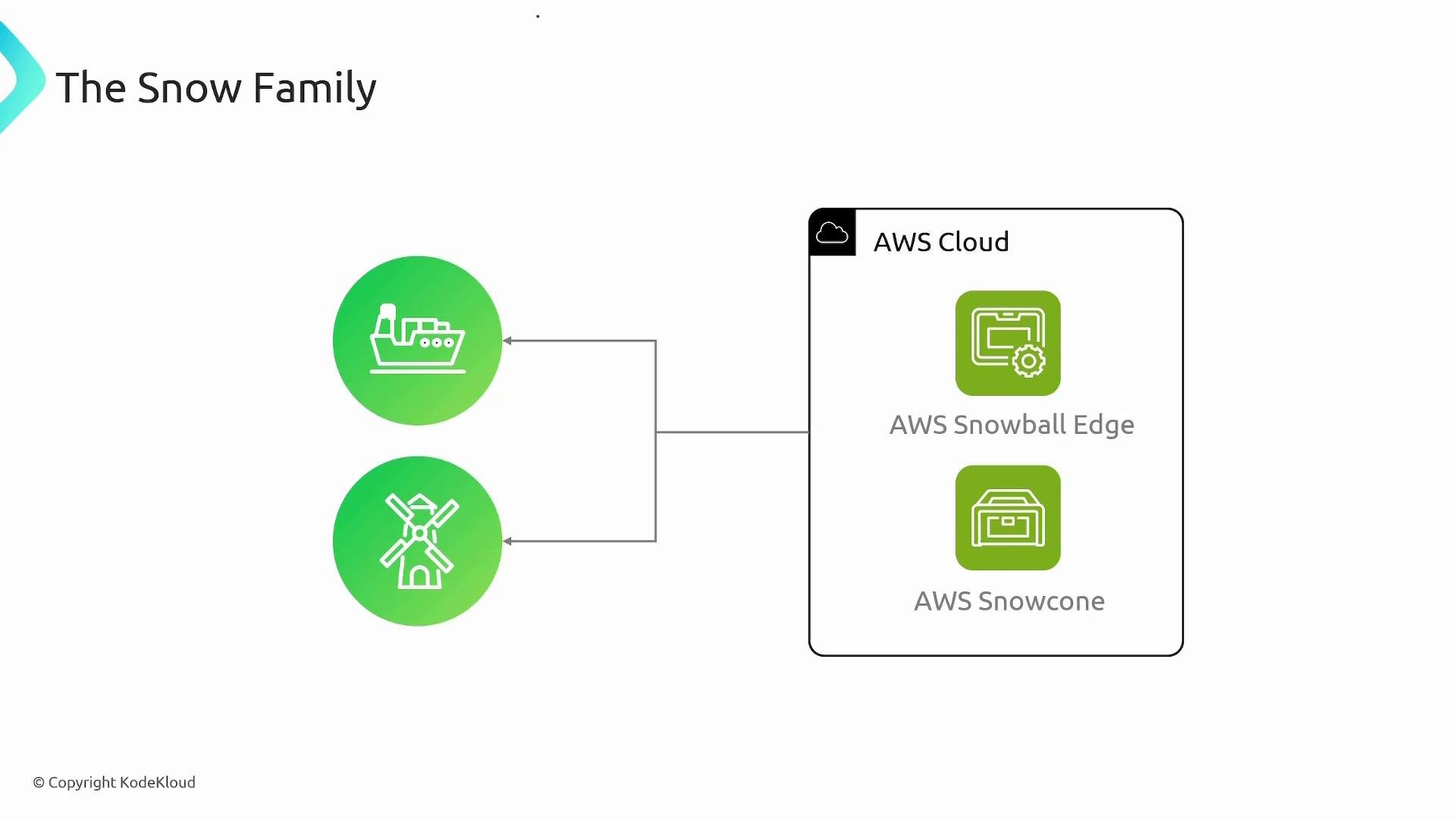
- Order a Snow device (for example, Snowcone or Snowball Edge).
- AWS ships the device to your location.
- Configure the device and copy your local data to it.
- Ship the device back to AWS for ingestion.
- AWS imports the data into your account and securely wipes the device.
- Ruggedness and portability: Built to endure extreme temperatures, dust, humidity, and physical shock—suitable for harsh or mobile environments where standard servers are impractical.
- Local processing and reduced transfer: Preprocess, encrypt, analyze, or filter data at the edge to reduce the amount and cost of data transferred to AWS.
- Offline and remote use cases: Useful on construction sites, ships, remote research stations, or other locations with intermittent or no connectivity.
- Integrated security: Hardware-based root of trust (TPM) and encryption integrated with AWS Key Management Service (KMS).
- Flexibility: Can run AWS IoT Greengrass components, Lambda functions, and containerized workloads depending on the model.
- AWS IoT Greengrass components for local messaging and management.
- Lambda functions (deployed via Greengrass) for event-driven processing at the edge.
- Local EC2 instances and accelerated compute on Snowball Edge (for higher compute needs).
- Portability: Extremely compact and lightweight (approximately 4.5 lb; ~9 in × 6 in × 3 in), designed for easy transport.
- Storage: Around 8 TB of usable storage (exact capacities vary by model).
- Rugged design: Dust-tight and water-resistant to withstand field conditions near deserts, oceans, and other harsh environments.
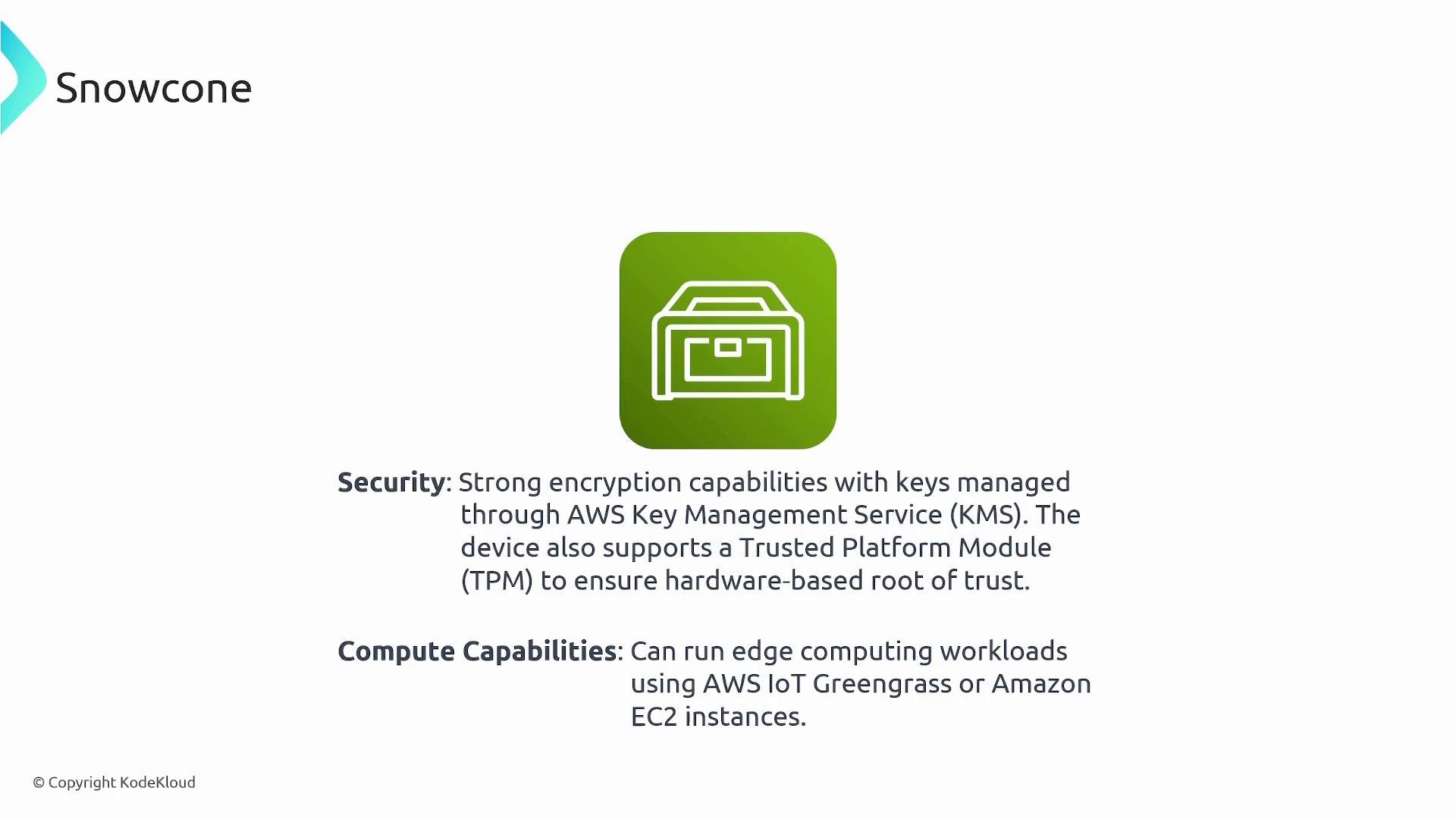
- Security: Built-in encryption integrated with AWS KMS and a Trusted Platform Module (TPM) for hardware-based root of trust.
- Compute: Supports edge compute via AWS IoT Greengrass—run Lambda functions and containerized workloads for local processing and analysis.
- Edge computing: Run local workloads close to the data source to reduce latency.
- Data migration: Collect, transport, and import large datasets into AWS securely.
- Ruggedness: Built for operation in remote and harsh environments.
- Security: Hardware TPM and AWS KMS integration provide robust encryption and device identity.
- Portability: Small, lightweight form factor for field use and mobile workflows.
Snowcone is the smallest, most portable Snow device—ideal for highly remote or mobile operations. If you require greater storage, full EC2 instance support, or GPU/accelerated compute, evaluate Snowball Edge models instead.