

- It means creating architectures focused on one or more desired attributes (the “X”) and choosing services and configurations that maximize that attribute.
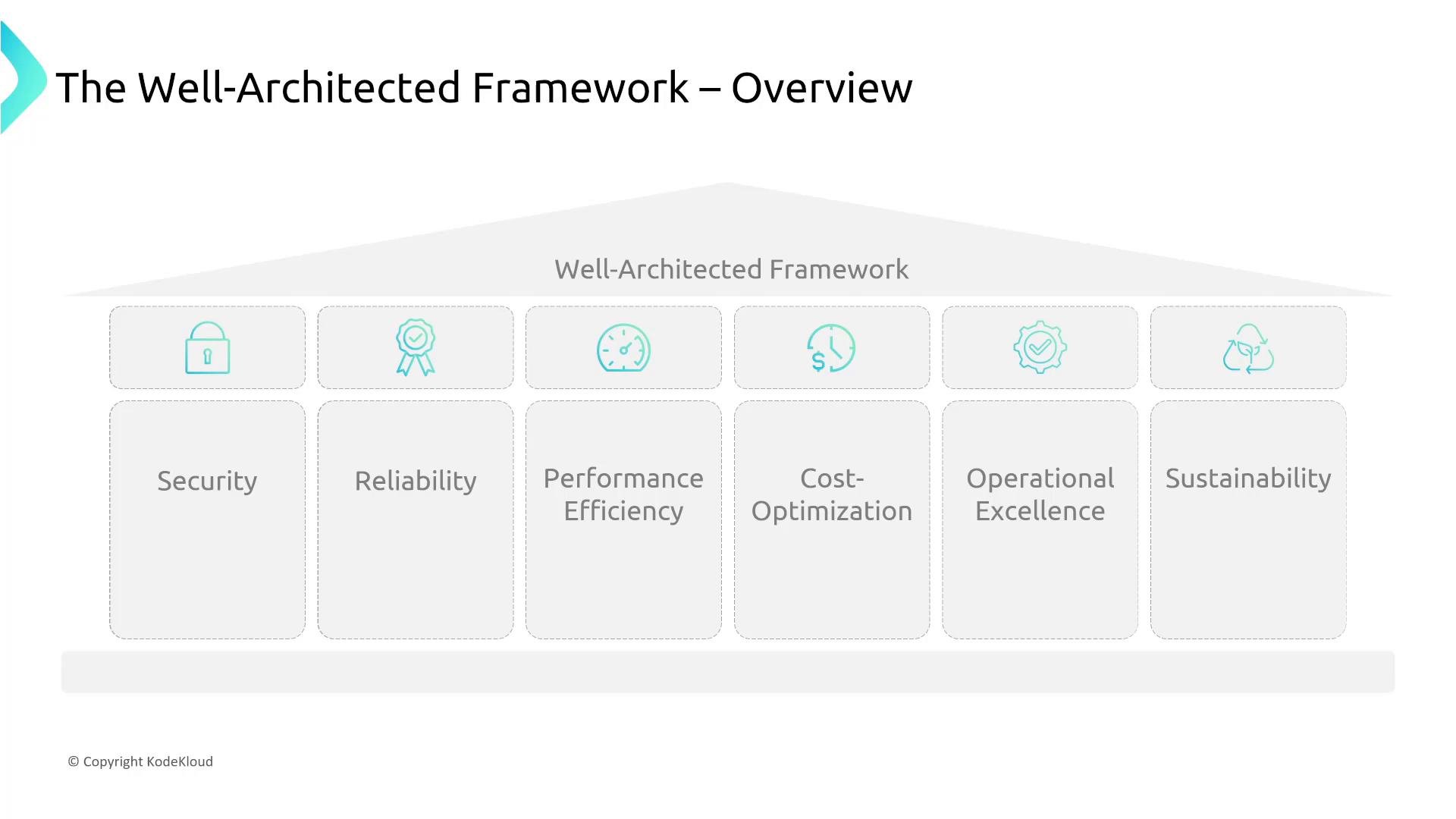
- For this course we emphasize the four pillars most relevant to the Solutions Architect Associate exam: security, reliability, performance efficiency (often shortened to performance), and cost optimization. These are drawn from the AWS Well-Architected Framework, which contains six pillars in total.
- Security — protecting workloads, access controls, identity management, and following the shared responsibility model.
- Reliability — designing for fault tolerance, availability, and disaster recovery.
- Performance efficiency — right-sizing, selecting the best services, and scaling appropriately.
- Cost optimization — minimizing spend through the right service choices, provisioning strategies, and operational practices.
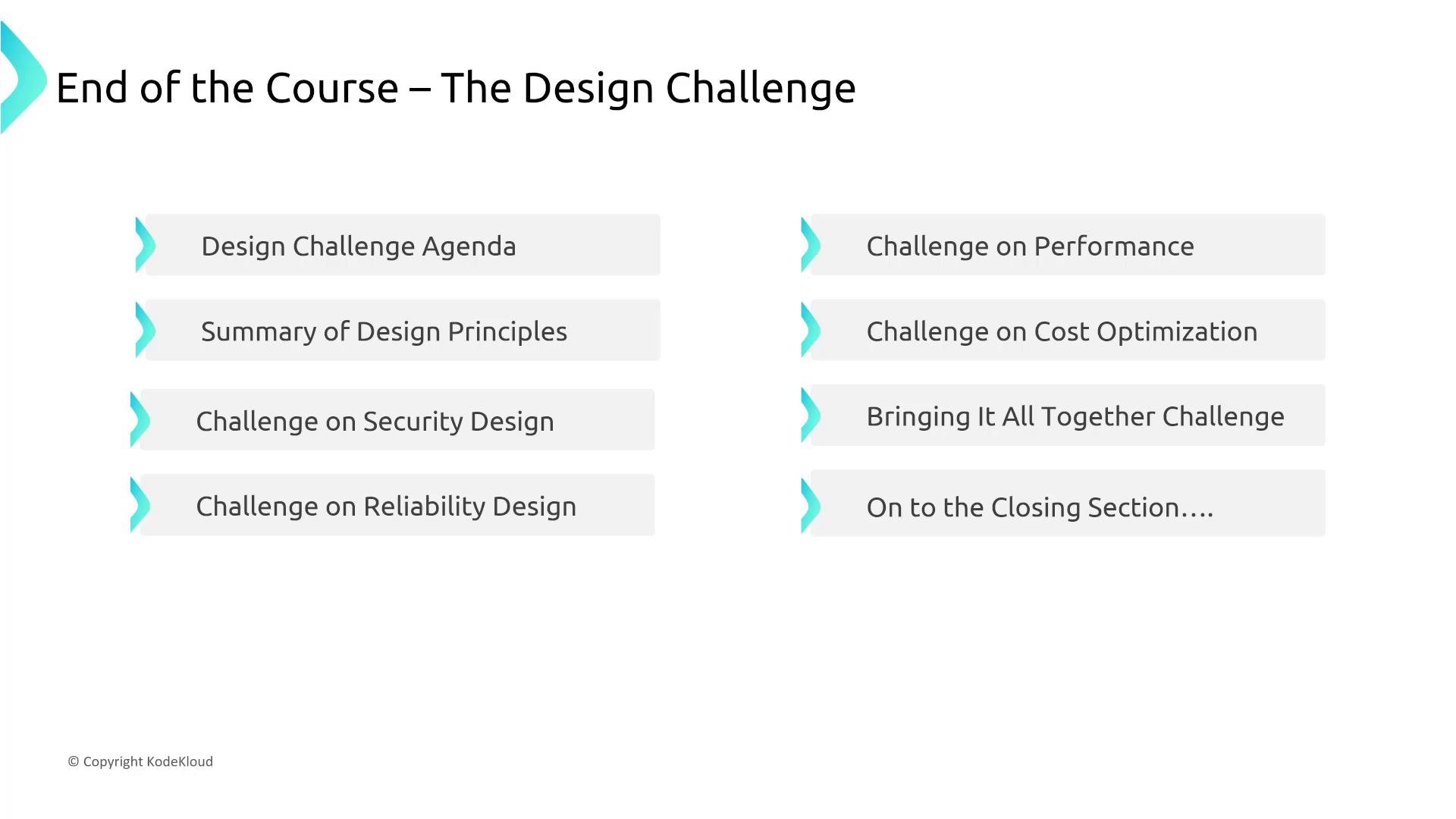
- The mega section is divided into five subsections:
- Design for Security
- Design for Reliability
- Design for Performance (Performance Efficiency)
- Design for Cost Optimization
- A drag-and-drop design challenge that tests service placement and integration
- Overview of the attribute and core principles.
- How to improve that attribute across major AWS service categories (networking, compute, storage, database, and other common groups).
- Exam-style questions and diagrams that reflect how these topics are tested on the certification.
Each subsection follows: overview → principles → service-specific choices → exam-style questions → a practical design challenge. This sequence helps you build conceptual understanding, then apply it in exam-like scenarios.
- Focus on exam-relevant reasoning and trade-offs rather than exhaustive configuration detail.
- Use short, exam-style questions and architecture diagrams to train your decision-making.
- Finish the mega section with a comprehensive design challenge that combines security, reliability, performance, and cost constraints.
- Each pillar is examined across nine common AWS service categories (networking, compute, storage, databases, identity & access, application integration, monitoring & logging, data protection, and deployment/operations). You’ll learn the levers and trade-offs for each category.
- The final activity is an integrated design challenge that requires you to apply the four pillars together.
- You will place services, pick configurations, and justify trade-offs across competing constraints (for example: maximize reliability while minimizing cost).
- This challenge simulates the multi-constraint problems you’ll face in the exam and in real-world architecture decisions.
- Learn the core principles for each pillar first — these are the highest-value concepts on the exam.
- For each service category, memorize key design levers (for example: use multi-AZ for availability, caching for read-heavy workloads, and lifecycle policies to reduce storage cost).
- Practice the exam-style diagrams: describe the trade-offs for each design choice and be ready to justify them in terms of the four pillars.
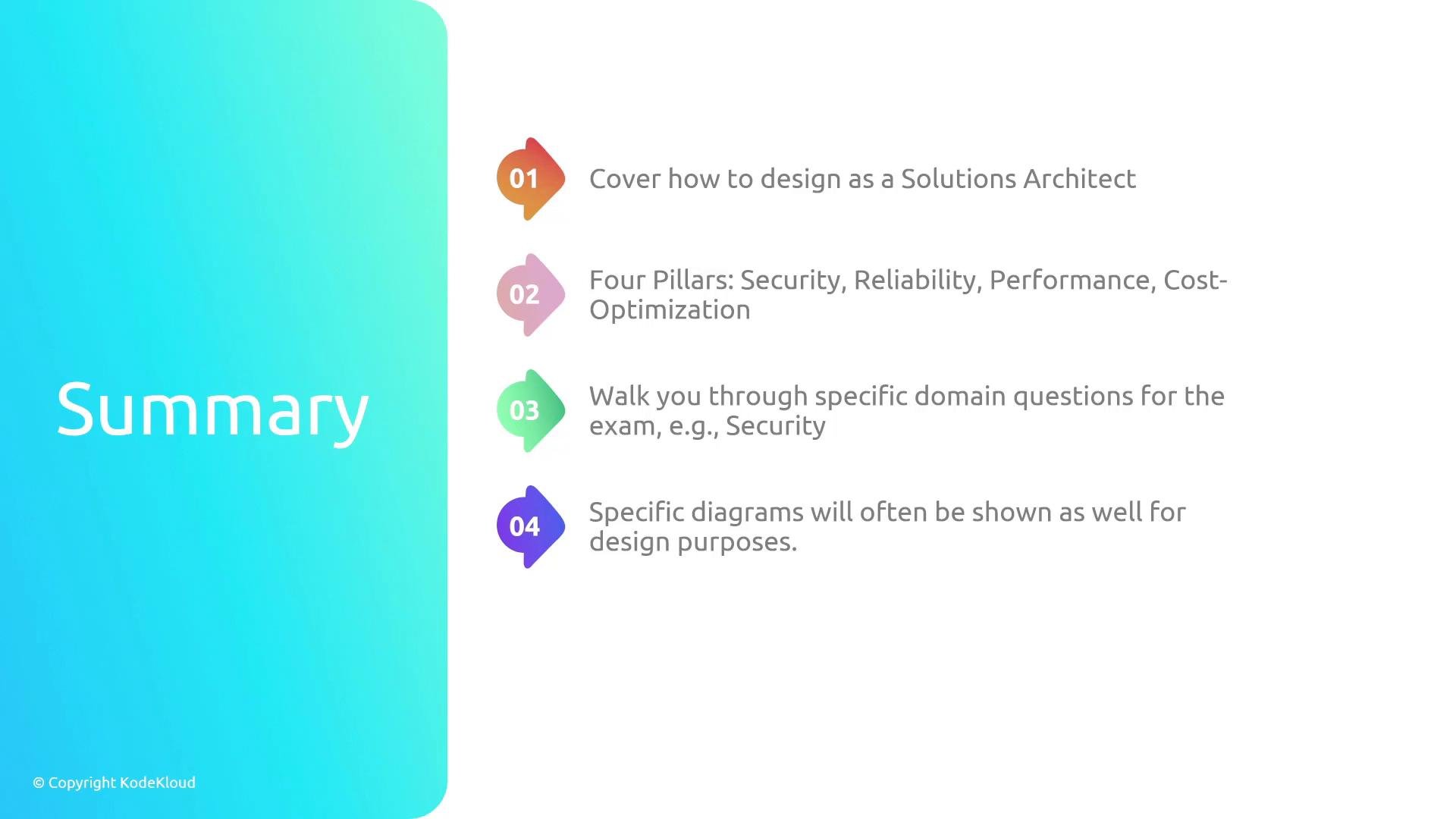
- This mega section trains you to design as a Solutions Architect with emphasis on the four exam-relevant pillars: security, reliability, performance, and cost optimization.
- Work through each subsection in order, practice the exam-style questions, and complete the design challenge to consolidate your skills.
- Take notes focused on the principles and service-level levers — you’ll need to reason across attributes during the final challenge.
When you begin the Design for X subsections, follow the structure: overview → principles → service-specific choices → exam-style questions → design challenge. This sequence improves retention and exam performance.