- Review high-level design principles for cost optimization.
- Organize cost thinking into foundational categories.
- Walk through service- and purchasing-specific cost choices plus billing tools and monitoring.
- Design principles for cost optimization
- Foundational cost categories and practices
- Service-specific cost optimization choices and billing tools
Design principles (high level)
These are concise, actionable principles to guide architecture and operational choices for cost optimization.- Think in terms of value — maximize performance per dollar: Value = desired performance ÷ cost. Optimize for business outcomes, not just raw cost reduction.
- Measure efficiency continuously — instrument workloads and correlate cost to performance and business metrics.
- Avoid undifferentiated heavy lifting — do not build or run components that do not give competitive advantage.
- Prefer variable consumption models where appropriate — shift fixed costs to pay-as-you-go or usage-based pricing to better align spend with demand.
- Right-size resources and choose the right purchasing patterns — use on-demand, Reserved Instances, Savings Plans, Spot Instances, or serverless architectures according to workload profile.
Foundational categories to organize cost-optimization thinking
Treat these categories as practical levers and organizational responsibilities for delivering predictable cost outcomes.
Use tagging consistently (team, project, environment) to make the table-backed reporting actionable.
Purchasing options and common trade-offs
When comparing cost options, consider both price and operational constraints (availability, flexibility, administration).
Example comparative guideline:
- Serverless (AWS Lambda) typically costs less for spiky, short-lived workloads because billing is per invocation and duration.
- Long-running, highly utilized EC2 instances can be cheaper with Reservations or Savings Plans.
Service-specific choices, licensing, and billing tools
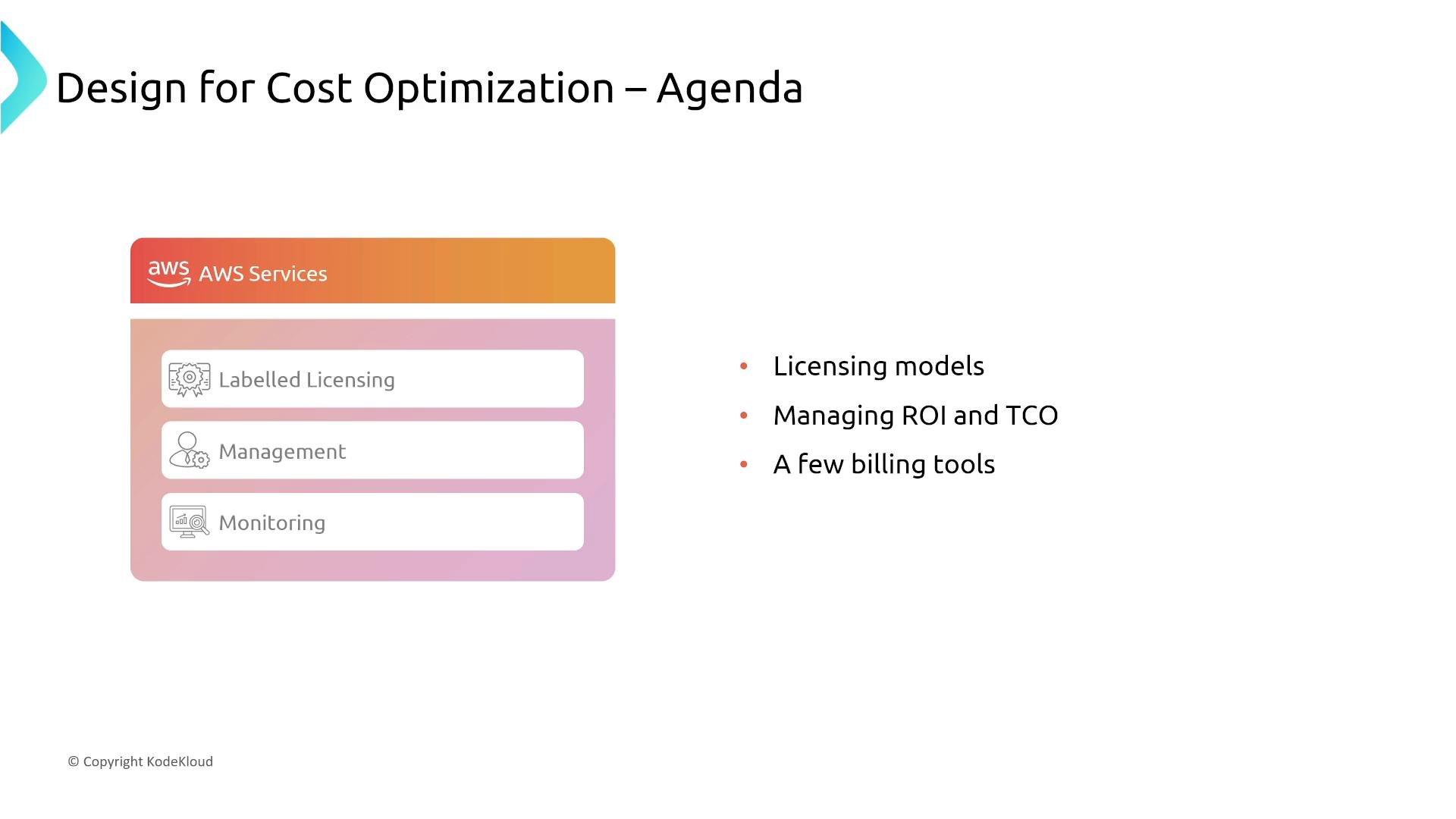
Key concepts and practical tools that architects should know:- Licensing models: Understand vendor licensing and how they map to cloud services (BYOL, license-included, subscription). Licensing can change cost calculus for lift-and-shift vs re-architect.
- Commitments: Use Reserved Instances or Savings Plans for predictable workloads to reduce compute spend.
- ROI and TCO: Compare total cost of ownership and return on investment when evaluating migration, re-platforming, or refactoring.
- Billing & monitoring tools:
- AWS Cost Explorer — analyze spending trends and identify cost drivers.
- AWS Budgets — set alerts for forecasted or actual spend thresholds.
- Cost and Usage Reports (CUR) — export granular usage data for downstream analysis.
- Tagging strategy — map resources to teams, features, and environments for accountability.
Treat cost optimization as a continuous process: instrument your workloads, automate tagging and budgets, and revisit purchase/architecture choices as utilization and business needs change.
Summary and exam perspective
- Expect cost optimization topics to be a smaller but important part of the design domain on the exam. Focus on comparative reasoning rather than exact dollar amounts.
- Know the trade-offs: when serverless is preferred over provisioned capacity, when to choose spot vs reserved capacity, and how tagging and budgets drive governance.
- Operational excellence matters: daily monitoring, automation (budgets, alerts), and disciplined financial management yield the best long-term value.