

Overview
Traditional Redshift setups involve provisioning a fixed combination of CPU, RAM, and storage resources. This model means you incur continuous charges—even when query activity is low—leading to overprovisioning and underutilization. As usage patterns fluctuate, you might end up paying for idle capacity.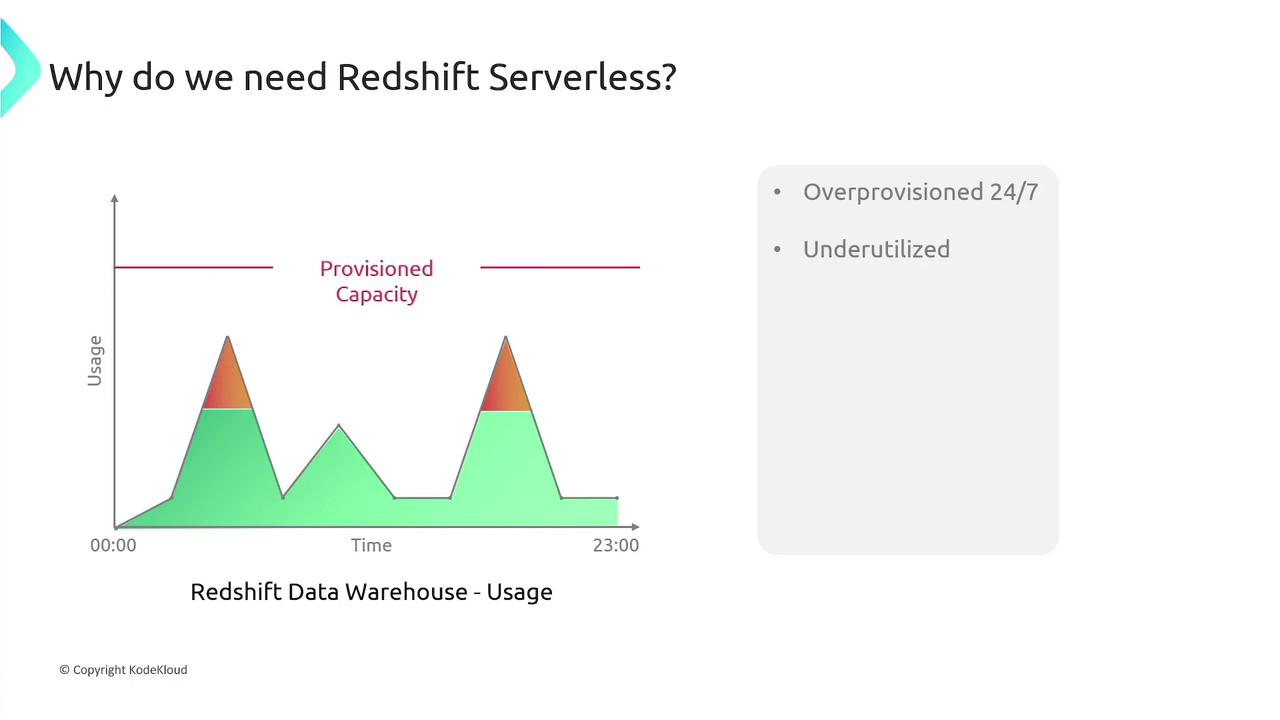
How Redshift Serverless Works
Redshift Serverless measures its data warehouse capacity in Redshift Processing Units (RPUs). Billing is executed on a per-second basis for RPU hours, covering all query workloads, including those accessing data in open file formats stored in Amazon S3.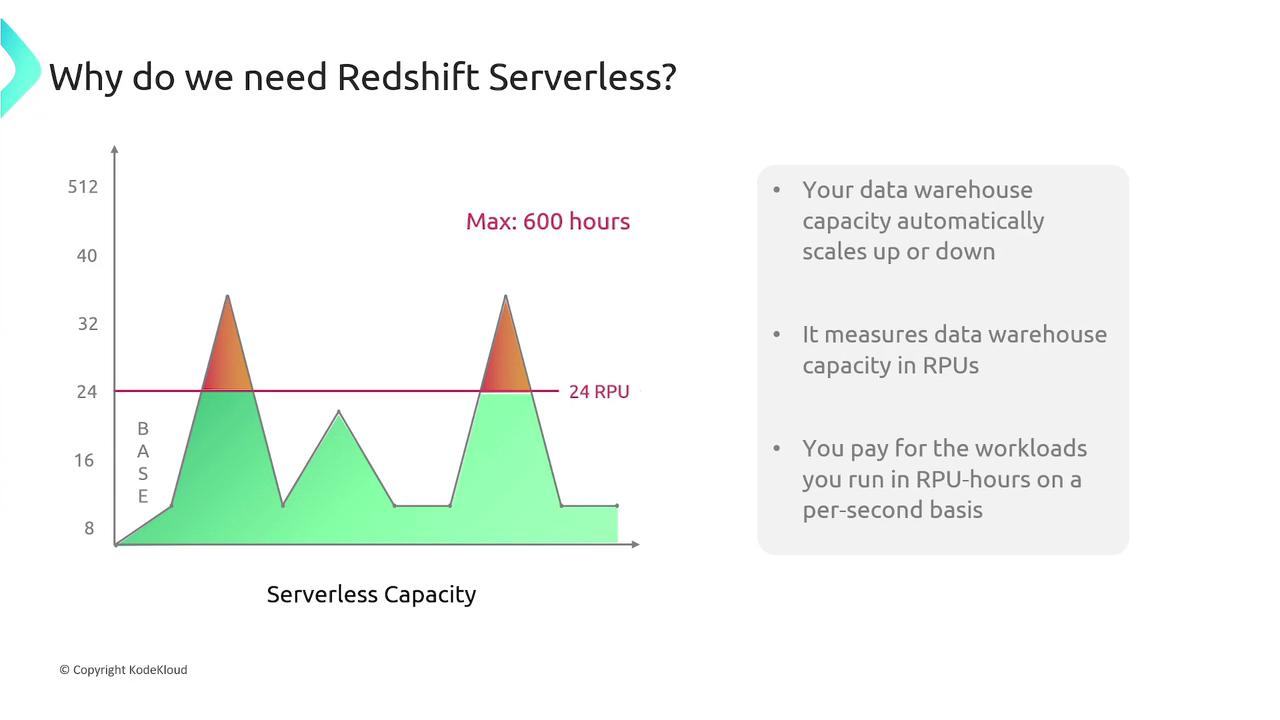
-
Base RPU:
Defines the minimum data warehouse capacity deployed to serve queries. This value is expressed in RPUs. -
Max Capacity:
Sets usage limits to control costs and defines automatic actions when limits are reached. The maximum capacity is also measured in RPU hours and can be configured for daily, weekly, or monthly durations.
Each RPU provides 16 gigabytes of memory. Adjusting the base capacity directly influences query performance, particularly for resource-intensive data processing tasks.
Configuring RPUs
The default base capacity for Amazon Redshift Serverless is 128 RPUs. You have the flexibility to adjust this setting between 8 and 512 RPUs in increments of 8 (for example, 8, 16, 24, etc.). These changes can be made using the AWS Management Console, the update workgroup API operation, or via the AWS CLI. For workloads operating with 8 to 24 RPUs, you can efficiently handle up to 128 terabytes of data. However, if your data storage requirements exceed this limit, a minimum capacity of 32 RPUs is recommended.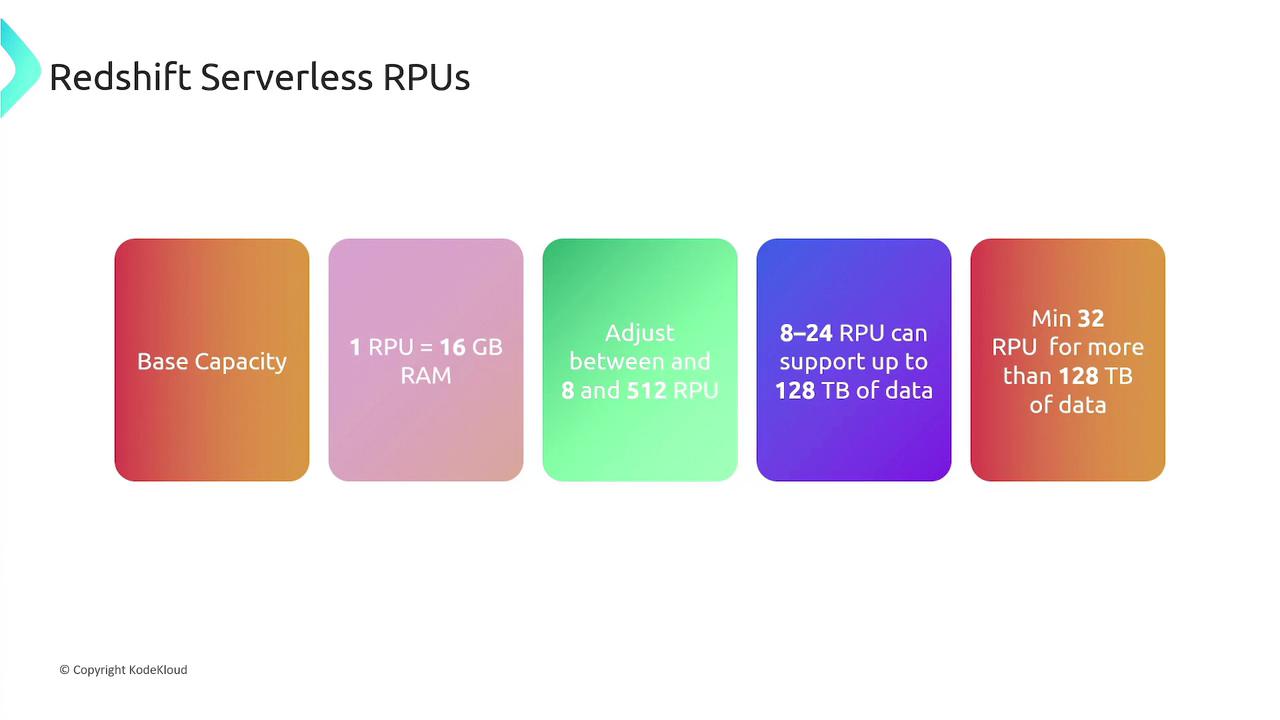
Features and Benefits
Redshift Serverless offers several key advantages:-
Cost Savings:
You pay only for the compute resources used, rather than incurring charges for pre-provisioned capacity that may remain idle. -
Scalability:
The service automatically scales resources up or down based on workload demands, ensuring efficiency during peak usage and cost reduction during off-peak periods. -
Simplified Management:
With automated scaling and resource allocation, you no longer need to manually balance the risks of overprovisioning and underprovisioning.
Summary
In summary, AWS Redshift Serverless is an on-demand data warehousing solution designed to automatically manage scaling and resource provisioning. RPUs serve as the measurement for both computational capacity and cost, with each RPU delivering 16 gigabytes of memory. You have the flexibility to adjust the capacity between 8 and 512 RPUs (in increments of 8) to meet your specific workload requirements. This dynamic adjustment ensures efficient query processing and predictable cost management while supporting modern data processing needs.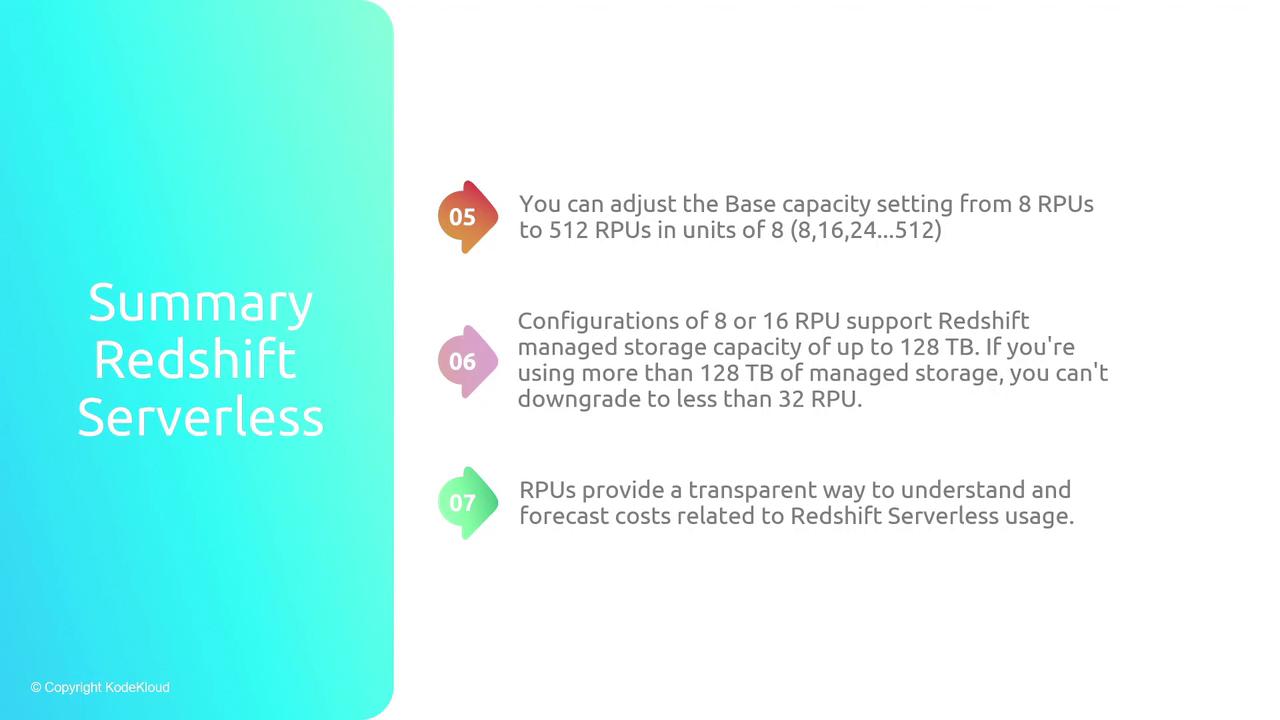
For further details on AWS Redshift Serverless and how it can revolutionize your data warehousing strategy, refer to the AWS Documentation.