

- OLTP systems are optimized for transactional operations (inserts, updates, deletes).
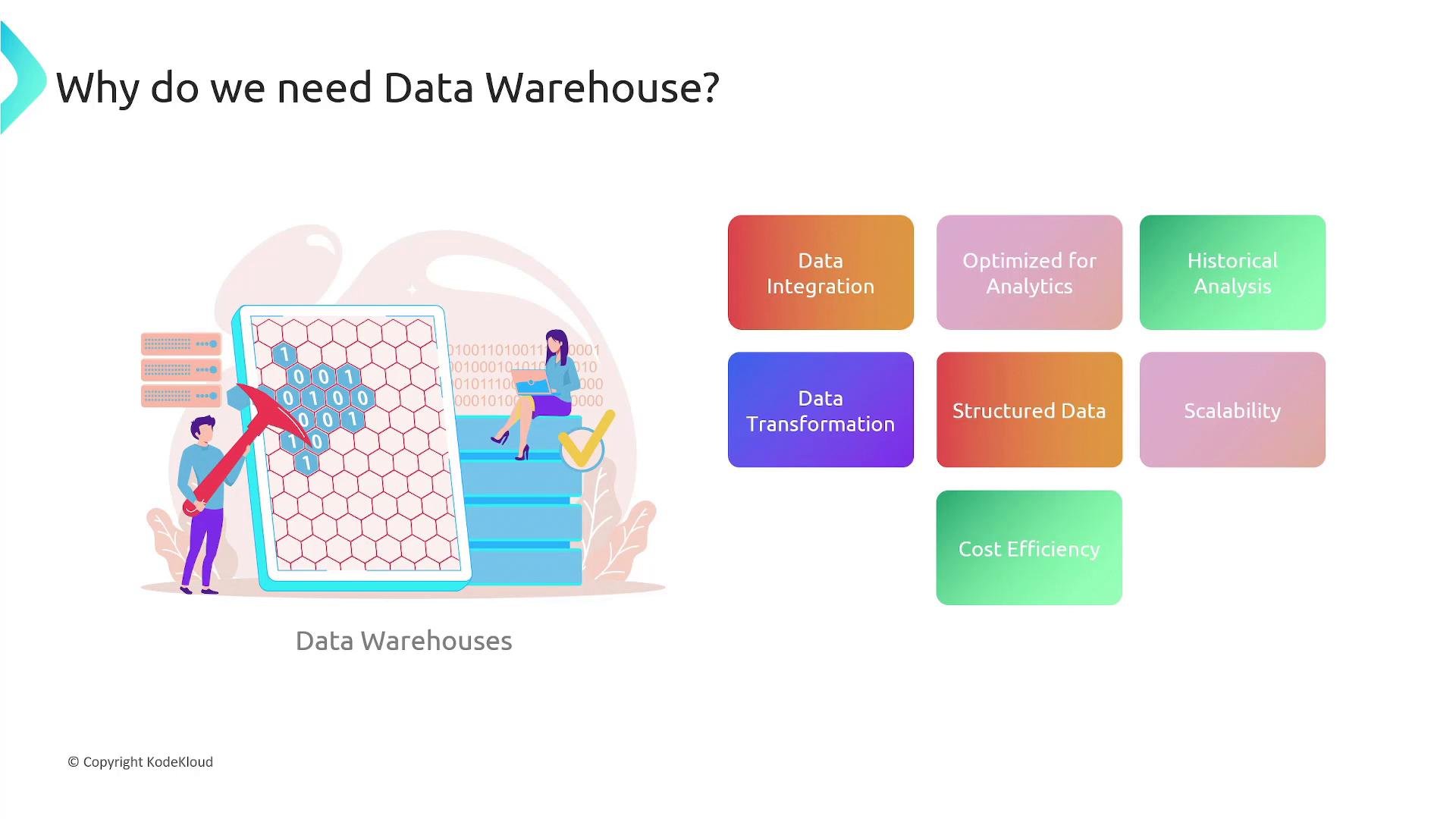
- Data warehouses are optimized for analytical, read-heavy workloads with complex, long-running queries and reporting across large datasets.
- Store historical data for trend analysis and comparisons.
- Include ETL pipelines to clean, transform, and aggregate data before analysis.
- Operate on structured and aggregated data to simplify analytics.
- Scale compute and storage independently to accommodate growth.
- Provide cost-effective read-optimized storage and query processing.
- Amazon Redshift is a fully managed, petabyte-scale cloud data warehouse on AWS.
- It provides a relational, SQL-based platform optimized for BI, reporting, and analytics.
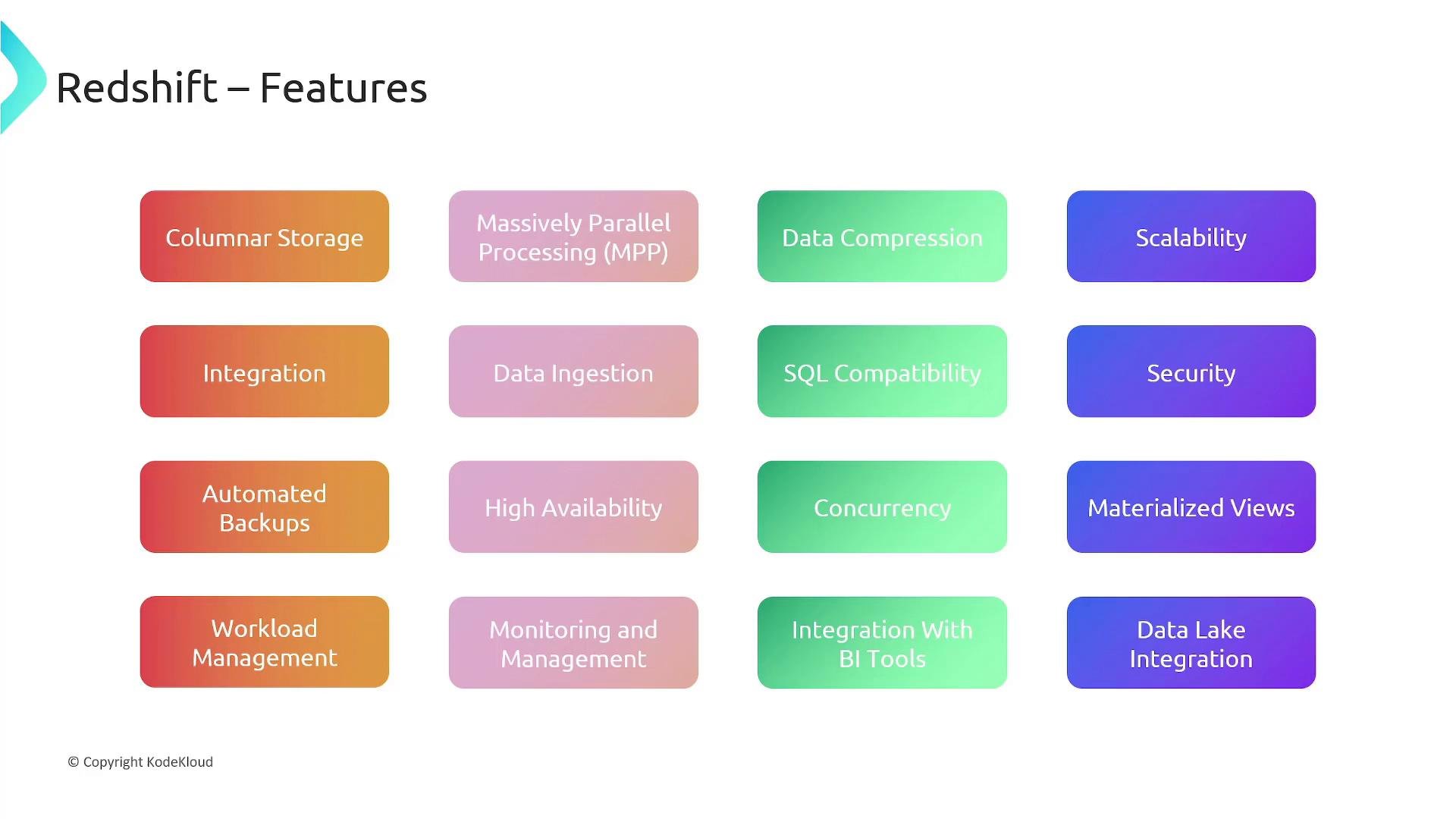
- Redshift uses columnar storage, compression, and massively parallel processing (MPP) to deliver fast query performance on very large datasets.
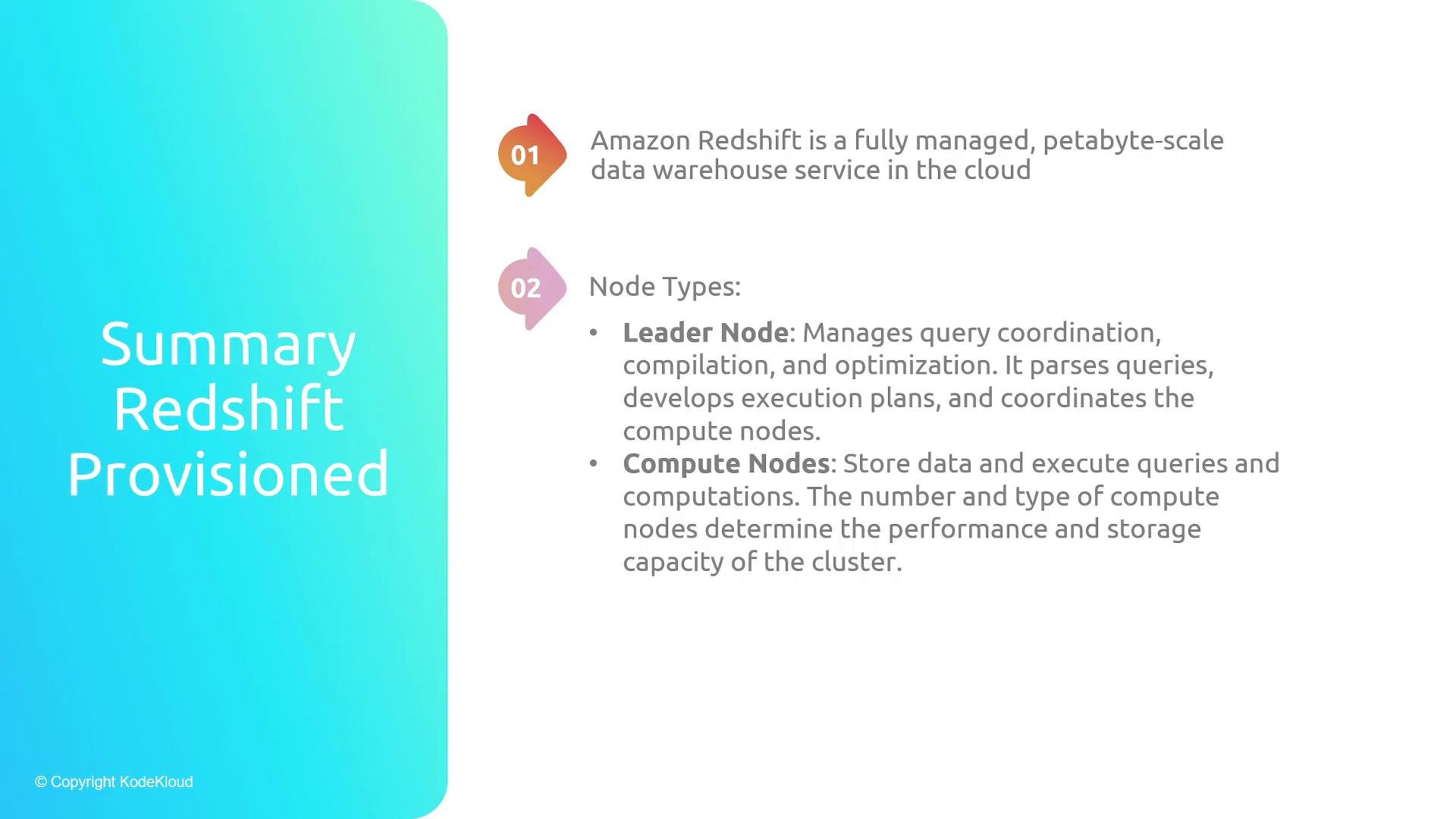
- Cluster: The fundamental deployment unit. A cluster contains one or more nodes.
- Leader node: Present when there are two or more compute nodes. The leader parses incoming SQL, generates query plans, coordinates compute nodes, and returns final results to clients.
- Compute nodes: Store data, execute query fragments, and send intermediate results back to the leader for aggregation.
- Redshift Managed Storage (RMS): Separates durable storage from compute. It uses S3 for petabyte-scale durability while local SSDs on nodes act as a high-performance cache. RA3 nodes exemplify independent compute and storage scaling.
- Database: Each cluster hosts one or more databases. Redshift implements a SQL-compatible engine influenced by PostgreSQL but has distinct behaviors and optimizations.
How the leader and compute nodes work together
- The leader node parses SQL, builds an execution plan, compiles plan elements, and assigns tasks to compute nodes.
- Compute nodes execute assigned operations on their data slices, returning intermediate results to the leader for final aggregation.
- You can scale compute by adding nodes or changing node types; RA3 enables independent storage scaling.
Typical Redshift use cases
- Forecasting and predictive analytics (integrate with Amazon SageMaker for ML workflows).
- Secure data sharing across AWS accounts and external partners without duplicating data.
- Dashboards and reporting with QuickSight, Tableau, Power BI, and similar tools.
- Centralized, performant SQL access for multiple client applications and languages.
- Hybrid analytics combining structured Redshift data with semi-structured or unstructured data in S3.
- You need a fully managed, SQL-based data warehouse for petabyte-scale analytics.
- You require fast aggregated queries across large historical datasets.
- You want native integration with AWS analytics and ML services.
- You prefer managed scaling and snapshot-based backup/recovery options.
Redshift is based on PostgreSQL and supports many PostgreSQL-compatible features, but it is not a drop-in replacement. Differences exist in concurrency, distribution keys, supported extensions, and certain data types. Test queries and schemas when migrating from PostgreSQL or other data platforms.
- Amazon Redshift is a fully managed, petabyte-scale cloud data warehouse optimized for analytics.
- A leader node coordinates queries while compute nodes store data and run distributed query fragments.
- Columnar storage, MPP, and automatic compression deliver efficient, high-performance analytics.
- Built-in security, snapshots, and scaling options support production analytics workloads.
- Compression selection and data sampling: Redshift recommends compression encodings and samples data to minimize storage and I/O automatically.
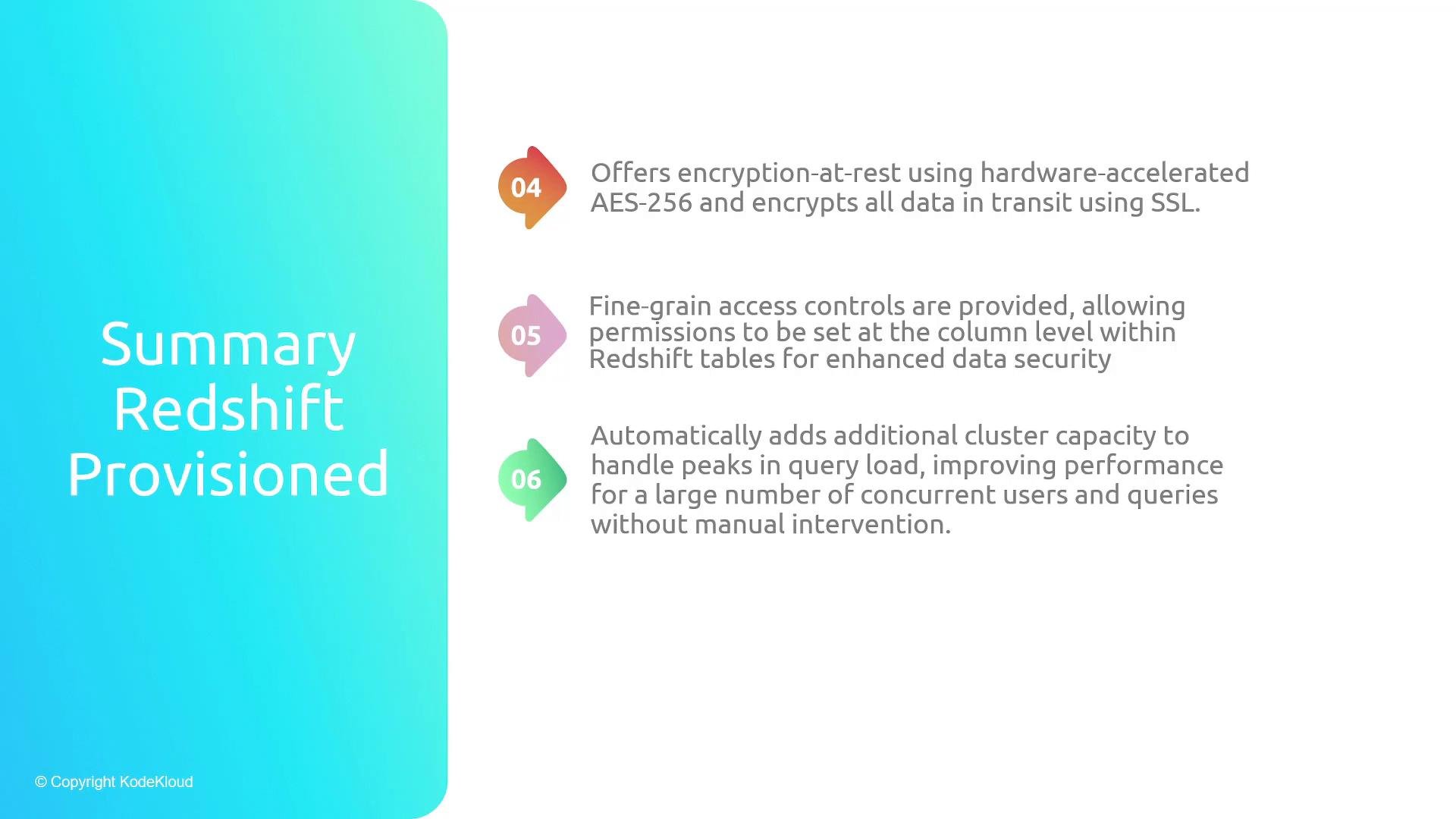
- Encryption: AES-256 for data at rest and SSL/TLS for data in transit; integrates with AWS KMS for key management.
- Access controls: IAM integration and fine-grained, column-level access control where applicable.
- Backups and scaling: Automated/manual snapshots for recovery and the ability to temporarily add capacity to handle peak workloads.
- Amazon Redshift documentation: https://docs.aws.amazon.com/redshift/
- Redshift best practices and architecture patterns: https://aws.amazon.com/redshift/
- PostgreSQL documentation (compatibility reference): https://www.postgresql.org/docs/