

Why use AWS Global Accelerator?
Applications hosted in a single AWS Region (for example, North America) can experience variable network performance for global users. Requests from remote users traverse the public internet via their ISP and multiple upstream providers before reaching your Region. That public-internet path:- May follow suboptimal routing determined by the ISP and upstream providers.
- Is subject to variable latency, packet loss, and congestion.
- Generally cannot match the performance and predictability of a managed, private backbone network.
How Global Accelerator improves traffic flow
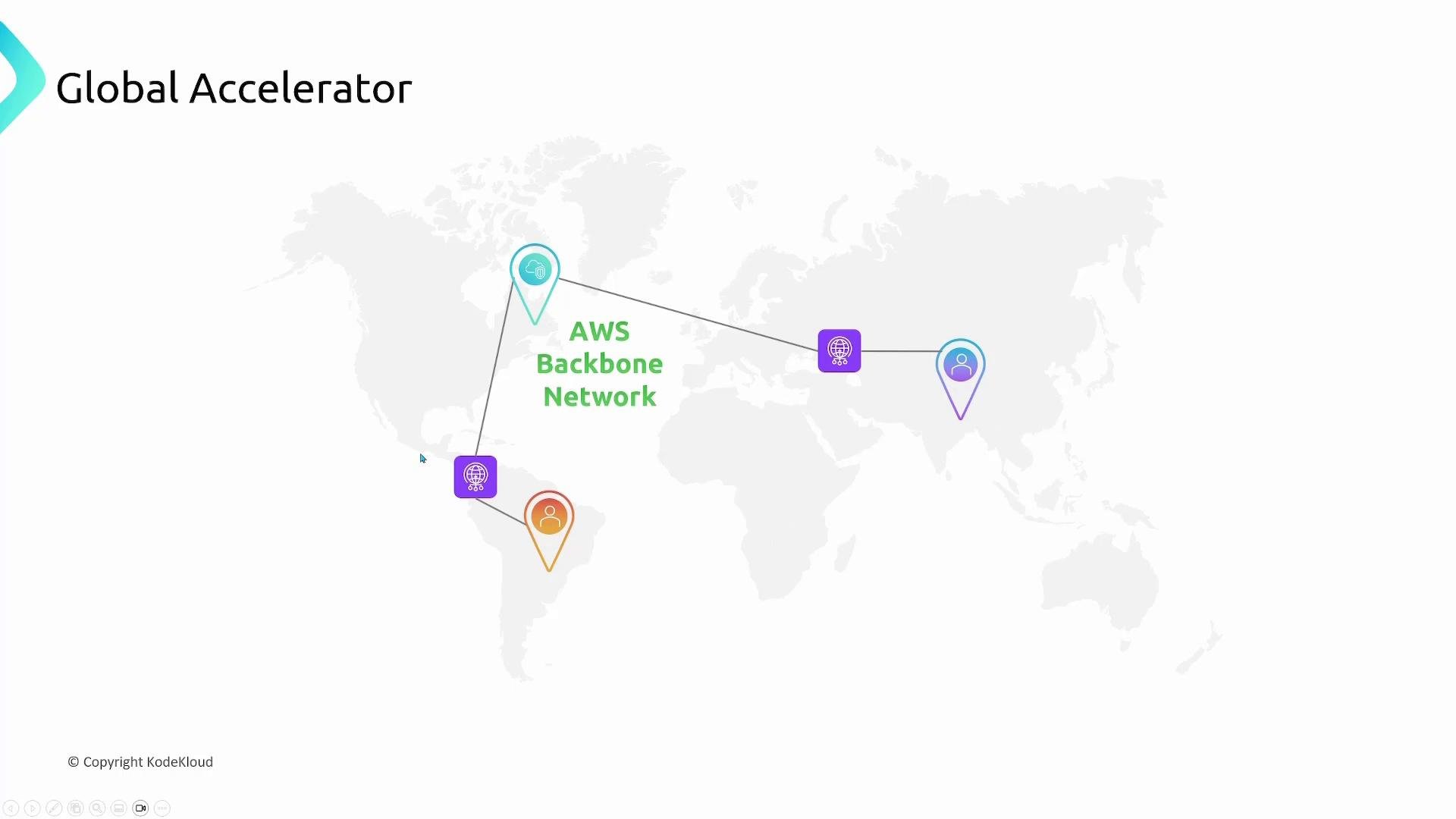
- When you enable Global Accelerator, AWS provides one or more global anycast IP addresses that are announced from multiple AWS edge locations around the world.
- Users connect to the nearest Global Accelerator edge location (similar in concept to CloudFront edge locations), and that edge injects traffic onto the AWS global backbone rather than allowing the connection to remain on the public internet.
- Traffic then traverses the AWS backbone to the optimal Region and registered endpoint (for example, an Application Load Balancer, Network Load Balancer, EC2 instance, or Elastic IP), avoiding the variability of multiple ISP networks.
Technical highlights and benefits
- Anycast static IP addresses: Global Accelerator assigns one or more static anycast IPs (or you can bring your own IP addresses). These IPs are announced from multiple edge locations so users always connect to the same IPs and are steered to the nearest edge.
- Global network routing: After the edge, traffic rides the AWS global backbone to the most optimal Region/endpoint, reducing latency and packet loss compared to traversing multiple ISP networks.
- Health checks and automatic failover: Global Accelerator runs health checks on registered endpoints and automatically routes traffic away from unhealthy endpoints, enabling quick cross-Region failover.
- Protocol support: Supports TCP and UDP, making it suitable for non-HTTP workloads as well as HTTP(S).
- Supported endpoint types: Register Network Load Balancers (NLB), Application Load Balancers (ALB), EC2 instances, and Elastic IP addresses (EIP).
CloudFront vs Global Accelerator — when to choose which
CloudFront is a Content Delivery Network (CDN) focused on caching and delivering static or cacheable content from edge locations. Global Accelerator is a network-optimization service that accelerates and routes client connections (does not cache). Use the table below to compare them:
Use CloudFront when your primary goal is to cache and serve content from edge locations. Use Global Accelerator when you need predictable, low-latency routing and fast cross-Region failover for dynamic or non-cacheable traffic (or for UDP/TCP workloads where caching isn’t applicable).
Summary
AWS Global Accelerator improves global application performance by getting user traffic onto the AWS global backbone at the nearest edge location and routing it to the optimal Region/endpoint. It provides static anycast IPs, supports TCP and UDP, performs health checks, and enables faster cross-Region failover. CloudFront remains the right choice for caching static or cacheable content, while Global Accelerator is the right choice for optimizing transport and connectivity for dynamic, interactive, or non-cacheable workloads.Use Global Accelerator when you need predictable, low-latency routing and fast cross-Region failover for dynamic or non-cacheable traffic. Use CloudFront when you want to cache and serve static or cacheable content from edge locations.
Links and references
- AWS Global Accelerator — https://aws.amazon.com/global-accelerator/
- AWS CloudFront — https://aws.amazon.com/cloudfront/
- Elastic Load Balancing (ALB & NLB) — https://aws.amazon.com/elastic-load-balancing/
- Amazon EC2 — https://aws.amazon.com/ec2/
- Elastic IP addresses — https://docs.aws.amazon.com/AWSEC2/latest/UserGuide/elastic-ip-addresses-eip.html