This lesson outlines the course objectives, structure, prerequisites, assessments, and study recommendations to help you prepare effectively for the exam and real-world AWS architecture. Instructor: Michael Forstner
Course objectives
- Teach you how to design systems on AWS that are secure, resilient, high-performing, and cost-optimized.
- Explain core AWS services and the design “dials and levers” to adjust security, resiliency, performance, and cost.
- Prepare you to pass the AWS Certified Solutions Architect – Associate exam and apply these skills in production.
- How do I improve security for EC2 instances?
- How do I increase resiliency for Direct Connect?
- How do I improve performance for DynamoDB?
Prerequisites and intended audience
- Recommended: a couple years of AWS experience in an architect role or the AWS Certified Cloud Practitioner.
- If you do not have Cloud Practitioner knowledge, start with the Cloud Practitioner course or assessment:
- Cloud Practitioner course: https://learn.kodekloud.com/user/courses/aws-cloud-practitioner-clf-c02
- Cloud Practitioner assessment: https://learn.kodekloud.com/user/courses/aws-cloud-practitioner-clf-c02
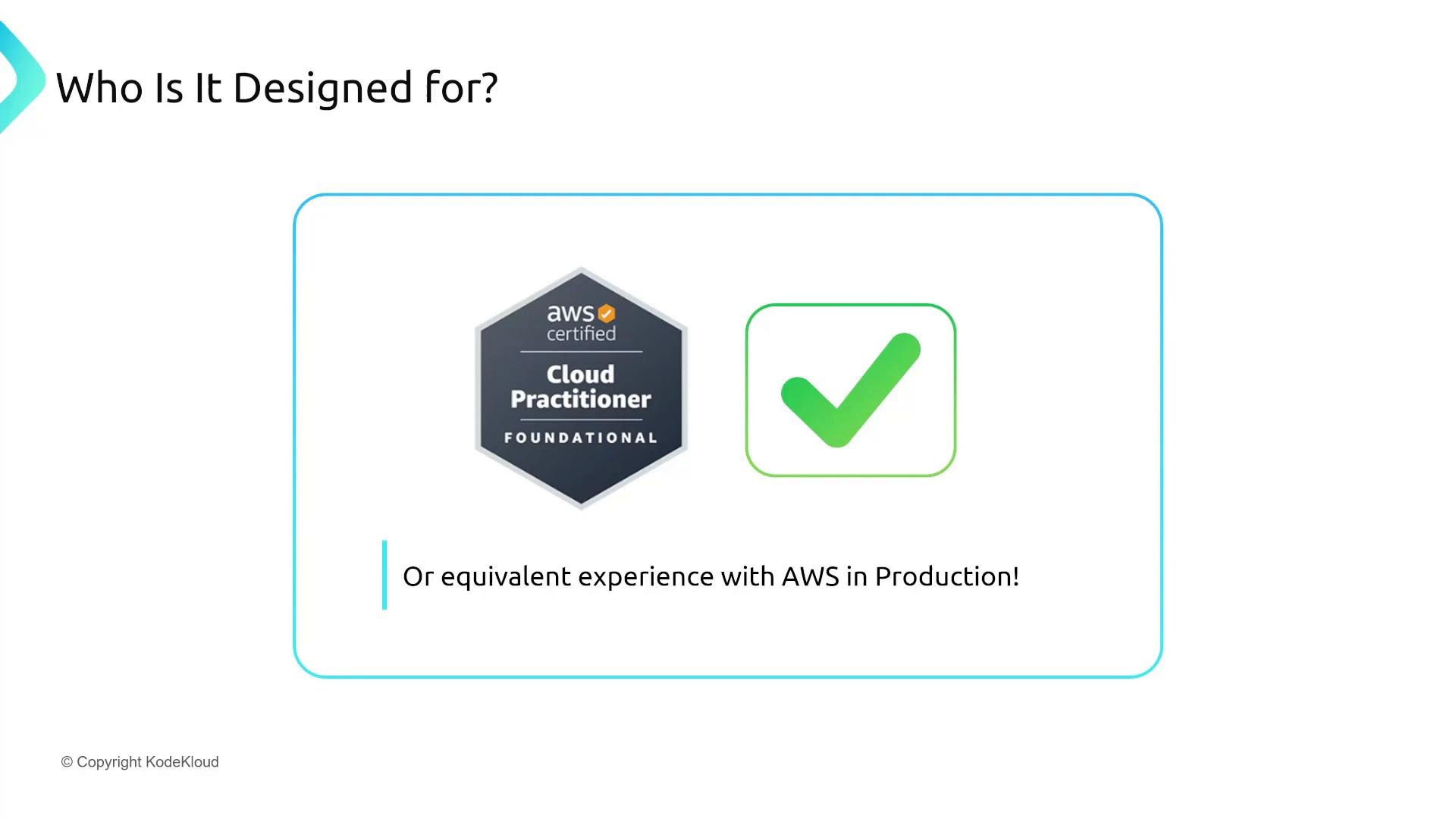
This course assumes familiarity with basic AWS concepts. If you’re unsure about fundamentals (IAM basics, VPC, core compute/storage services), complete the Cloud Practitioner track before advancing.
Course structure and flow — two main “mega-sections”
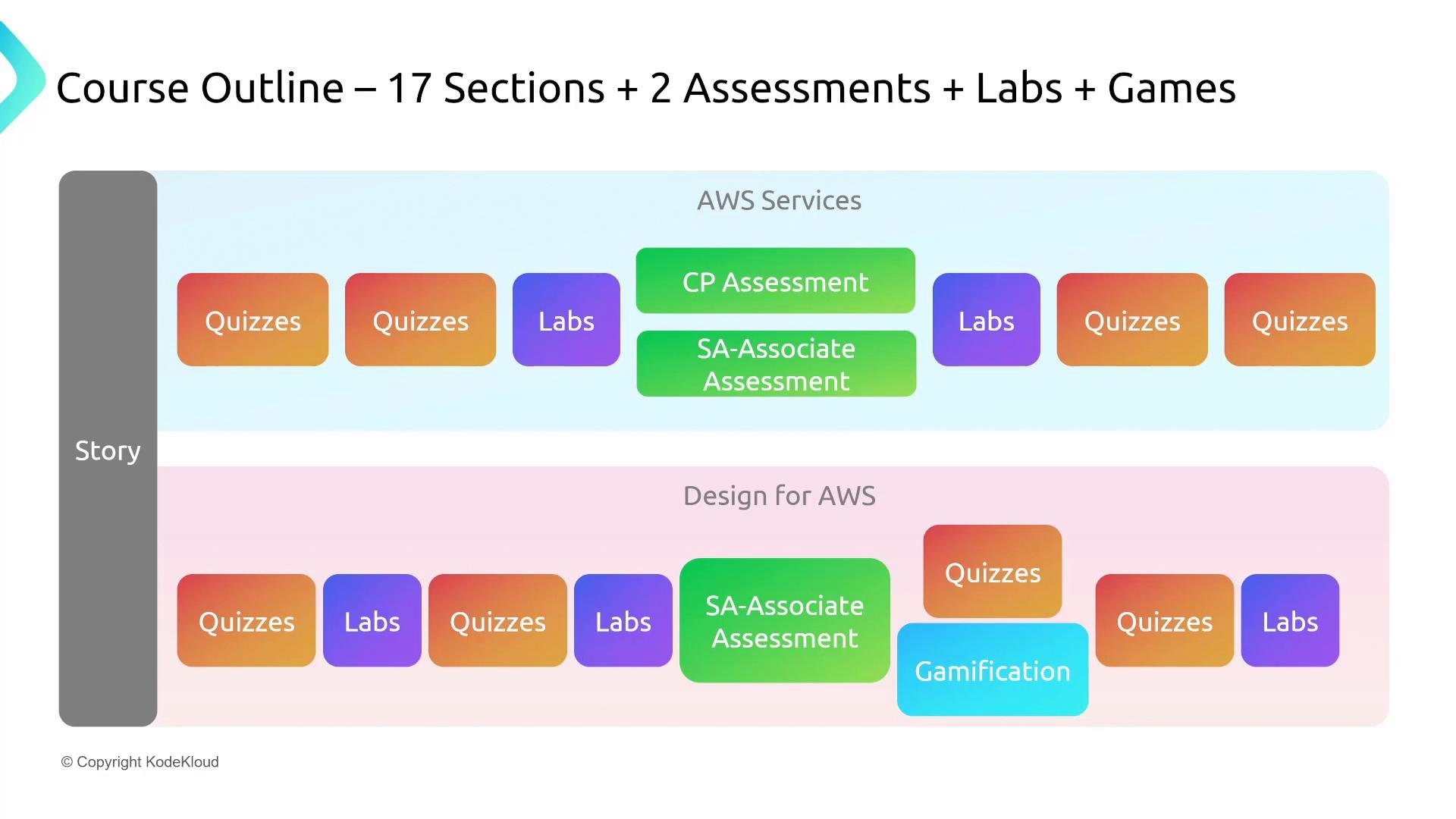
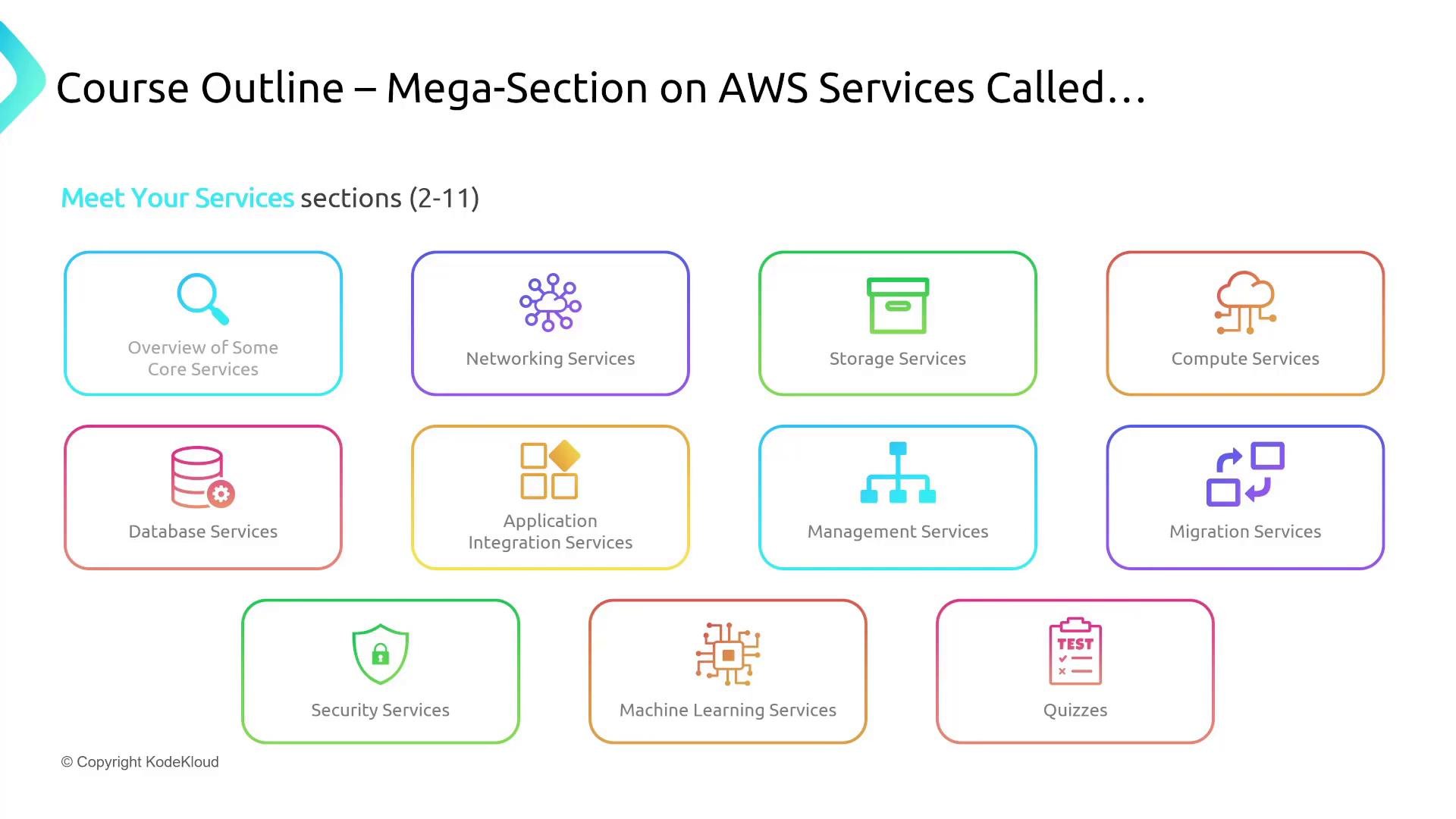
We structure the course into two primary mega-sections to build both service knowledge and design decision skills:- Meet Your Services — core AWS services (networking, compute, storage, database, security, management, migration, ML, application integration).
- Design for X — design principles and patterns focused on Security, Reliability, Performance, and Cost-Optimization.
Assessments — pre, formative, and post
Assessments are built in to measure your starting point and progress.- Use the pre-assessments to define your study focus and the post-assessment to confirm readiness for the real exam.
Meet Your Services — what to expect
- You’ll be introduced to core AWS services across categories: Networking, Compute, Storage, Database, Security, Management, Migration, Machine Learning, and Application Integration.
- Expect to encounter roughly 100–150 services; you do not need to memorize every one. Instead, focus on common services and patterns, and group related services for easier recall (e.g., put networking services on one page, storage on another).
- Each service lecture includes key use cases, important settings, and recommended follow-up labs.
- There are end-of-section quizzes for each category in Meet Your Services — roughly ten quizzes total.
- Quizzes help reinforce retention and show which topics to revisit.
Design for X — the second mega-section
This section teaches how to tune services for the four design pillars:- Security — least privilege, data protection, isolation
- Reliability — fault domains, redundancy, failure recovery
- Performance — scaling, caching, storage choices
- Cost-Optimization — right-sizing, tiering, reserved capacity
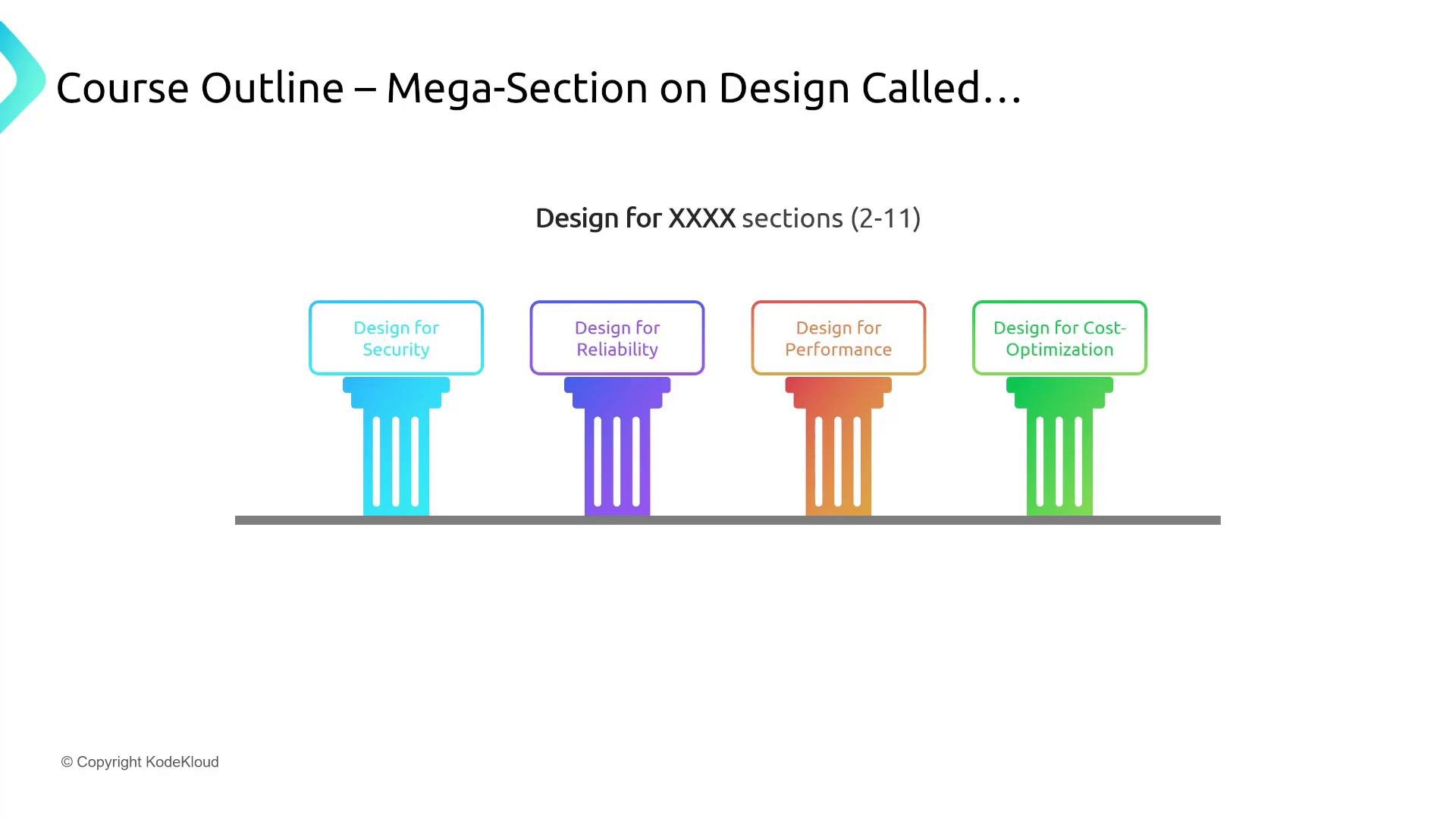
- Each design subsection includes quizzes that emphasize trade-offs: selecting services and configurations to meet security, reliability, performance, and cost constraints.
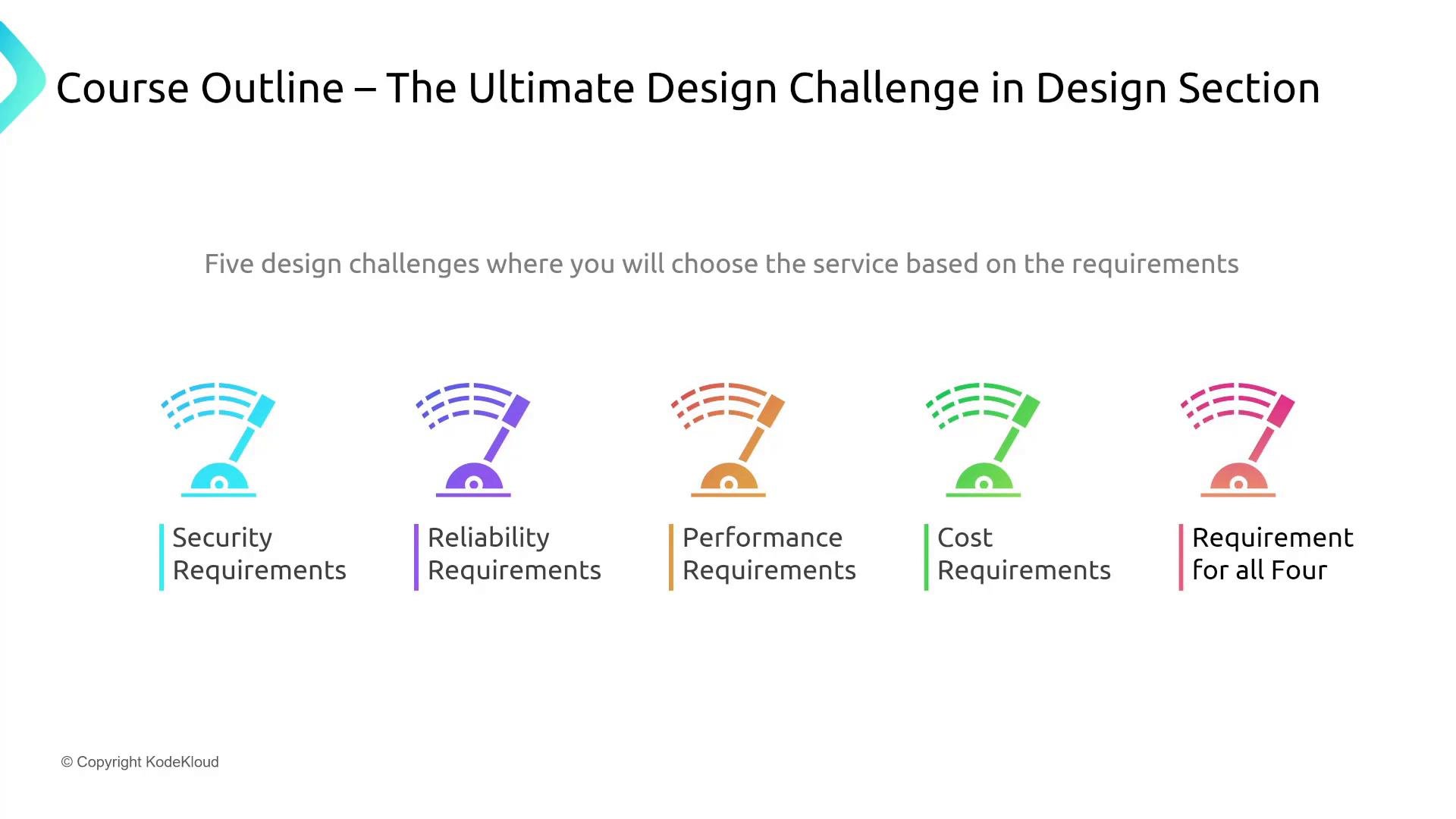
- The course culminates in the Ultimate Design Challenge: given diagrams + requirements, you choose the best services and configurations to satisfy the objectives. This simulates real exam and real-world decision-making.
Study recommendations and pacing
- Be consistent: study a small, fixed amount daily (for example, 15–30 minutes) over approximately eight weeks of regular practice and review.
- Use hands-on labs and playgrounds — active practice greatly improves retention.
- Keep costs low: shut down resources when finished and avoid running expensive services unnecessarily.
Protect your AWS account and manage costs: avoid leaving resources running, and follow the labs’ cost-saving guidance to prevent unexpected charges.
- Take structured notes: dedicate one page per service or group services by category.
- Create diagrams, mind maps, or flowcharts to visualize relationships and data flows.
- Revisit and rewrite notes after labs to reinforce learning.
- Use the pre- and post-assessments to measure improvement and focus revision.
- If you need foundational knowledge, complete the Cloud Practitioner course first: https://learn.kodekloud.com/user/courses/aws-cloud-practitioner-clf-c02
Summary — how to get the most out of this course
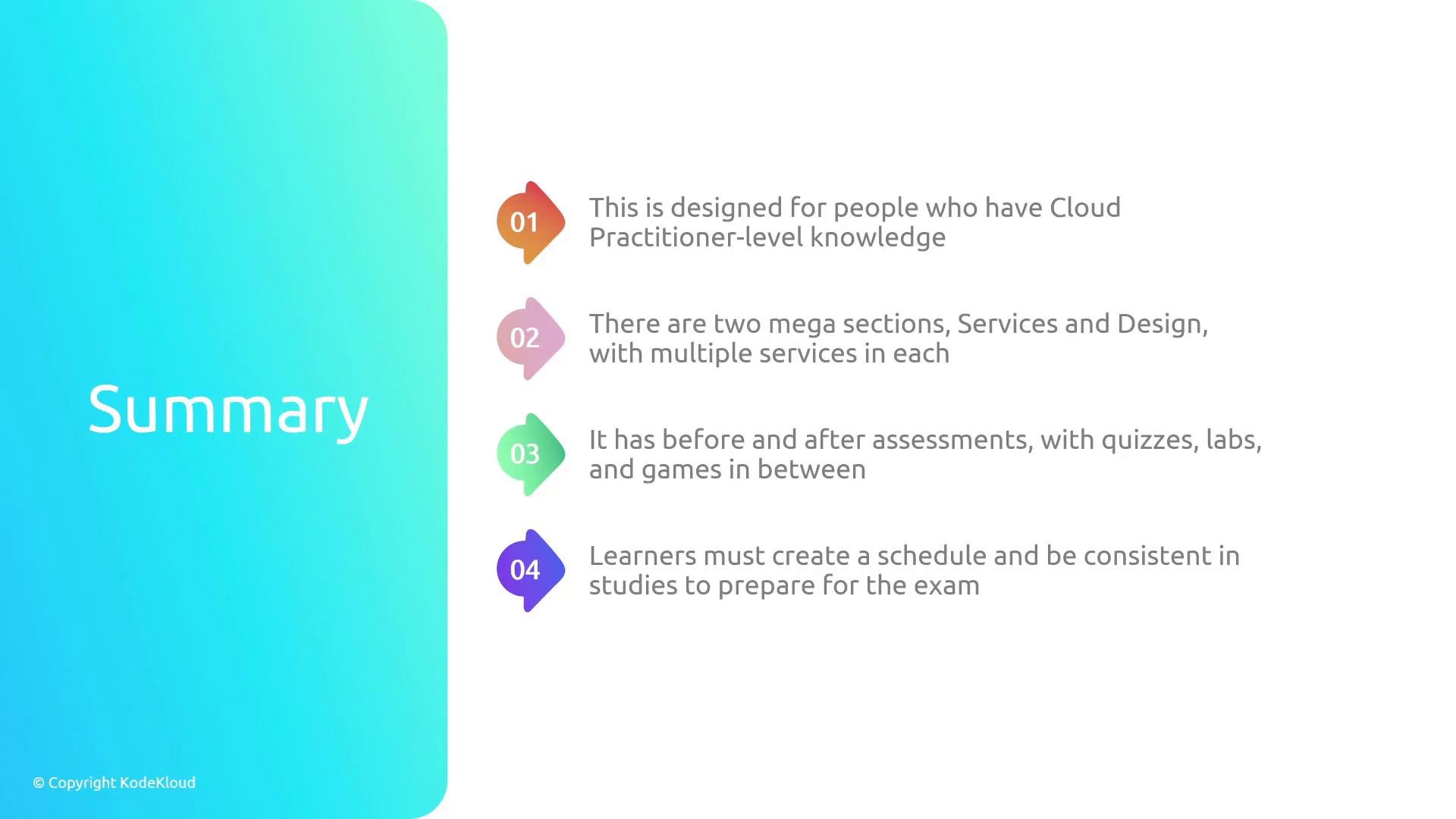
- Target audience: learners with Cloud Practitioner-level knowledge or equivalent AWS production experience.
- Two main sections: Meet Your Services (service-focused) and Design for X (design-focused).
- Course includes pre/post-assessments, end-of-section quizzes, hands-on labs, gamification, and a final Ultimate Design Challenge.
- Recommended study approach: consistent daily practice, active labs, structured notes, and regular self-assessment.