Welcome back, future solutions architects. This is Michael Forrester. In this lesson we will learn about Managed Service for Kafka.
Amazon MSK stands for Managed Streaming for Apache Kafka — AWS’s managed offering for running Apache Kafka clusters (both provisioned and serverless options).
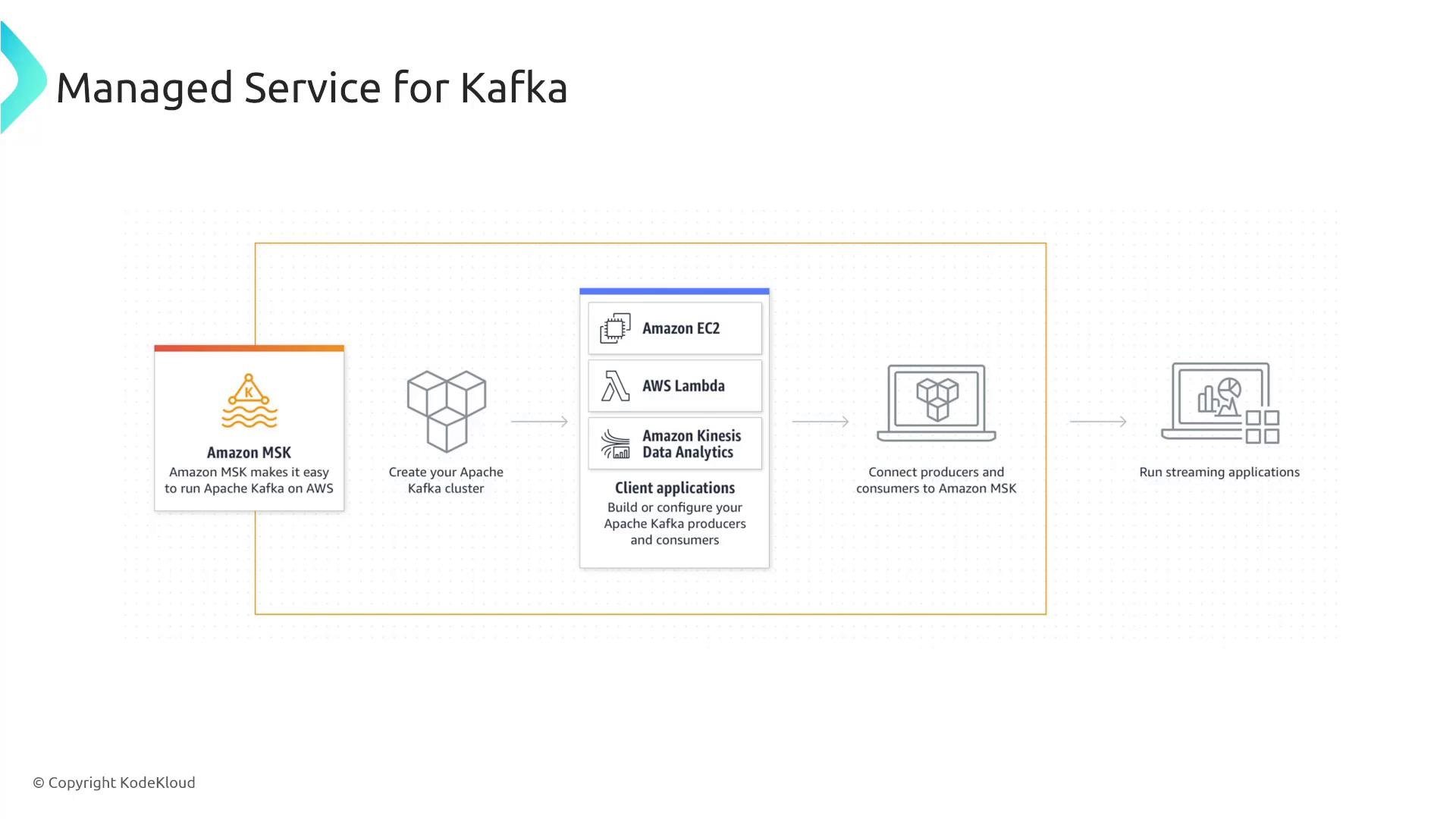
Apache Kafka is an open-source distributed streaming platform originally developed at LinkedIn. Amazon MSK (Managed Streaming for Apache Kafka) removes much of the operational overhead of running Kafka on AWS by handling provisioning, patching, scaling, and monitoring while exposing standard Kafka APIs so your existing producers and consumers work unchanged.
A simple architecture diagram titled "Managed Service for Kafka" showing Amazon MSK creating an Apache Kafka cluster and connecting producers and consumers. It highlights client applications (Amazon EC2, AWS Lambda, Amazon Kinesis Data Analytics) feeding into MSK and running streaming applications.
Conceptually, MSK provides a streaming data bus:
  • Create topics to organize streams of events.
  • Producers publish events to those topics.
  • Consumers subscribe to topics and read events in near real time.
Common use cases for Amazon MSK:
  • Real-time analytics (clickstream processing, behavioral analytics)
  • Event sourcing and CQRS (capture state changes and application events)
  • Centralized log aggregation from distributed services
  • IoT telemetry ingestion and processing
  • High-throughput, low-latency streaming pipelines feeding downstream storage and analytics
Think of MSK as your organization’s data radio station: producers broadcast messages to topics; consumers tune in to receive and process those messages. Streaming applications can enrich, filter, and transform events on the fly to power dashboards, alerts, and persistent data stores. Operational modes (choose based on control vs. convenience):
  • Provisioned clusters — you select instance types, storage, and capacity. MSK manages broker lifecycle, software patching, and multi-AZ placement.
  • Serverless clusters — MSK Serverless removes capacity management. You focus on throughput, and MSK scales automatically.
Kafka architecture essentials:
  • Brokers are the Kafka nodes that store and serve topic partitions. Clients read and write through brokers.
  • Coordination historically used ZooKeeper for metadata and leader elections. Newer Kafka versions may use KRaft mode to remove the ZooKeeper dependency.
  • MSK manages broker replication and multi-AZ placement to ensure high availability and data durability.
Security, observability, and integrations:
  • VPC network placement for private cluster access
  • Encryption: TLS for in-transit, and AWS-managed or customer-managed keys for at-rest encryption
  • Authentication & authorization: SASL/TLS, IAM integrations for management APIs, and resource policies
  • Monitoring and logging: Amazon CloudWatch metrics, CloudTrail for auditing, and integration with AWS monitoring/alerting tools
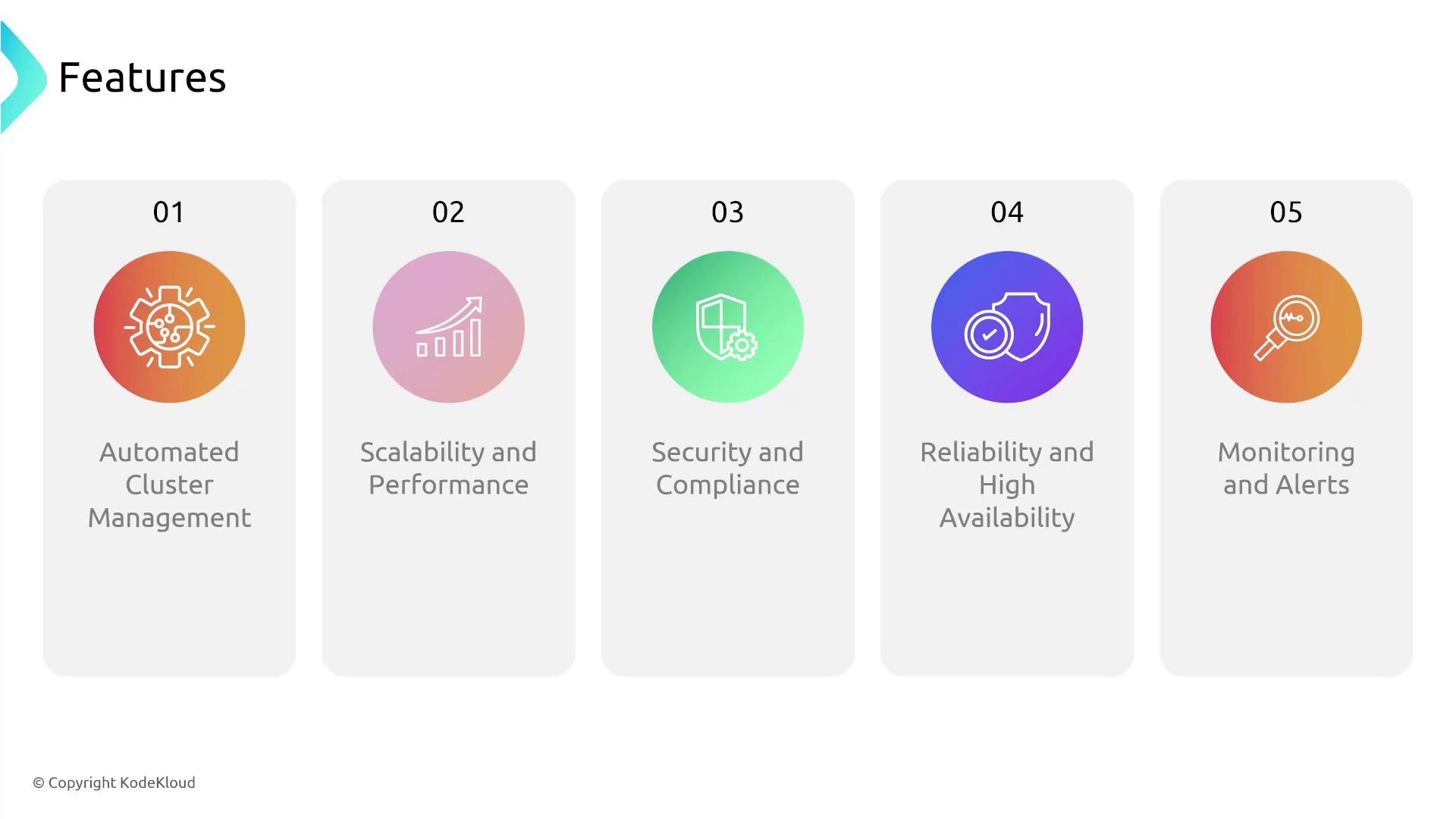
MSK automates routine cluster operations (patching, failure recovery) and supports features that help you meet compliance requirements (GDPR, HIPAA) when configured appropriately.
A slide titled "Features" showing five numbered panels with circular icons and labels: Automated Cluster Management; Scalability and Performance; Security and Compliance; Reliability and High Availability; and Monitoring and Alerts. Each feature is presented in a rounded rectangle with a colorful gradient icon above the text.
Summary table: MSK cluster types and recommendations Key integrations and resources To summarize, Amazon MSK is a managed way to run Apache Kafka on AWS that reduces operational overhead while providing the performance, scalability, security, and integrations expected from AWS services. It’s ideal for ingesting, processing, and distributing high volumes of streaming data in real time. If you have questions, catch us on https://kodekloud.slack.com and visit the AWS For Beginners with Hands-On Labs course.

Watch Video