Serverless design considerations
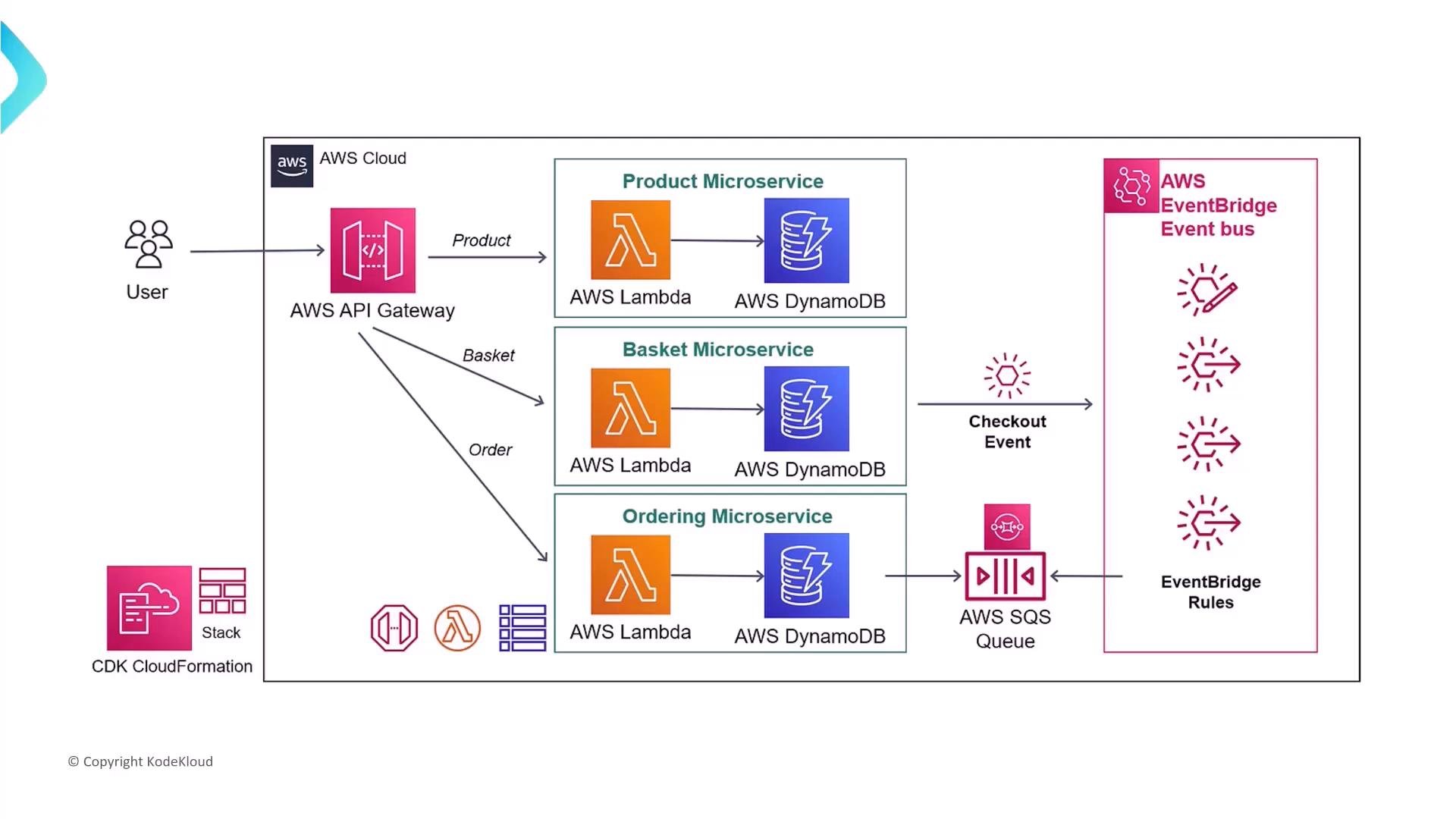
- Lambda is event-driven and best suited for short-running, stateless workloads. As you design for reliability and security, prefer decomposed, observable, and retryable patterns (e.g., chunking, queues, or Step Functions) over monolithic long-running functions.
- Treat Lambda as a managed runtime: AWS controls the platform and many infrastructure responsibilities; you control your code, configuration, identity policies, secrets, and how you store/process data.
Example scenario — long-running video processing
A media company needs to process and transcode very large videos using Lambda. Lambda maximum execution timeout (as of early 2024) is 15 minutes. Which strategy avoids Lambda timeouts for very large files? Options
Analysis and recommendation
- Option 1: Increasing memory (and therefore CPU) is a valid performance optimization, but it does not guarantee completion for very large files; it only reduces runtime in many cases.
- Option 2: Splitting the file into smaller chunks (or orchestrating multipart/chunked processing with Step Functions or a queue) is the most reliable design — each invocation completes within limits, enables retries, and scales horizontally.
- Option 3: Setting the timeout to the maximum and hoping for success is not a robust design practice.
- Option 4: Triggering from S3 is a common mechanism to start processing, but by itself it doesn’t solve execution-time limitations.
Setting the timeout to the maximum and hoping it completes is not a reliable design. Prefer chunking, orchestration (Step Functions), or hybrid architectures for long-running jobs.
Shared responsibility — what the customer controls
Lambda is mostly managed by AWS, but customers retain key responsibilities:- Application-level encryption and data protection (e.g., encrypt sensitive outputs in S3/DynamoDB).
- Authentication and authorization for APIs and functions (API Gateway authorizers, IAM).
- Least-privilege IAM roles for Lambda execution roles and any service access.
- Secrets management — do not hardcode credentials; use encrypted environment variables, AWS Secrets Manager, or Systems Manager Parameter Store.
- Logging, monitoring, and remediation workflows.
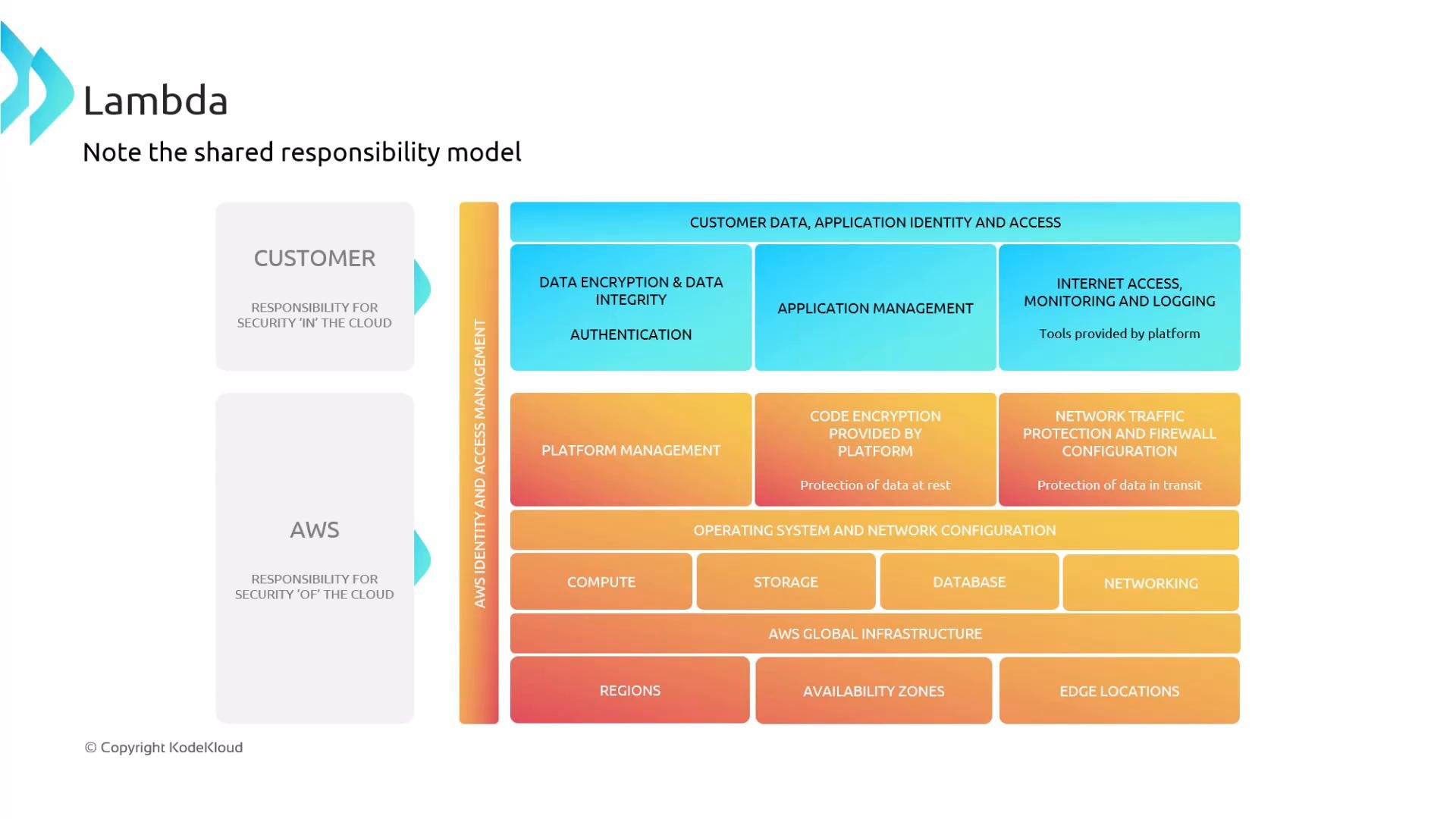
- If a startup processes sensitive financial transactions using Lambda, the correct customer responsibility is to implement proper IAM roles and permissions for Lambda functions (least privilege and role scoping). Physical data center security, patching the underlying Lambda infrastructure, and managing global AWS infrastructure are AWS responsibilities.
Detection, tracing, and observability
Use standard AWS tools to gain visibility into Lambda behavior, performance, and security:- CloudWatch Logs and Metrics: function logs, duration, errors, concurrency, and custom metrics.
- CloudTrail: API-level events and management plane auditing.
- AWS Config: configuration auditing and drift detection.
- AWS X-Ray: distributed tracing and service maps for end-to-end request visualization.
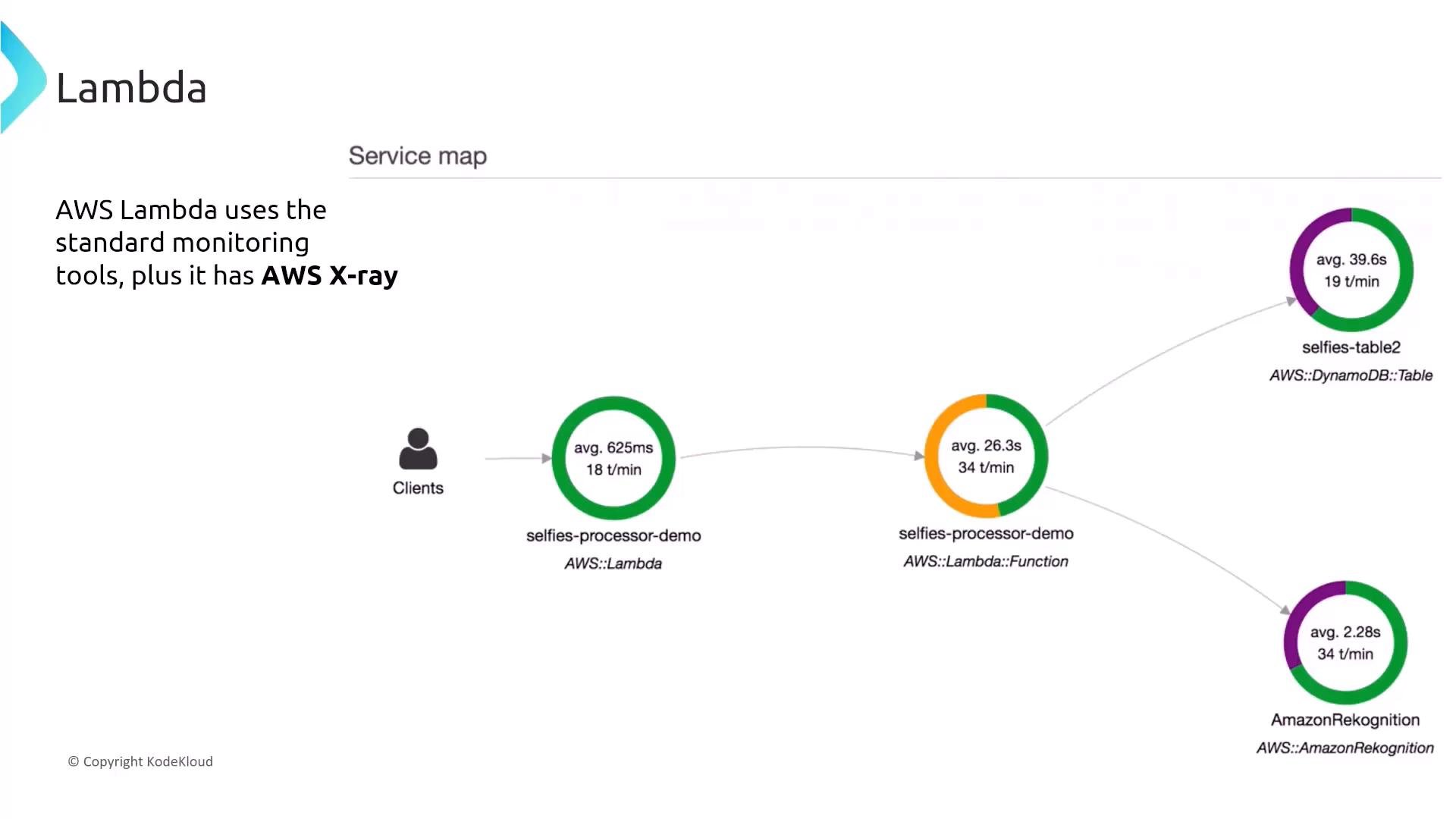
- Enable active tracing in the Lambda function configuration.
- Grant the Lambda execution role permissions for X-Ray, e.g.,
xray:PutTraceSegmentsandxray:PutTelemetryRecords. - Optionally include the X-Ray SDK in your code for custom subsegments or annotations; basic tracing still works when enabled and the role has permissions.
Enable X-Ray and ensure IAM permissions are in place before relying on distributed traces for troubleshooting. Use annotations and custom subsegments in the X-Ray SDK when you need richer request metadata.
Threat detection and remediation
AWS GuardDuty provides managed threat detection for serverless environments:- GuardDuty analyzes CloudTrail, VPC Flow Logs, DNS logs, and other telemetry to identify suspicious activity.
- GuardDuty includes Lambda-specific findings and can surface vulnerable or compromised functions.
- Configure findings to trigger automated responses (for example, via EventBridge rules that invoke remediation Lambdas), but do not attempt to embed a GuardDuty SDK inside your functions for detection — GuardDuty is a managed service.
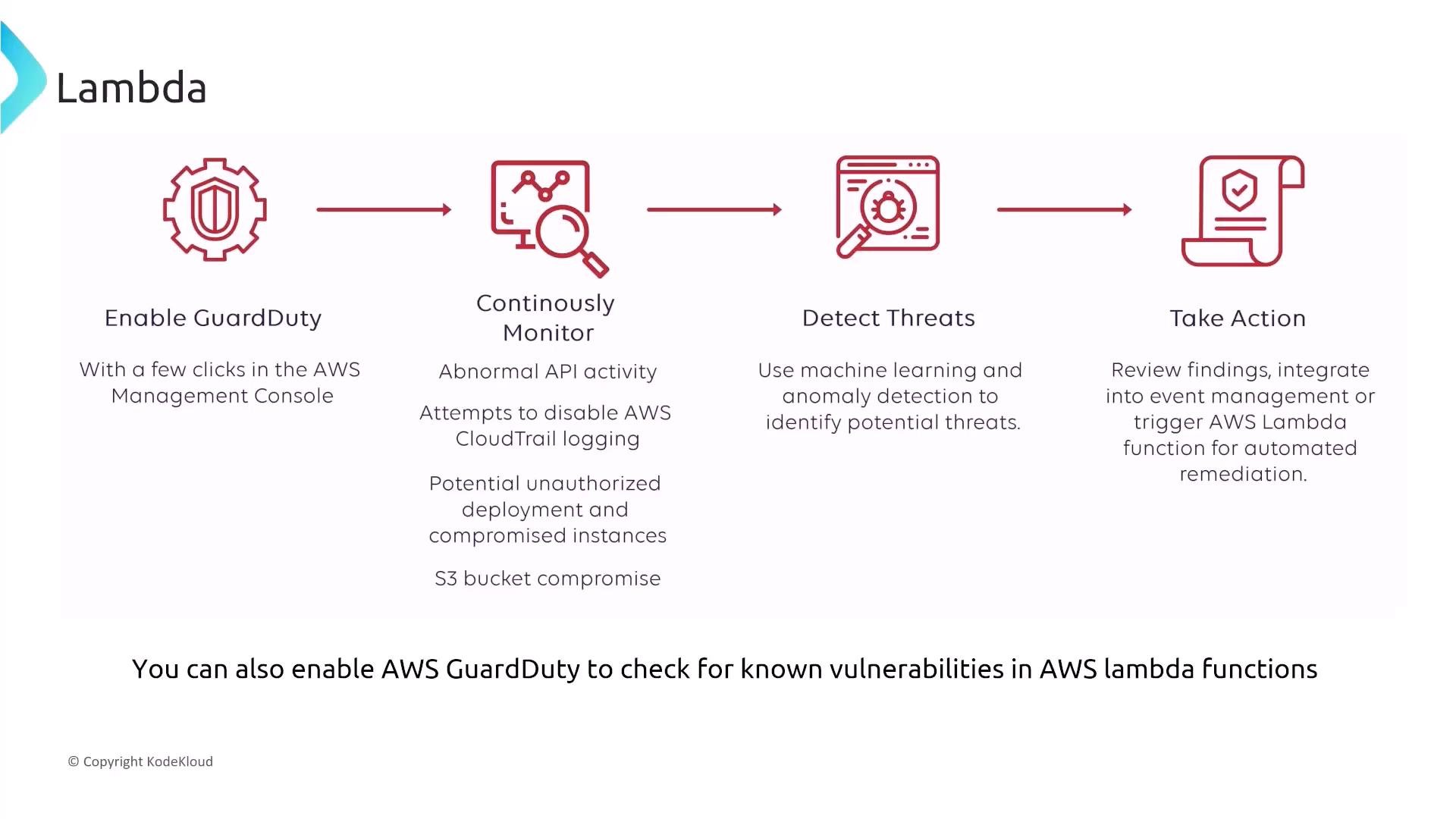
- Enable GuardDuty in the AWS account and allow it to analyze the relevant data sources (CloudTrail, Flow Logs, DNS logs).
- Integrate GuardDuty findings into your incident response plan and automate low-risk remediation using EventBridge + Lambda.
Other Lambda security best practices
- Secure data outputs: ensure S3 buckets and DynamoDB tables receiving Lambda data are encrypted, have tight IAM policies, and use bucket policies or resource-based policies as needed.
- Protect secrets: use AWS Secrets Manager or Parameter Store with encryption; avoid plaintext environment variables or committed secrets.
- Limit network exposure: attach functions to VPCs only when necessary and control egress with NAT, VPC endpoints, and security controls.
- Use least-privilege IAM roles: scope resource ARNs and avoid broad permissions like
*. - Use concurrency controls: reserved concurrency can limit blast radius and protect downstream dependencies.
- Consider hybrid or step-based architectures: for workflows exceeding Lambda limits, orchestrate with Step Functions, ECS/Fargate, or batch processing.
Quick reference — detection and observability tools
Summary
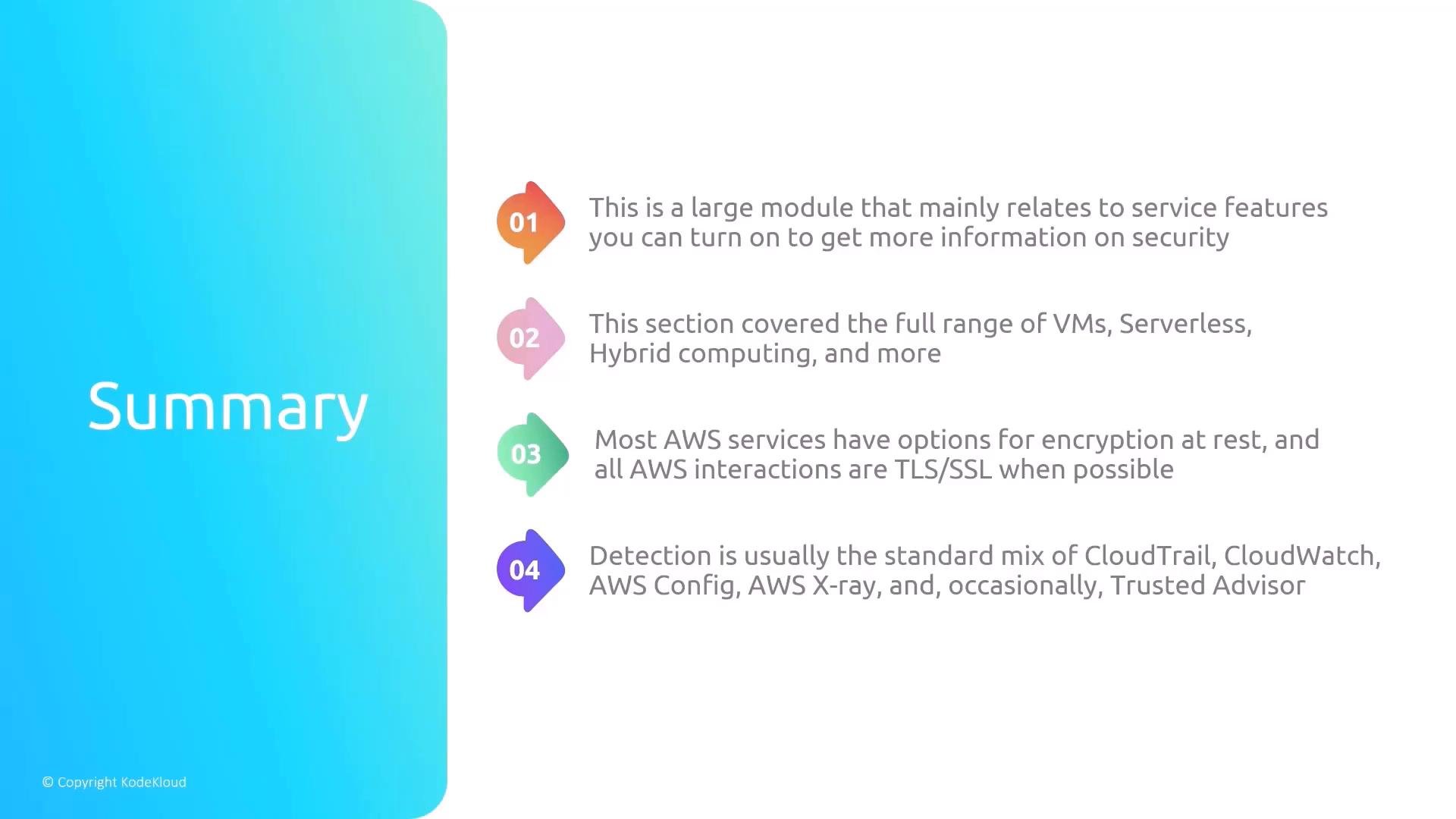
- Lambda simplifies operations but shifts responsibility for application security, IAM, and data protection to you.
- For long-running workloads, prefer chunking, queuing, or Step Functions rather than relying on larger memory or maximum timeouts.
- Use CloudWatch, CloudTrail, Config, X-Ray, and GuardDuty for monitoring, auditing, tracing, and threat detection.
- Apply least-privilege IAM, encrypt data at rest/in transit, manage secrets securely, and design observable, retryable workflows.