

allow, review, or deny.
Key SEO terms: AWS Fraud Detector, fraud detection, real-time scoring, decision logic, managed ML, detector, retraining.
What is AWS Fraud Detector?
AWS Fraud Detector is a managed service that handles data preprocessing, model selection, training, hosting, and real-time scoring. It is optimized for common fraud scenarios (payments, account creation, content abuse) and provides templates, rules, and integration points so teams can operationalize fraud detection quickly.AWS Fraud Detector is designed for teams that need effective fraud detection without owning the full ML lifecycle. Provide the use case and labeled data, and the service helps you produce deployable detectors with decision logic and outcomes.
Key capabilities
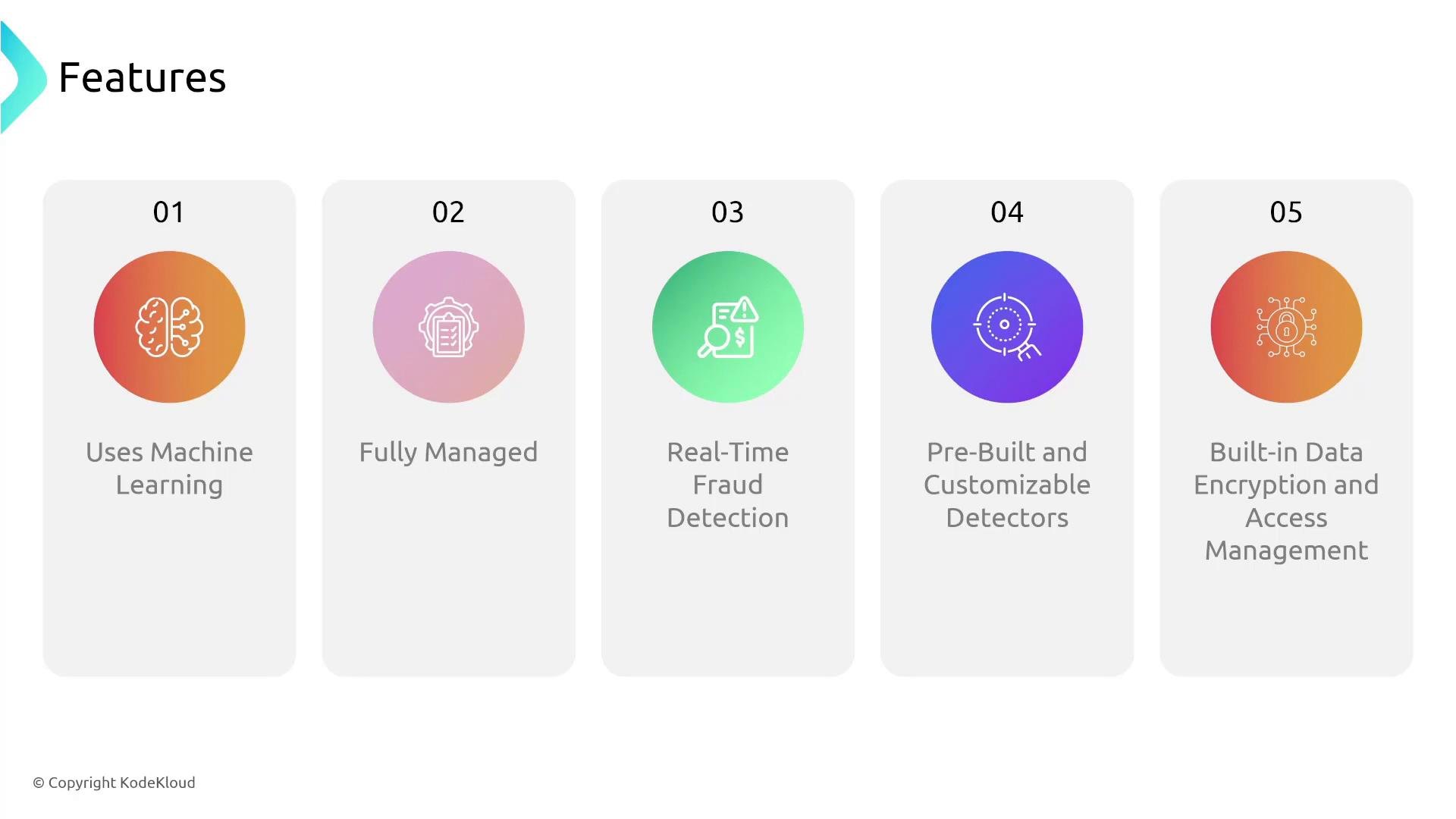
How Fraud Detector helps
- Rapid model creation: Supply historical or live transaction data and define the fraud objective. Fraud Detector recommends model types and trains models using your labeled data.
- Scoring and outcomes: Trained models return risk scores (for example, “90% likely fraudulent”). Use those scores with decision logic to map to outcomes (
allow,review,deny). - Rules and detectors: A detector packages the model, your decision logic, and any rule-based overrides. You can test detectors locally, then deploy them for real-time or batch inference.
- Continuous improvement: Capture human-review labels and production outcomes, reingest them, and retrain models to improve accuracy over time.
Typical workflow
- Define the business problem (e.g., online payment fraud, fraudulent account creation, abusive reviews).
- Prepare and upload historical event data (labeled transactions) to Fraud Detector.
- The service recommends a model type and trains a model on your data.
- Evaluate model performance, choose thresholds, and set decision logic.
- Map risk scores to outcomes (for example
score >= 0.90 → deny,0.70 ≤ score < 0.90 → review,score < 0.70 → allow). - Deploy the detector and invoke it from your application for real-time scoring or run batch jobs.
- Log outcomes and human-review labels, store them, and reingest that data for retraining.
Architecture example (client app flow)
- A client application (web or mobile) submits an event (transaction, review, sign-up) to the Fraud Detector endpoint.
- Fraud Detector returns a risk score and evaluates your configured decision logic to produce an outcome.
- Events flagged as suspicious can be routed to human reviewers or automated review workflows.
- Scores, outcomes, and reviewer feedback are logged (for example to S3 or a database) and used to retrain models and refine rules.
Common outcomes and threshold examples
Example use case: detecting fake or abusive product reviews
- Event: a user submits a product review that could be abusive, spam, or fake.
- Fraud Detector can screen reviews in real time using a detector tuned to review attributes (user behavior signals, text features, historical flags).
- Suspicious reviews can be auto-blocked, queued for moderation, or tagged for further verification—scaling moderation while reducing manual work.
When using Fraud Detector with user data, be mindful of privacy, PII, and regulatory requirements (for example GDPR or CCPA). Avoid storing sensitive information unless necessary and ensure your logging and retention policies meet compliance obligations.
Security and integrations
- Encryption: Data is encrypted at rest and in transit.
- Access control: Integrates with AWS Identity and Access Management (IAM) for resource-level permissions.
- Storage & orchestration integrations: Works with Amazon S3 for data storage, Amazon EventBridge or Amazon SNS for eventing, and AWS Lambda for custom preprocessing and post-processing.
- Auditability: Log outcomes and decisions to enable model explainability and compliance reporting.
Operational considerations
- Retraining cadence: Define a schedule or event-driven trigger for retraining (for example after collecting X new labeled events or monthly).
- Drift detection: Monitor model performance in production to detect feature or concept drift and adjust models or rules accordingly.
- Hybrid approach: Combine ML scores with deterministic rules for edge cases (e.g., known bad actors, velocity checks).
Summary
AWS Fraud Detector provides a managed, production-ready way to add fraud detection to your applications. It abstracts much of the ML lifecycle—data preprocessing, model selection, training, hosting—so teams can focus on business use cases, decision logic, and operational integration. This lowers the barrier to deploying effective, continuously improving fraud detection without building a full in-house ML team.Links and references
- AWS Fraud Detector documentation
- AWS Identity and Access Management (IAM)
- Amazon S3
- Best practices for machine learning on AWS