

Serverless: AWS Lambda — fundamentals and reliability responsibilities
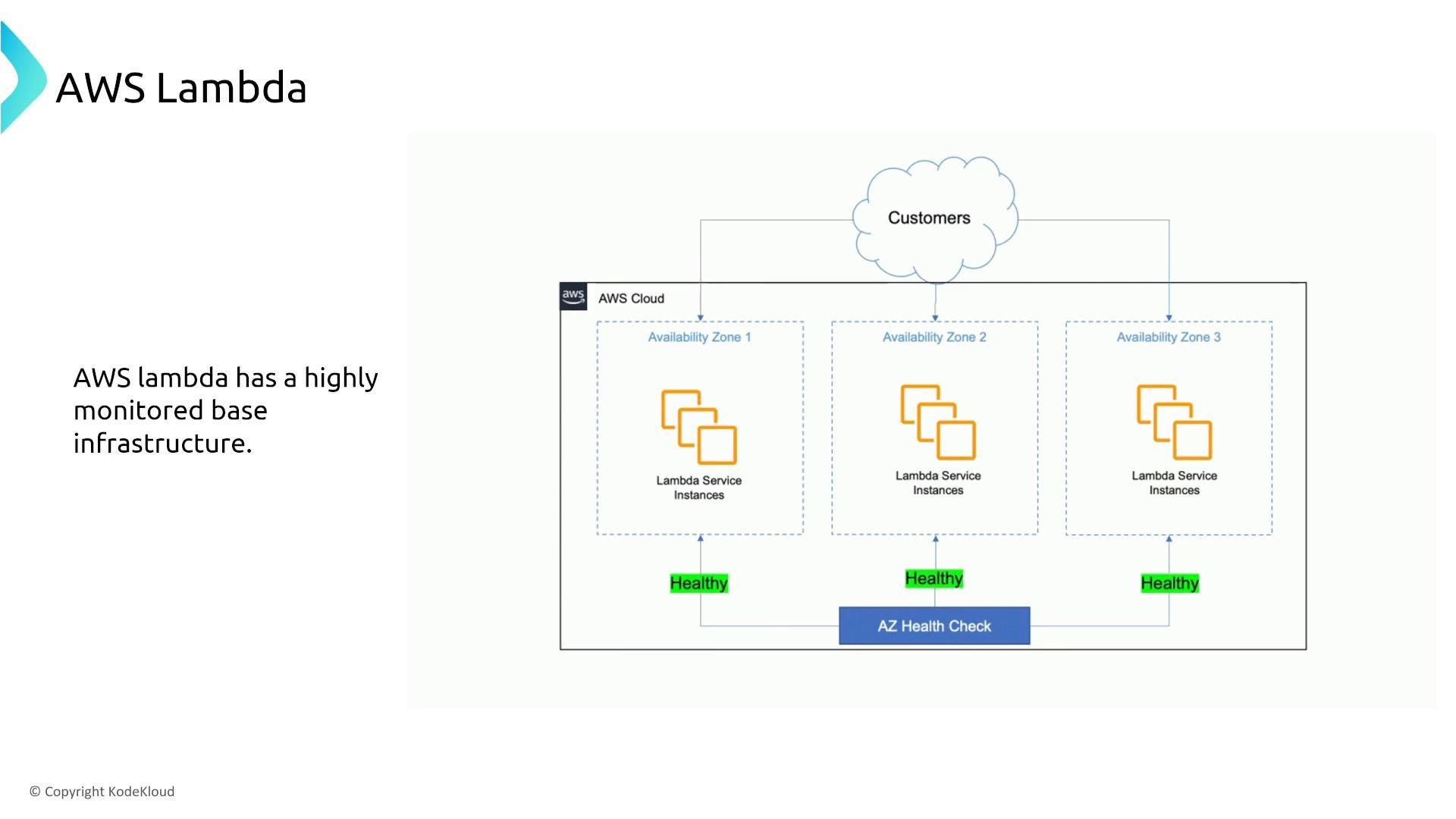
AWS Lambda is a managed serverless compute service: you provide code and triggers, and AWS runs the execution environments. Lambda scales automatically — if a trigger fires 10,000 times concurrently, Lambda will attempt 10,000 concurrent executions (subject to account concurrency limits). This model provides strong isolation and autoscaling without server management, but shifts the reliability focus to function design, permissions, and retry/error handling.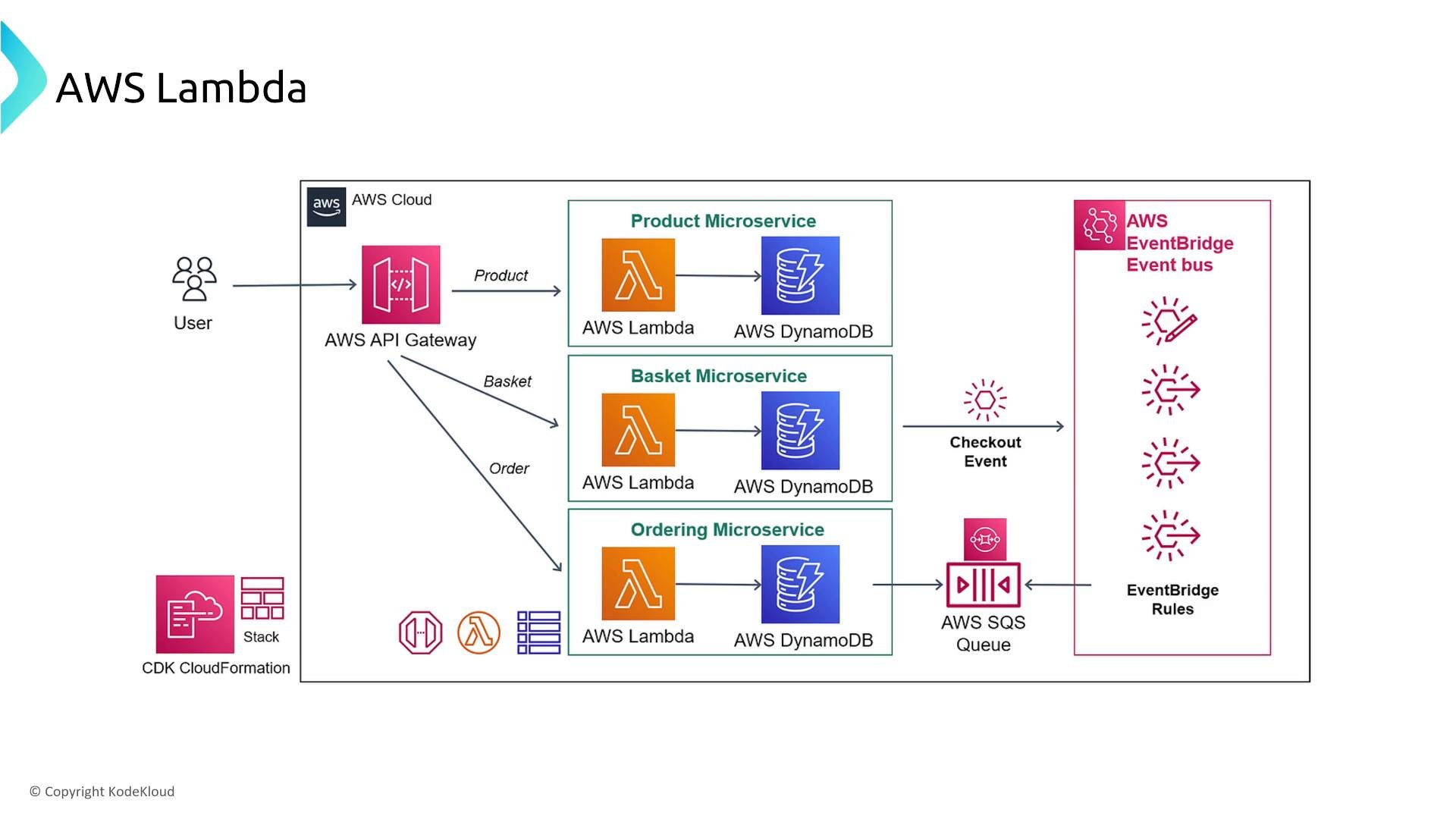
- Design proper retries, backoff, and dead-letter handling for both synchronous and asynchronous invocations.
- Ensure least-privilege but complete IAM permissions so functions can access required services.
- Monitor quotas and throttles (concurrency limits) and request increases ahead of major events.
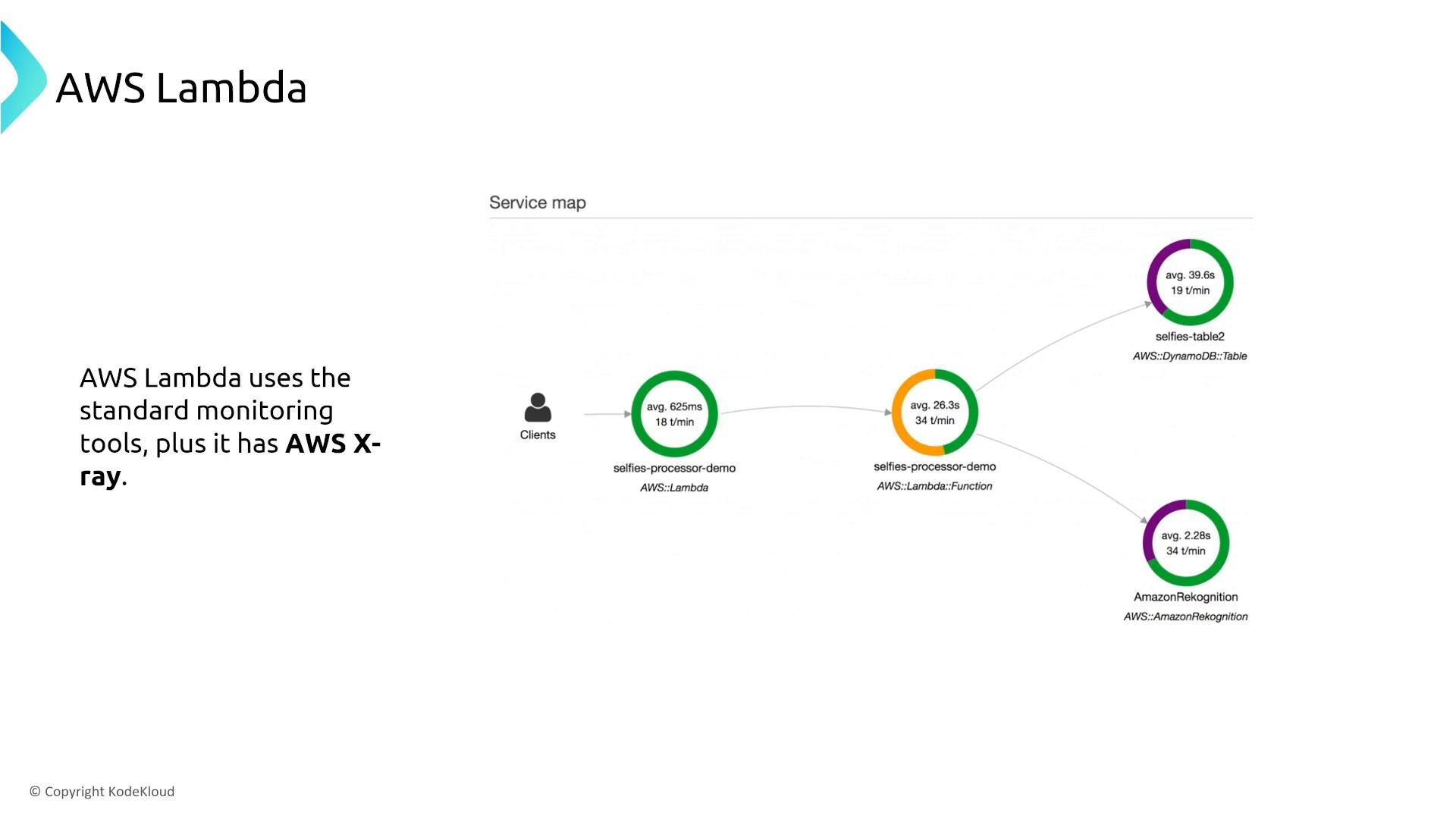
- Use CloudWatch, X-Ray, and structured logging for observability.
Cold starts and how to reduce them
Cold starts are a common performance concern — latency introduced when Lambda initializes a new execution environment. Practical approaches:- Provisioned Concurrency: reserve a number of initialized execution environments to provide consistent low-latency responses.
- Runtime and architecture optimizations: minimize initialization work, prefer lightweight runtimes where possible.
- Lambda SnapStart (for supported runtimes like Java): speeds up cold-start by snapshotting initialized execution environments.
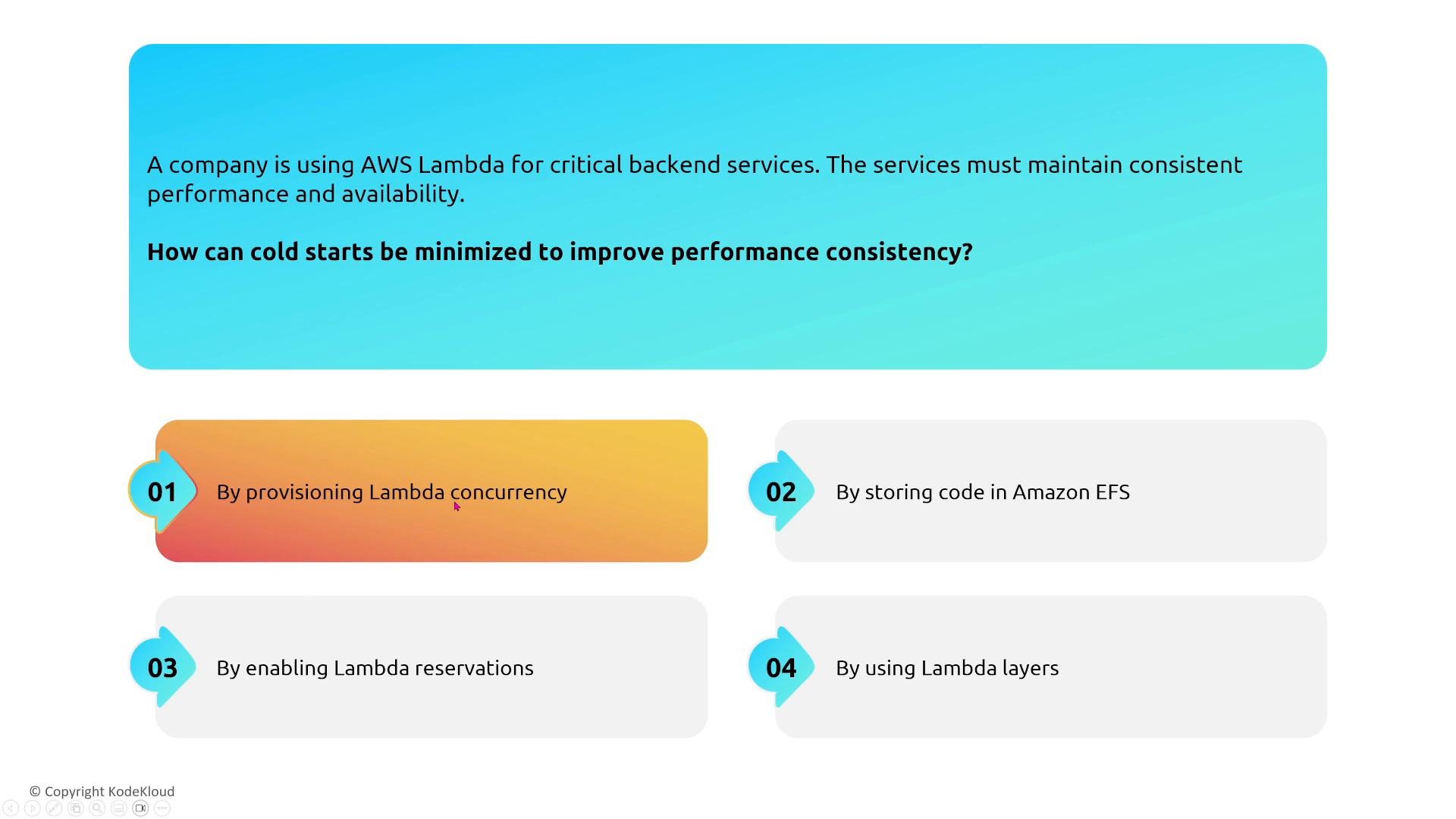
If you need predictable low-latency responses, evaluate
Provisioned Concurrency and startup optimizations. Provisioning pre-initialized environments increases cost, so size it to match expected steady traffic patterns.Shared responsibility for Lambda
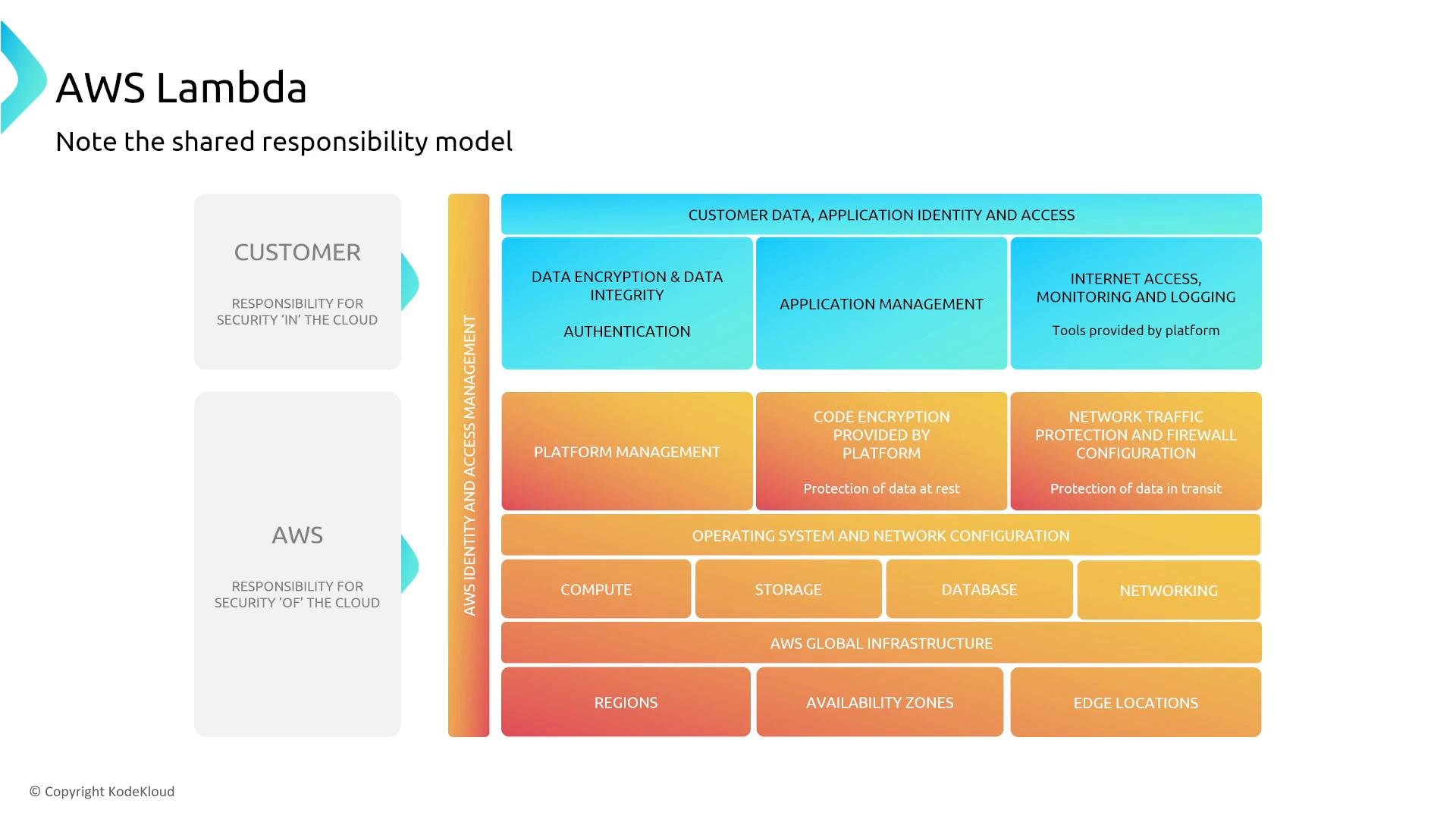
AWS manages the platform and underlying infrastructure. Your responsibilities include code, application configuration, data protection, and access control. Focus reliability work on:- Retry policies and dead-letter queues (DLQs) or Lambda Destinations for asynchronous invocations.
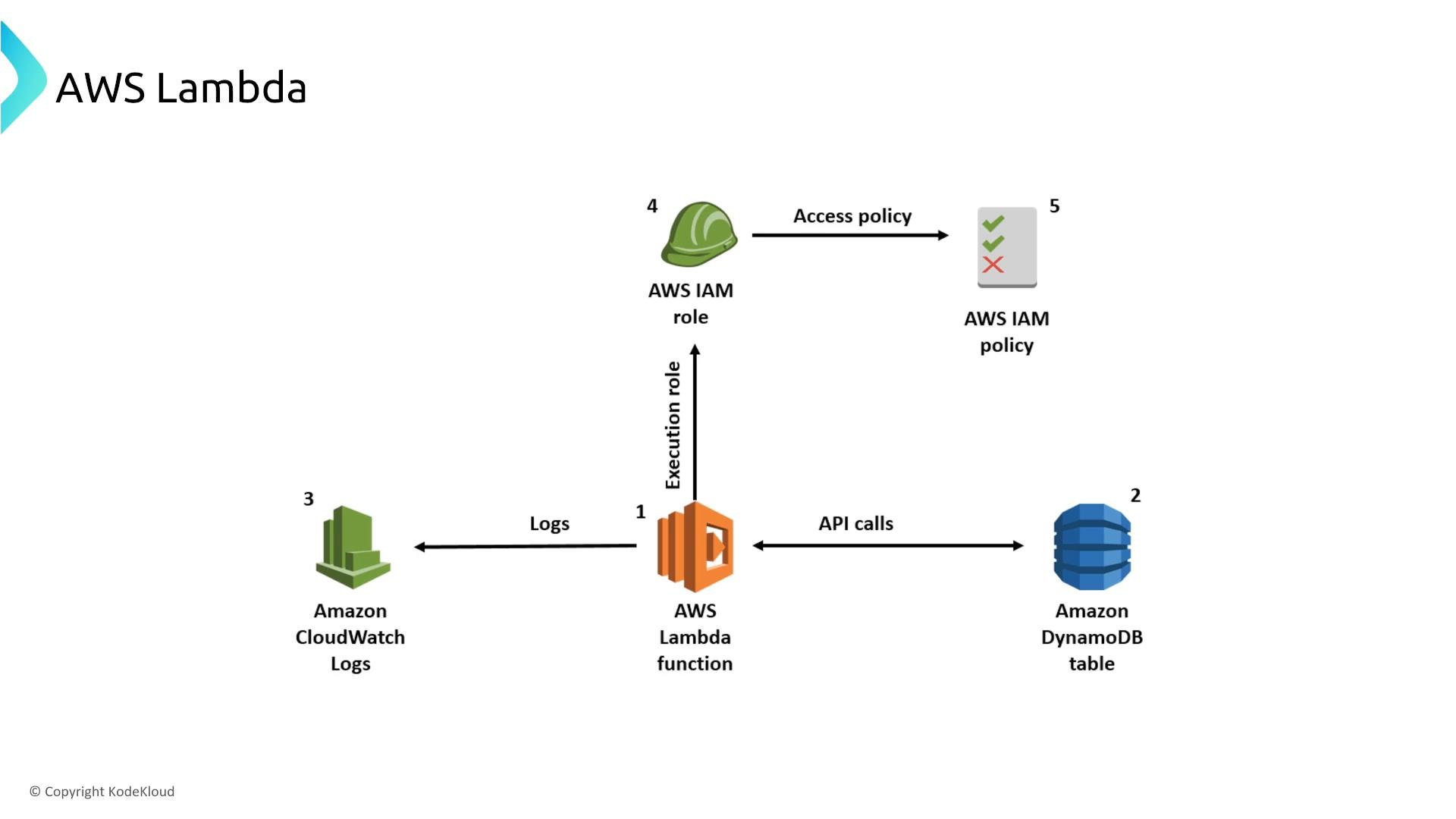
- Correct IAM roles and resource policies to prevent avoidable permission failures.
- Monitoring with CloudWatch metrics and logs, X-Ray for distributed tracing, and CloudTrail for API auditing.
- Tracking service quotas and concurrency usage to avoid throttles.
- Configure retries with exponential backoff for transient errors.
- Use DLQs (SQS/SNS) or Lambda Destinations (EventBridge, another Lambda) to retain failed events for analysis or replay.
- Track metrics: Invocations, Errors, Duration, Throttles, and IteratorAge (for stream-based triggers).
Incorrect or missing IAM permissions are a frequent operational cause of Lambda failures. Treat permissions as part of your resiliency design to avoid runtime access errors.
Step Functions — durable orchestration and error handling
AWS Step Functions coordinate serverless workflows and long-running processes. For resilient workflows:- Use
Retrywith appropriate backoff for transient failures. - Use
Catchhandlers on states (includingParallelandMap) to handle non-recoverable errors or to route to compensating paths. - Design state machines to isolate failures so a single branch failure doesn’t cascade into a total workflow failure.
Serverless Application Model (SAM) — deployment and resilience patterns
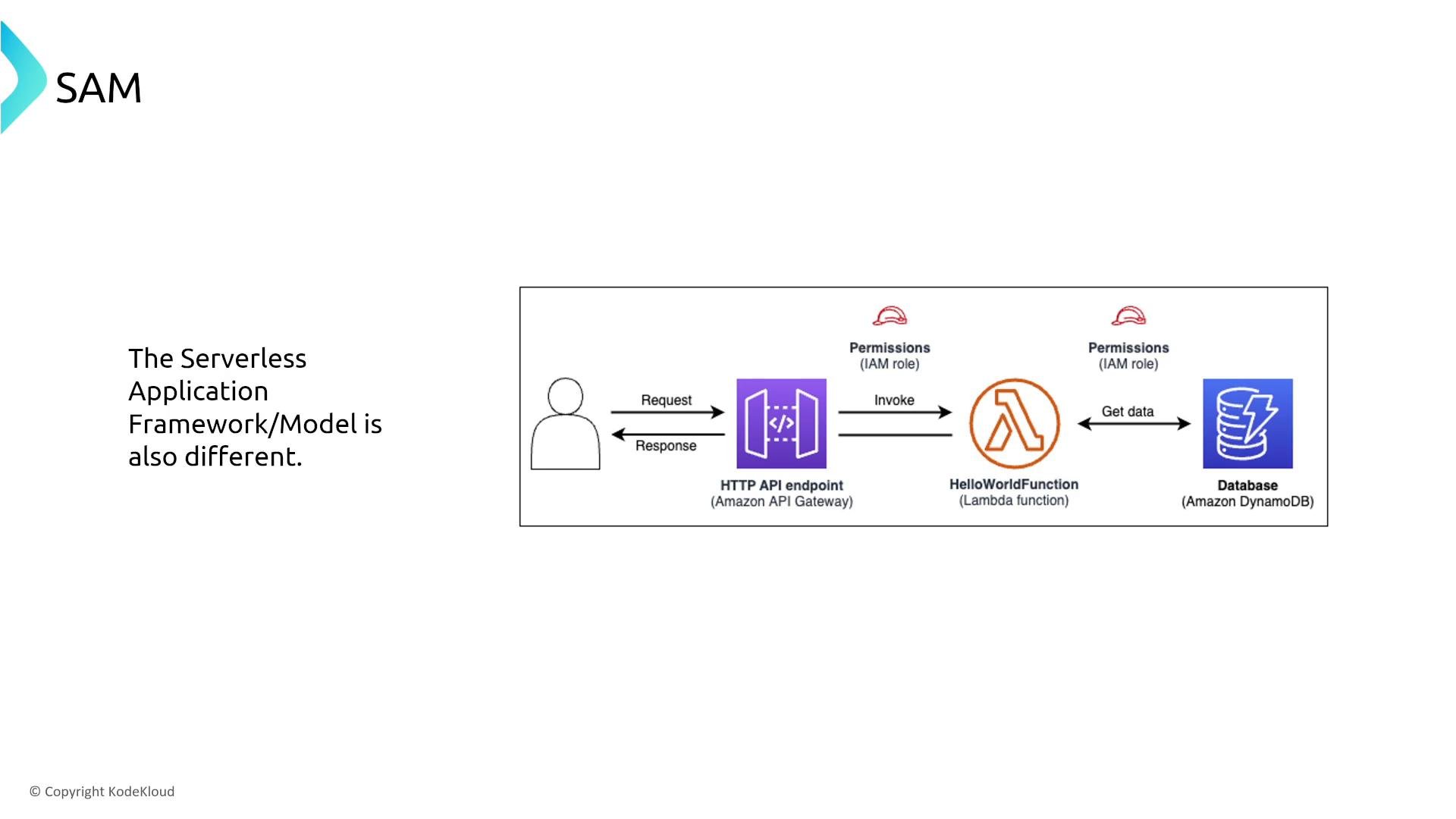
AWS SAM simplifies defining serverless applications in CloudFormation-compatible templates. SAM helps structure deployments but the underlying services determine run-time resiliency.- Include DLQ/Destinations and retry settings in SAM templates for Lambda functions.
- Use CloudFormation StackSets with SAM templates to deploy across multiple Regions and accounts for improved recovery and availability.
Serverless Application Repository (SAR) — reuse and versioning
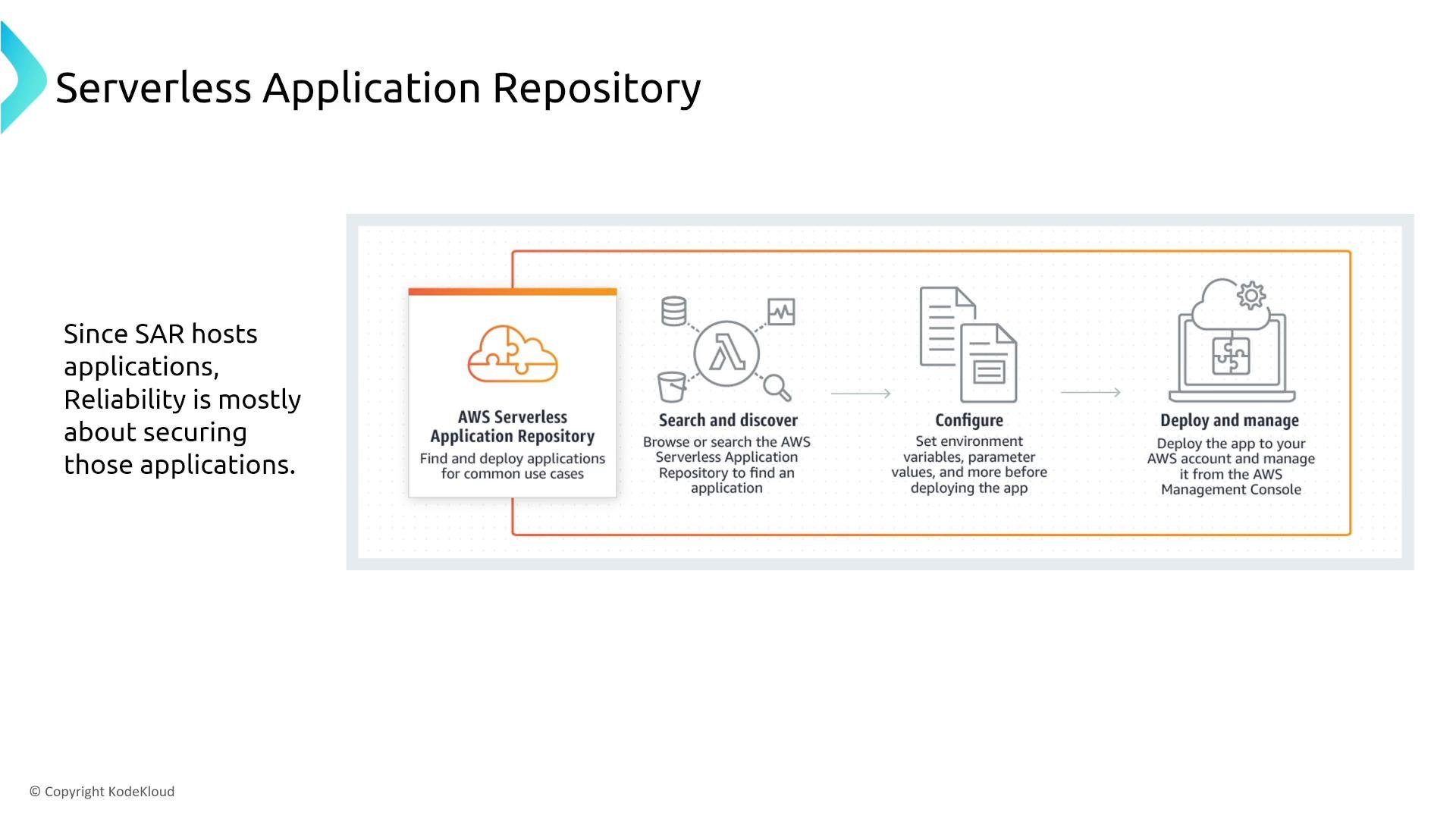
SAR hosts reusable serverless apps. For reliability when using SAR artifacts:- Use semantic versioning to manage deployments and rollbacks.
- Keep clear version fingerprints for quick rollback if a release causes regressions.
AWS Amplify — managed full‑stack hosting and resiliency tips
Amplify provides a managed platform for web and mobile backends/frontends, often integrating AppSync, Lambda, and DynamoDB. Amplify reduces operational work, but your architecture and data management still determine overall reliability.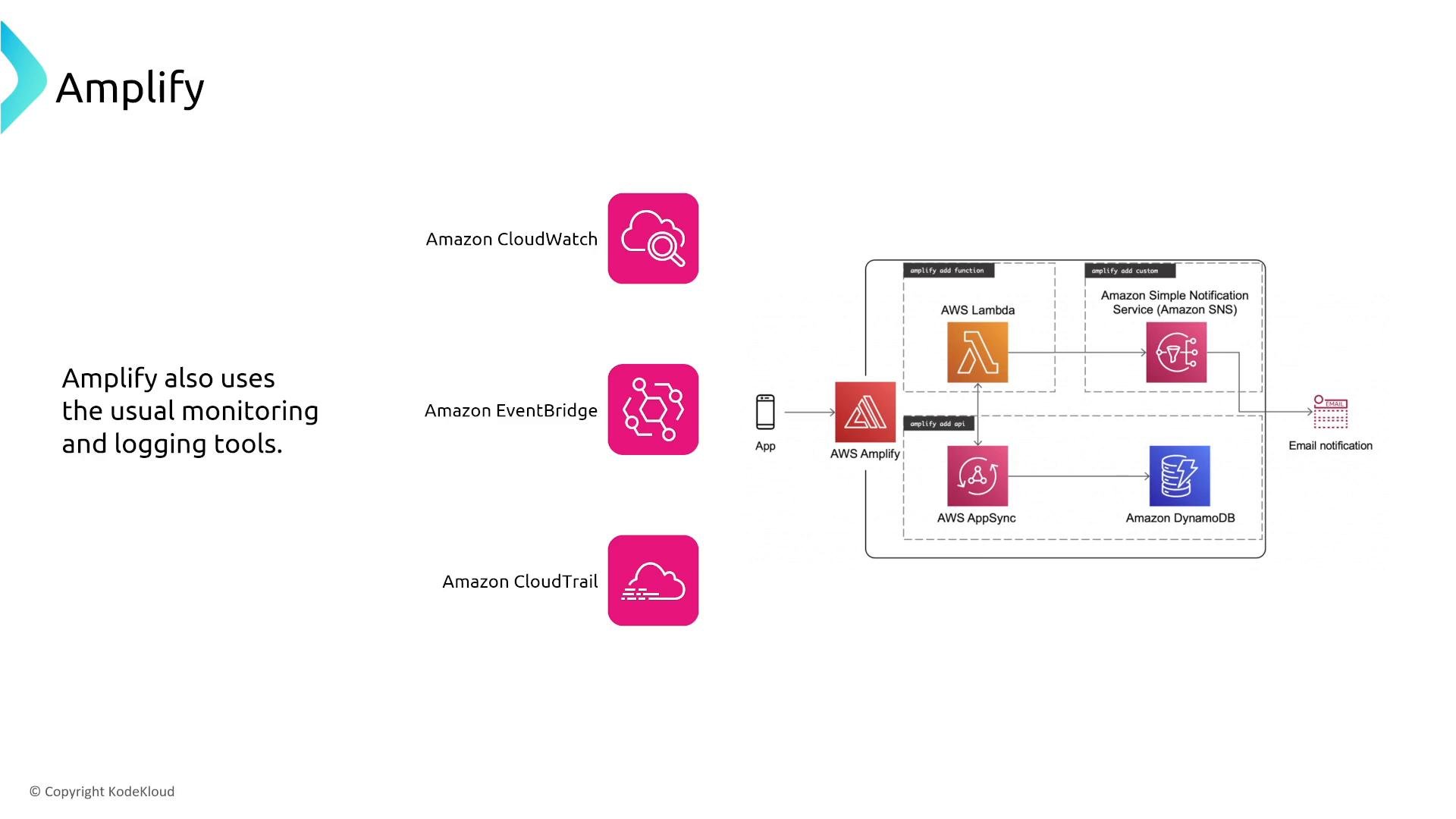
- Use API versioning and GraphQL Transformer patterns to evolve APIs safely.
- For production workloads, back Amplify DataStore with robust backend stores like DynamoDB.
- Integrate monitoring with CloudWatch and operational events with EventBridge.
Hybrid compute: AWS Outposts — local AWS hardware and connectivity
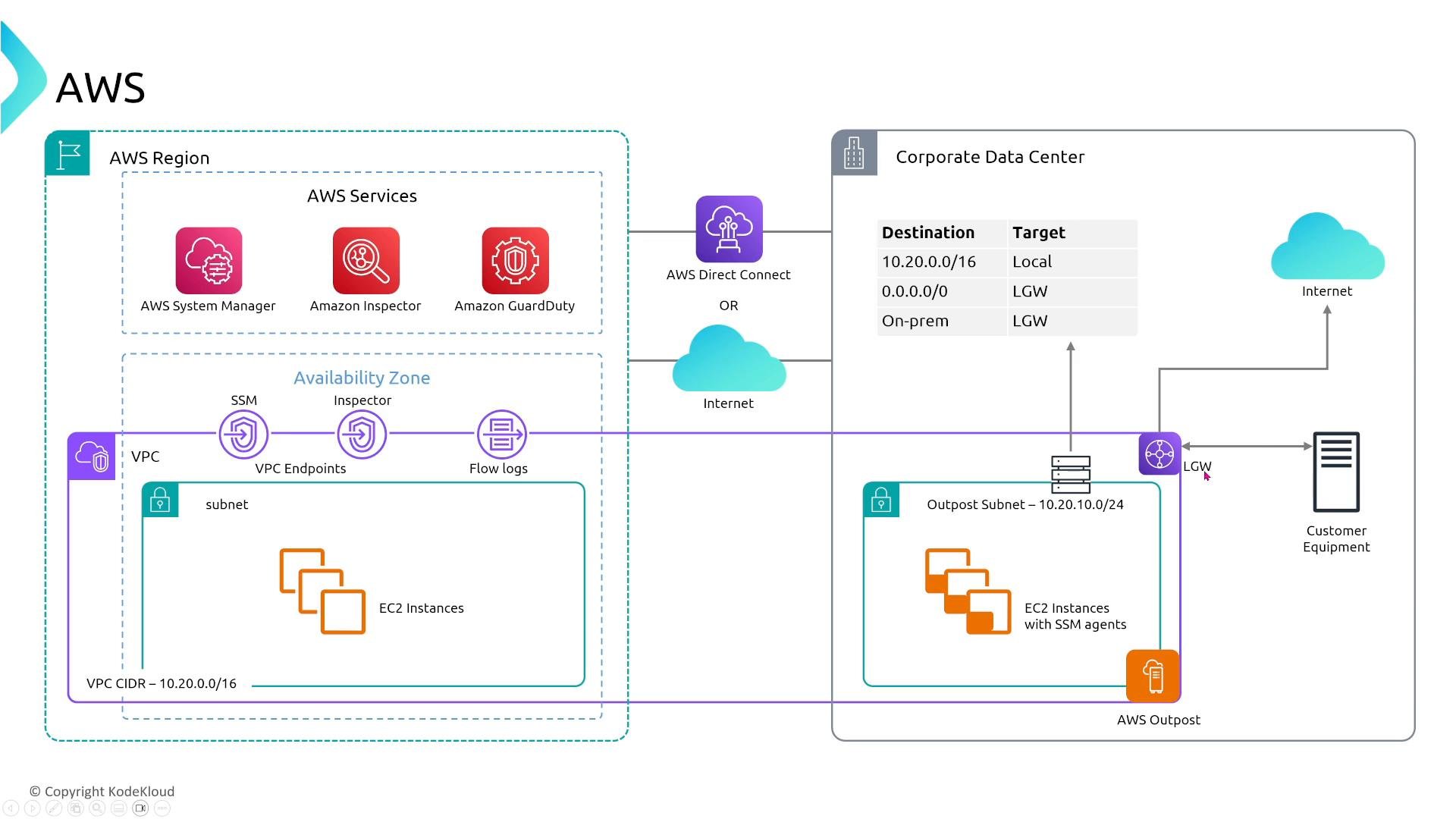
Outposts extend AWS infrastructure on-premises and appear as part of your VPC. They provide low-latency local compute while integrating with the AWS control plane over a service link (Direct Connect or internet).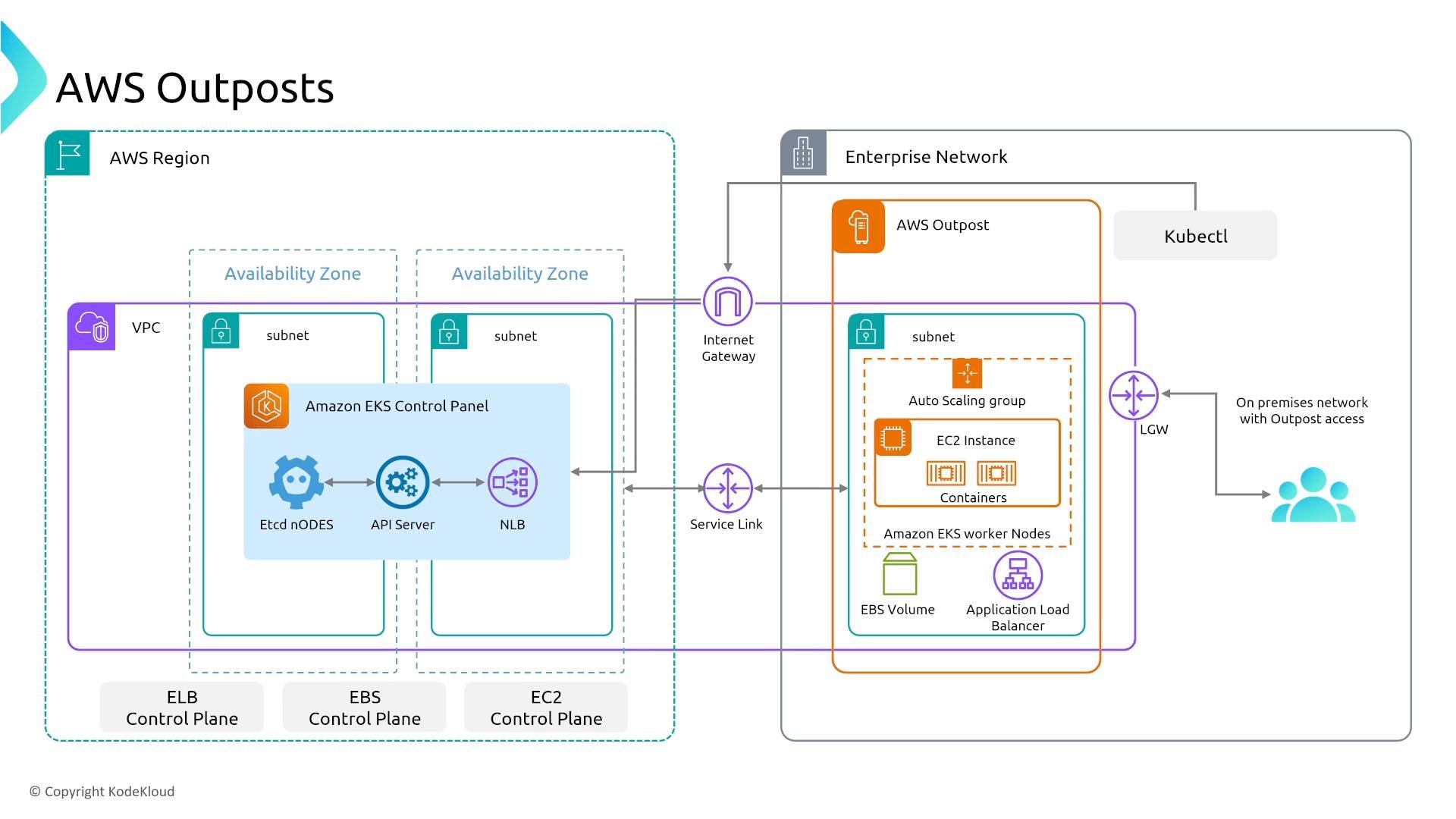
- Redundant network connectivity (multiple Direct Connect links or diverse network paths).
- Deploy multiple Outposts or multiple racks across data centers to avoid single points of failure.
- Design local routing and gateways (LGW) for performance and data residency.
- Treat Outposts as a data center: design backups, replication, and failover procedures.
ECS/EKS Anywhere — running containers and Kubernetes on-premises
EKS Anywhere and ECS Anywhere enable running container workloads on your infrastructure with management ties to AWS control planes. Responsibility for infrastructure reliability shifts to you.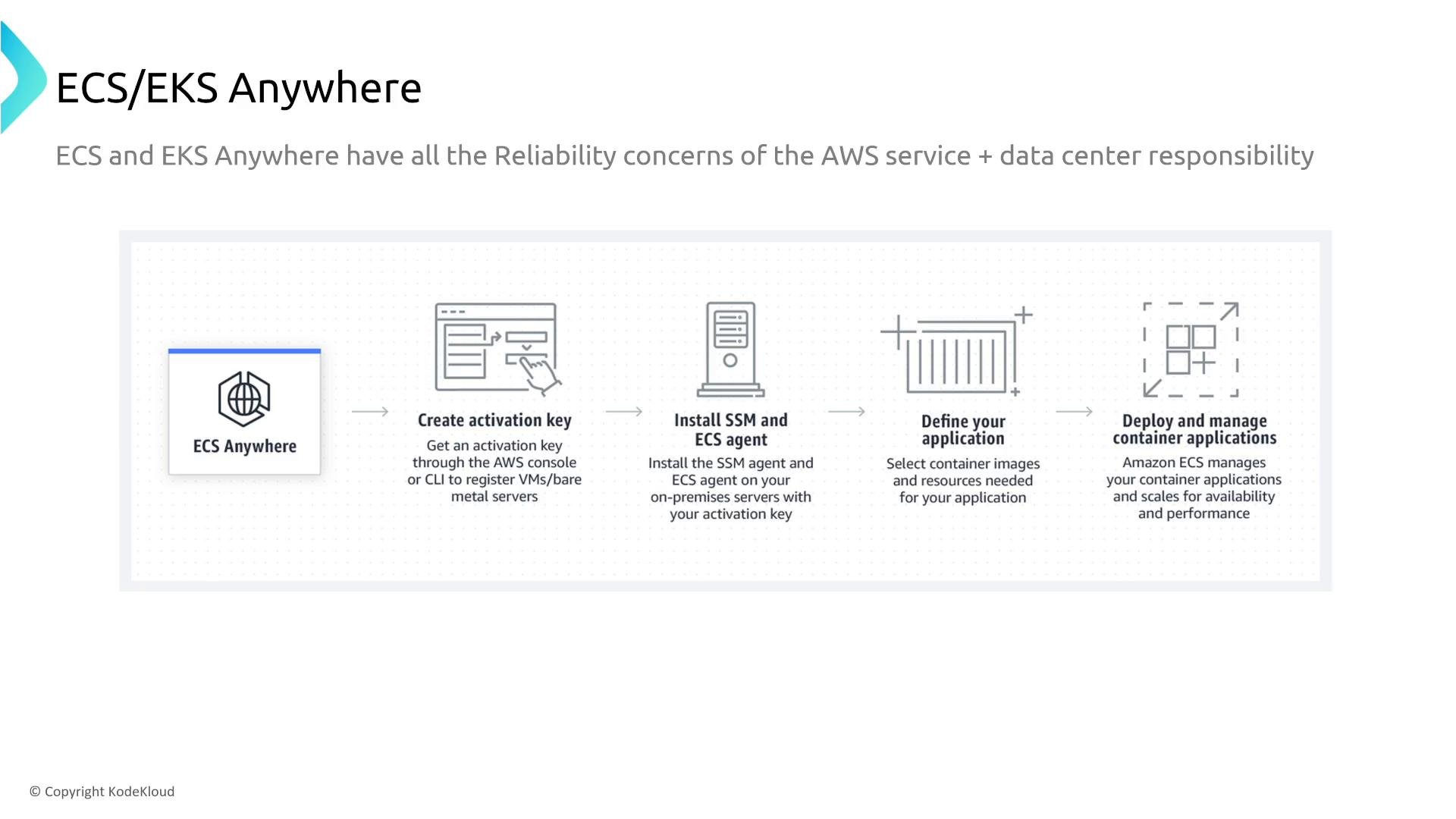
- Architect clusters for redundancy: multiple nodes, zones, and resilient storage.
- Ensure secure, reliable control-plane connectivity and lifecycle management for agents.
- Implement observability, patch management, and automation for node provisioning and recovery.
VMware Cloud on AWS — managed VMware stack on AWS infrastructure
VMware Cloud on AWS provides a managed vSphere stack running on AWS hardware. It enables lift-and-shift migrations with familiar VMware tooling while exposing integration to native AWS services.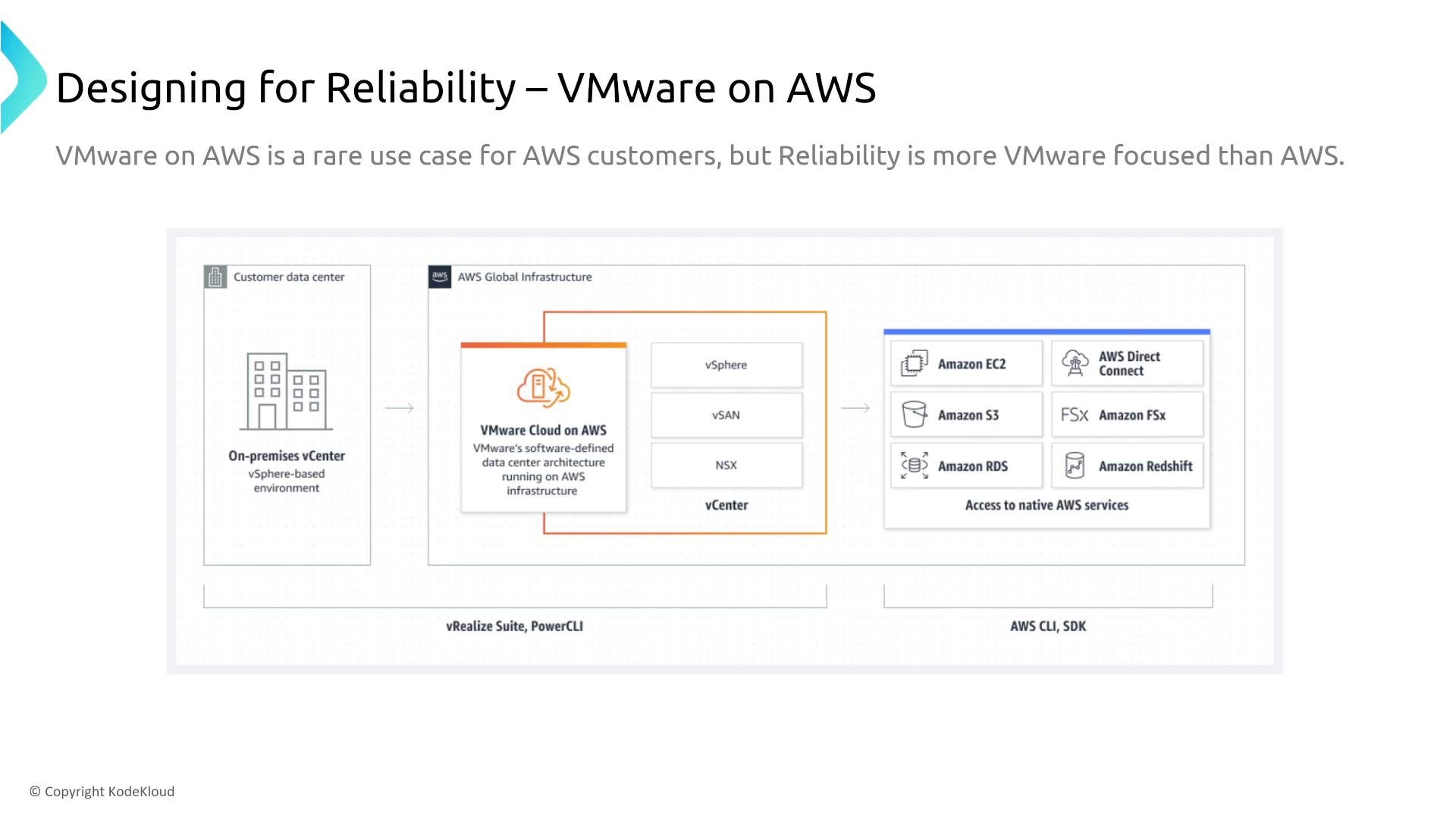
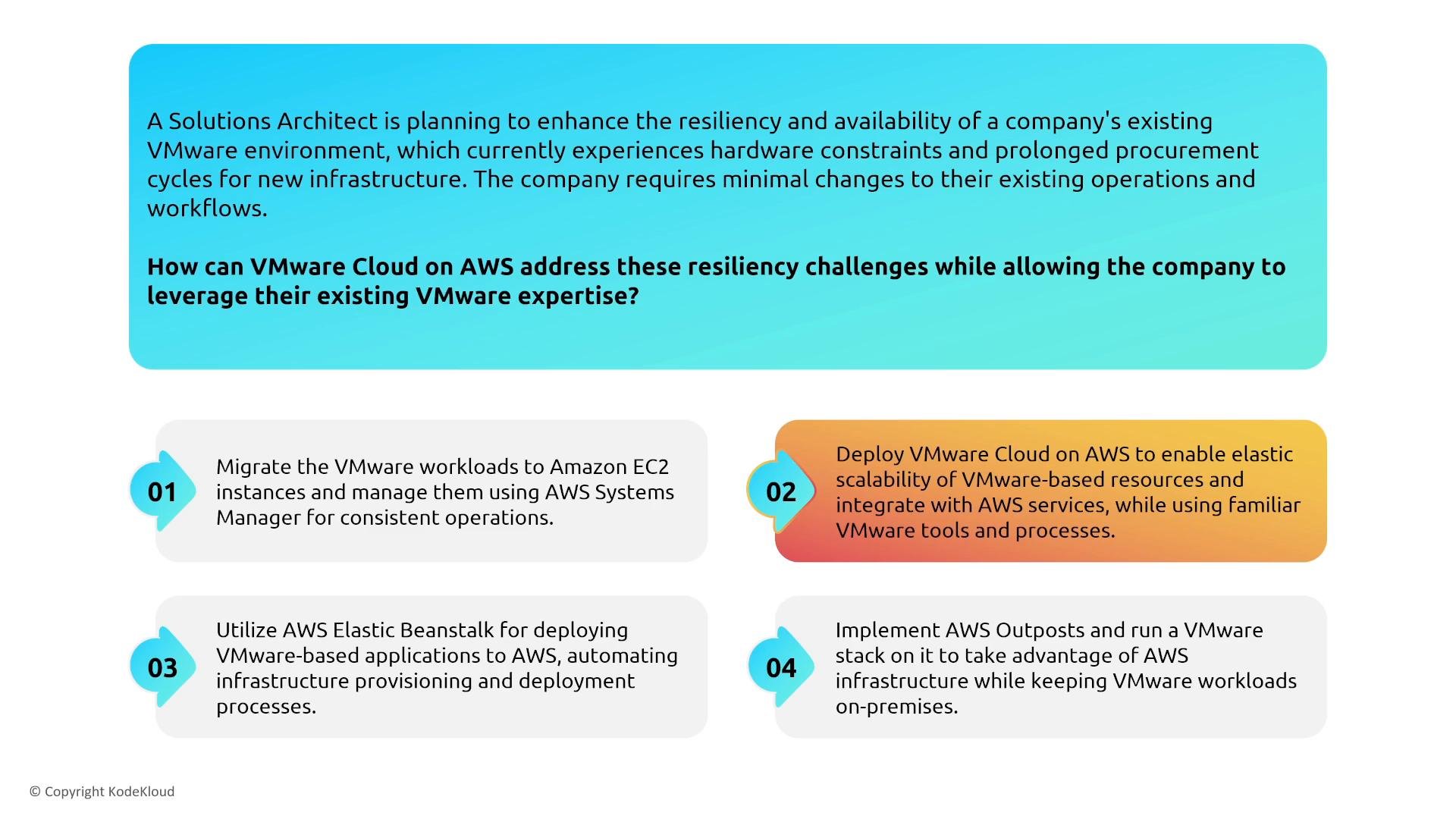
- Reuse existing operational processes while taking advantage of AWS-native services for data durability and scaling.
- Consider hybrid disaster recovery designs: replicate workloads to another AZ/Region or to native AWS services.
Edge compute: AWS Snow Family — Snowcone, Snowball Edge, Snowmobile
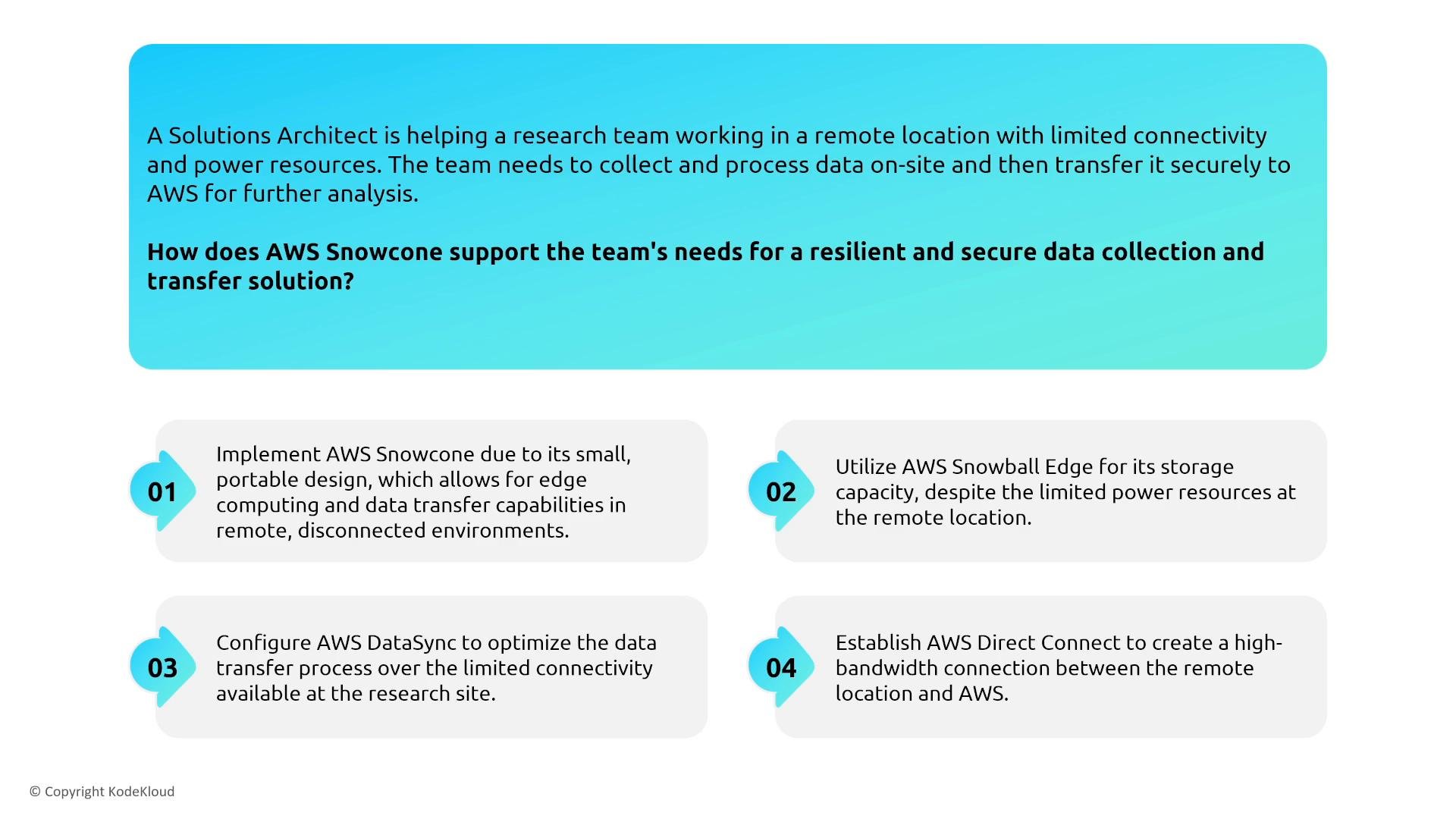
Snow devices enable secure data transfer and edge compute in disconnected or bandwidth-constrained environments. They are physical appliances with durability and security guarantees, but operational practices determine resilience.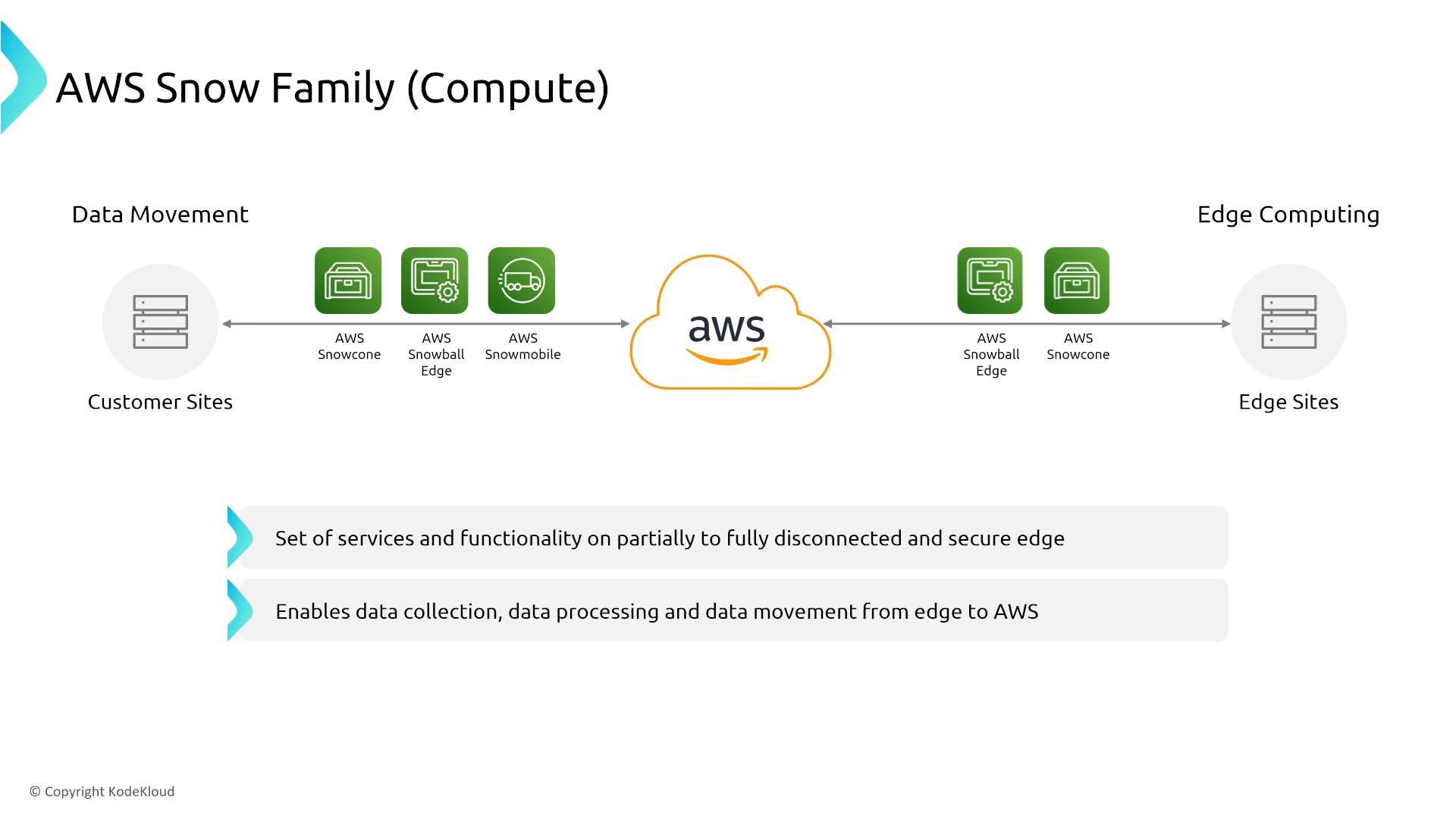
- Use multiple devices or workflows that replicate processing outputs so a single device failure doesn’t cause data loss.
- Secure chain-of-custody and logistics for physical device transport.
- Automate data ingestion and verification after devices arrive in the cloud.
Summary — key takeaways for compute reliability
This section distills practical reliability principles that apply across serverless, hybrid, and edge compute models. Key principles:- Redundancy and loose coupling: run multiple instances or replicas and decouple components with queues or load balancers.
- Auto Scaling and graceful replacement: use autoscaling groups, container orchestration, or serverless autoscaling to recover from failures.
- Data duplication and replication: use multi-AZ or multi-Region replication for critical data and read replicas where appropriate.
- Robust error handling: design retries with exponential backoff, DLQs, and compensating transactions for non-idempotent operations.
- Observability and quotas: instrument systems (CloudWatch, X-Ray), monitor throttles and service quotas, and request quota increases in advance of major events.
- Hybrid and edge operations: focus on network redundancy, multiple appliances, and clear logistics/operational runbooks.
Bottom line: the simplest and most effective pattern for compute reliability is usually “more than one, and a load balancer or queue in front.” Replicate workloads and data, instrument for observability, and prepare operational runbooks for failover and recovery.
Links and references
- AWS Lambda Developer Guide: https://docs.aws.amazon.com/lambda/latest/dg/welcome.html
- Lambda Provisioned Concurrency: https://docs.aws.amazon.com/lambda/latest/dg/configuration-concurrency.html#config-provisioned-concurrency
- Lambda SnapStart: https://docs.aws.amazon.com/lambda/latest/dg/snapstart.html
- Lambda async invocation and DLQs/destinations: https://docs.aws.amazon.com/lambda/latest/dg/invocation-async.html
- Amazon CloudWatch: https://docs.aws.amazon.com/AmazonCloudWatch/latest/monitoring/what-is-cloudwatch.html
- AWS X-Ray: https://docs.aws.amazon.com/xray/latest/devguide/aws-xray.html
- Step Functions: https://docs.aws.amazon.com/step-functions/latest/dg/welcome.html
- AWS SAM: https://docs.aws.amazon.com/serverless-application-model/latest/developerguide/what-is-sam.html
- CloudFormation StackSets: https://docs.aws.amazon.com/AWSCloudFormation/latest/UserGuide/what-is-stacksets.html
- Serverless Application Repository: https://docs.aws.amazon.com/serverlessrepo/latest/devguide/what-is-serverlessrepo.html
- AWS Amplify: https://docs.amplify.aws/
- AWS Outposts: https://docs.aws.amazon.com/outposts/latest/userguide/what-is-aws-outposts.html
- AWS Direct Connect: https://docs.aws.amazon.com/directconnect/latest/UserGuide/Welcome.html
- EKS Anywhere: https://aws.amazon.com/eks/anywhere/
- ECS Anywhere: https://docs.aws.amazon.com/AmazonECS/latest/developerguide/ecs-anywhere.html
- VMware Cloud on AWS: https://aws.amazon.com/vmware/
- AWS Snow Family: https://aws.amazon.com/snow-family/