

- What Amazon Lex does and where it fits in an application architecture
- How a simple hotel booking chatbot flow works (intent recognition, slot filling, fulfillment)
- Key Lex capabilities, integrations, and practical implementation notes
-
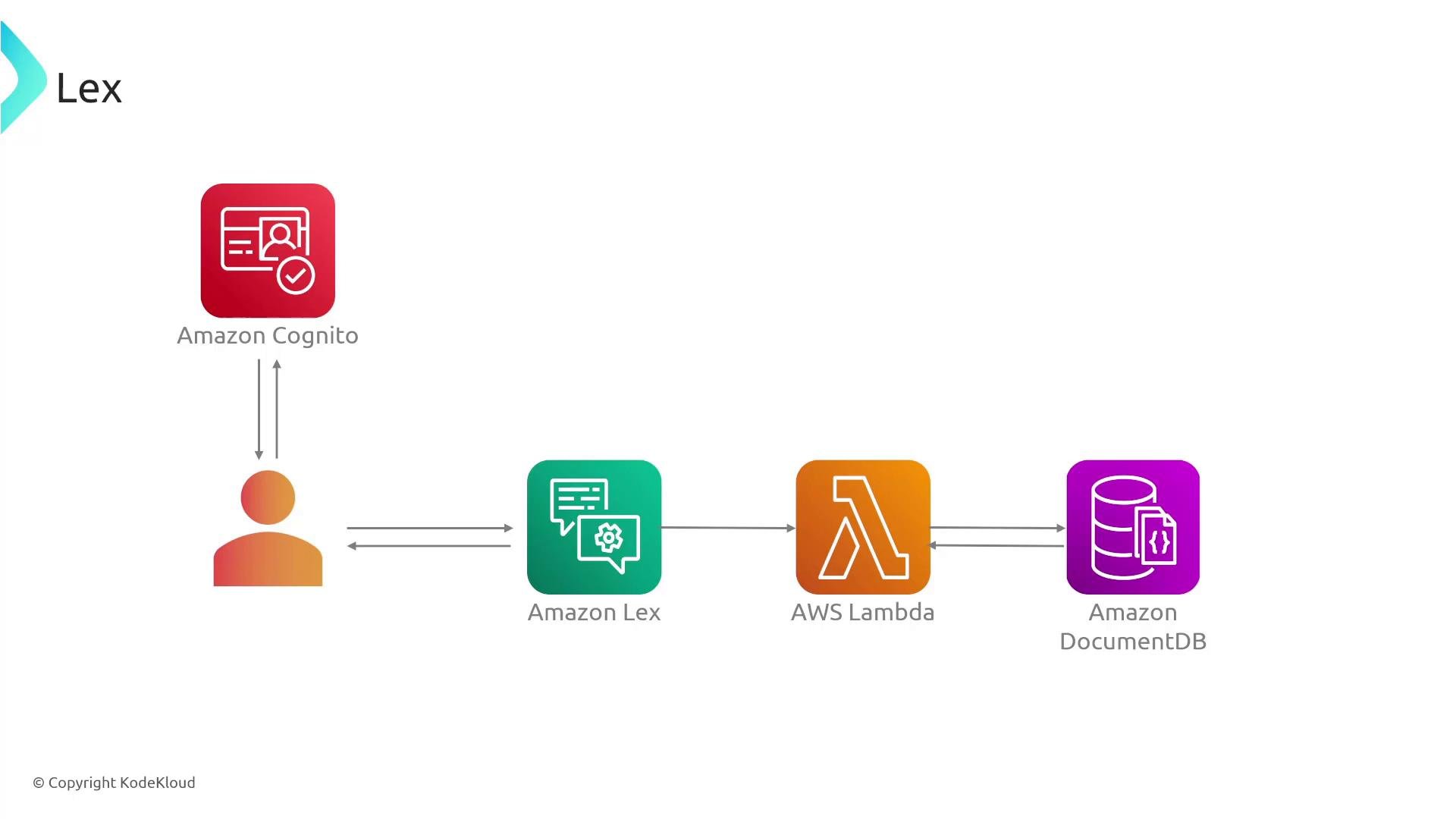
Authentication: Users sign in to your app using Amazon Cognito (user pools or federated identities). Cognito handles application user authentication and identity management — it is not the same as AWS account authentication (IAM).
Cognito authenticates end users of your application (e.g., customers). Use IAM for managing access to AWS resources.
- Interaction channels: Users communicate with a Lex bot via text or voice. Lex supports multi-channel deployment (web/mobile SDKs, messaging platforms, contact center integrations, IoT devices).
-
Speech and language processing:
- ASR (Automatic Speech Recognition) converts spoken audio into text.
- NLU (Natural Language Understanding) classifies the user’s intent and extracts parameters (slots).
- Dialog management: Lex uses intents, sample utterances, and slots to orchestrate conversations. It handles prompts for missing slot values, input validation, and maintains multi-turn dialogue state.
-
Integration and fulfillment:
- Lex can invoke AWS Lambda at dialog hooks for validation, business logic, or fulfillment.
- Lambda functions can interact with any backend: databases (e.g., Amazon DocumentDB), APIs, or other AWS services.
- For voice responses, Lex can return text which is rendered as speech via Amazon Polly.
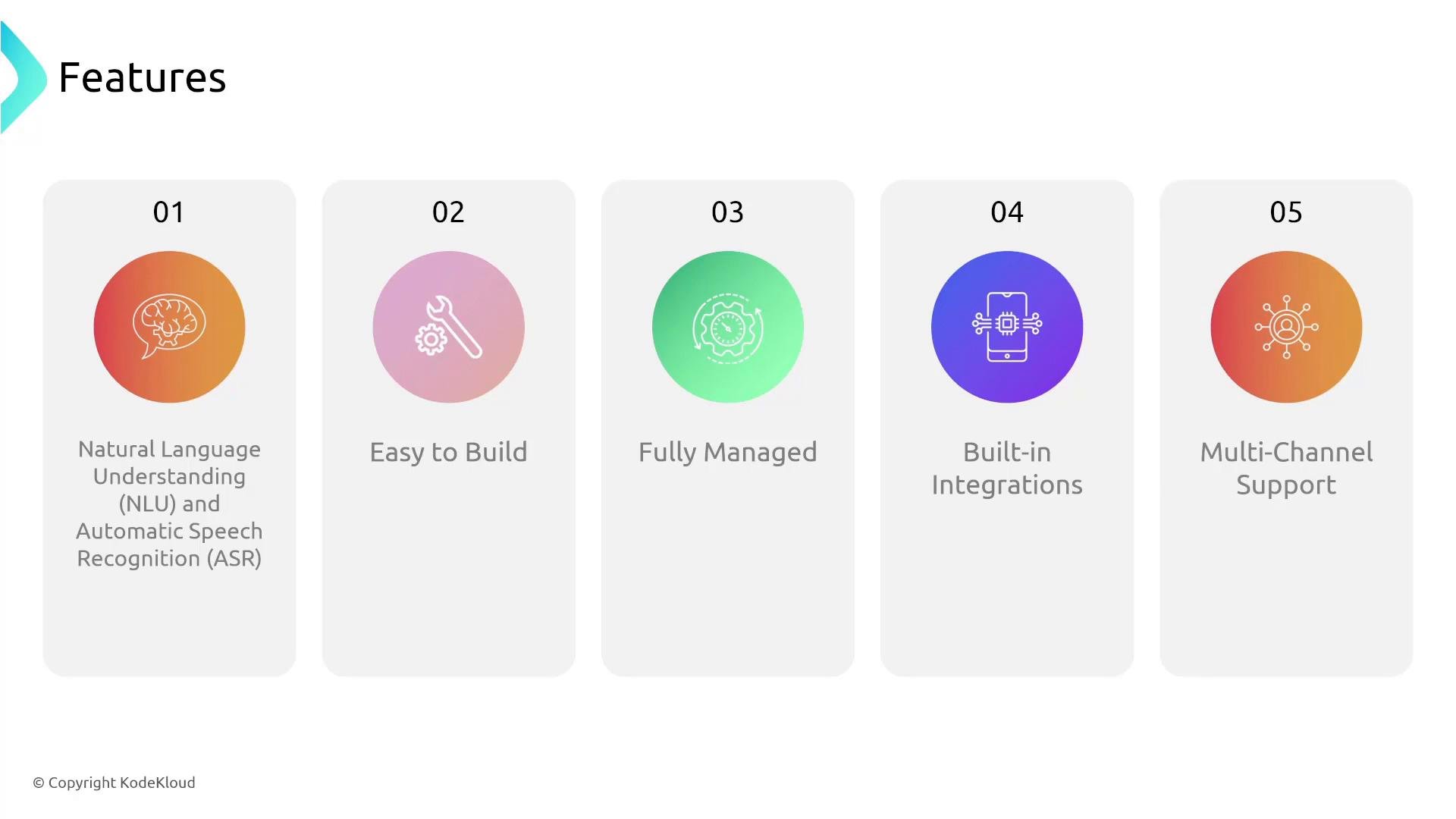
- NLU & ASR: Accurate recognition of spoken or typed user input.
- Conversation authoring: Define intents, slot types, sample utterances, prompts, and confirmation responses via console or APIs.
- Fully managed: AWS handles model training, hosting, scaling, and availability.
- Built-in integrations: Native support for Lambda, Cognito, Polly, and more. Lambda enables access to any external API or service.
- Multi-channel runtime: Deploy bots to web apps, mobile apps, messaging platforms, contact centers, and devices.
Practical notes and best practices
- Interaction modes: Lex supports synchronous text-based interactions and real-time voice interactions. For voice, send audio to Lex; it performs ASR → NLU and can respond with text or synthesized speech via Polly.
- Dialog hooks: Use Lambda’s dialog code hooks for custom validation, slot elicitation logic, and fulfillment. This is where you implement business rules and persist data to backend stores such as Amazon DocumentDB.
- Lex versions: Lex v1 and Lex v2 exist. Lex v2 offers an improved console, better support for multiple locales, environments, and streamlined multi-bot management. Review the official docs to pick the best version: https://docs.aws.amazon.com/lexv2/latest/dg/what-is.html
- Security: Protect user data, secure Lambda execution roles, and use Cognito or other identity providers for application-level authentication. Use IAM to control permissions on AWS resources.
- Testing and iteration: Start with simple intents and utterances, test with real user phrases, and iterate on slot types and prompts. Leverage CloudWatch logs to debug Lambda and bot interactions.
- Amazon Lex documentation: https://docs.aws.amazon.com/lex/latest/dg/what-is.html
- AWS Lambda documentation: https://docs.aws.amazon.com/lambda/latest/dg/welcome.html
- Amazon Cognito overview: https://docs.aws.amazon.com/cognito/latest/developerguide/what-is-amazon-cognito.html
- Amazon Polly overview: https://docs.aws.amazon.com/polly/latest/dg/what-is.html
- Amazon DocumentDB: https://docs.aws.amazon.com/documentdb/latest/developerguide/what-is.html