

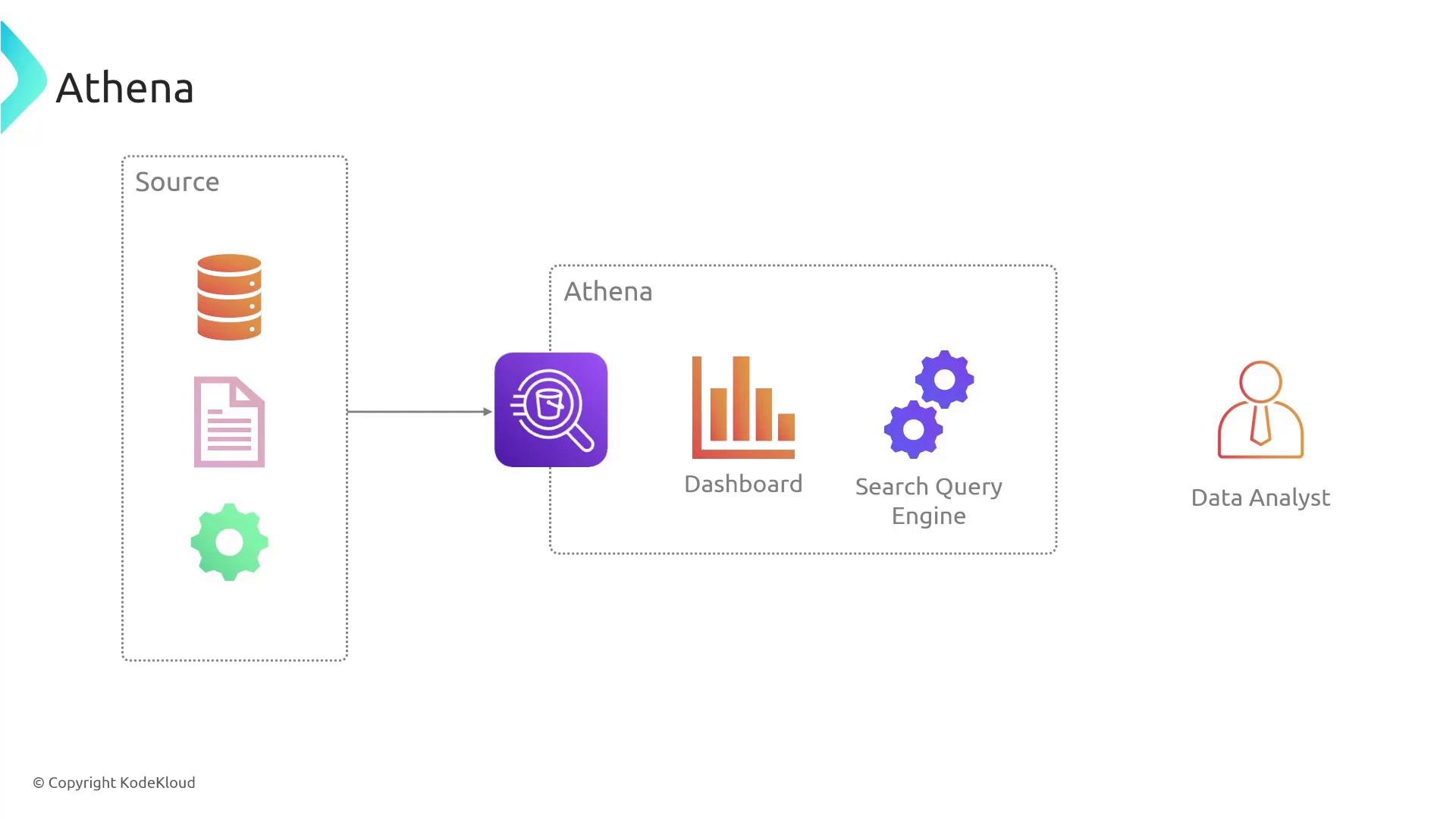
- Data stays in Amazon S3 and is queried in place — no ETL load into a managed database is required.
- A metadata catalog (usually AWS Glue) stores table definitions, schema, and partitions so Athena can interpret files on S3.
- Because Athena is serverless, you don’t provision query clusters; you pay per query based on data scanned.
Example: analyzing customer purchase data
- Identify the data sources: sales transactions with fields such as
customer_id,product_id,purchase_amount,purchase_date,payment_method. - Use AWS Glue to discover schemas, convert raw files to a columnar format (e.g., Parquet), and register tables in the Glue Data Catalog.
- Store the transformed Parquet files in an S3 bucket and keep the metadata in the Glue Data Catalog.
- Analysts run SQL in Athena to aggregate and analyze purchases. For example:
- Fast ad hoc queries against datasets that live on S3 without provisioning infrastructure.
- Exploratory analysis, log analytics, and interactive querying of large datasets when you prefer a pay-per-query model.
- Integrations with ETL pipelines and BI tools where maintaining an S3-based data lake is desirable.
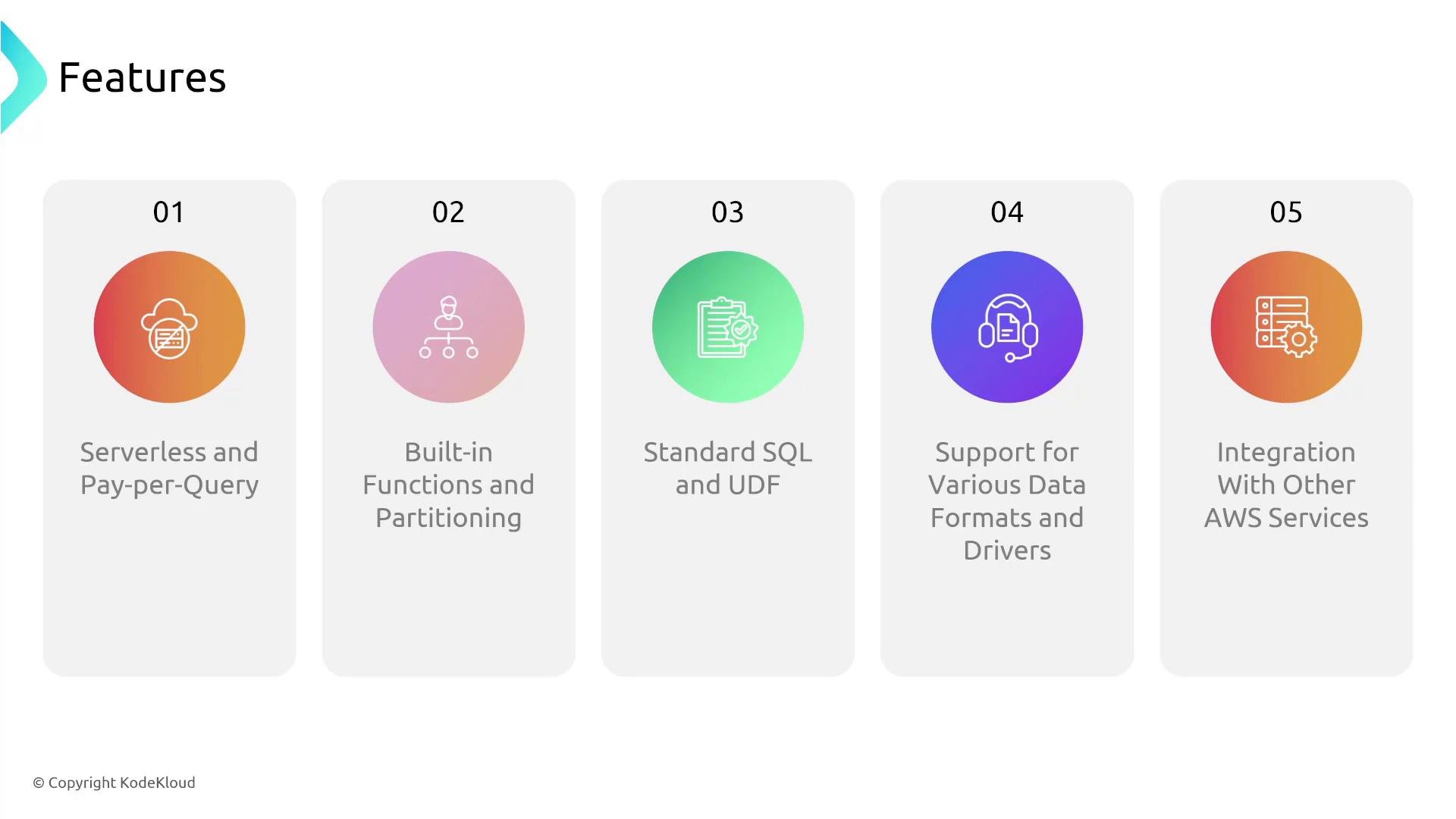
Athena charges are based on the amount of data scanned per query. Use partitioning and columnar formats such as Parquet or ORC to reduce scanned data and lower costs.
Unoptimized queries can scan large amounts of S3 data and incur significant costs. Always test queries on samples, apply predicates, and prefer columnar/partitioned data for production workloads.
- Use the Glue Data Catalog (or Athena’s internal catalog) to manage table definitions, schema evolution, and partitions.
- Convert raw data to columnar formats (Parquet or ORC) to reduce I/O and cost.
- Partition data by commonly filtered fields (for example
date,customer_id, orregion) to limit scanned partitions. - For frequently-run or dashboard queries, consider materializing results into new Parquet files in S3, or use Amazon Redshift Spectrum when an analytical data warehouse is needed.
- Performance is tied to how data is formatted and partitioned; poor layout leads to high scan volumes.
- For extremely low-latency or highly concurrent analytic workloads, consider a dedicated data warehouse (e.g., Amazon Redshift).
- Athena’s concurrency limits and resource controls should be reviewed for heavy multi-user environments.
- Amazon S3
- AWS Glue Data Catalog
- Amazon QuickSight
- Amazon Redshift Spectrum
- Amazon Athena Documentation