

This guide focuses on operational levers (scaling, replication, retention, monitoring) and orchestration patterns (buffering, retries, multi‑AZ/multi‑region) you can use to improve availability, durability, and recoverability for AWS data and ML/AI services.
Kinesis Data Streams — data-in-transit (shards, autoscaling, retention)
Kinesis Data Streams is AWS’s managed streaming service for data-in-transit. Its unit of scale is the shard: each shard provides a fixed amount of read and write throughput and you scale a stream by adding or removing shards. When a shard splits, resulting child shards manage throughput independently.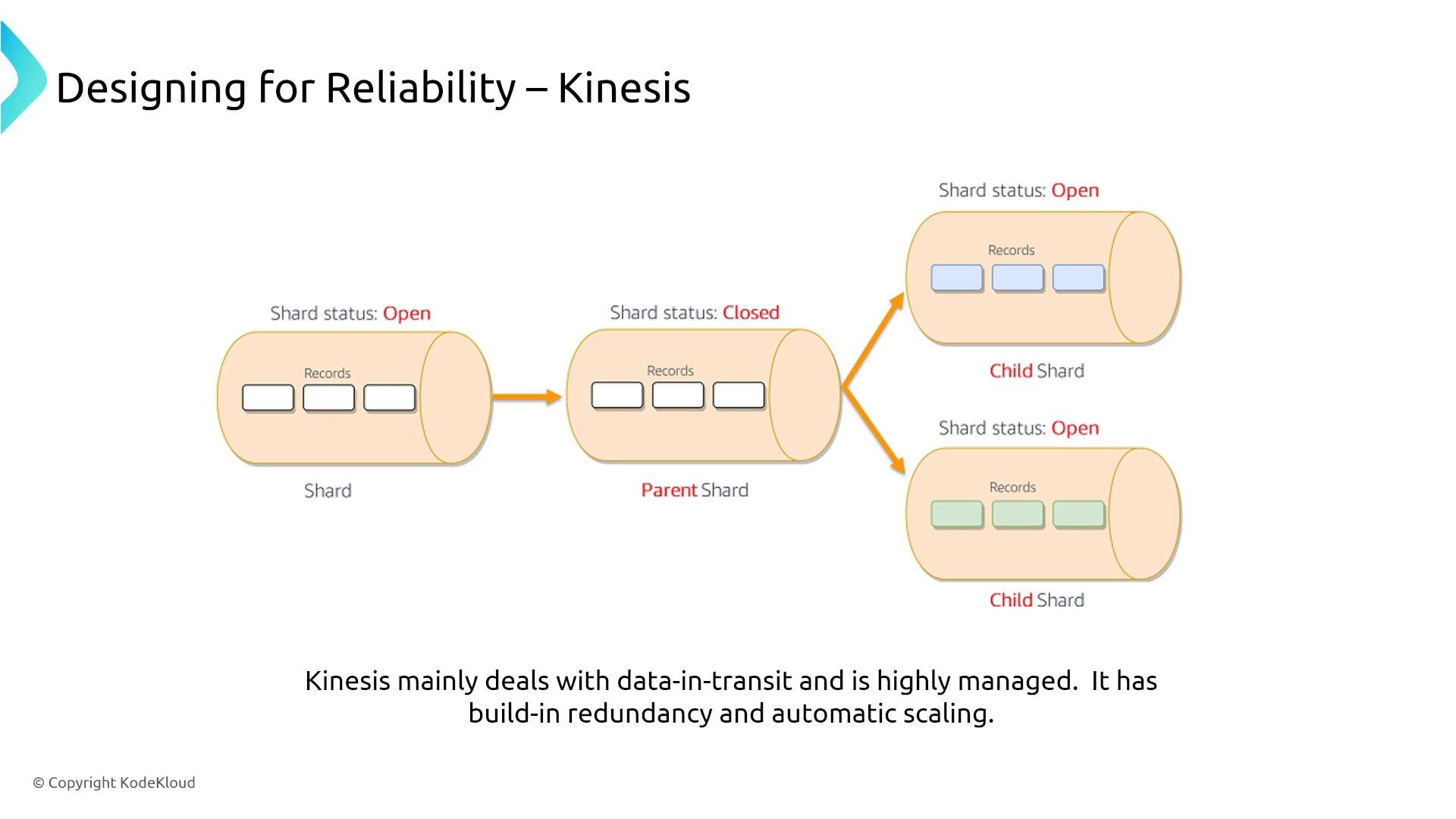
- Shard autoscaling (based on utilization) to adapt to workload spikes and drops.
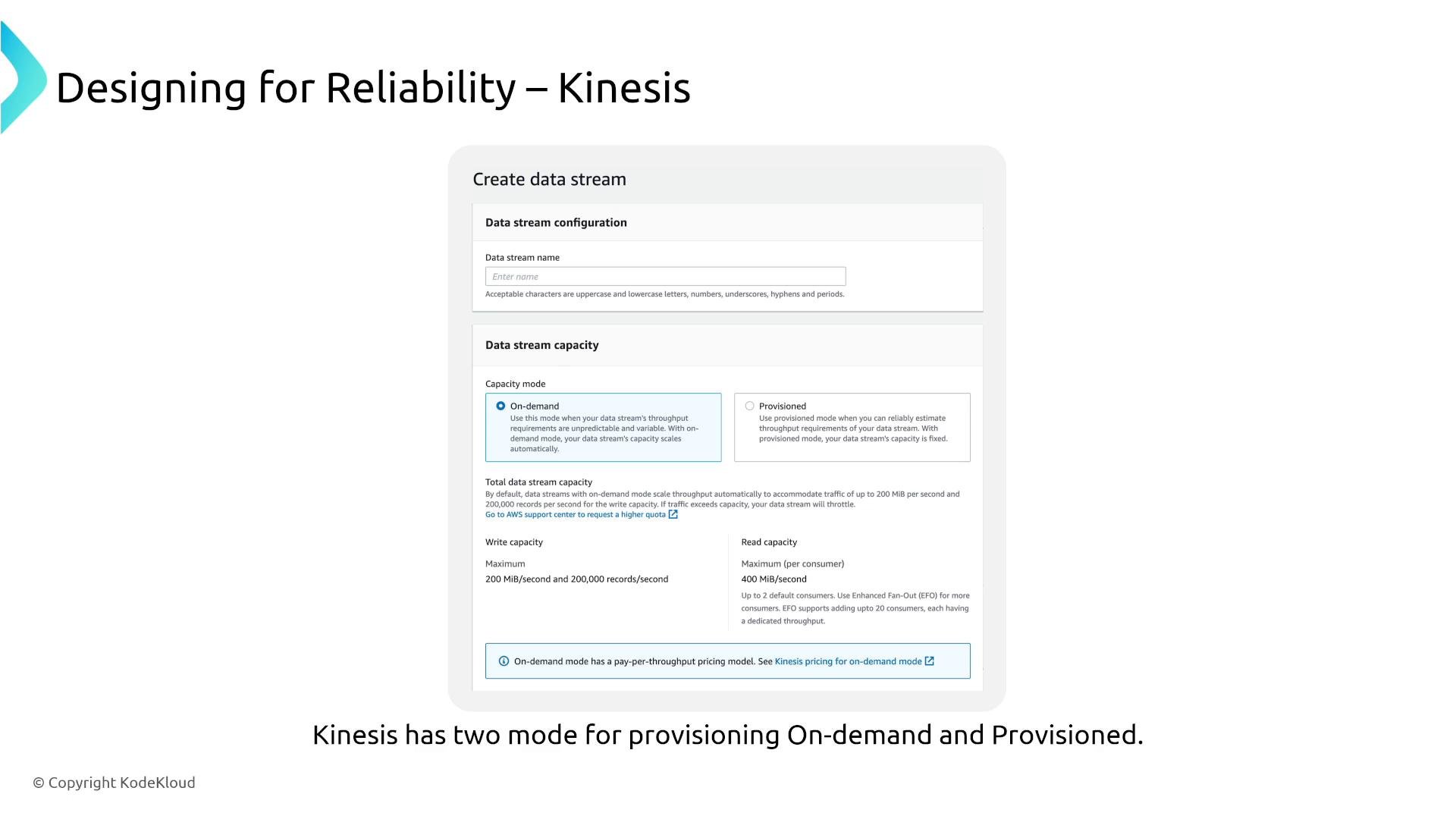
- Capacity mode selection at stream creation: Provisioned or On‑demand.
- Retention period: configurable from 24 hours up to 365 days.
- Write: up to 1 MB/sec or 1,000 records/sec per shard.
- Read: up to 2 MB/sec per shard.
- Provisioned: use when your traffic is predictable and you want precise throughput control.
- On‑demand: use when workloads are unpredictable or have bursty spikes; AWS manages scaling.
- Account and regional quotas can limit shard counts and aggregate throughput — request increases via Service Quotas when needed.
- Increase retention if downstream processing delays exceed the default retention window to avoid data loss.
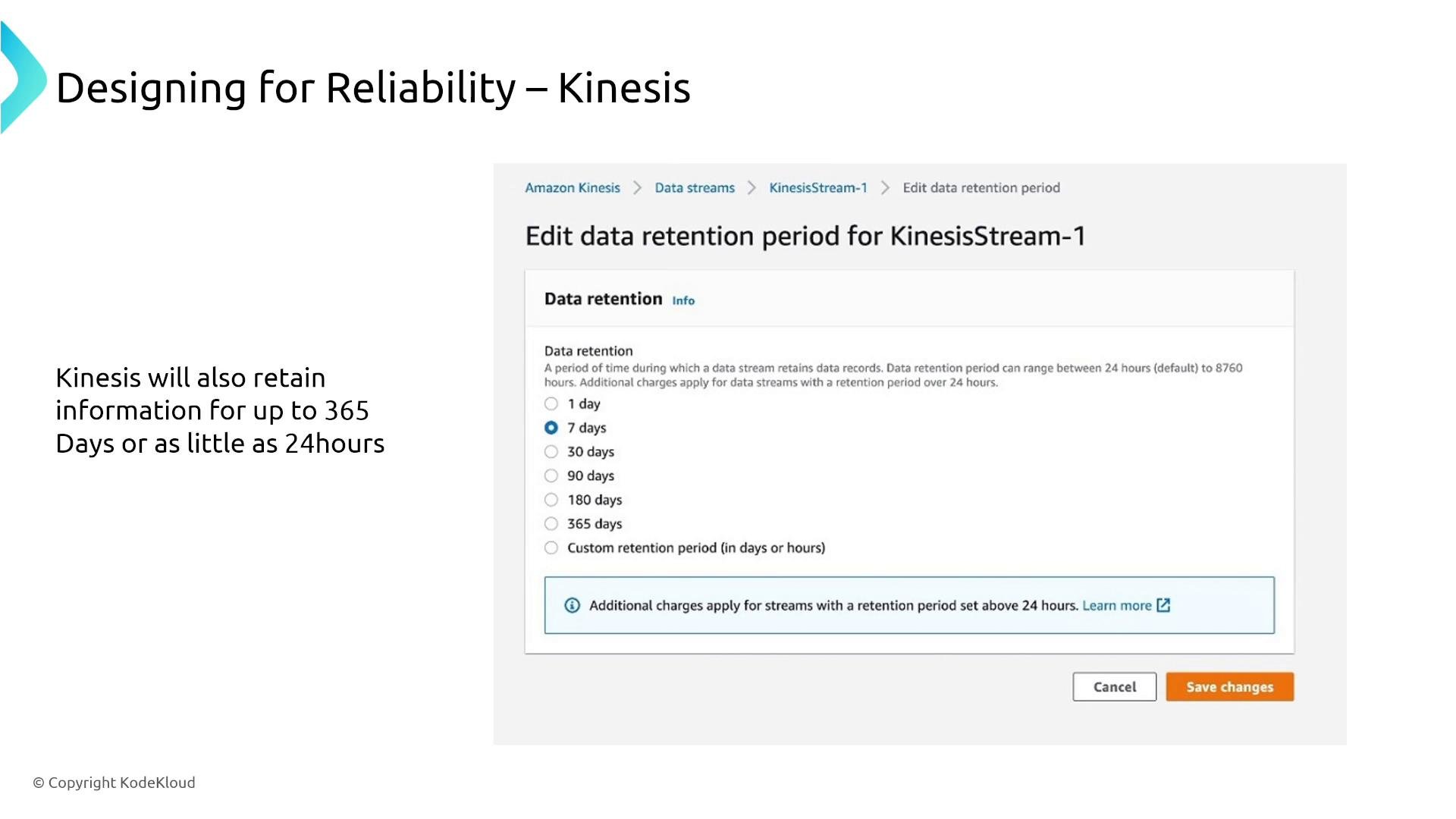
Beware of exceeding shard quotas or retention costs. Long retention increases storage costs; many teams use on‑demand shards combined with durable S3 backup or DynamoDB checks to balance cost and recovery needs.
Managed Streaming for Kafka (MSK)
Amazon MSK provides managed Apache Kafka with broker nodes, Zookeeper (for older Kafka versions), and network entry points. Producers write to brokers; data is replicated and consumed by clients.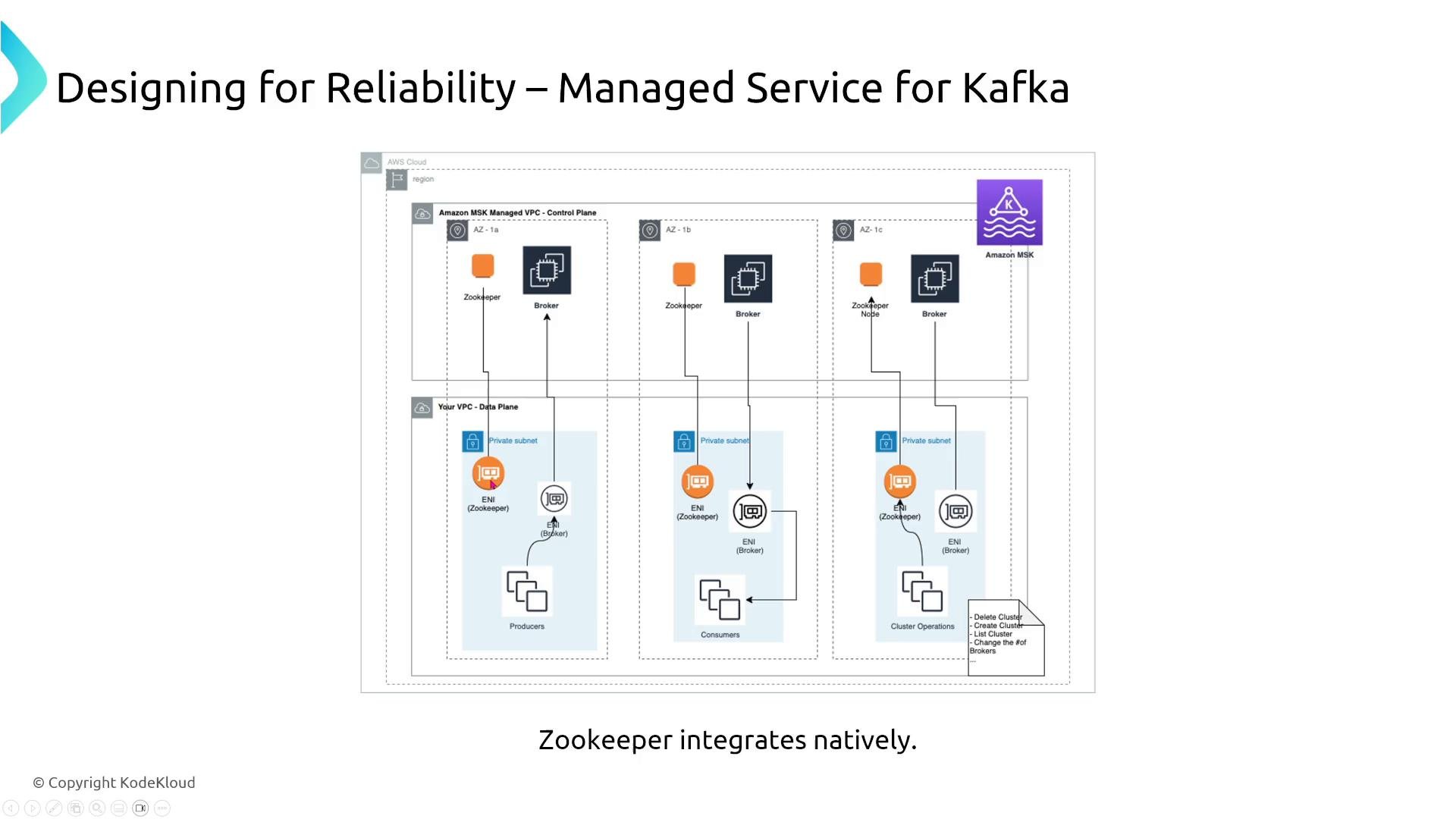
- Deploy brokers across multiple Availability Zones to achieve fault tolerance.
- Configure replication factor and in-sync replicas (ISRs) to balance durability and write latency.
- MSK supports automatic broker replacement and can automate certificate renewals and maintenance.
- For cross-region replication, use MirrorMaker or other async replication strategies.
- Newer Kafka KRaft modes reduce or remove ZooKeeper dependency; MSK supports evolving architectures as available.
- Set appropriate
ackson producers (e.g.,allfor durability). - Monitor broker health, topic lag, and ISR counts with CloudWatch metrics.
- Plan maintenance windows and use MSK’s automated patching where acceptable.
AWS Glue — serverless ETL (Apache Spark)
AWS Glue is a serverless ETL service built on Apache Spark that crawls data, builds the Glue Data Catalog, and runs ETL jobs to transform and move data (commonly into S3 for Athena/QuickSight).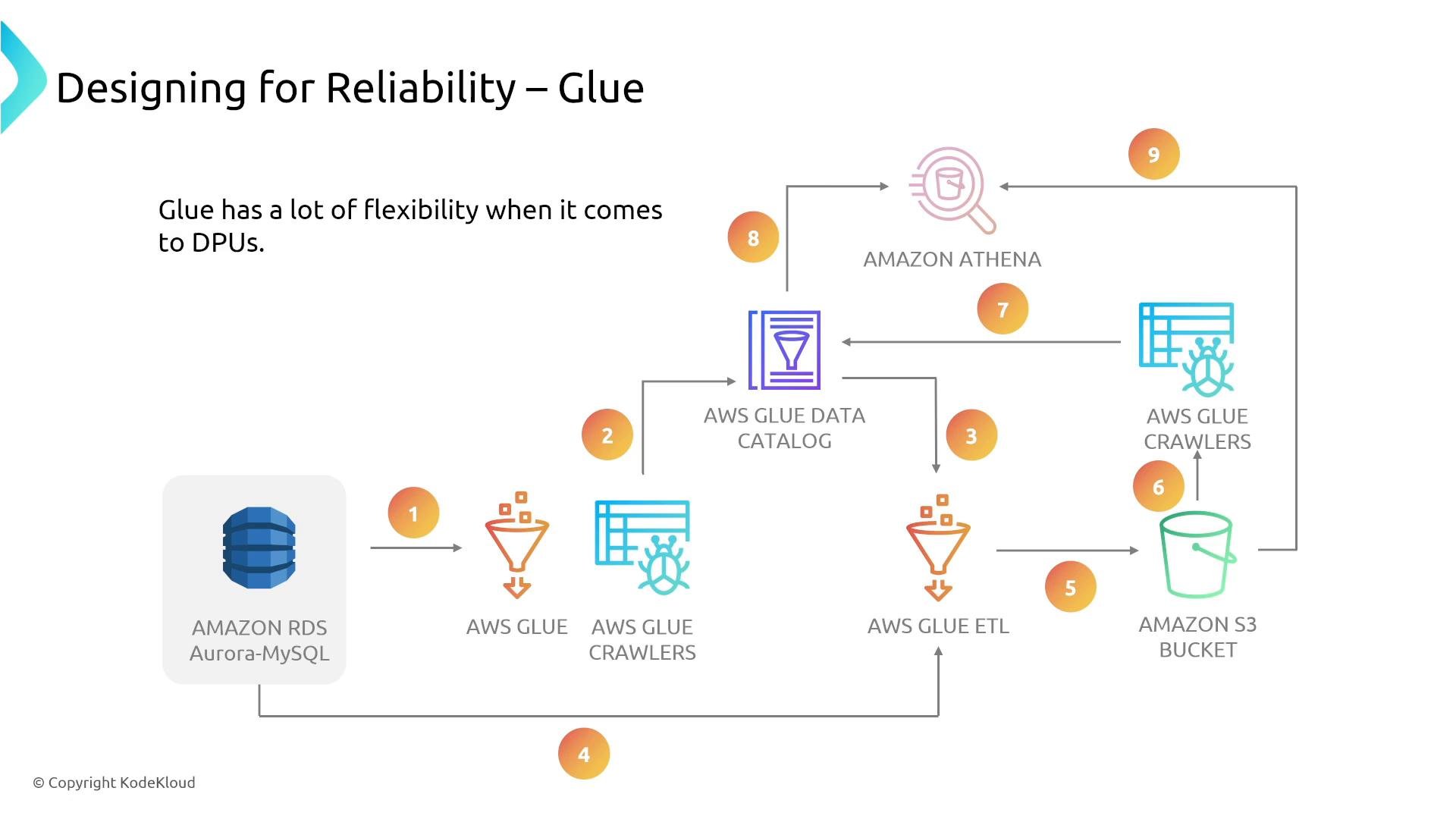
- Retries: enable automatic retries for transient job failures.
- DPUs (Data Processing Units): scale compute per job; right-size DPUs to match job complexity and cost goals.
- Use job bookmarks/state to avoid reprocessing and reduce failure blast radius.
- Tune DPUs and monitor job run times and errors with CloudWatch.
- Use incremental ETL patterns and idempotent transforms to support safe retries.
Amazon EMR — big data processing clusters
EMR is a node-based, managed platform for Hadoop, Spark, HBase, and more. Reliability controls:- Configure multiple master nodes or automatic failover for NameNode redundancy.
- Tune YARN for resource allocation and reliable Spark execution.
- Spread clusters across Availability Zones when feasible.
- Use EMRFS to interact with S3 for durable storage and checkpointing.
- Integrate EMR with CloudWatch, CloudTrail, and AWS Config for monitoring and auditing.
- Enable SSH access to inspect logs on core/task nodes when troubleshooting.
Glue DataBrew — visual data preparation
Glue DataBrew is a fully managed visual data-prep service with few operational knobs — AWS handles scaling and infrastructure. Focus on job-level settings and retries.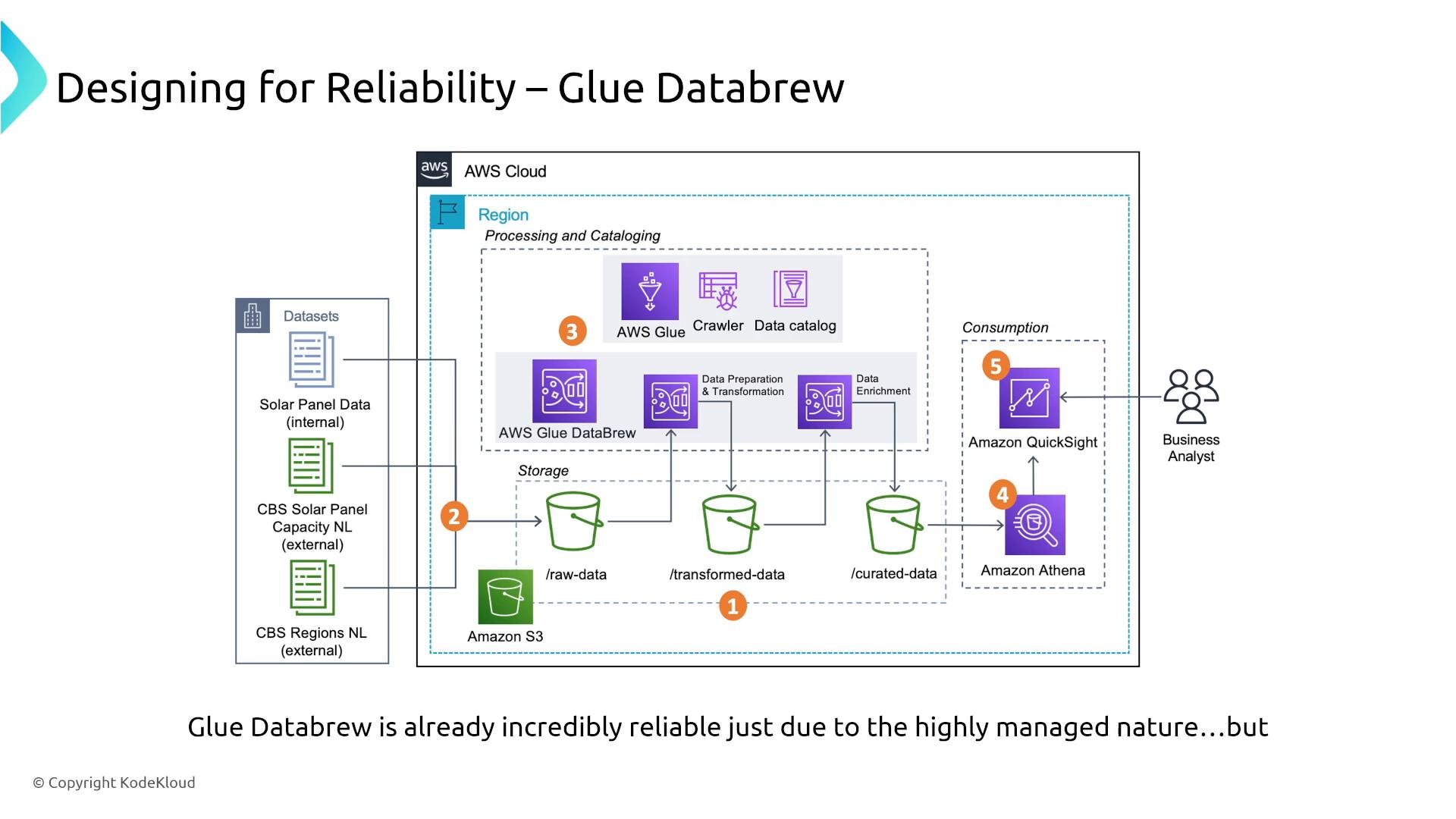
Lake Formation — unified data lake management
Lake Formation orchestrates S3, the Glue Data Catalog, and IAM to build secure data lakes. It relies on the reliability of underlying services like S3, Glue, and EMR.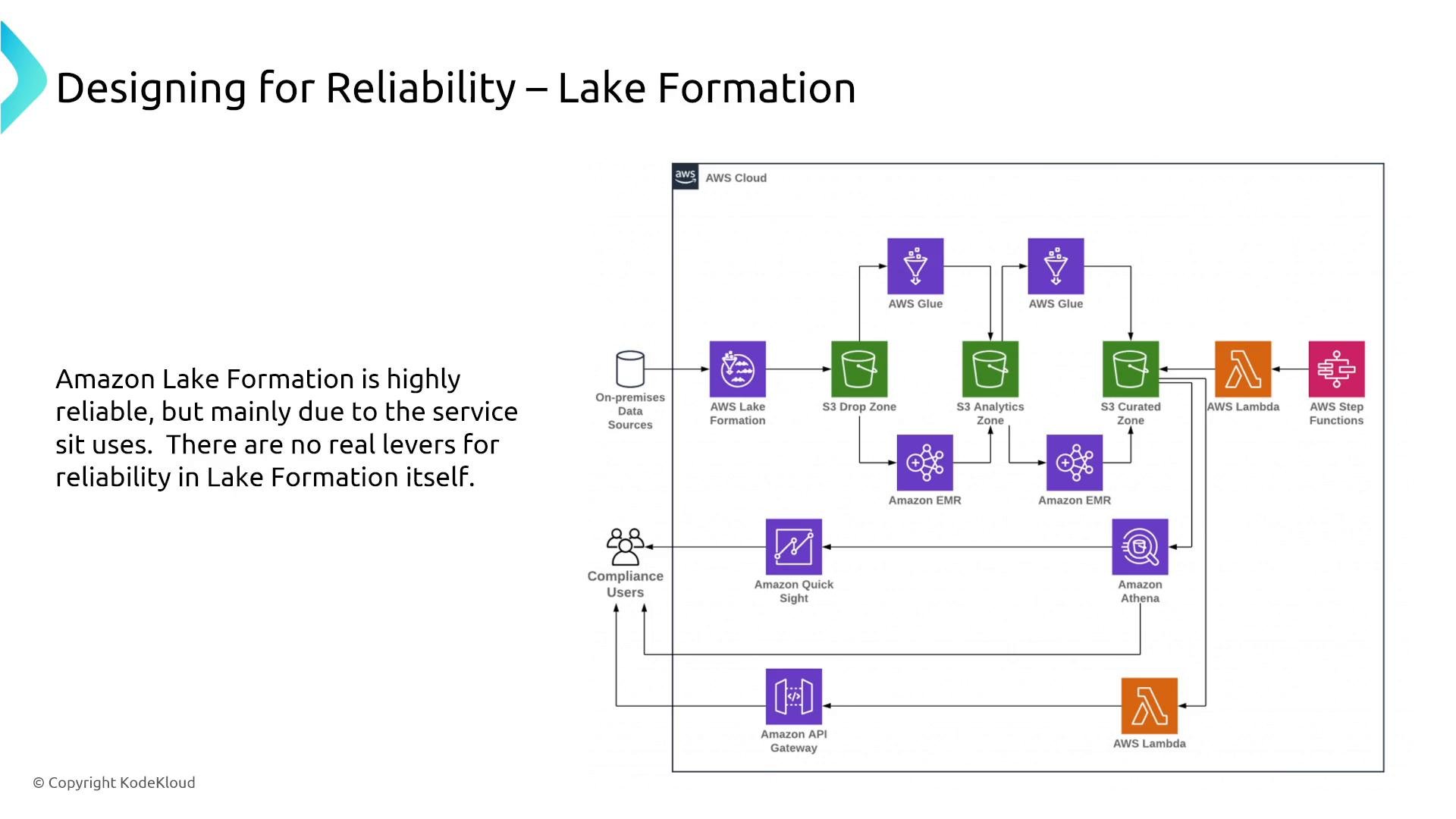
- Rely on S3 durability for storage; enforce fine‑grained access via Lake Formation and IAM policies.
- Use catalog versioning and replication strategies for cross-region resilience if required.
Athena — serverless interactive queries
Athena is a serverless SQL query service (based on Presto) that queries data in S3 and federated sources.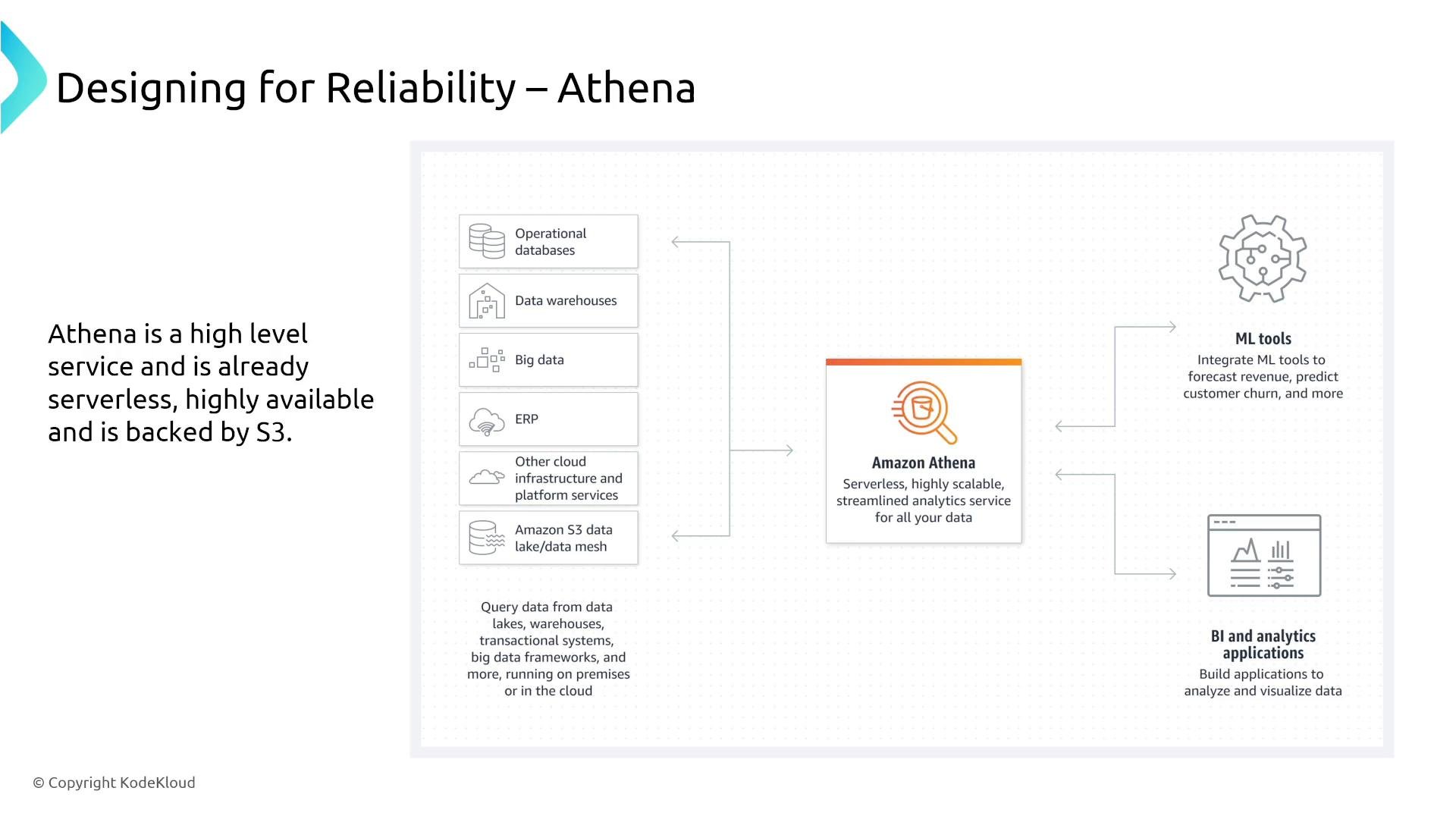
- Ensure S3 data durability and correct IAM permissions for query access.
- Partition and compress data to improve query performance and reduce failures due to timeouts.
- Monitor query metrics and logs in CloudWatch and use cost controls (query limits) to prevent noisy neighbors.
QuickSight — managed BI and dashboards
QuickSight is a managed BI tool with autoscaling and a SPICE in-memory engine.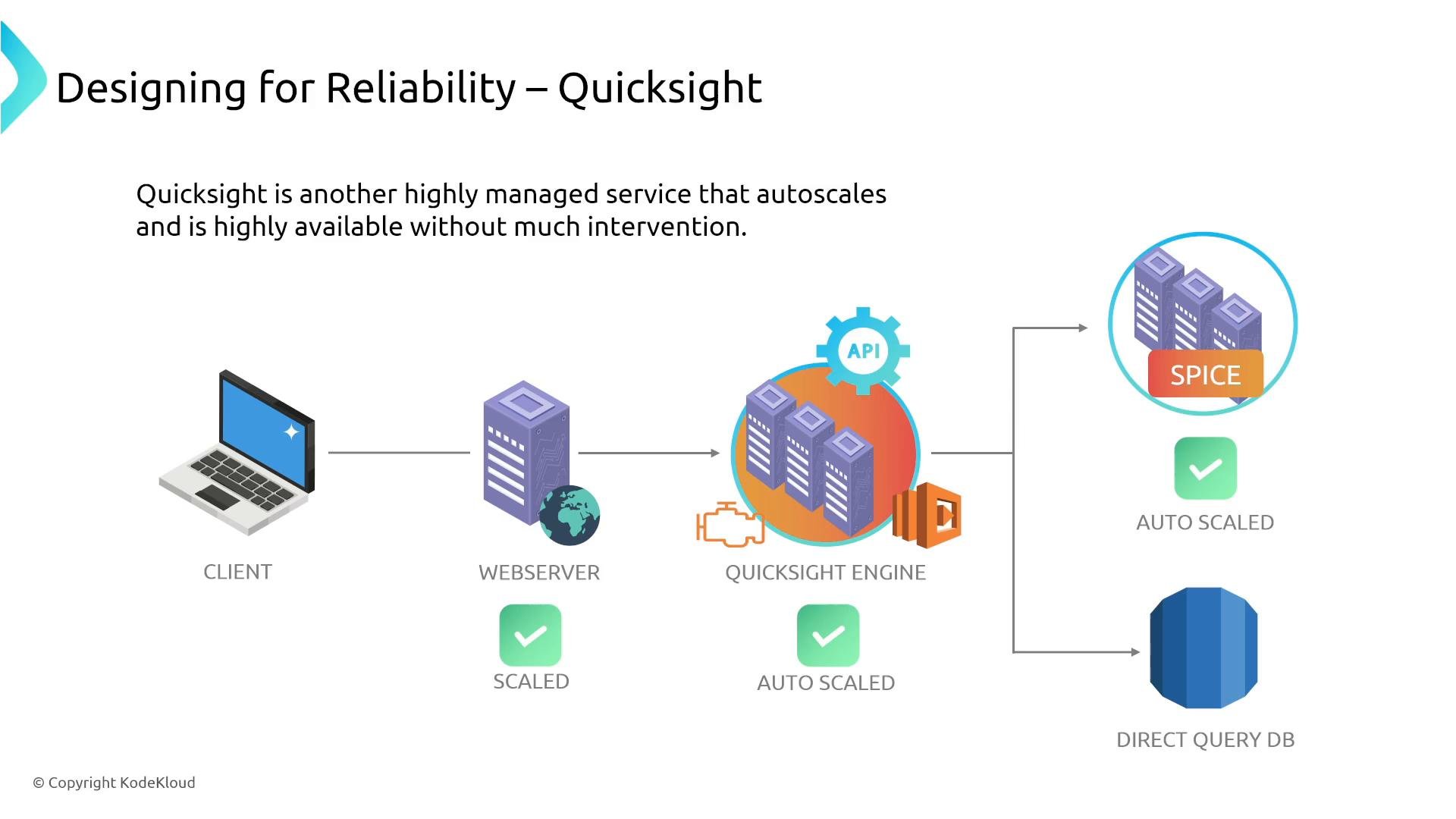
- Manage SPICE refresh schedules and dataset size.
- Secure access and permissions; monitor dashboard health and query times.
Redshift — data warehouse
Amazon Redshift provides clustering, replication, and snapshotting for analytical workloads.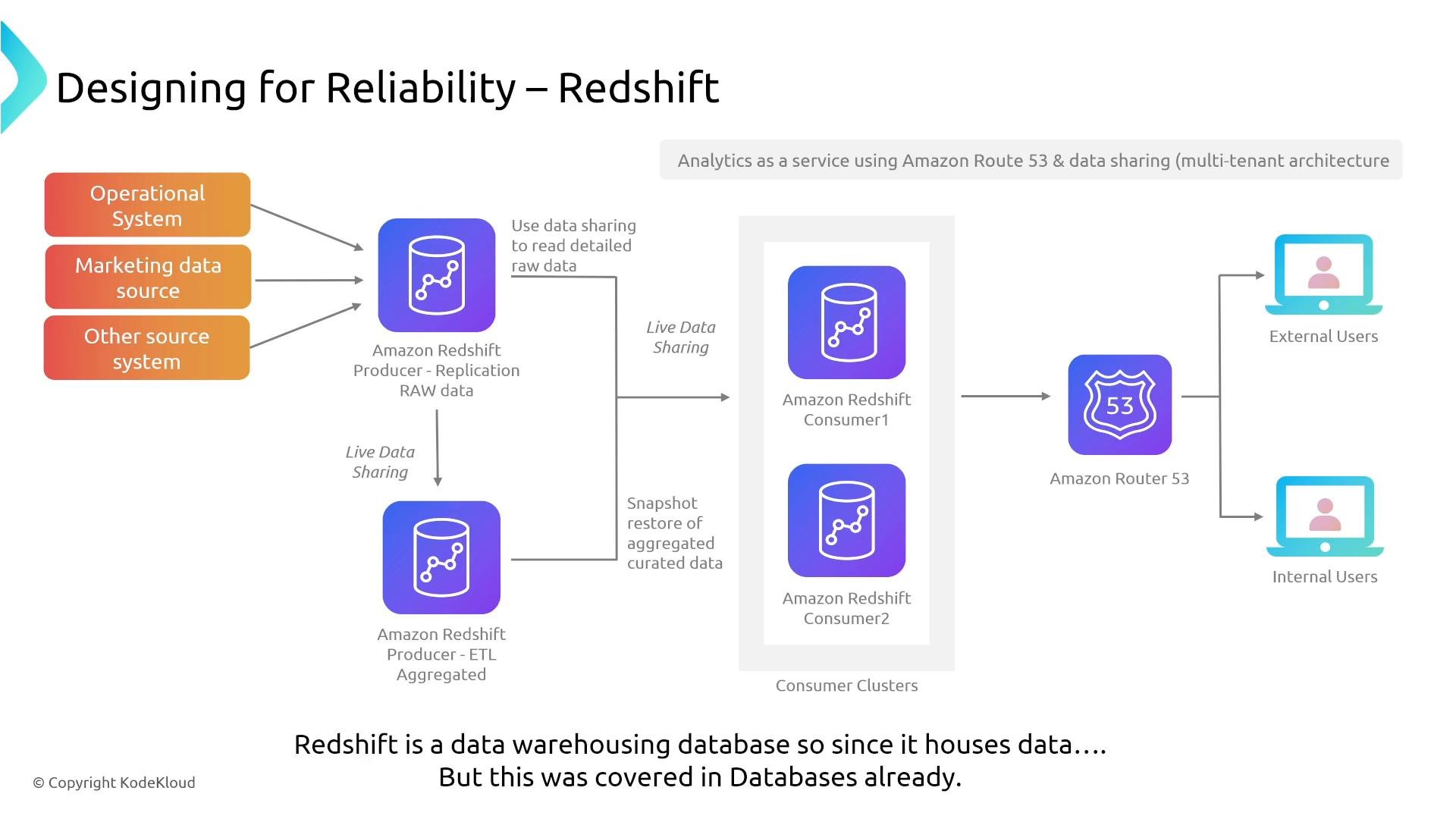
- Use snapshot retention and automated snapshots for backups.
- Consider RA3 nodes with managed storage for scaling and durability.
- Implement cluster resizing and concurrency scaling to handle variable query loads.
- Use cross-region snapshots for DR scenarios.
SageMaker — model training and hosting (instance-based)
SageMaker includes both managed and instance-based features. When using instance-based training or hosting, treat instances like EC2: you own configuration, scaling, and HA.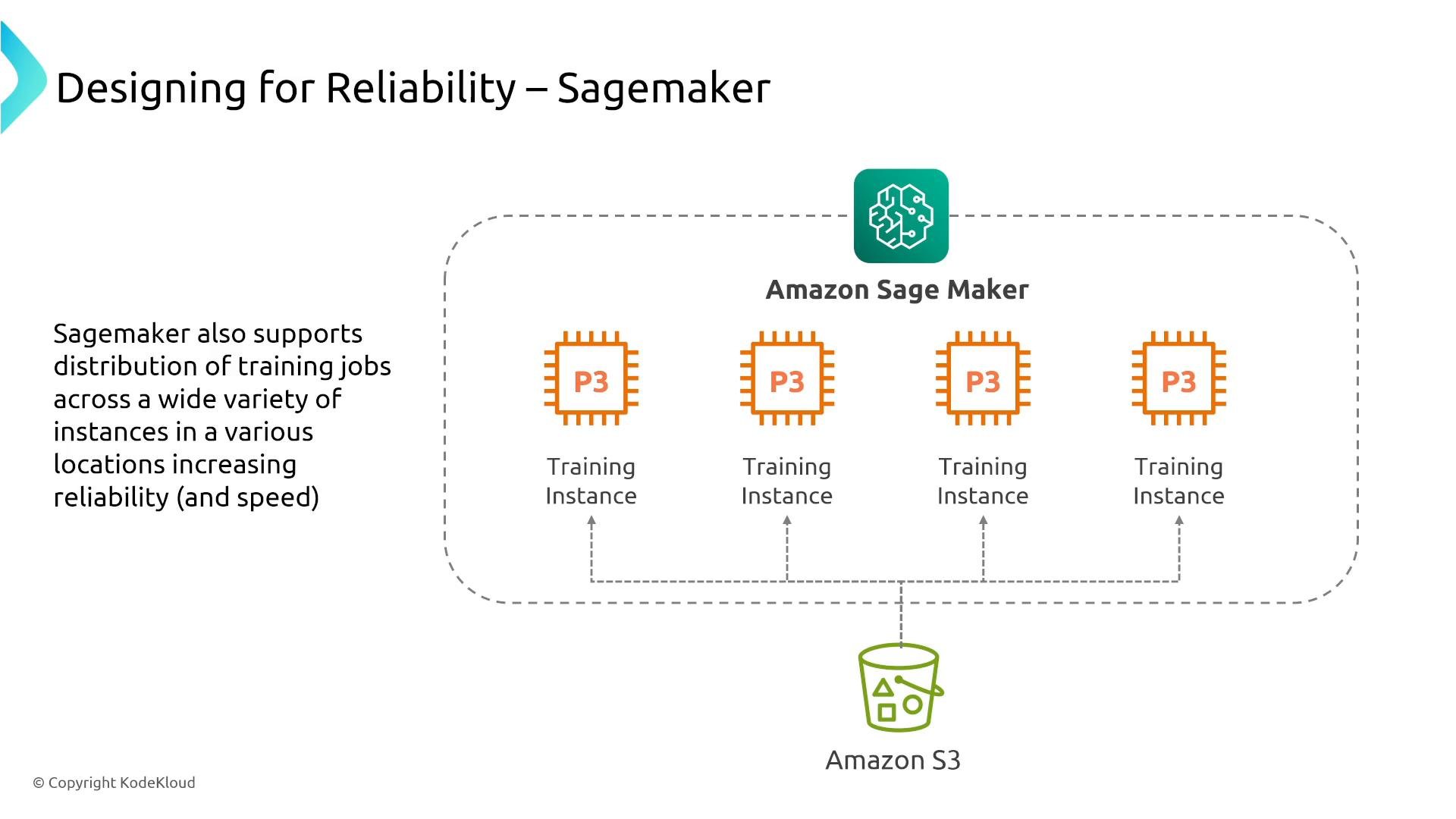
- Use distributed training across multiple instances for large models/datasets.
- For hosting: place endpoints behind Application Load Balancers, use multi-AZ endpoints or multiple endpoints with route control, implement canary or blue/green deployments, and enable autoscaling.
- Monitor training and hosting with CloudWatch, and audit via CloudTrail.
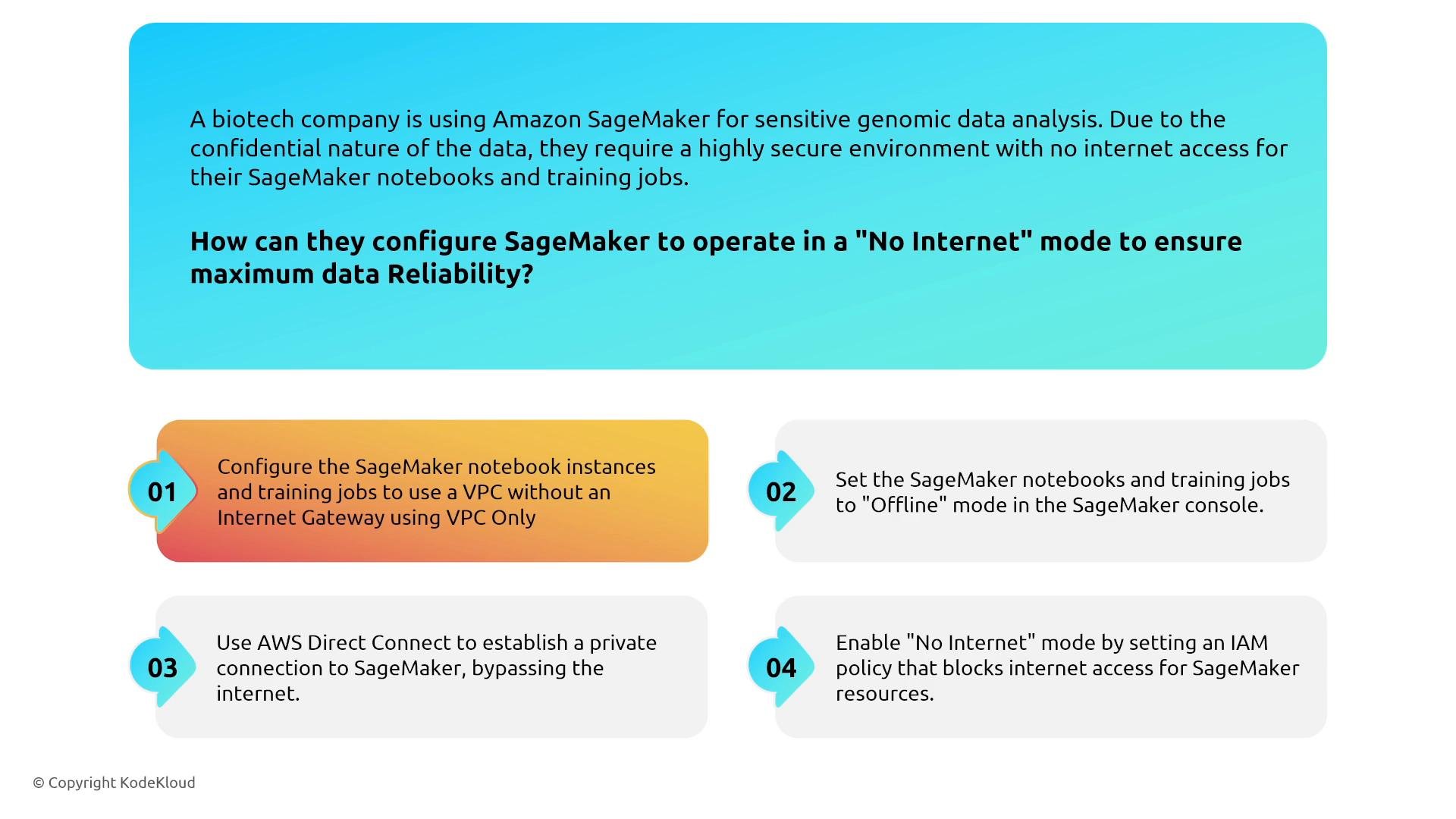
- For sensitive workloads, run SageMaker in a VPC without an internet gateway and use Direct Connect, VPC endpoints, and strict IAM policies.
Rekognition — image and video analysis
Rekognition is a managed image/video analysis API. AWS manages scaling and fault tolerance; architect around the service for resilience.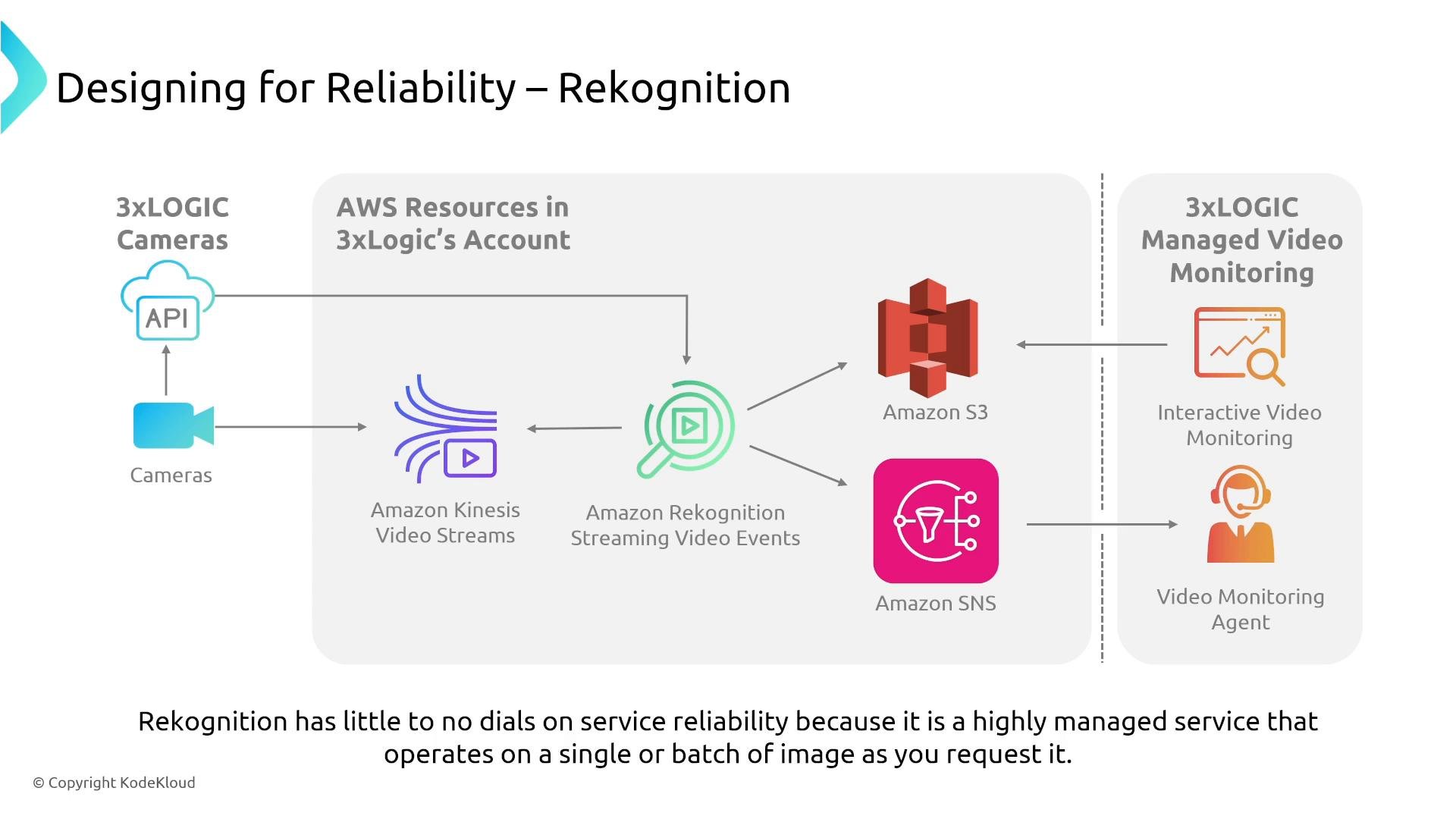
- Durable ingestion (S3) + buffering (Kinesis or SQS) to decouple upstream devices from Rekognition availability.
- Implement retry/backoff and dead-letter handling for failed requests.
- Monitor API errors and latency in CloudWatch.
Polly, Lex, Comprehend — managed AI services
Polly (TTS), Lex (conversational bots), and Comprehend (NLP) are highly managed. Focus on instrumentation, monitoring, and resilient integration patterns. Polly architecture example: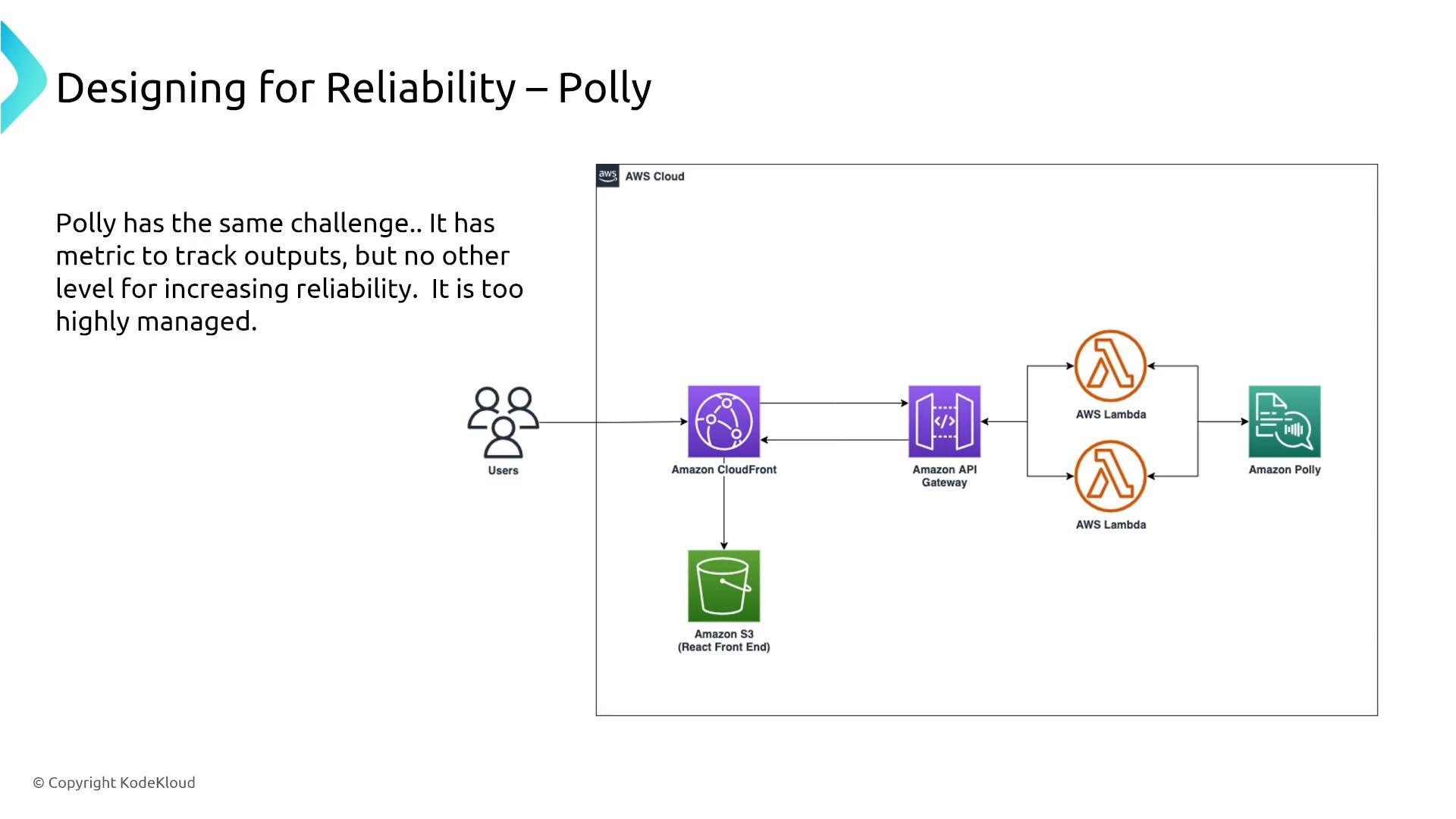
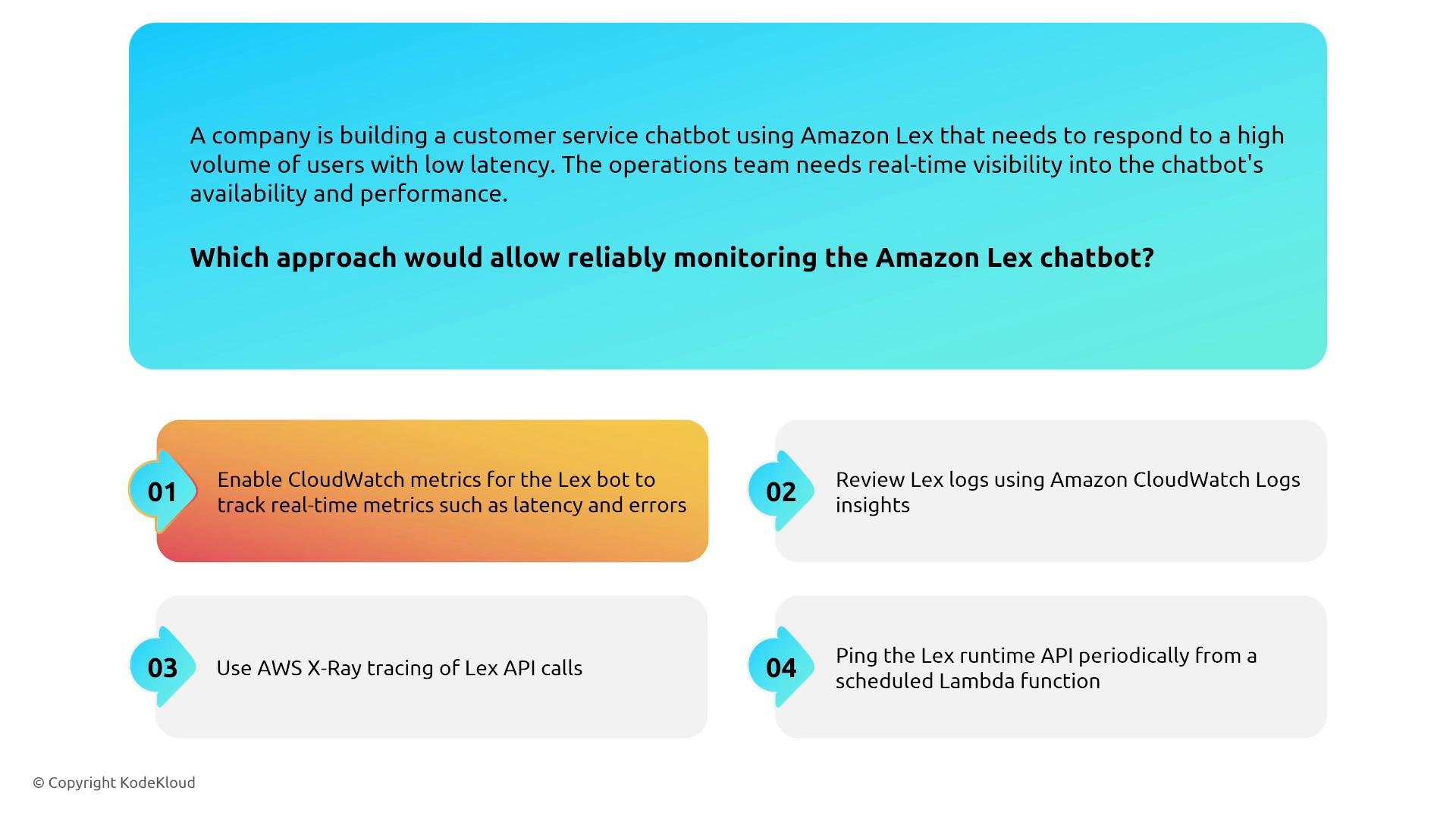
- Enable CloudWatch metrics and logging for each service.
- Use X‑Ray for end‑to‑end tracing across Lambda/API Gateway/Lex if you need request-level diagnostics.
- Consider synthetic checks for critical conversational flows.
Forecast, A2I (Augmented AI), Fraud Detector
- Amazon Forecast: managed time-series forecasting; monitor model accuracy metrics, prediction latency, and retraining cadence via CloudWatch.
- Augmented AI (A2I): provides human-review workflows. Reliability concerns focus on orchestration and human process availability (worker queues, scaling, notifications).
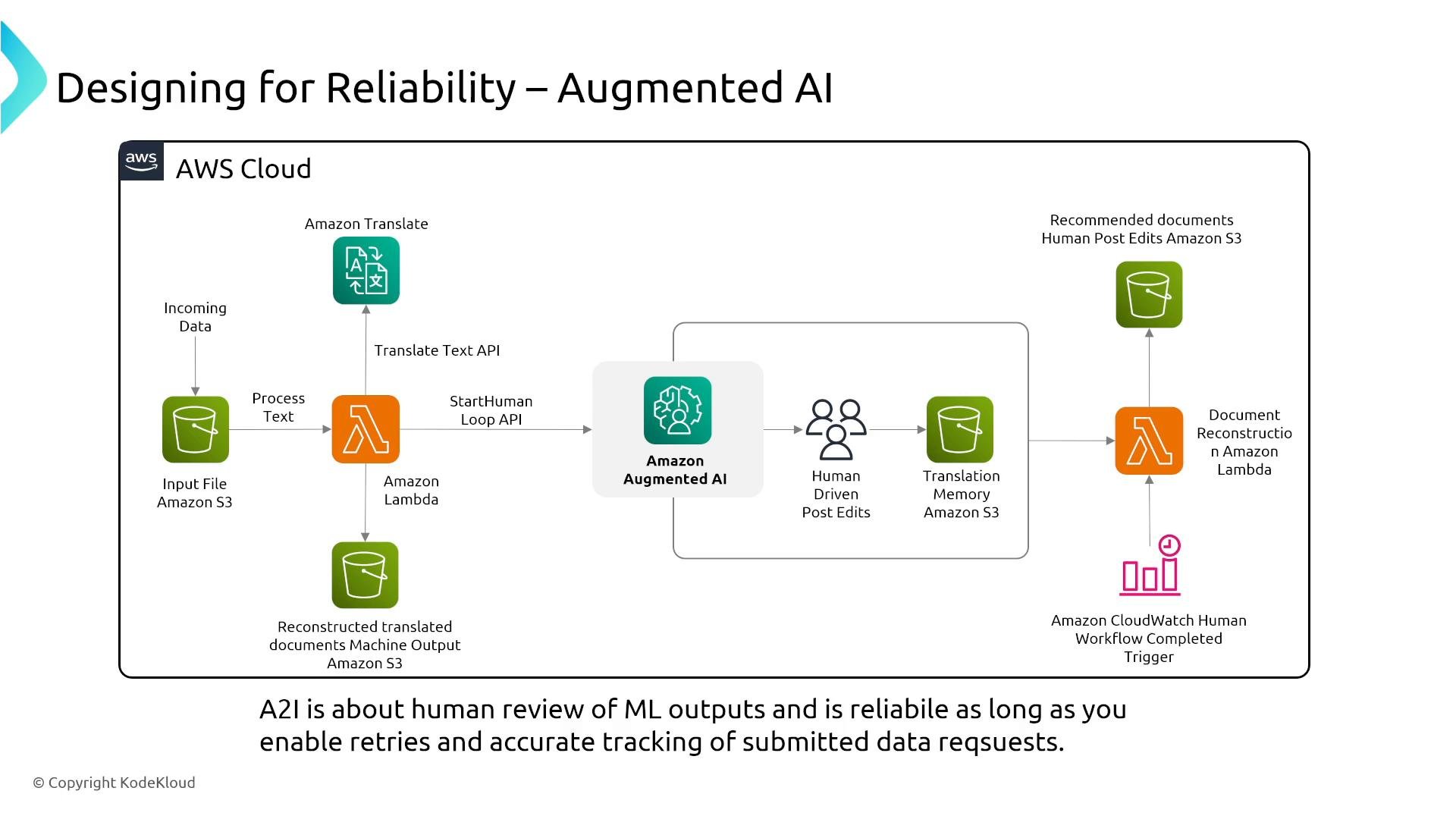
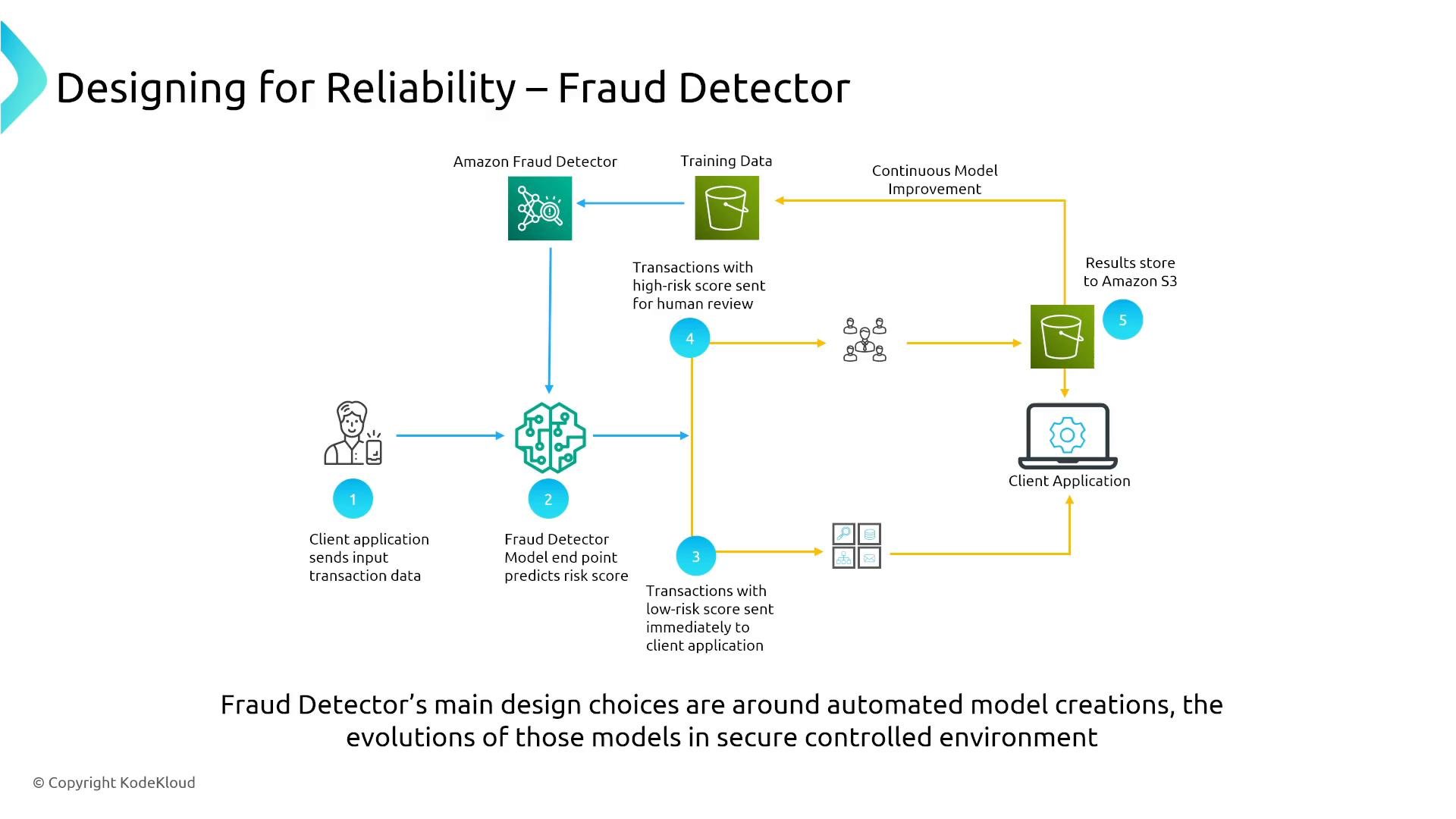
- Fraud Detector: a managed anomaly/fraud service — architect ingestion, queueing, and human-review around it for end-to-end resilience.
Transcribe and Translate
Amazon Transcribe and Translate are fully managed APIs. For reliability, focus on:- Request retry logic and exponential backoff in clients.
- Buffering and queuing (SQS/Kinesis) for bursts.
- CloudWatch metrics and alarms for latency and error rates.
Textract — document data extraction
Textract extracts text, forms, and tables from documents. Typical pipelines use S3 for ingestion, Textract for extraction, a rules engine (plus optional A2I human review), then downstream storage/visualization.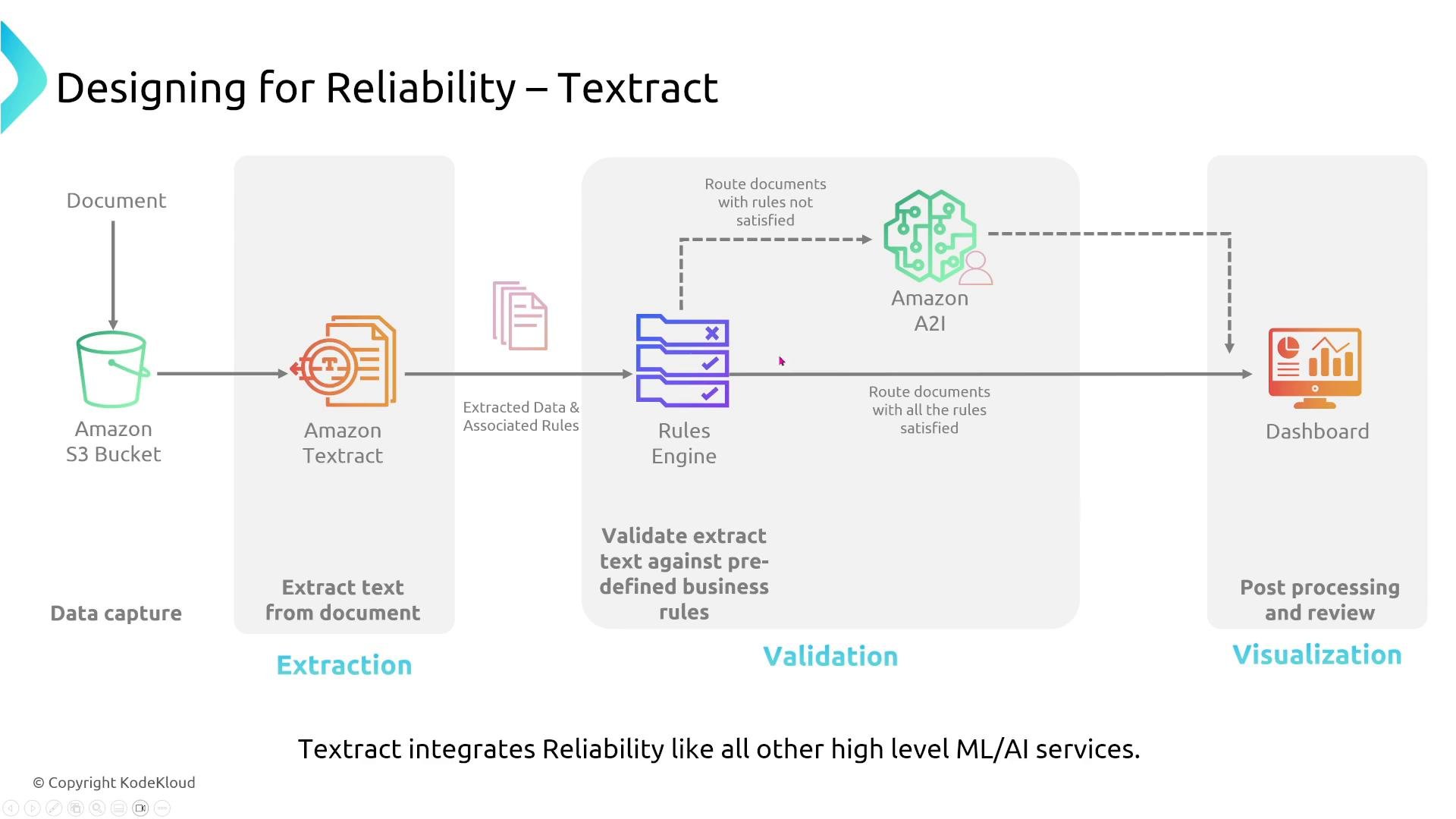
- Use S3 notifications + Lambda workflows for asynchronous processing.
- Add retries with dead-letter queues for failed extractions.
- Enable CloudWatch metrics and optionally X‑Ray for tracing complex pipelines.
Summary — where the reliability levers are
Use the following table to quickly identify which services expose reliability controls you manage versus those that are highly managed by AWS.
Operational practices that apply everywhere:
- Use CloudWatch for metrics, alarms, and logs.
- Use CloudTrail for auditing and investigating API changes.
- Implement retries with exponential backoff and idempotency to avoid duplicate processing.
- Design multi‑AZ or multi‑region failover when service and workload requirements justify it.
- Right‑size compute (DPUs, instance types, shard counts) to balance performance and cost.
Links and references
- AWS Kinesis Data Streams: https://docs.aws.amazon.com/streams/latest/dev/introduction.html
- Amazon MSK: https://docs.aws.amazon.com/msk/latest/developerguide/what-is-msk.html
- AWS Glue: https://docs.aws.amazon.com/glue/latest/dg/what-is-glue.html
- Amazon EMR: https://docs.aws.amazon.com/emr/latest/ManagementGuide/emr-what-is-emr.html
- Amazon Athena: https://docs.aws.amazon.com/athena/latest/ug/what-is.html
- Amazon SageMaker: https://docs.aws.amazon.com/sagemaker/latest/dg/whatis.html
- AWS Well-Architected Reliability Pillar: https://wa.aws.amazon.com/wat.pillars.reliability